On 8 February 2001, when I was 10 years old, I bought my copy of Championship Manager: Season 00/01 from my local Woolworths in Romford. These days, it’s now a post office that doubles up as a pound shop, but I digress.
I’d already been playing Champ Man for a couple of years, but it was CM00/01 which firmly cemented my addiction to the series. It was also on CM00/01 that I played my first of MANY save games as Millwall manager. As a tactical novice with a habit for recklessly chopping and changing my squad, I somehow fluked a promotion through the Division 2 play-offs in my first season – but once we made it to Division 1, it all came crashing down.
Now two-and-a-half decades older, and a little bit wiser, I decided it was time to shine some new light through old windows. I was ready to go back to The Den once again.
On 8 February 2026, I booted up CM00/01 and began a brand new career with Millwall. My challenge was simple, but not easy. With 25 years’ worth of Championship Manager knowledge and experience under my belt, could I lead this third-tier club all the way to the top of English, European AND world football… in just TEN in-game seasons?
This is the first part of a trilogy, in which I will tell the story of my decade at The Den.
PHASE 1: REACH THE PREMIERSHIP
SEASON 1: 2000/2001
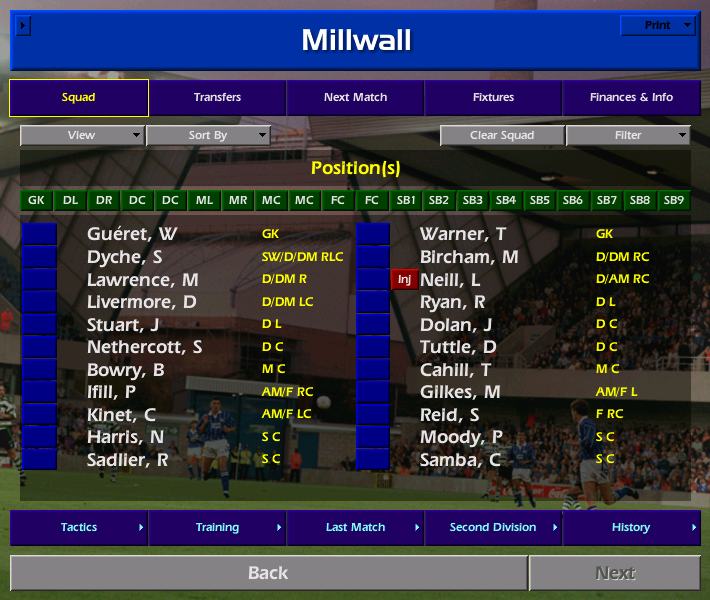
My first task as Millwall manager was to improve on a squad that had just lost in the Division 2 play-offs, and take that next step up into Division 1. With all due respect to players such as Michael Gilkes and Bobby Bowry, they were probably not going to cut it with me.
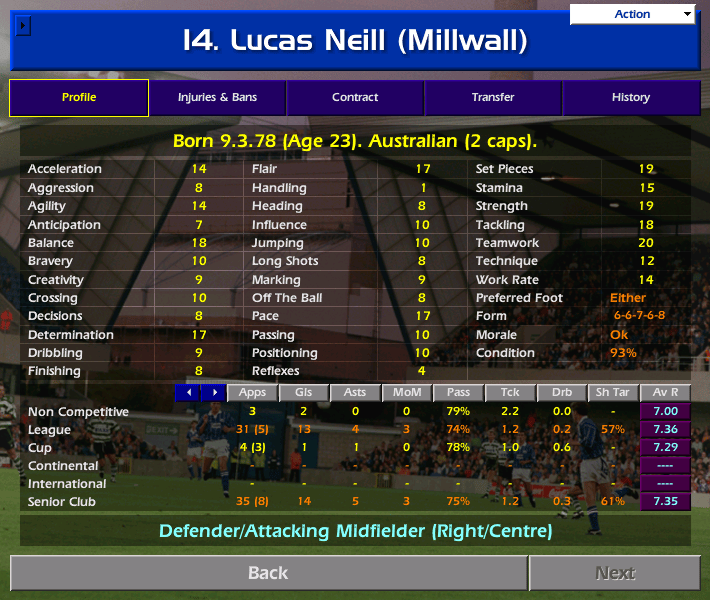
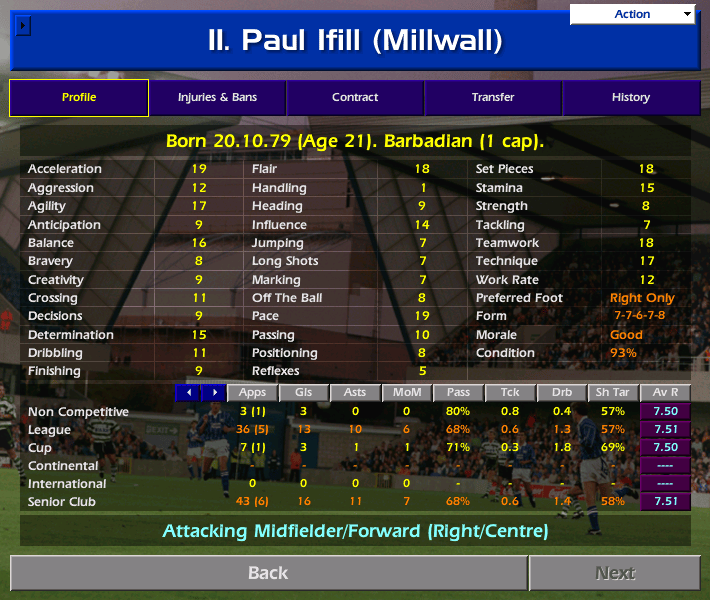
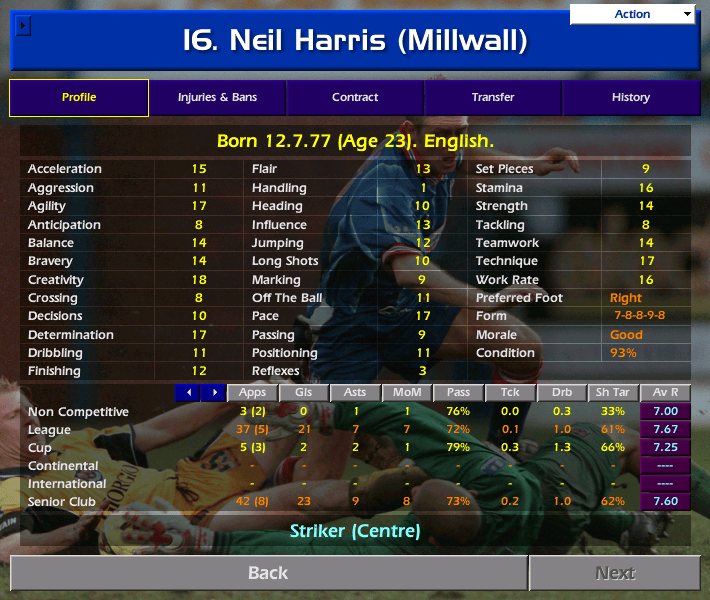
While we did have a decent defence – with experienced centre-backs Stuart Nethercott and David Tuttle protecting our excellent shotstopper Tony Warner – the real talent could be found further afield. Australian midfielders Tim Cahill and Lucas Neill were perhaps the picks of a young and hungry Lion pack which also included pacey wing wizard Paul Ifill and lower-league goal machine Neil Harris.
Of course, we also had a certain 15-year-old wonderkid named Cherno Samba… but not for long. Manchester City immediately offered us £150,000 plus a sell-on clause for Samba, so I decided to take the money and invest it in improving our defence. Out went Sean Dyche and Robbie Ryan; in came Scotland international Brian McAllister, QPR right-back Antti Heinola, and the vastly-underrated Blackpool centre-back Eifion Jones.
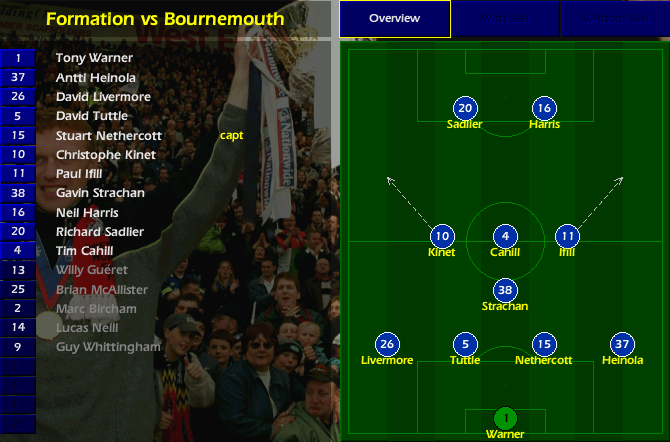
After having some early problems when playing a standard 4-4-2 in pre-season, I switched to a narrow 4-1-3-2 – with Ifill and Christophe Kinet drifting out wide on the attack. The results were stunning – we won 12 of our first 13 league matches (and drew 2-2 at Port Vale) before our unbeaten run was finally halted by Stoke.
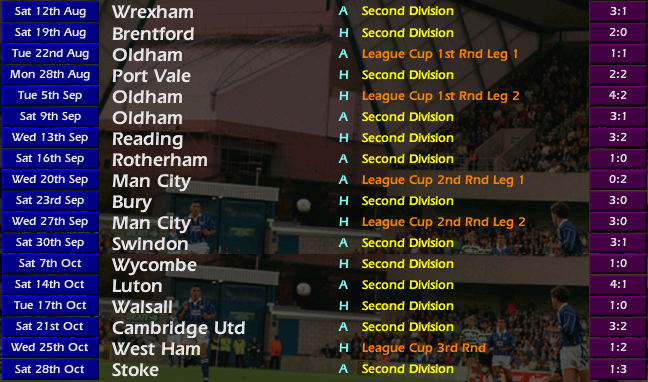
Meanwhile in the League Cup, we bounced back from a 2-0 first-leg defeat at Maine Road to knock Manchester City out of the League Cup, before narrowly losing out 2-1 to arch-rivals West Ham in Round 3. Another valiant performance in the FA Cup ended in heartbreak against Ipswich.
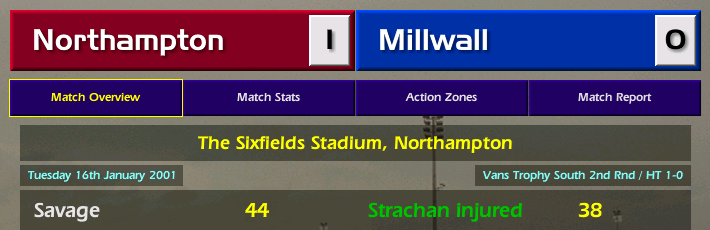
There were a few more wobbles later on, which included our only home league defeat of the season (2-0 against Bristol City). But after loaning in Gavin Strachan (Gordon’s son) as a defensive midfield shield, and adding 36-year-old Portsmouth legend Guy Whittingham up front, we enjoyed a second wind and never let go of top spot.
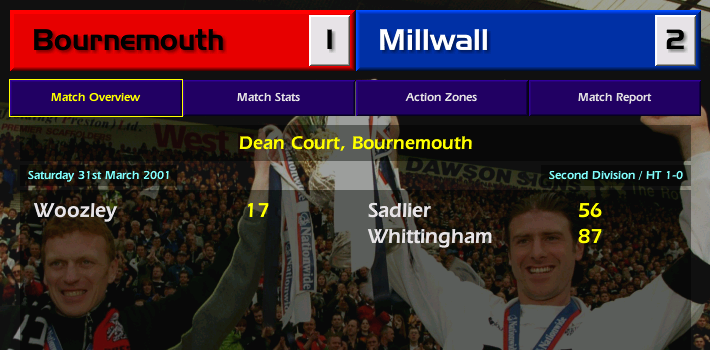
As our title rivals Bristol City and Port Vale faded away, we clinched promotion with SIX games to spare – Richard Sadlier and Whittingham getting the decisive goals in a 2-1 comeback victory at Bournemouth.
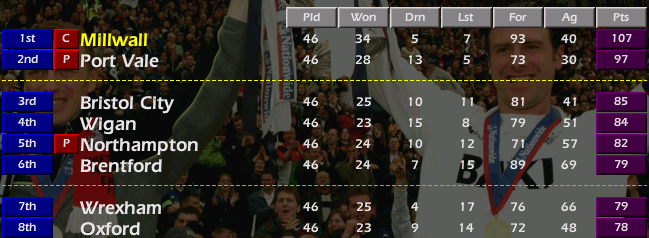
The Division 2 title was secured soon afterwards, and we eventually finished up with 34 wins, 93 goals and 107 points. Sheesh.
Chopper Harris led the way with 23 goals in all competitions, with Ifill, Neill, Kinet and Sadlier also hitting double figures. However, I felt that we would need a bit more quality going forward if we were to survive in Division 1.
SEASON 2: 2001/2002
On my very first CM00/01 save with Millwall, we had a disastrous start to life in Division 1 – picking up just two points from seven matches. To be fair, I was a dumb kid back then, and now I actually knew how to build tactics and play this game. With Portsmouth and Wolves awaiting us in our first two matches… what could possibly go wrong?
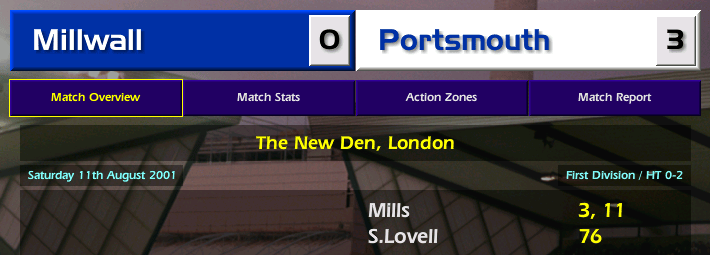
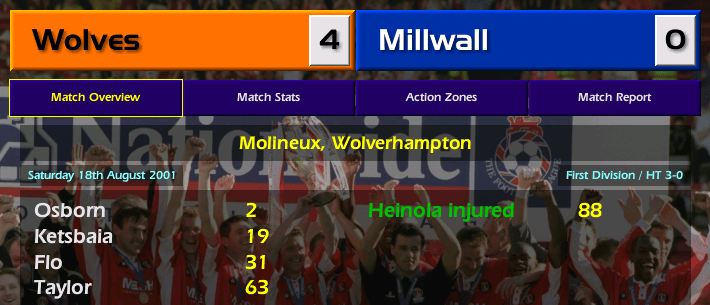
Errr…
I was already panicking. Nethercott had already gone to Lincoln, and McAllister and Heinola would soon be sold too, as they were simply not good enough for Division 1. Defensive midfielder Marc Bircham raced off to Genk, and after seeking a move to a bigger club, Cahill eventually shacked up at Everton (how fitting).
Our new-look defence included three grizzled, no-nonsense stoppers in their mid-to-late 20s – left-back Simon Charlton, new club captain Tony Vaughan, and Gary Rowett (whom I’d politely describe as a jack of all trades and master of none). Strachan joined us in a permanent deal from Coventry, goalkeeper Andy Marshall was signed from Norwich, and ex-Lions striker Chris Armstrong returned to the club from Tottenham.
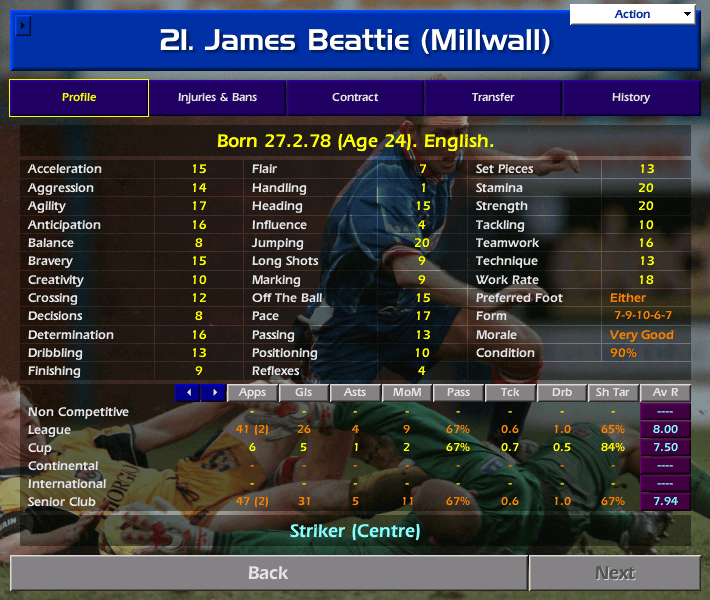
One of my biggest signings was James Beattie, who initially arrived on loan after he lost his place in the Southampton squad. I actually had Beattie on my first Millwall save, where he tore up Division 2… and incredibly, he was even better in this universe!
31 goals in 49 games, and a 7.94 average rating! Suffice to say, I wasted no time in making his transfer permanent.
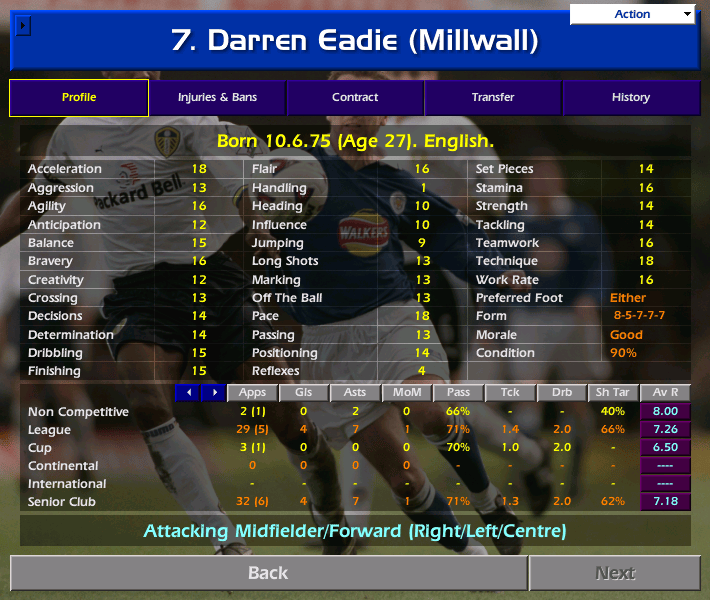
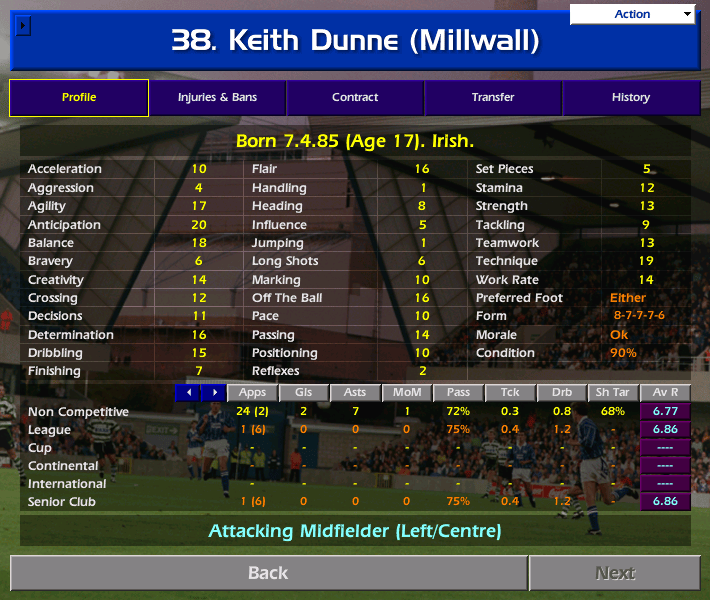
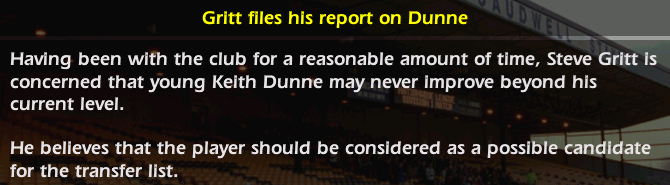
As for Darren Eadie, the flamboyant but injury-prone midfielder effectively displaced Kinet on the left after his club-record £3.5million buy from Leicester. Though Eadie had a pretty fine first year in south London, he came under some pressure late on from Keith Dunne – a rapidly-improving 17-year-old midfielder who had joined us as a free agent in the summer.
Anyway, after a brief resurgence in September and October lifted us to 9th place, a seven-match losing run had dragged us back into a relegation scrap by early November. That was when I begged Gavin’s dad to let us have Christopher Kirkland on loan. Chris excelled in goal, and with Beattie hitting top form, we steadily climbed back up the table.
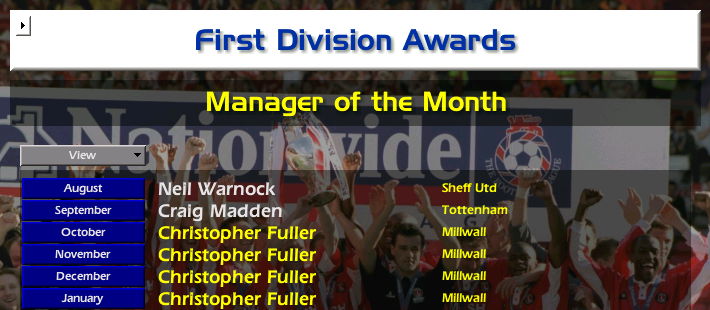
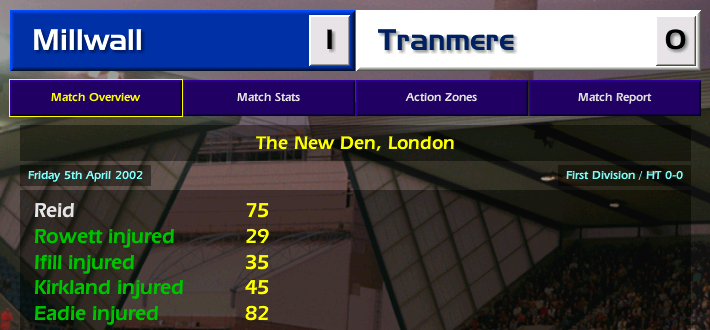
Indeed, we only lost only FOUR of our next 30 league games – and I was named Manager of the Month four times in a row! My Lions looked unstoppable, despite Tranmere’s best attempts to cripple our entire team on Good Friday.
Come the final day, we were up in 7th – and, incredibly, still in with a shout of making the play-offs. We just needed to beat Manchester City – and hope that Grimsby lost at home to Wolves. A Richard Edghill own goal got us the victory we needed, and with our favourite Black Country lupines leading at Blundell Park, it looked like we were about to gatecrash the top six…

…until Grimsby equalised in the 90th minute! DANG IT!
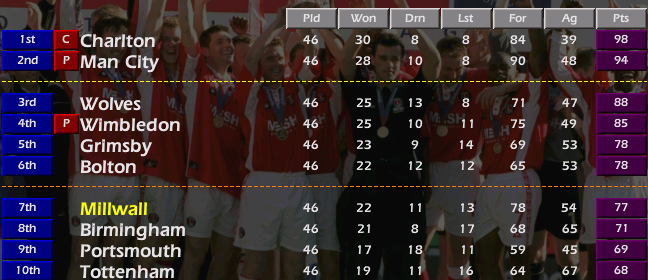
Welp. It wouldn’t be a Fuller FM story without another trip to Heartache Avenue, would it? (And yes, Spurs got relegated last season – what of it?)
SEASON 3: 2002/2003
After last season’s late heartbreak, there weren’t many major changes in the summer of 2002. With Kinet and Harris being poached by Leeds and Leicester respectively, and Beattie officially joining us for £2.5million, there was only one ‘new’ addition to the squad. Chris Bart-Williams (RIP) initially came in to be a holding midfielder, but after struggling there early on, he eventually found more success as a wing-back.
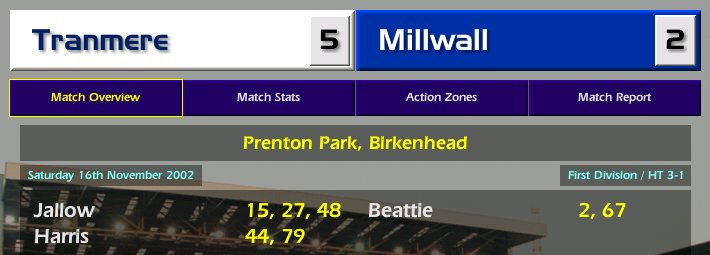
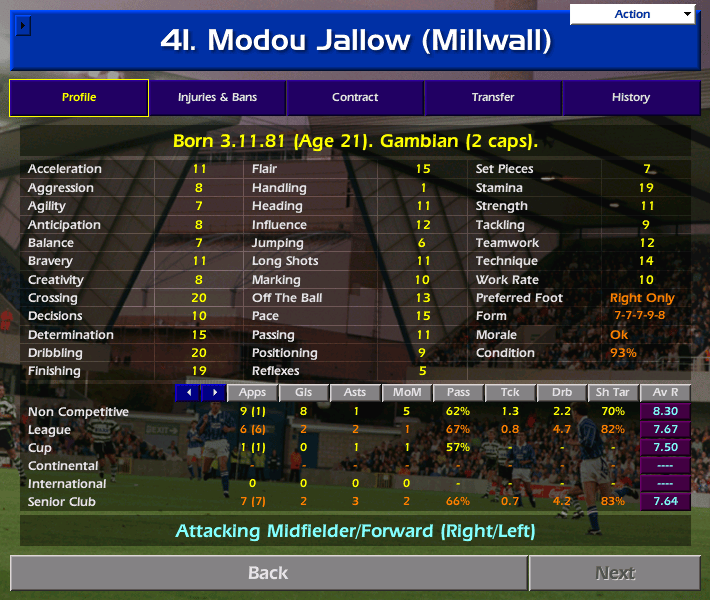
We quickly set out our stall by winning 8 of our first 10 matches, but not all was well. We crashed out of the League Cup very early against our old enemies Tranmere, who then annihilated us 5-2 in the league. Modou Jallow was so devastating on the right wing that I decided, “If you can’t beat him, buy him.”
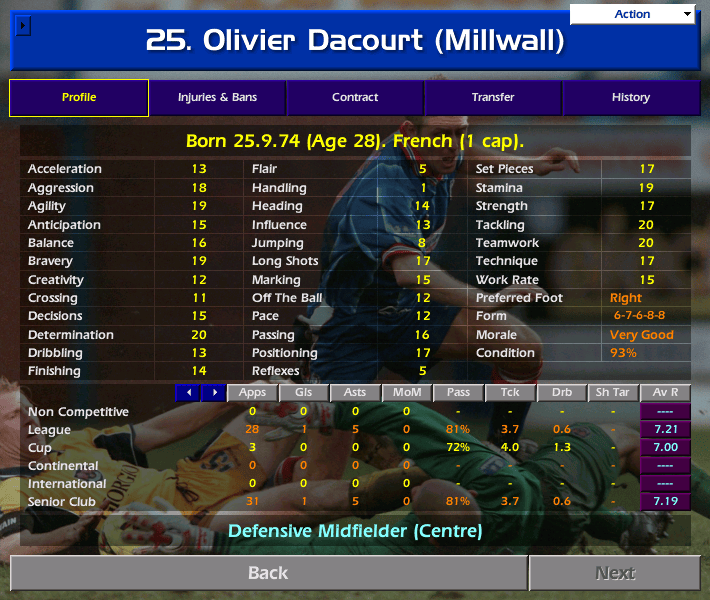
With Strachan’s form falling off a cliff, and Rowett also on the slide, we were leaking goals and struggling to keep clean sheets. My solution was to spend £2.3million on Leeds’ Olivier Dacourt, whose tackling, bravery and agility made him the ideal defensive midfielder. I also restored Warner as our first-choice keeper, as an increasingly hapless Marshall joined the even less impressive Rowett on the next train to Southampton.
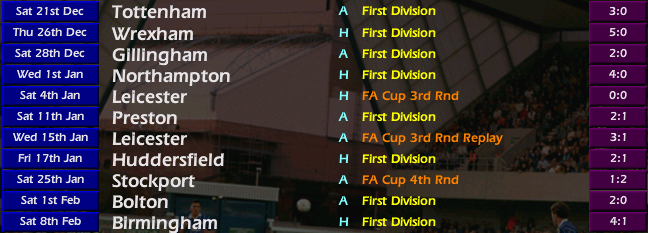
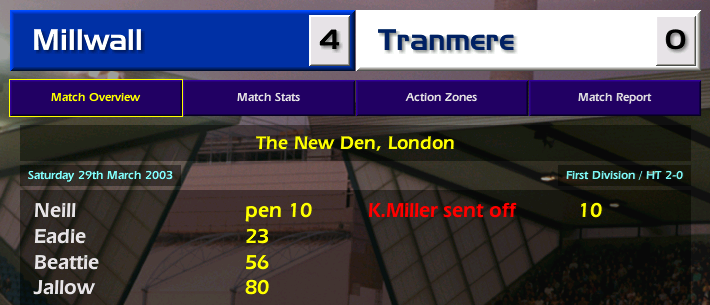
Another impressive winning streak between December and February (interrupted only by a shock FA Cup exit to Division 2 Stockport) put our promotion charge back on track. When Jallow rounded off a 4-0 vengeance win over his old club at the end of March, I knew it was only a matter of time before our ticket to the Premier League was secured.
A hard-fought goalless draw at Blackburn sealed the deal, though we had to wait until we beat West Brom 3-2 on the final day to confirm ourselves as Division 1 champions – just ahead of QPR.
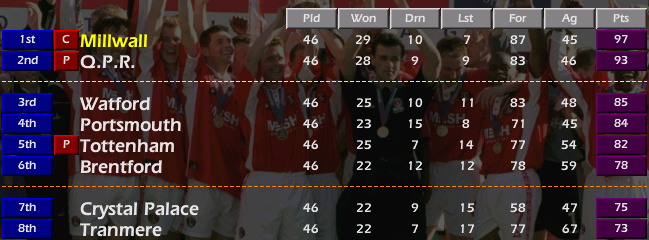
So Millwall were heading into the top flight for the first time since 1990. Beattie’s 23-goal haul – while not as impressive as last season – had been crucial, as had Warner’s goalkeeping brilliance. Vaughan and Jones had built up a strong partnership in the centre of our defence, though it remained to be seen whether they could handle the step up to the big time.
I was also excited to see Keith Dunne rack up 13 assists in his first full season in the senior squad. Remember that name, folks – I’ve a feeling you’re going to read it a lot more often in the next two chapters…
Please join me again soon for the continuation of this CM00/01 adventure, as Millwall begin life in the Premiership.
If you want to be notified when the next post goes live, please hit the “Follow” button below. You can also find me on Threads and Bluesky.

