
Championship Manager: Season 01/02 was released 25 years ago today.
The final game of the classic CM3 era, this was also the last version before Sports Interactive made the big leap towards adding a 2D match engine. For many people, it offers the perfect balance between playability and depth – not too shallow, not too much pointless fluff.
CM01/02 remains hugely popular to this day – getting regular data updates, and even new patches that add more leagues and new tournament formats.
Oddly enough, I never really got into CM01/02 – instead preferring to stick with its predecessors Championship Manager: Season 00/01 and Championship Manager: Season 99/00. Then, in the summer of 2021, I decided to write a new Championship Manager story, titled “25 Years”.
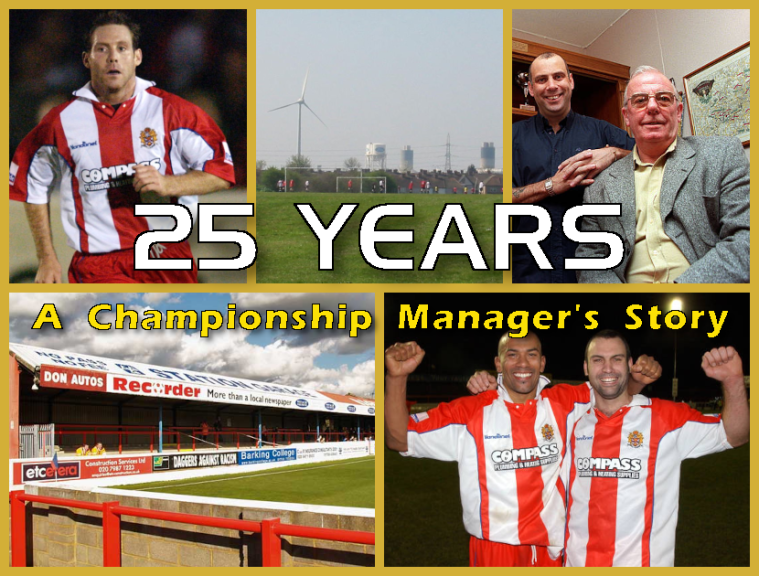
Starting at Dagenham & Redbridge in the Conference, I would chronicle my virtual manager’s journey over the course of 25 years – from July 2001 up until the end of the 2025/2026 season. As the story progressed, I would also include regular updates from the wider game world, as well as references to real-life events – from the September 11 attacks, right up to the rise and fall (and rise again) of a certain tangerine man-baby.
I ran the game on a fully-patched copy of CM01/02, but with some extra user-made patches to improve long-term playability. I used a heavily edited version of the Luessenhoff database, which expanded the database to over 100,000 players – including a 14-year-old Lionel Messi in Barcelona’s C team.
I began posting my story on the SI forums back in October 2021 and eventually completed it in July of this year. This adventure took in five clubs, over 1,200 competitive matches, and more tantrums and overpowered goalkeepers than any sane football manager could handle.
Now that the story is finished, I am ready to share it with you in its full glory. I have uploaded the story as six separate PDF files, all of which are completely free to download. The main story is split into five ‘parts’ consisting of five seasons apiece, and the final part is an epilogue, which also includes various facts, statistics, and biographies of the main players.
To celebrate this story’s official induction into the Fuller FM archives, I have posted the prologue below. If you want to read more, you can find links to the full 1,874-page story underneath that.
PROLOGUE
25 years is a long time, especially in football.
When my love for the beautiful game began, the sport looked quite different to what it has become now. In the 1970s, drinking was still a major part of football culture. Terracing was still preferred to seating at the biggest stadiums. The game wasn’t as ethnically diverse, and the most exotic foreigners in the Football League generally came from Ireland.
I grew up in east London, but my parents were originally from the north of the city. My father was a lifelong Arsenal supporter who took me to my first game at Highbury when I was just 10 years old.
It was 2 October 1976, and the Gunners were hosting Queens Park Rangers. The visitors took the lead twice, but goals from the Irish trio of playmaking magician Liam Brady, veteran right-back Pat Rice, and goal machine Frank Stapleton sent us home celebrating a 3-2 victory. From that day, I wanted to be a footballer – and I wanted to play for the Arsenal.
After rising through the local youth leagues, and after several unsuccessful trials, my dream came true when I signed schoolboy forms with Arsenal as a 14-year-old in 1980. I was a central defender who wasn’t afraid to get stuck into challenges, though I could also play at full-back if required. My regular partner in the youth and reserve teams during those early days was another boy in my age group: Tony Adams. You might have heard of him.
Adams broke into the senior team for the first time in 1983, though I had to wait a couple of years before Don Howe gave me my debut – at home to Hereford United in the second round of the League Cup. We won that match 2-1, and I went on to feature in three more cup ties until Howe stepped down in March 1986.
George Graham – a former Arsenal midfielder who was part of the 1971 double-winning team my dad would always wax lyrical about – took over as manager ahead of the 1986/1987 season. Graham’s pragmatic, safety-first approach to football tactics wasn’t universally popular, but it would soon deliver results.
To revitalise a Gunners team that had stagnated in 7th place in Division 1, Graham decided to ditch most of his ageing players and promote youth talent. Adams became an established starter and would be appointed club captain in 1988 – a role he still holds today – while still in his early 20s. Other youngsters who emerged as first-team regulars included Paul Merson and the late, great David Rocastle.
I was not so lucky. I never played a league match for Arsenal – and on one rainy day in January 1987, Graham summoned me to his office and told me I was no longer required. Instead, I was offered the chance to kick-start my senior career in Division 2 with Millwall, whom Graham had managed with distinction before returning to Highbury.
Based in New Cross in south-east London, Millwall were the only professional football club in the capital never to have played in the first division – but they weren’t exactly regarded as plucky underdogs. The Lions’ supporters had long been associated with hooliganism, with one particular night at Luton in 1985 going down in history for all the wrong reasons.
Following those darkest of days, my arrival at The Den coincided with an upturn in fortunes. With future club legends Alan McLeary and Keith Stevens playing alongside me in defence, and Tony Cascarino and Teddy Sheringham banging in the goals at the other end, we would produce arguably the greatest team in the club’s history.
After slowly working my way into manager John Docherty’s team during my first half-season, I became an established starter in the 1987/1988 season, which ended in us surprisingly winning the Division 2 title by four points. Millwall were promoted to Division 1 for the first time in their history.
Despite being tipped for relegation, we defied all the odds with a fantastic start to the 1988/1989 campaign – even leading the table for a few days at the beginning of October. It didn’t last, though, and we ultimately dropped to 10th place after failing to win our final 10 matches. That was a sign of struggles to come in 1989/1990, when our top-flight fairytale ended in us finishing rock-bottom – with just five victories to our name.
Millwall would not return to England’s elite. For my final six years with the club, we were back in Division 2 – which was confusingly rebranded as Division 1 in 1992, after top-flight clubs broke away from the Football League to form the Premiership, which would transform the sport like never before.
We reached the second-tier play-offs twice – firstly in 1990/1991 under the disciplinarian regime of Bruce Rioch, and then in 1993/1994 under the more affable Mick McCarthy, which was our first season at our new all-seater stadium. The New Den never generated quite the same atmosphere as the old Den, which was renowned for its ‘Millwall Roar’ from the club’s most passionate followers.
The 1994/1995 season was an unmemorable one spent largely in mid-table, but it delivered one of my career highlights. After holding Arsenal to a 0-0 draw at The Den in Round 3 of the FA Cup, we went to Highbury for the replay… and shocked the Gunners 2-0 with goals from Mark Beard and Mark Kennedy. We then knocked out Chelsea on penalties before falling to QPR in Round 5.
1995/1996 started promisingly enough, and we were top of Division 1 midway through the season until a crushing 6-0 defeat against Sunderland knocked us off our stride. Shortly after that, McCarthy resigned to become the new Republic of Ireland national team manager. His successor Jimmy Nicholl was unable to steer our form out of a catastrophic tailspin, and within a few months, we had gone from promotion contenders to being relegated in 22nd place.
Millwall were now in the third tier, but I would not be joining them there. After playing over 300 matches for the Lions in nine-and-a-half years, the club had decided not to renew my contract. That was partly due to financial problems which would eventually see them enter administration, but also because I was starting to suffer from chronic knee problems.
Instead, I dropped down another division – and moved back north of the River Thames to play for Leyton Orient in Division 3. However, I did not particularly enjoy my time at Brisbane Road, and after quickly losing my first-team place, I left Orient on a free transfer at the end of my first season.
I was now 31 years old and contemplating retirement… until I got a career-changing phone call from an affable old gentleman named Ted Hardy. He was the manager of Dagenham & Redbridge – a semi-professional club near where I grew up in east London – and had just taken them to the 1997 FA Trophy Final at Wembley, which they lost to Woking.
Hardy offered me the chance to play part-time for the Daggers in the Isthmian League – two divisions below the Football League – while also coaching the youth team. This was a young club (formed only in 1992 after the merger of Dagenham FC and Redbridge Forest), but one with ambitions of playing in the professional ranks. It was an exciting prospect, and one I wanted to be involved in.
The Daggers finished 4th and 3rd in the Isthmian League during my first two seasons at Victoria Road. Hardy retired at the end of the 1998/1999 season, and his successor Garry Hill immediately finished the job, leading us to the league title in 1999/2000. We would be heading back to the Conference for the first time since our relegation four years prior.
Sadly, my playing days would come to an abrupt halt when I tore my anterior cruciate ligament during a pre-season friendly in July 2000. At the age of 34, and with my right knee almost completely ruined, it was time to hang up my boots and concentrate on the next phase of my career.
I joined Hill on the first-team coaching set-up for our first season back in the Conference. It was a huge success, with a 3rd-place finish behind big-spending Rushden & Diamonds and perennial challengers Yeovil giving us hope that the Daggers would soon be playing in Division 3.
Everything changed on 7 July 2001. After a disagreement with chairman Dave Andrews over the club’s transfer policy, Hill suddenly resigned. A week later, after considering several candidates to replace Hill, Andrews asked me if I would like to take over as manager. I couldn’t accept the offer quickly enough.
At the age of just 35, I am heading into the unforgiving world of football management, and I will have to be prepared for the huge pressures that come with this job. Nonetheless, I am relishing the opportunity to (hopefully) finish the job that Hardy and Hill started – by leading the Daggers into the Football League.
In my first 25 years in football, I’ve experienced many of the highs and lows that come with being a fan, a player, and a coach. Who knows what the next 25 years will bring as a manager?

