
Welcome to a new Fuller FM ‘retro review’, where I pluck a classic football management game from the mists of time and ask whether it still stands up today.
This is actually the first review in a mini-series that I will be running throughout this month. This is ‘EA MAY’, where I will look at four different games from the FIFA Manager series – Electronic Arts’ long-running, polarising challenger to Sports Interactive’s monopoly on the genre.
To kick things off, I’m looking at the game that started it all for EA back in the mid-1990s – FIFA Soccer Manager.
BACKGROUND
Electronic Arts had already been active for a decade when they first ventured into football video games in late 1993. FIFA International Soccer was the debut of what would become a huge franchise, loved and loathed in equal measure by soccer fans worldwide. Being the first video game to have an official licence from football’s governing body was truly groundbreaking at the time.
About three seasons later, EA put their licensing to further use by releasing a management simulation, at a time when the Championship Manager series was still establishing itself. The end product was FIFA Soccer Manager – released in 1997 by EA Sports, and developed by EA UK in Chertsey, Surrey.
FIFA’s management game would undergo several transformations and name changes over the next 16 years. It first became FA Premier League Football Manager for the second release in 1998, then Total Club Manager in 2002, and finally FIFA Manager in 2005. The series was cancelled in 2013, following the release of FIFA Manager 14.
I’ll write more about some of those games in future reviews, but let’s bring it back to FIFA SM. The unmistakable sight of then-Barcelona manager Bobby Robson adorns the box art – a role that the Geordie gentleman would reprise for Total Club Manager 2003, incidentally.
STARTING OUT

After installing the game (using EA’s custom installation program) and booting it up for the first time, you’ll be greeted by a grainy – and very blue – full-motion video that screams mid-1990s. You are bombarded with ‘buzzwords’ in various languages, while a tracksuit manager who looks like the secret lovechild of John Toshack and Steve Bruce shouts passionately at his players. That probably won’t be the last time you see ‘Mr Tracksuit’ in this game.
There’s no fancy menu screen with dozens of options. Instead, you only have to decide whether to load an existing save, or begin a new game. Then again, you could also perform an about-turn and ‘exit’, which gives you another grainy FMV clip of the game’s credits before returning you to your desktop.
When starting a new game, your first decision is to name your save file. Then you have a choice of managing in one of five countries (England, France, Germany, Italy or Scotland) and in either of up to four divisions. On the next screen, though, you are given a huge list of every possible manageable club in your selected country. Yes, folks: you can manage any club in any division!
In FIFA SM, you can start out managing Hereford in the Super League, which is the unlicensed name for the Premiership – and nothing to do with out-of-touch billionaires wanting even more money. Keeping the Bulls in the top flight, though, will be a monumental challenge, to say the least. Alternatively, you could bring Rangers’ liquidation forward 16 years and drop them into the bottom rung of Scottish football.
You should also be aware that once you pick a club, you’re stuck there for the entire save. There are also no options for saving your career manually, with the game instead autosaving after virtually every decision you take. That means if you accidentally make a big mistake – like selling your star striker for peanuts, or building a huge 50,000-capacity stand your club cannot afford – you’re pretty much screwed.
WHAT I LIKED
Yes, you can build your own ground in this game! FIFA SM proudly boasts a stadium builder where you can combine 300 pieces of stand and roof to construct a huge arena with up to 300,000 seats! To put that into perspective, the largest football stadium in the real world – the 1st of May Stadium in Pyongyang, North Korea – has a pitiful capacity of only 114,000.
You are also in charge of other financial aspects such as merchandising and concessions. While it’s hard to imagine Alex Ferguson ordering 1,000 replica shirts for the Manchester United club shop, you can still make a fair amount of money with good micro-management. Even largely neglecting that aspect of the game shouldn’t cost you too much.
All that being said, you will need to pay attention to pitch maintenance. Skimp on that too much, and your club will eventually be left with a glorified cabbage patch which FIFA will ban you from playing home matches on. Thankfully, upping your weekly payments to a couple of thousand pounds a week should be enough to keep your surface in good condition.
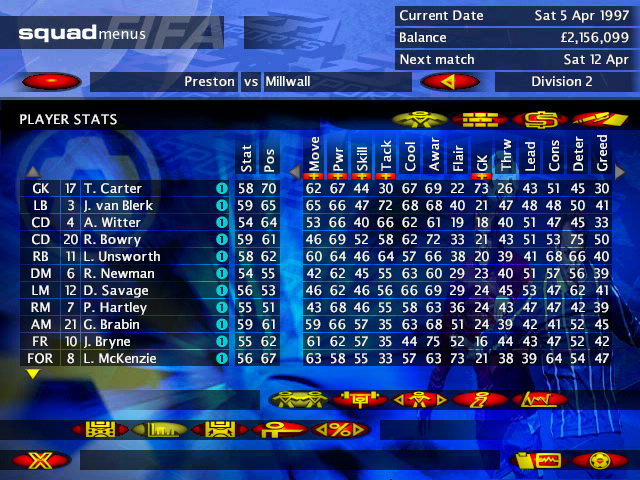
As far as your squad goes, your players are rated out of 100 on various ‘stats’. Perhaps most of interest to you are ‘Stat Average’ (the average score of the player’s stats) and ‘Position Average’ (the average score of stats relative to a player’s position). It’s also worth keeping an eye on ‘Form’ and ‘Energy’, so as to avoid playing anyone who’s knackered and/or struggling to perform.
When you’re ready to go into a fixture, you have two options: ‘Generate Next Match’ or ‘Play Next Match’. The first option is effectively an ‘instant result’ service, generating a basic match report in next-to-no time. You can effectively complete a season in two or three hours just by constantly generating your matches.
WHAT I DIDN’T
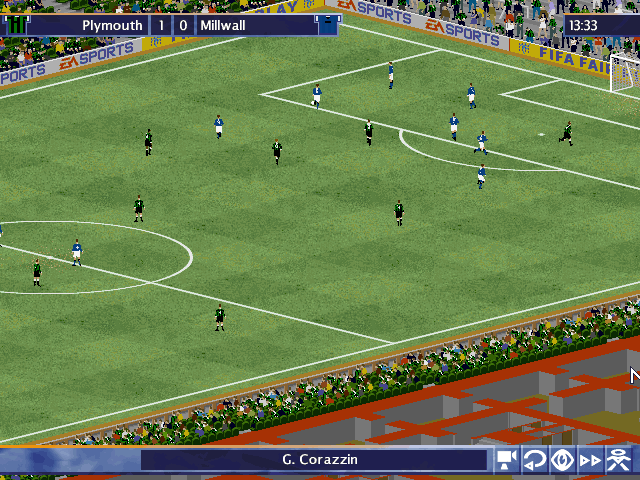
I hope you’ve got some popcorn at the ready, ‘cos this’ll be a long one. I’ll start with what I feel is the worst aspect of FIFA SM. That is the ‘Play Next Match’ option.
The match engine is truly laughable. Players are generally static, though not as much as the spectators, who seem comatose by comparison. The style of football is ugly to watch, and the sound is very bland and repetitive (much like it is in the game as a whole, to be honest).
And then there are two speed options. On normal speed, the match is played at a steady pace but the match clock is obscenely quick, so even a simple pass apparently takes almost an entire minute in-game to complete! If you choose the fast-forward option, though, the match will whizz through at warp speed with goals seemingly being scored at will, like Kevin Keegan’s Newcastle producing their own sporting tribute to Benny Hill.
To make matters worse, this aspect of the game was genuinely unplayable on my Windows 98 virtual machine. At some point, usually between halves, the game would fade to black and freeze, forcing me to restart my VM. Despite several attempts, I never completed a full game after selecting ‘Play Next Match’. Thankfully, I didn’t have such issues on my Windows XP laptop.
Back on the main screens, the interface is a mess, full of submenus with unintelligible icons that you need to hover over to learn what they do. You need to go to one screen to view your players’ full stats, and another to view their general info.
While it is relatively easy to drag and drop a player onto the pitch on your formation screen, assigning them a position other than their favoured one can be much trickier. The training screen is another nightmare, and you will have to change every player’s training programme one-by-one, unless you really want them to see the physio twice a week. If their name isn’t Darren Anderton, that’s probably not a good idea.
Also… remember that manager from the intro video? You’ll come across another FMV clip involving Mr Tracksuit and his players if you’re promoted or relegated, or if you win the cup or the league. Frustratingly, those half-minute clips are all unskippable.
EA even have a video ready go in the event that you are sacked. What’s more, IF you do get fired, it really is game over, because the program will DELETE your save file before you can back it up in Windows! It’s probably one of the earlier examples of ‘ironman mode’ in video gaming, but if you have the misfortune of experiencing this, I supect you might describe it differently.
WE MUST TALK ABOUT…
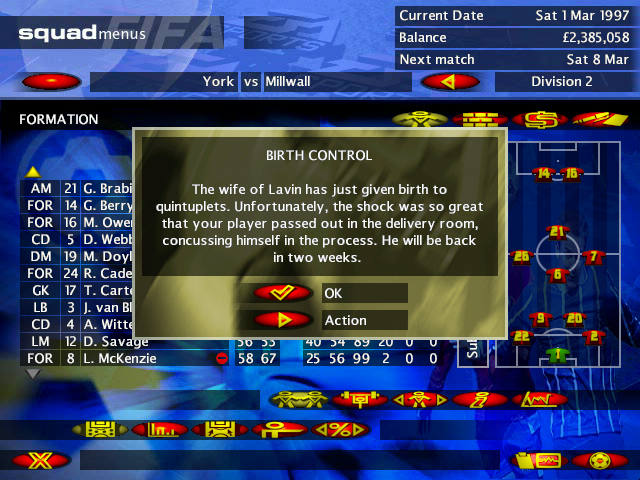
Random events. Every now and then, a message may pop up that causes your club to gain – or occasionally lose – some money. Such events include include EA producing a video game about your club (very meta), or a function room needing extensive repairs after an elderly fan is cremated there.
In the game files, EA call these events ‘Acts of God’. Another AoG could result in a game being postponed, perhaps because of an outbreak of food poisoning or a supporter protest. This could potentially led to fixture congestion later in the season if you’re especially unlucky, or if you have a small squad further decimated by injuries and/or suspensions.
Players can also suffer ‘comedy’ injuries, alongside the more typical ones they sustain in matches or training sessions. For instance, I lost my right-back for a fortnight because he fainted with shock after his wife gave birth to quintuplets. Other incidents can involve a player being struck in the eye by a flying champagne cork, or twisting their ankle after falling off a catwalk.
On one hand, it’s refreshing to see a football management game that doesn’t take itself extremely seriously. On the other, these attempts at humour fall flat when some events are so outlandish that they could have tested even Terry Pratchett’s suspension of disbelief.
SUMMARY
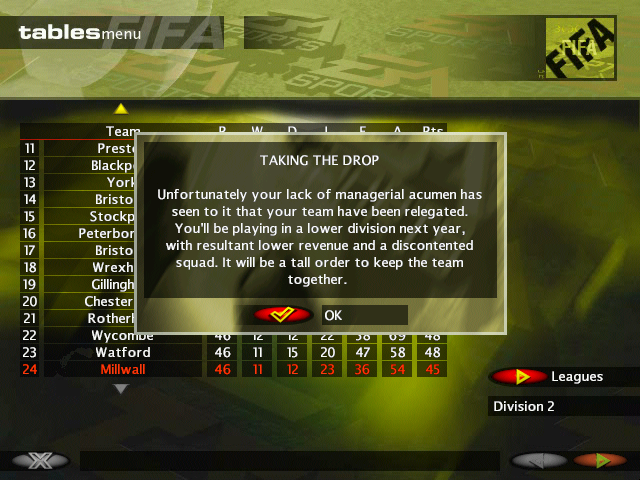
All style, little substance. That sums up most titles in EA’s football management series, and in retrospect, FIFA Soccer Manager was a warning of worse to come. While it looks attractive and interesting in parts, a generally messy interface and a God-awful match engine make this a forgettable experience.
But if you do wish to play this game in 2021, you probably won’t have much running it on Windows 10 (after all, it’s nearly 25 years old). Your best bet would be to run it on a virtual machine or an old computer running Windows 95, 98 or XP. Second-hand copies may be available for a few quid if you know where to look.
FULLER FM RATING: 2* – National League.
If you’ve enjoyed reading this retro review, feel free to leave a comment below or tweet me @Fuller_FM. There’ll be more of these to come over the next few weeks, as I continue to trail through EA’s back catalogue.


You must be logged in to post a comment.