


If you play Football Manager, you’ve probably seen the commentator say this line countless times before: “It’s his first goal of the season!”
Imagine the scenario. It’s April, the season’s almost over, and you’re up against some bang-average mid-table defender who suddenly pops up and opens his account for the campaign. Or maybe it’s that misfiring striker who makes Rudy Gestede look like Robert Lewandowski, but who finally breaks his duck on the day he happens to be playing your team.
Some FMers might cry conspiracy. Some might say that the game buffs certain players’ attributes to boost their chances of scoring against them, or even that the developers have written some secret code to make this happen.
In today’s installment of FM Mythbusting, I’m going to use real-life English league data to show you just how regularly these “first-goals” are scored. I’ll then see how that compares to an average Football Manager save.
INTRODUCTION
I actually began working on this experiment in the spring, but put it on the backburner to focus on another blog series. Then, last month, something happened that drew me right back to it.
Mid-table Southampton were hosting 2nd-placed Manchester City in the Premier League. Since arriving from Birmingham a year earlier, Che Adams had played 29 times for the Saints without scoring… until the 16th minute, when he chipped Citizens keeper Ederson with a first-time shot from 40 yards.
That was the only goal of a game where Manchester City had far more shots and possession than Southampton, yet still lost (sound familiar?). It also came just three days after City thrashed newly-crowned champions Liverpool 4-0. Football, eh?
How did a striker on such a long barren run as Adams suddenly come up with a stunner against one of the pre-eminent teams in world football? Likewise, how would you explain Isaac Mbenza scoring the only goal of his Huddersfield career against Manchester United – on the penultimate weekend of the 2018/2019 season?
Let me explain how my analysis is going to work. I’ve gone back over five recent Premier League campaigns to see how often first-goals are scored over the course of a season – and who they are scored against. I’ve also done the same with League Two (excluding the play-offs), so I can compare statistics from different levels of football.
I’ve recorded data for every instance a player scored their first goal in the relevant division that season. Own goals don’t count (obviously), and goals scored in cup competitions or other leagues aren’t considered either. If a player scored for two clubs in the same league in the same season, only their first goal for their first club is included.
This analysis includes data from the 2014/2015 season to the 2018/2019 season. For obvious reasons, I have not included data from the disrupted and recently-concluded 2019/2020 campaign.
WHO ARE THEY SCORED AGAINST?

Over the course of those five years, Premier League teams conceded an average of 12 to 13 goals per season to players who hadn’t scored before. In the longer League Two campaign, it worked out at around 15 per season.
But surely those averages wouldn’t be consistent across the league? Surely the better teams concede fewer goals, and thus concede fewer first-goals? That is indeed correct… to a point.
I looked at the final finishing positions of the teams that each first-goal was scored against. These finishing positions were then grouped into clusters of four, so the teams finishing 1st to 4th were in one cluster, 5th to 8th in another, et cetera.
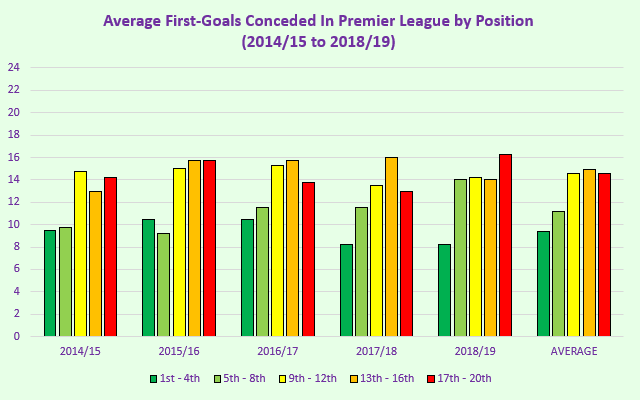
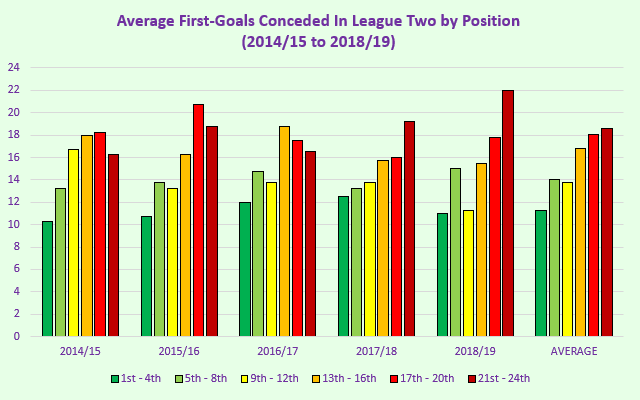
You can see straight away that, yes, the leading teams do concede far fewer first-goals than the others. It’s also quite easy to see that top-half teams fare better than bottom-half sides.
In League Two, the bottom four teams let in the most FGs overall, though they only let in 0.5 more FGs per season on average than the four teams directly above them. The quality gap at the lower end of the Premier League table is even less obvious.
Looking deeper into the figures throws up a few interesting results. In 2015/2016, the surprise Premier League champions Leicester conceded 16 FGs – nearly half of the 36 total goals they let in. That’s one more first-goal conceded than Norwich, who shipped 67 overall and were relegated in 19th!
The fewest conceded in a season is 5 – a figure achieved by both Northampton (champions in 2015/2016) and Exeter (9th in 2018/2019). Several Premier League teams conceded 6 in a campaign, with Manchester City being the only club to do so twice.
At the other end of the scale, West Ham conceded to maiden scorers 24 times in the 2017/2018 Premier League campaign, despite finishing a respectable 13th. They got off lightly compared to the following season’s Macclesfield team, who just escaped relegation from League Two but got that annoying “it’s his first goal” feeling 29 times.
Eleven teams were ever-present during the five Premier League seasons included in this research. I’m now going to sort them in order of fewest FGs conceded:

Manchester City were the only team to consistently finish in the top four during this period. It’s perhaps not surprising they also had the best FG record, letting in an average of only 7.6 per season. 2nd place goes to Tottenham, and 3rd goes to… Southampton?!
This is one of the most peculiar results my research threw up. Southampton had the second-worst average position, yet they conceded two fewer first-goals per season than Liverpool. In fairness, the Saints had a fairly watertight defence during this period – at least until Messrs Pellegrino and Hughes almost got them relegated in the last two seasons.
Winning the league in 2016 didn’t stop Leicester from letting in more FGs over half a decade than all the other top-flight mainstays… except West Ham. Poor West Ham. No wonder their fans are so miserable.
WHEN ARE THEY SCORED?
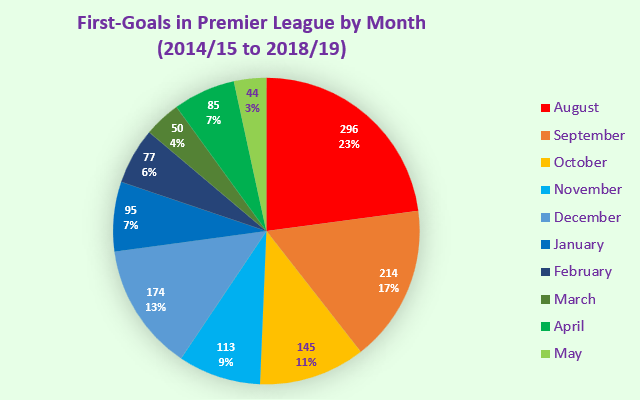
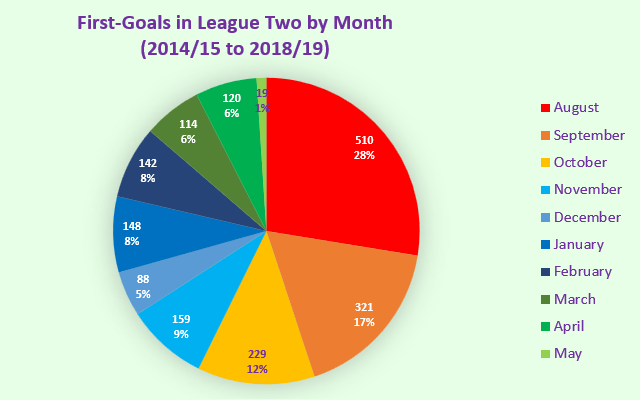
Shock of the century: more first-goals come in August than in any other month. The opening month of the campaign accounts for 23% of all Premier League FGs – and 28% of those in League Two.
This flood of players opening their scoring accounts starts to slow down dramatically as we enter the autumn. By the end of October, around 125 to 135 players have netted in the top flight, making up just over 50% of all those who will score at least once in the league this season. (In League Two, that figure is around 57% come Halloween.)
Over 70% of all league scorers get off the mark in the first five months. But that still means a significant number of players – an average of 70 in the PL, and 109 in League Two – will get on the scoreboard in the new year. It’s typically from January onwards when FMers will really start to notice that commentary line.
Many of those first-time scorers will arrive in the relevant league during the January transfer window, while some earlier goal-getters will move on to pastures new. That opens up more opportunities for players to turn their zeroes into ones.
Typically, fewer first-goals are scored month-on-month – but this isn’t always the case. More PL duck-breakers are scored in December than November, as there’s a packed festive league schedule with no international breaks and fewer midweeks reserved for European games. That could also explain why slightly more are scored in April than March, just before the PL steadily comes to a halt in the middle of May.
However, something strange happens in League Two. Despite marking the midway point of the campaign, December sees far fewer first-goals than any other month except May (which only hosts the final round of regular-season games). As most teams still play plenty of league fixtures just before and just after Christmas, there isn’t an obvious explanation.
COMPARING REAL-LIFE TO FM
Now you have a good idea of how often first-goals are scored in certain periods of the season – and against which teams they are scored – let’s compare those stats to Football Manager.
I have holidayed through five seasons of a Football Manager 2019 save with just the English leagues loaded. All matches in the Premier League and League Two were simulated in full detail. I have then trawled through every instance of a player scoring their first goal of the season in each division.

In my simulation, slightly more first-goals were scored in the Premier League compared to real-life, but slightly fewer were scored in League Two.
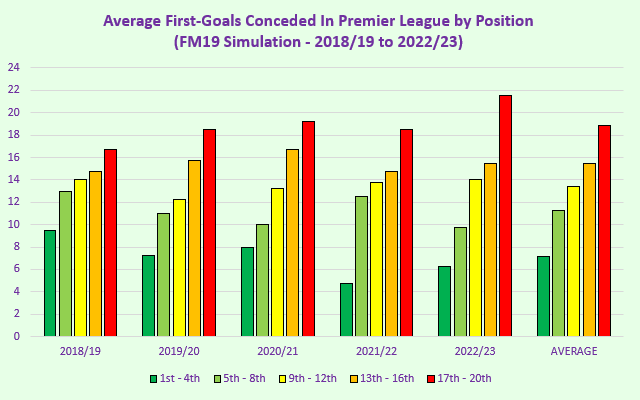
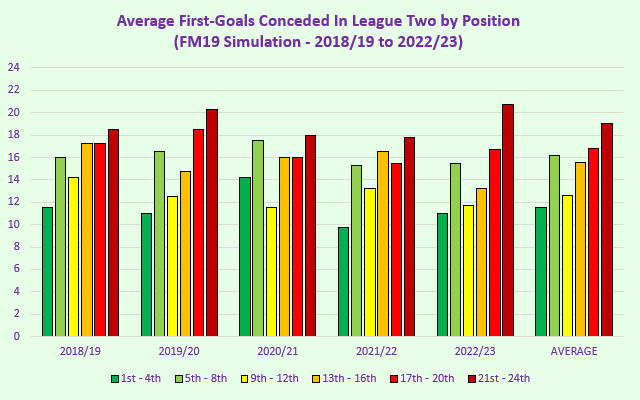
When it comes to analysing who those first-goals are scored against, the simulation throws up some interesting results. In the Premier League, there’s a clear increase in the number of FGs conceded per finishing position – with the gap steadily widening with each season.
Three teams ended a PL season conceding only THREE first-goals – including 2021/2022 champions Arsenal, who let in their last one in September. At the other end, 2022/2023 wooden-spoon winners Crystal Palace shipped 27.
In League Two, the figures for the four best and four worst teams are what you’d expect, with the odd outliers. The 2018/2019 season of this simulation saw rock-bottom Morecambe concede 12 FGs – two fewer than champions Colchester. When Oldham topped the table in 2020/2021, a whopping 17 players popped their proverbial cherries against them!
Things get a little more messed up in between, with sides finishing 5th to 8th almost conceding as many FGs on average as those who came 17th to 20th. No team in the division let in fewer than 7 or more than 27.
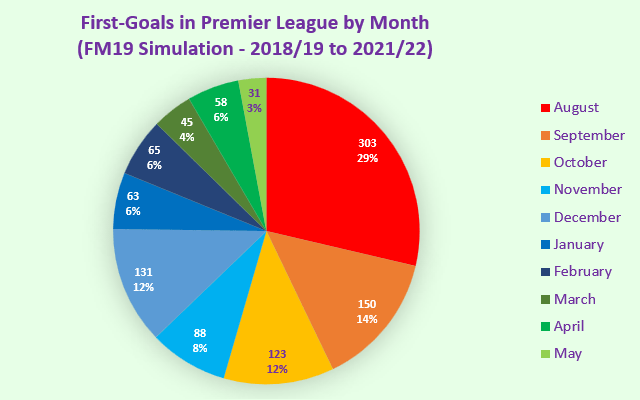
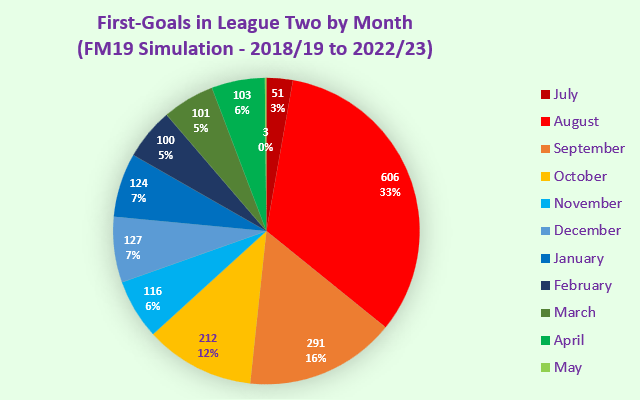
Those pie charts show that, typically, more first-goals are scored in the opening months of an FM season compared to real-life. In League Two, 53.2% of all FGs are accounted for by the end of September, rising to 78.7% by New Year’s Eve. (Note: in the last two seasons, League Two’s regular season ran from July to April, rather than from August to May.)
In later months, the percentages are much closer to their real-life equivalents – at least in the PL. For those who might be wondering, I haven’t included the 2022/2023 season in the PL pie chart. The World Cup in Qatar meant the season began in July, while no league matches were played in November or December, which would have skewed the results quite significantly.
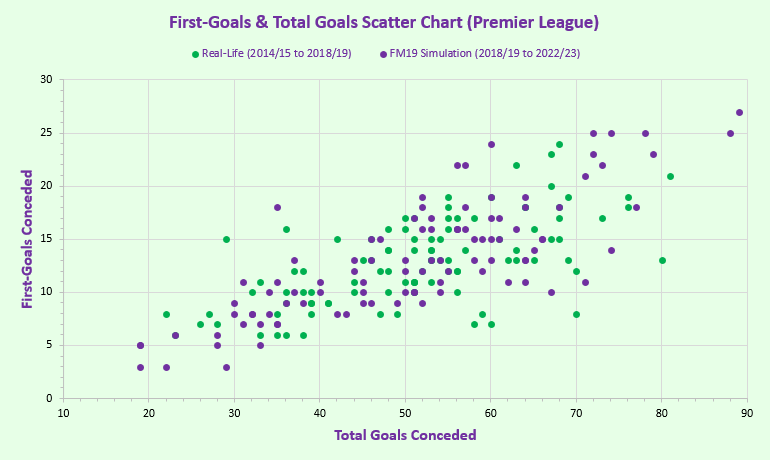
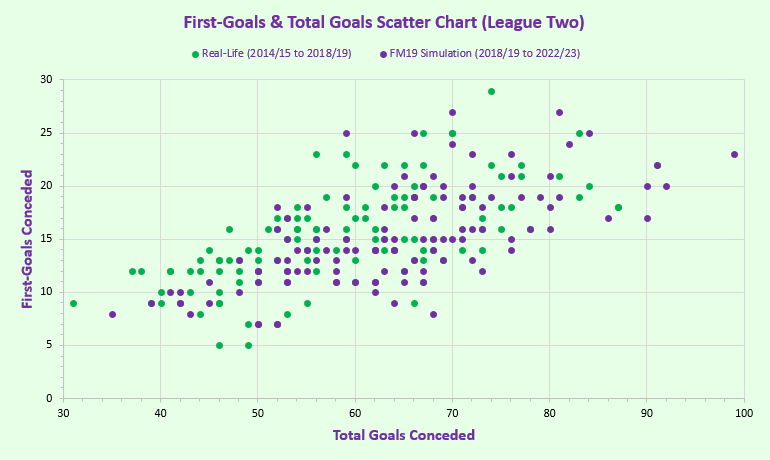
And here are a couple of scatter charts which show how many total league goals teams conceded in a season compared to how many first-goals they let in.
Teams who yielded more goals overall are further to the right of the chart, while teams who shipped more first-goals are further up the chart. Unsurprisingly, as teams concede more goals, they also tend to concede more first-goals, though this trend is not as clear in League Two as it is in the Premier League.
Teams who let in a lot of first-goals and total goals are in the top-right corner, where you’ll find several teams from my FM19 simulation, but only a handful from real-life. Otherwise, there aren’t many differences between history and reality to write about.
IT’S NOT YOU, IT’S M.E.?
I now want to touch on that one question many of you might be asking: “Are more first-goals scored against user-managed teams than typical?”
For the umpteenth time, Football Manager is NOT programmed to discriminate against your team. The match engine cannot tell the difference between your team and an AI-managed side. Many factors go into determining results – tactics, attributes, fitness, form, you name ’em – but ‘screwing the user over’ isn’t among them.
Similarly, there’s no evidence that more goalless opponents will score against you surely because your team is managed by a human rather than artificial intelligence. There’s usually a reason why Fortuna Düsseldorf could ‘suddenly’ play like Bayern Munich against you, or why that goalless midfielder of theirs could ‘suddenly’ break his duck on the final day against you.
Still, I thought I’d look into this anyway. I analysed my first two FM19 careers to see how many first-goals were scored against my teams. I then compared them to the average figures we’d expect in similar-sized leagues at a similar level.
Fiorentina – Serie A (38 games per season, 4 seasons)

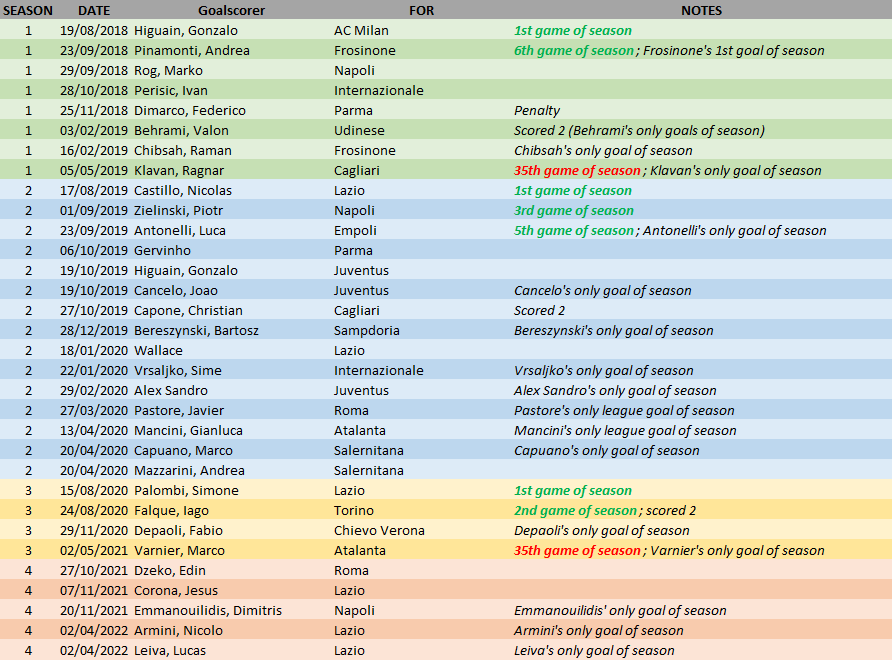
My Fiorentina team generally conceded fewer first-goals than you’d probably expect. We were comfortably below the average FGs conceded per position, position cluster (e.g. 1st-4th, 5th-8th) and league in three out of the four seasons.
(Granted, I’ve based that off the data from my Premier League simulation, but we’re talking about two major European leagues with similar structures, so the goal figures should be fairly similar too. It’s not like I’m comparing oranges with chalk.)
The second season (2019/2020) was an outlier, with 15 FGs conceded – noticeably more than average. A third of all Serie A goals we’d let in were to players who hadn’t scored before. Eight players netted their only league goals of the season against us, but hey, that’s no big deal when you consider that around 80-90 players score exactly once in any given PL campaign.
We tightened up our defence over the next two campaigns, and those numbers consequently dwindled. We let in only FOUR first-goals in 2020/2021 (two of which were in the opening couple of rounds), and FIVE in 2021/2022. Interestingly, Lazio alone accounted for nearly half of those.
Shrewsbury Town – League One (46 games per season, 3 seasons)


In my Shrewsbury save, where we consistently lost in the League One play-offs, our first-goal stats were similarly consistent. Around 25% of league goals conceded by my Shrews were FGs.
Using the data from my League Two simulations as a guide, I estimated that we conceded slightly fewer FGs compared to the EFL average. In terms of FGs conceded per position (or position cluster), we were either below average or slightly above.
While these are small sample sizes based off two save games from one user, there really isn’t a lot there for the FM conspiracy theorists to latch onto. There isn’t any clear evidence that AI-managed players are more likely to score their first goals of the season against user-managed teams.
ANYTHING ELSE?
The final part of this article is for those other areas of analysis I looked into. The results for these were not conclusive or interesting enough to write about in great detail, but I’ve included them here anyway.
Around 20-25% of all league goals conceded were first-goals. Most teams are firmly in the 20s, though some teams went as low as 10% or as high as 51%. There is NO correlation between league position and a higher/lower percentage of FGs conceded.
And you know how goals can be like London buses, in that you wait ages for one – and then get two or more in the same game? I recorded the number of times a previously goalless player scored multiple goals in the match where they got off the mark.
Between 2014/2015 and 2018/2019, there were 80 of these cases in the Premier League, and 134 in League Two. In my five-year FM simulation, there were 103 such instances in the PL, and 132 in League Two. So these scenarios appear to be more common in FM compared to reality, but perhaps not to a ridiculous degree.
I also noticed several cases in my FM simulation where players scored their first goals of the season against former clubs. For example, left-back Olexandr Zinchenko scored first-goals against Manchester City in consecutive Septembers – firstly for Blackburn in 2020, and then for Leicester in 2021.
Personally, I think that’s just confirmation bias at play. There are many more instances of goalless players taking on ex-employers and NOT scoring… but we only ever take notice on those rarer occasions when they DO find the net.
Indeed, you could argue that much of this Football Manager “first goal of the season” myth can be put down to confirmation bias.
Whenever our team concedes a first-goal, a little seed is planted in our memory banks. This seed then grows and grows every time it happens again. Eventually, we reach the point where we’re having nightmares about Aston Villa’s defensive midfielder transforming into Lionel Messi on the final day to deny our team the title.
We also don’t take too much notice of other teams’ results. When an AI-managed player opens their account against AI-managed title or relegation rivals, we don’t bat an eyelid… but when they score against our team, we obviously do. That might lead some FMers to conclude that they are more prone to conceding first-goals out of nowhere.
As I’ve written, there’s no evidence that FM is programmed to suddenly make misfiring players score against you. Likewise, Che Adams didn’t suddenly decide he’d score his first goal of this season with a 40-yarder against Manchester City rather than a penalty against Norwich.
While better and more defensively solid teams are usually less prone to conceding goals against players who haven’t scored before, they are far from invulnerable. This is true both in Football Manager and the actual beautiful game.
I hope this has eased some worries you might have about this Football Manager myth. If you have any thoughts on this, feel free to drop a comment below or tweet me @Fuller_FM.
You can download my analysis spreadsheets below, so you can peruse them at your leisure. Have a nice day.
PREMIER LEAGUE FGs (2014-2019)
PREMIER LEAGUE FGS (Football Manager simulation)
LEAGUE TWO FGs (2014-2019)
LEAGUE TWO FGs (Football Manager simulation)
(Also, you might have noticed that last photo wasn’t actually of Olexandr Zinchenko. I’m a cheeky sausage, aren’t I? Anyway, here’s the actual Ukrainian bombshell…)
 Fuller FM
You must be logged in to post a comment.