

Hello there, folks, and I’m glad you could join me for another ‘retro review’, in which I take a retrospective look at a football management game from years gone by.
This is the second part of my ‘EA MAY’ mini-series. Throughout this month, I will be reviewing a number of titles from EA Sports’ FIFA Manager series, which was a major player in the genre from 1997 to 2013.
I’ve already looked at the original release, but now it’s time to fast-forward a couple of years, to 1999. Here is the game that dragged this series kicking and screaming into the new millennium – FA Premier League Football Manager 2000.
BACKGROUND
After releasing FIFA Soccer Manager in early 1997, EA decided not to put out a sequel in the 1997/1998 season. ‘Mr Tracksuit’ – the star of the original game’s iconic FMV clips – quietly got the boot, never to be seen again.
Instead, the Californian behemoths agreed a licensing deal with the Premier League, which spawned FA Premier League Football Manager 99 – again developed by EA UK, and released in late 1998. The general consensus was that it was a solid and good-looking effort, but that it would only have a short shelf life before Championship Manager 3 blew it away a few months later.
And that brings me onto FA Premier League Football Manager 2000, which I’ll mercifully shorten to PL FM2K from now on. This was one of THREE football video games EA published in the 1999/2000 season, the others being FA Premier League STARS (a bizarre FIFA/RPG mashup which had a cool dance soundtrack) and FIFA 2000. I’m not even including the official UEFA Euro 2000 game, which just proves how much EA milked their licences in those days!
I got my copy of PL FM2K as a Christmas present in circa 2001, as part of a three-game box set with FIFA 2000 and PL STARS. I only asked Father Christmas for a new FIFA 2000 disc, as my original CD was so badly scratched and worn out, but those extra two games were a nice surprise.
While PL STARS couldn’t hold my interest for long, PL FM2K was a different matter. I had fond memories of playing this as a young lad, and I spent three years trying to get it running again on modern hardware before finally succeeding last month. So… was all that effort worthwhile?
STARTING OUT

After getting the usual EA Sports (“It’s in the game”) and title videos (featuring a bevy of late-90s Premier League highlights), you’re ready to jump into a new game. You can manage in any of seven nations, with the English leagues going all the way down to the Conference.
As the title suggests, only the 20 Premier League teams are fully-licensed in terms of badges, kits and stadia. All other clubs are given plain logos, with some leagues having further licensing restrictions. French-based players don’t have their full first names (just their initials), while Inter’s Brazilian superstar Ronaldo is identified simply as ‘No. 9’ (which at least makes a change from being dubbed ‘Fat Ronaldo’, I suppose).
When you’ve found the club you want to manage, you just have to name your manager – or you can stick with the incumbent’s name. You can even select a title (Mr, Mrs, etc.), by which you will be identified in the various emails you’ll receive during this game.
Being the new first-team manager, some of your first tasks upon taking over will be – of course – to decide season ticket prices and sort out your players’ injury insurance. Yep, just like FIFA Soccer Manager, you’re expected to be involved in matters off the pitch as much as those on it!
WHAT I LIKED
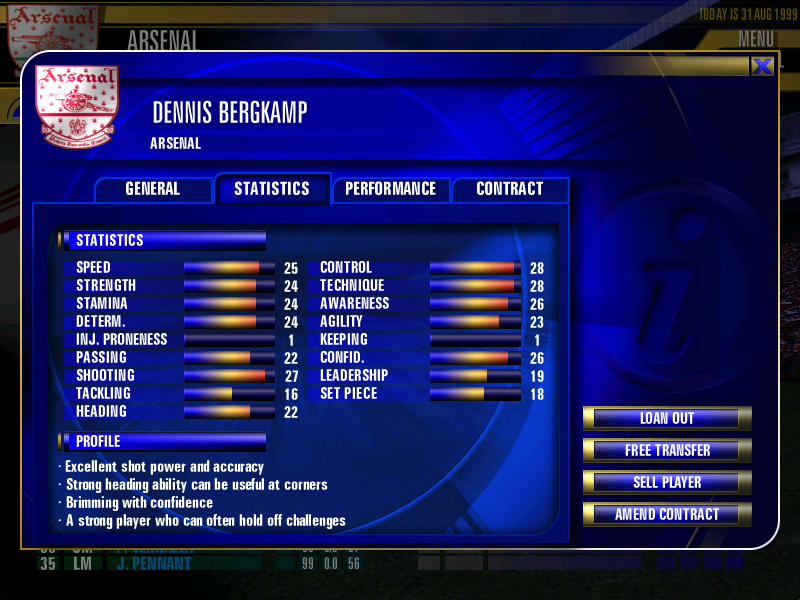
The player profiles are nicely laid-out. Right-clicking on their name will bring up some basic information about them, and you can also click on tabs to view their attributes, performance ratings, and contract details.
Attributes are confusingly labelled as ‘statistics’, but there are 17 of them in total, which gives you enough to think about without being overwhelmed. They are all rated from 1 to 30, and the profile section gives you a good idea of where their main strengths and weaknesses are. If someone “doesn’t have the slightest idea what motivates players” (i.e. they have poor Leadership), that’s a clear sign they shouldn’t be your captain!
Selecting your team is just a matter of dragging and dropping players on the squad screen. If a player is assigned to a position they’re not comfortable in, this will be clearly highlighted in red. Thierry Henry apparently can’t play as a striker… but it’s worth remembering that he was originally a left-winger when Arsenal signed him in 1999, and the game is simply reflecting this.
If you want to change your system, you have to go to a separate formation screen. Again, this is pretty intuitive, with many pre-built formations available, alongside the ability to create your own. My Arsenal team had plenty of success with an asymmetrical 4-4-2 (two defensive midfielders, a left midfielder, and a right-winger). Setting personal and team instructions also have their own dedicated screens.
If you want to improve your squad, the player search features don’t take long to get to grips with. You will have to scout a player to view their full ‘statistics’, which takes one week if they’re in your league or two if they play abroad. It’s also worth remembering that when you’re bidding for players, that AI clubs will demand much more than their value unless they are on the transfer list.
But it’s not just players that matter; staff do as well. You can hire a limited number of staff members (all given star ratings out of 5) who can benefit your team in different ways. A good assistant manager will give you pre-match tactical advice, a quality scout will recommend you some players every month, and a competent business consultant will not suddenly enter your club into a European Super League.
WHAT I DIDN’T
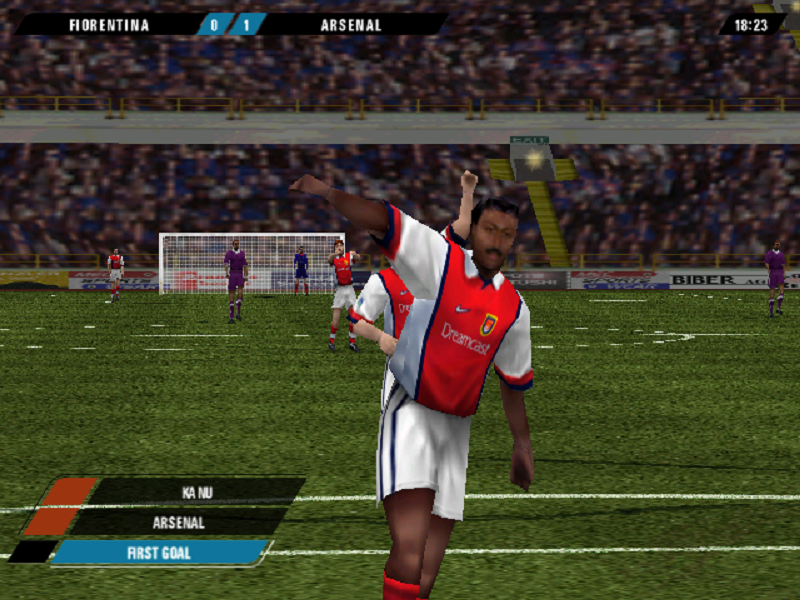
Unfortunately, the match experience is rather drab. While there are several different ways to watch or manage your matches, none of them are particularly satisfying.
The default quick sim will simply generate a result, without allowing you to make mid-game changes, though you can watch 3D highlights later. On the other hand, you can choose to watch the entire match in 3D, but tactical changes are again off the table.
If you actually want something closer to the FM experience, there’s a middle-ground option that shows you all the latest scores in your league, plus 3D highlights from your match. The UI is very bare-bones, though you can at least change your tactics… to a point. Substitutions are a simple ‘right-click, left-click’ job, but altering the formation is an arduous clickathon challenge that’s too nightmarish to properly explain.
The match engine itself is a disappointment, with players often making odd passing decisions, missing sitters, or otherwise playing as if they’ve been lobotomised. The player models are also not as lifelike or appealing as they appeared on FIFA 2000, but at least the authentic PL grounds and kits look nice, considering the technology of the time. The presence of Sky Sports’ Martin Tyler on commentary duties adds to the immersion.
League and cup results are mostly realistic (which is fine by me), but things fall down when it comes to European and international competitions. On my game, world champions France DIDN’T qualify for Euro 2000 but the Faroe Islands DID… while Sweden went on to beat Albania in the Final!
Even more strangely, Arsenal won the Champions League! Yeah, we did beat a pretty strong Fiorentina team in the Final, but we only needed to get past Spartak Moscow in the Semis. The strength of these continental teams seems to be entirely randomised, to the point where I found an elite left-back playing for Avenir Beggen in Luxembourg, as well as several outstanding players in the Irish league.
WE MUST TALK ABOUT

Stadium building. Just like in FIFA Soccer Manager, and indeed in all subsequent versions of EA’s management sim, you can expand the various stands at your home ground to your heart’s content.
You don’t have 300 different pieces of stand to put together and can’t create an insane mega-stadium, but there are still enough options to get wannabe architects drooling. They are inevitably expensive, though they are mercifully built at a ridiculous pace. In real life, knocking down your main stand and building a new 13,000-seater in its place would probably take much longer than three months!
If you’re managing one of the licensed Premier League clubs, building a new stand will remove your stadium’s unique look and give you a generic-looking ground in its place. Just bear that in mind when you’re thinking about whether Upton Park needs more than a lick of paint.
You can also build new facilities, which can improve your club in certain departments. A medical centre will help with treating injuries, a school of excellence will bolster your youth players’ development, and a training ground… you get the idea.
SUMMARY

I always review games based on their own merits instead of unfairly comparing them to modern titles. PL FM2K is definitely prettier than Championship Manager, and it does a good job of replicating the Premier League experience of its time. But as a management sim, it doesn’t even come close to matching its big rival for depth and engagement, and I quickly lost interest after the first season.
If you want to play this for yourself, running it on Windows 10 is a no-go. You’ll need an old Windows 95, 98 or XP computer, or an XP virtual machine. Even they can be hit-and-miss, though, and I ultimately had to go down a legally questionable route just to get it running smoothly on my laptop. Please be careful.
FULLER FM RATING: 2.5* – Football League
If you’ve enjoyed reading this retro review, feel free to leave a comment below or tweet me @Fuller_FM. I’ll be back next week to look at another of EA’s football management games.
 Fuller FM
You must be logged in to post a comment.