
Here we go again with another Retro Review on Fuller FM – and it’s time for something a bit different.
In the past, I’ve tended to focus strictly on football management games. Nowadays, however, I’m much happier to broaden my horizons and cover any football-related PC game that catches my eye. (This does not include action games where you control the players, so no FIFA or Pro Evolution Soccer reviews. Sorry.)
The game I’m going to discuss today is the reason why I’ve decided to relax the rules the little bit. It’s not really a management game, but its unique card-based gameplay had me hooked for weeks when I was a teenager. And while it was a fairly popular freeware game when it was originally released in the mid-2000s, it now seems to have been largely forgotten.
Well… it’s time to change that! It’s time to (re)introduce you to the pleasure of SoccerCards!
BACKGROUND
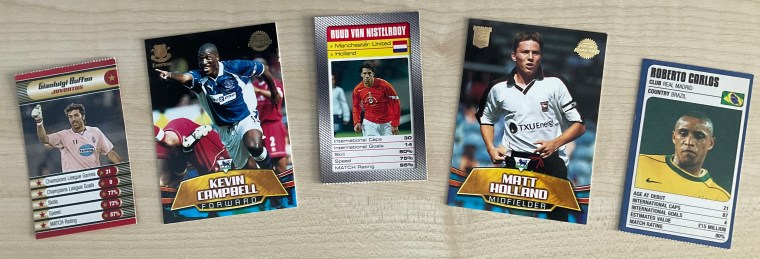
There are plenty of football-related card games out there. But a football card game that you can play on PC? Now that’s a rarer kind of beast.
In 1992, a fella named Stephen Corry wrote a game for the Commodore Amiga titled Soccer Cards: FA Cup Championship. As the name suggests, this was a game where you would try to win the FA Cup – with each cup tie being determined by you and your opponents randomly drawing cards. Some cards would award a goal, some would not, and one card would end the game immediately.
The Amiga was a fair bit before my time, so I never played the original Soccer Cards. One person who did was Mike Douglas, who was disappointed that the game was entirely based on luck. Around a decade later, while he was at university, Douglas developed his own version of the game – one that would require at least some skill to beat.
And so, in 2003, Douglas released SoccerCards (or Soccer Cards; the space between the words appears to be optional) as freeware on his website at manwithnomouth.nildram.co.uk . Sadly, the URL is now dead but you can still access an old version via the Wayback Machine.
This was one of the many freeware or shareware football games that I tried during my early days on the interwebs. It was also one of the elite few – including Championship Soccer and Simsoc 6 – that I enjoyed enough to stick with.
Douglas later released a EuroCards spin-off for Euro 2004 before starting work on a sequel – SoccerCards 2, which came out in 2005. That was more in-depth than the original, but it was slower, less stable, and generally much less enjoyable. I also can’t find that version anywhere online anymore, so we’re sticking with SoccerCards 1 today.
Though the SoccerCards project now appears to be dead, you can still download the game via this link. (I’ve also provided an alternative download here.) You’ll also be delighted to read that the game still runs perfectly on modern operating systems!
STARTING OUT
SoccerCards is set in the 2003/2004 English football season. You can play as a team in any of the top five leagues, from the Premier League to the Conference. In fact, you can even go all the way down to the Ryman League, the Dr Martens League or the Unibond League – which were the three regional feeder leagues to the Conference at the time.
There are two career modes to choose from. “Career With Club Selection” will let you pick any club you want – even in the Premier League. “Soccer Cards Career Challenge” will randomly pick one of the worst teams in the regional leagues and then send you straight over there. Tonight, Matthew, I’m going to be managing Chelmsford City in the Dr Martens League.
Your goal from here is either to gradually build your team up through the leagues, or progress your career by jumping from club to club. At the end of every season, you may receive some job offers, depending on how you’ve performed. You’ll then have the option to either stick with your original club or jump ship for a new challenge – perhaps in a higher league.
Each team in the pyramid has a skill rating between 10 and 100, which affects their chances of scoring chances and keeping possession in matches. Higher-rated teams are more likely to play well against lower-rated teams, so Chelmsford (who start with a skill rating of 12) would probably struggle to beat Manchester United (skill rating 98).
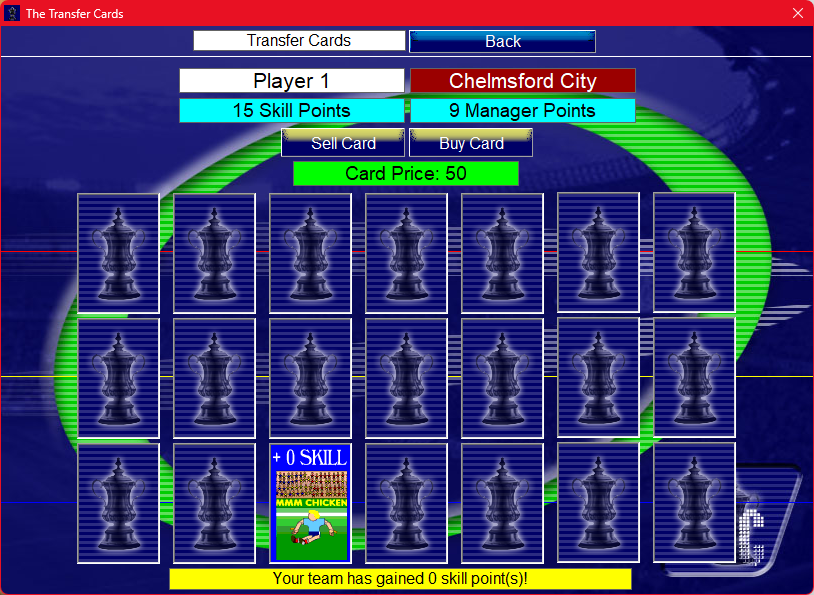
As you play matches and progress your career, you will earn manager points. You can spend these on the ‘Transfer Cards’ section, where you can make a transfer (pick a card at random) for the chance to improve your club’s skill rating. A lucky pull will earn you 1, 2 or even 3 skill points – but most cards will earn you nothing at all! It’s a gamble, but that’s the whole fun of it.
WHAT I LIKED (THE GAMEPLAY)
Oh… yeah. I should probably explain how the bloody game works now, shouldn’t I?
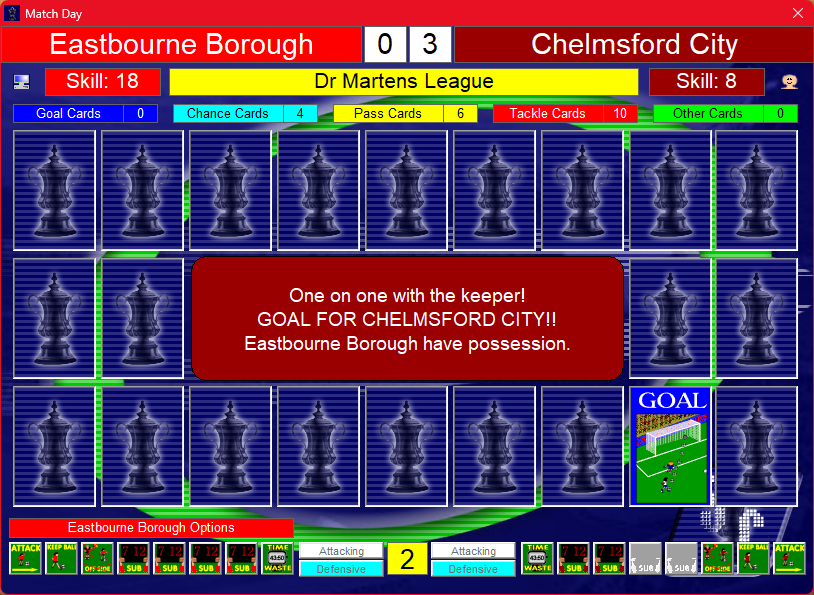
The rules take a little explaining, but basically, 22 cards are laid down at random before each half. When you have possession (i.e. it’s your turn), you can pick one card at a time to reveal it. Each card will have a different impact on the match, and it will also end with you either retaining possession for another turn, or giving your opponent the chance to pick a card themselves.
Selecting a GOAL card will guarantee you a goal, while a CHANCE card will give you a chance to score (depending on your team’s skill level, the quality of the chance, and your tactics). The OFFSIDE card will lose you possession immediately in most cases. If you pick a PENALTY card, you will play a penalty mini-game for the opportunity to score another goal. More on that later.
A PASS card will usually retain possession for another turn, though it can be intercepted. Likewise, a TACKLE card typically results in your team losing possession, though there is still a chance to retain the ball or win a foul.
The worst cards to pick are INJURY and RED CARD, which will cost you skill points and substitutions, thus weakening your team. Picking the END OF HALF card will end the half immediately, even if there are still several cards that haven’t yet been selected.
There are also tactical options you can use to try and weight the odds in your favour. For example, you can select either an Attacking or Defensive mentality. Selecting Attacking means you are more likely to you score chances, but also more likely to lose possession and be vulnerable to counter-attacks. On the flip side, going Defensive will reduce your odds of scoring chances, but you are more likely to keep possession.
You can make up to four Substitutions per match. If you use a sub on an Attacking mentality, you replace a random TACKLE card with a CHANCE card. The reverse happens with Defensive substitutions.
Other options allow you to Keep Possession (guarantees you keep possession for another turn, even if you’d normally lose it), go All Out Attacking (massively increases your chances of turning a chance into a goal), or Play For Time (replaces a random hidden card with an extra END OF HALF card). You can also Break The Offside Trap, which also increases your odds of scoring on the next turn – and if you pick an OFFSIDE card next, that automatically turns into a goal!
Higher-skilled teams will win more often, and major upsets are unlikely… but they are possible. When I first played SoccerCards almost two decades ago, my all-conquering Millwall team went through to an FA Cup Final against Division 3 minnows Mansfield Town. I replayed the match ten times until Mansfield finally beat us (on penalties) to win the FA Cup and qualify for Europe. What do you mean “match-fixing”?
WHAT I DIDN’T LIKE
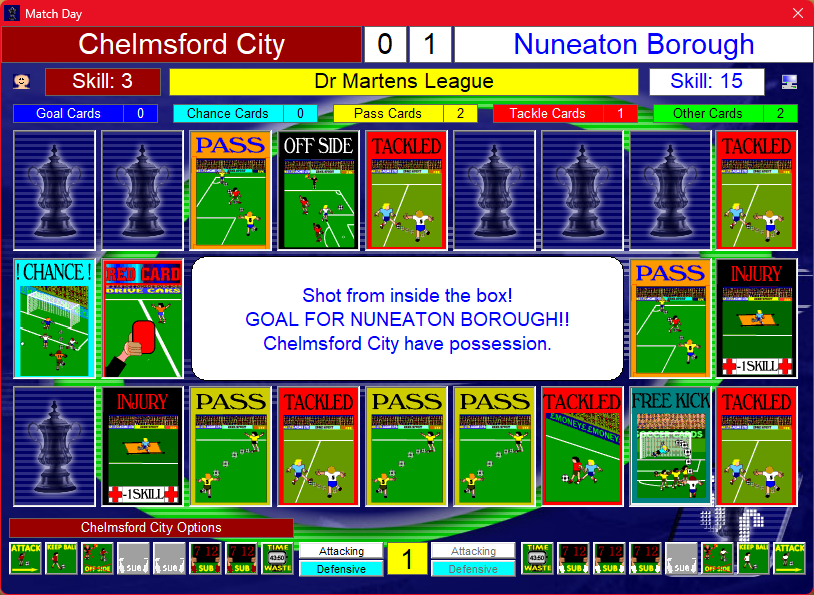
Though there is some strategy involved in SoccerCards, it is still essentially a game of chance. Don’t expect to win every game.
Sometimes, Lady Luck will swing your way, and you can score twice on the same possession or get an unexpected victory against much stronger opposition. Other times, you’ll pick up two red cards and an injury – cripping your team’s skill rating and effectively costing you a winnable match.
It’s also possible that you can pick the END OF HALF card with the very first turn of each half – resulting in the most boring goalless draw you’ve ever seen since George Graham was in his pomp!
There also isn’t much playability beyond the English leagues. Though you can play a standalone club or international tournament, there are no other playable leagues in SoccerCards. There is a pre-game editor, but it’s very basic and can’t really be used to create new leagues.
The non-English teams in European competitions are pretty static as well. For example, because Barcelona were not particularly good in 2003, they will only ever play in the UEFA Cup on SoccerCards. You’ll never see them in the Champions League.
WE MUST TALK ABOUT…
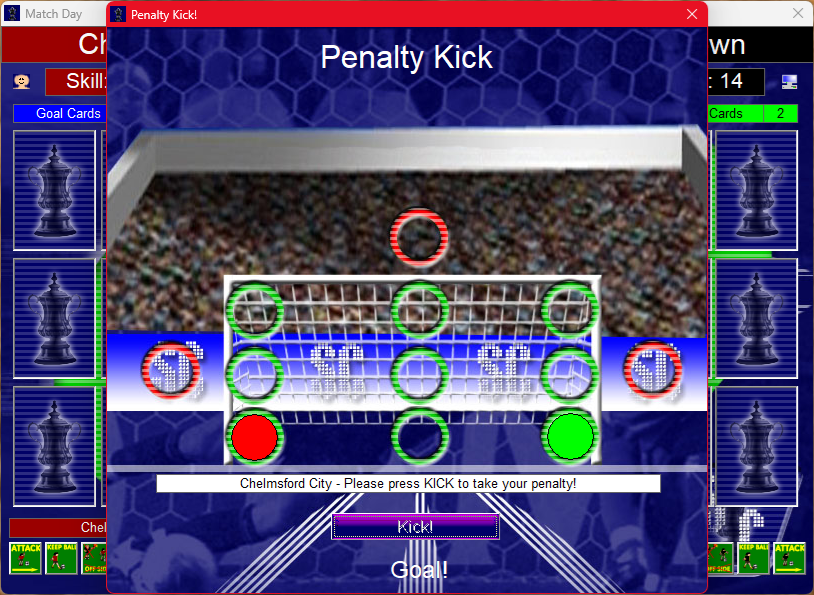
Penalties. How do they work?
A pop-up flashes up on screen, with nine green targets inside a goal and three red targets outside of it. Each target then quickly lights up one by one until you click the “Kick!” or “Save!” button, depending on whether you’re taking or defending the penalty.
When you’re taking the penalty, your aim is to press “Kick!” when one of the green targets is flashing to score. Hit a red target, and you miss the penalty! However, one of the green targets will be lit up in red. If you press the button when that target is lighting up, the opposition will save the penalty.
When you’re saving the penalty, one of the targets will be highlighted to show you where the opponent has taken it. If it’s red, they miss the penalty and you don’t have to do anything else. If it’s green, you must press “Save!” when your flashing target is over the same target, so that you can make a save. There’s an 88% chance you’ll get it wrong and concede the penalty, but who knows – maybe you’ll get lucky.
SUMMARY
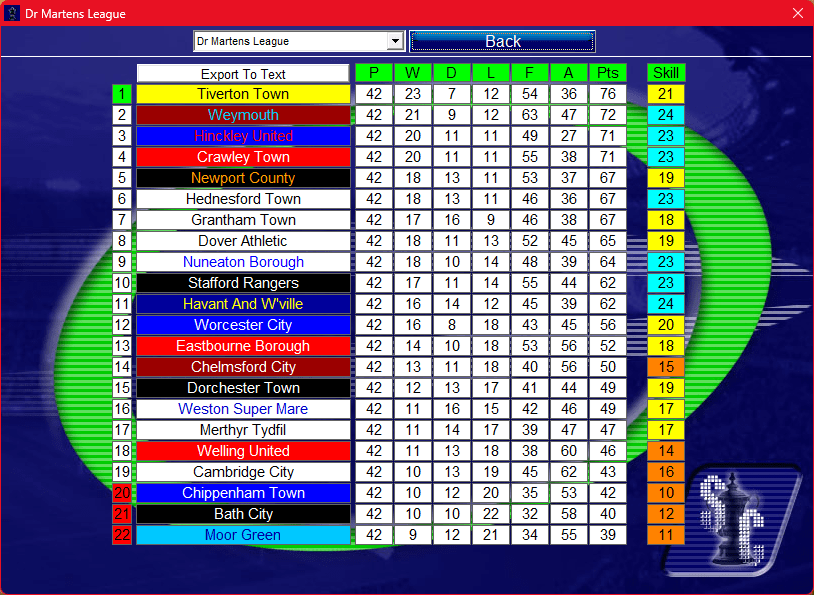
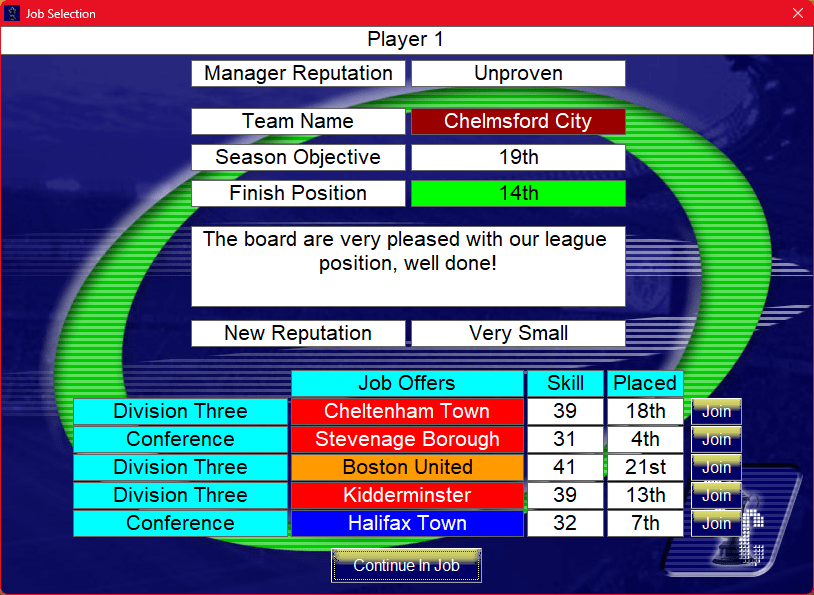
I really enjoyed playing SoccerCards as a teenager, and that feeling is still there even today. Okay, so it’s not your typical football game, and results do often depend more on luck than skill, but it’s pretty simple to learn and difficult to master. You can easily complete a full season within an hour or so.
Though SoccerCards is still very playable on Windows 10/11, it’s a shame that nobody has yet developed a modern remake. I get the feeling that a card-based game like this would play especially well on mobile devices. So if there are any budding developers reading this, perhaps it’s time to give us a new version of Balatro – with balls.
FULLER FM RATING: 3.5* – Premier League.
Thanks for reading. Feel free to give SoccerCards a try yourself, and let me know your thoughts by leaving a comment below. You can also find me on Threads and BlueSky.
 Fuller FM
You must be logged in to post a comment.