Here’s another non-Football Manager football manager game review… because apparently that’s all I write about on here anymore!
Ah, but I’ve been wanting to check this title out for a while now. If you’re fed up of ultra-realistic simulations with less soul than a Reform UK party conference, or AAA games that turn your kids into broke gambling addicts, you’ll probably find this just as refreshing as I did.
Last month, SEGA officially released their newest multi-platform football management game. Sadly, it’s not a rebuilt, reskinned Football Manager 26 that anyone born before the year 2000 might actually enjoy. Though this new game is officially “powered by Football Manager”, it isn’t even close to the FM experience.
Having tried the new game out over the past few weeks, I’m now ready to give my thoughts. Is it a fresh take on the genre – even an FM killer? Or is it “the worst football manager game of all-time”, as some have said?
Here is my honest review of SEGA Football Club Champions.
BACKGROUND
SEGA have owned Sports Interactive since 2004, but they have been in the football video game market for longer than you might think.
Go back about a decade… to February 1996, when SEGA launched Pro Soccer Club o Tsukurō! (often shortened to SakaTsuku) in their native Japan. This was around the same time that the J.League was just getting started, with foreign imports such as Dunga, Dragan Stojković and Salvatore ‘Toto’ Schillaci elevating the standard of Japanese football to a new level.
SakaTsuku was relatively popular in Japan, but it didn’t enter the western market until 2006, when Let’s Make A Soccer Team! was released on PlayStation 2. This was a largely story-driven game where you first had to save your football club from being bought out by an asset-stripping multi-millionaire businessmen, and then lead them to greater glories. I’m not sure what sales figures were like, but the reviews were pretty mediocre at best.
After that brief foray overseas, SakaTsuku remained a strictly Japanese title for the next two decades… until the summer of 2025. That was when we first heard about SEGA Football Club Champions “powered by Football Manager”. With Football Manager 25 now binned, some FMers thought this meant their beloved franchise was being turned into a soulless mobile game – whereas, in fact, it was just an international relaunch of SakaTsuku.
FCC was officially released on 22 January this year, as a free-to-play game on Steam, mobile and console (with in-app purchases, of course). After the first month, English-language reviews were “mostly negative”… but I would not immediately write this game off.
There are some important thematic differences between video games made in the western world (i.e. North America and Europe) and those made in Japan. Western games generally favour gritty realism, glossy presentation and action… while Japanese games lean towards story-driven fantasy, character development and symbolism. There are obviously some exceptions to the rules, but that’s just a general summary.
This is not an endorsement or a criticism of either approach. FCC is clearly meant to be enjoyed as a very different experience to Football Manager, so I will not even begin to compare the two games. In this review, I will be judging FCC solely on its own merits.
STARTING OUT
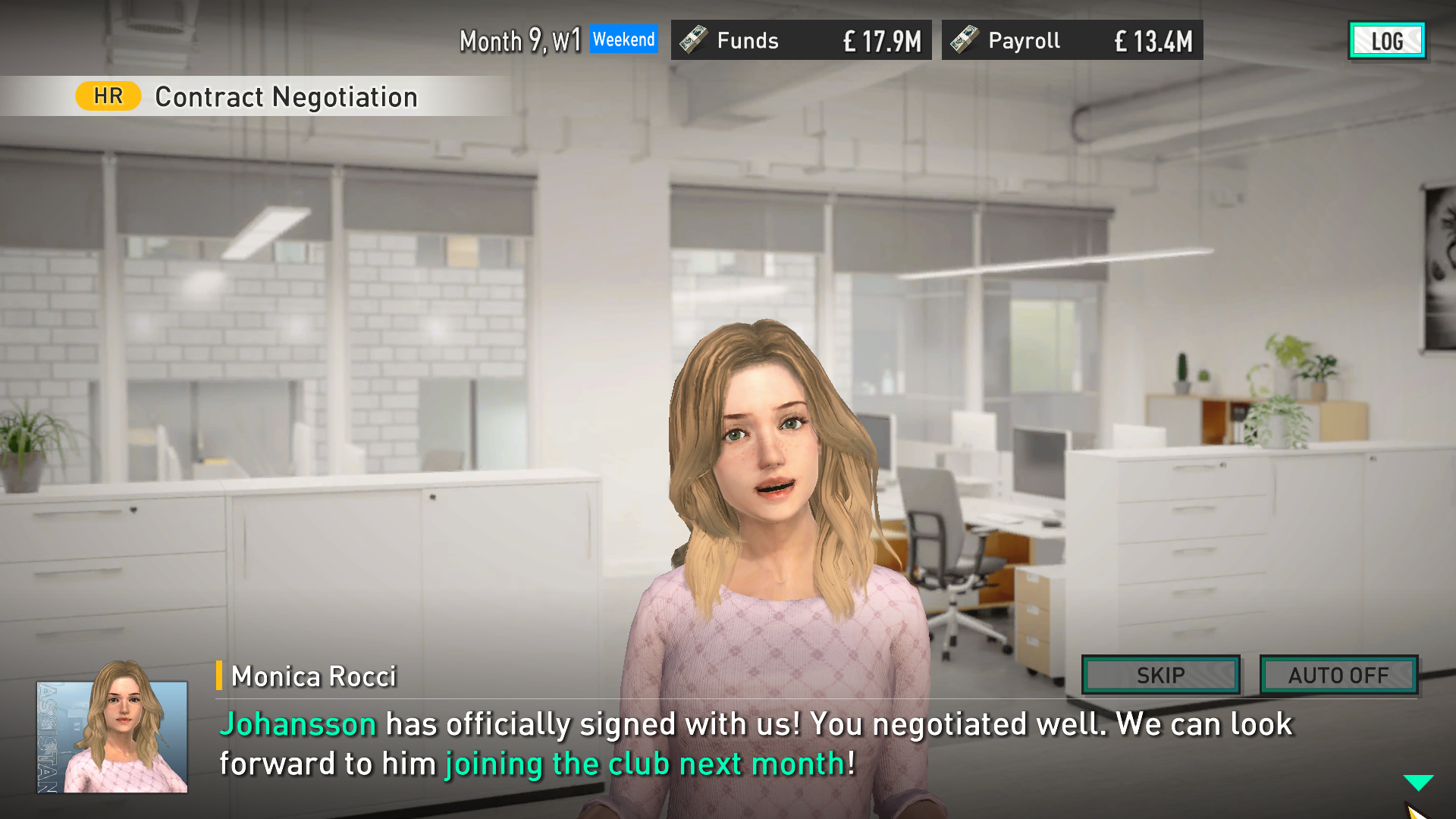
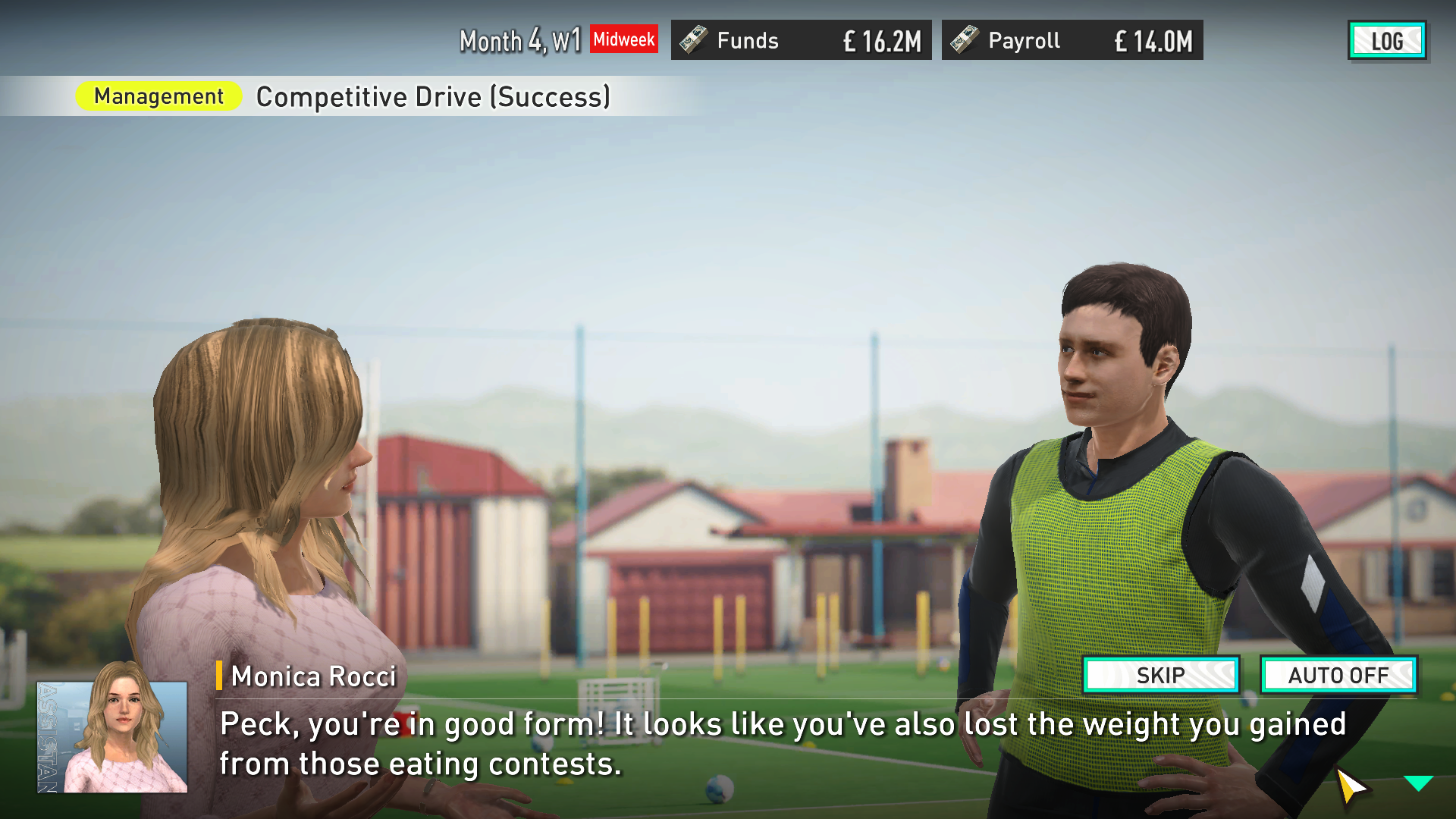
“A little bit of Monica in my life…”
Once you download and launch the game for the first time, you will be taken into a tutorial. A legendary manager with an equally legendary ego will take you under his wing as he teaches you the gameplay basics, such as setting up tactics, negotiating new signings and training players. It takes around 20 minutes, which is a bit long in all honesty… but once that’s out of the way, you’re pretty much good to go.
Then the real fun begins, with several modes to choose from. Dream Team is the game’s equivalent of EA Sports FC‘s Ultimate Team, where you can pit your wits against other managers. Tours allows you to play matches against clubs in various regions to complete missions and earn rewards. For this review, I’m going to focus on the main single-player experience – Career Mode.
FCC makes good use of FM’s database and FIFPro’s licence by including thousands of players from clubs across the world. But while all these players have their real names and likenesses, only the J.League and South Korea’s K-League have all their clubs fully-licenced. That means that instead of managing Millwall, I will be taking charge of AS Bermondsey, as they face off against the likes of Greenwich, Hertfordshire and Lexham.
In some leagues, you also have an option to create your own custom club. You can set its name, kits, and the region and city it’s based in – though you only have a limited choice of badges to choose from and can’t create your own.
One of your first big decisions as manager will be to appoint an assistant, who will lead your interactions with players and give you general advice. Naturally, most of the applicants are young women who appear to have stumbled out of college or a modelling agency. This use of fan service isn’t unique to Japanese games, of course, but they really like eye candy over there.
Speaking of eye candy, a lot of people have compared FCC to Umamusume: Pretty Derby. (That’s the racing game with the horse girls; it has nothing to do with John Eustace.) If you have ever played Umamusume – full disclosure: I have not – then you probably have a good idea of what to expect from this.
WHAT I LIKED
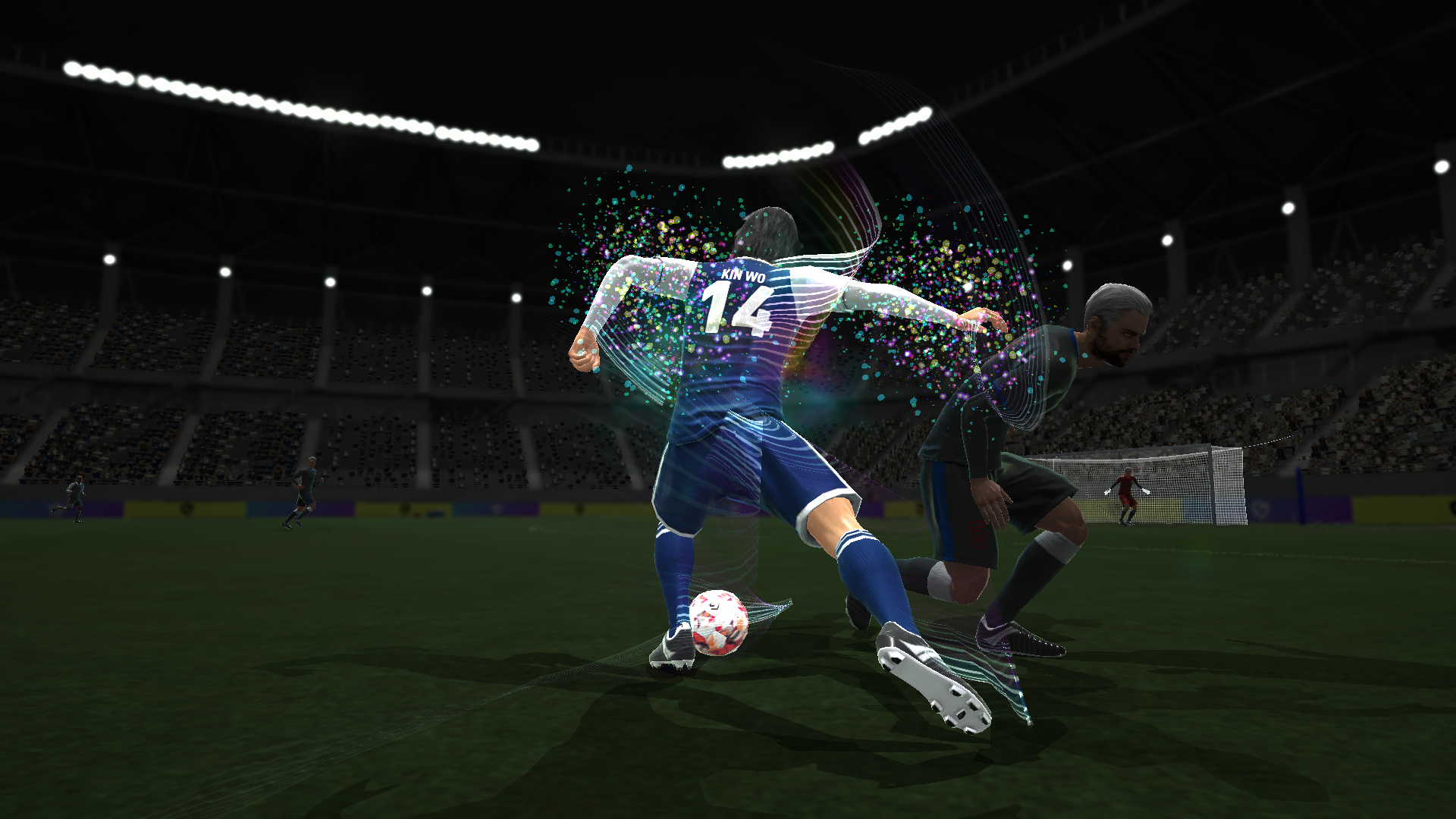
[BOOM] UNBELIEVABLE TEKKERZ!
Just to reiterate – FCC is not designed to be a hyper-realistic simulation of professional football. Indeed, this game includes some role-playing and fantasy elements that make the experience feel rather cool and fresh.
Signing players is done through playing a three-question mini-game. If you give a player a high-enough squad status and answer another question correctly, you will be able to negotiate his wage demands to a more reasonable level. If he accepts your demands, he will join your squad at the start of the next month.
Also breaking up the monotony of playing and progressing between matches, you will get storylines that can either help your players improve quicker or boost your team for a limited time. There are short and wholesome storylines like your players getting addicted to trading cards, or slightly longer affairs like your new star signing considering a move to a bigger club.
The interactions with your players also help bring them to life. Admittedly, some of the English translations aren’t perfect. When one of your players signs for another team, they are said to “retire” from your club, and your assistant will tell them, “It was an honour to fight alongside you.”
The graphics engine looks pretty good as well. It’s not EA levels of graphical quality, and some of the movements are a bit iffy, but it looks visually pleasing. The short slomo cut-scenes that play out when a top player pulls off a skill move are so cool to watch, and it’s clear that a lot of effort was put into making them.
Likewise, the user interface can take some getting used to, but navigating through the game soon feels natural. I certainly didn’t need to spend 20 hours trying to work out where everything was, Miles.
WHAT I DIDN’T
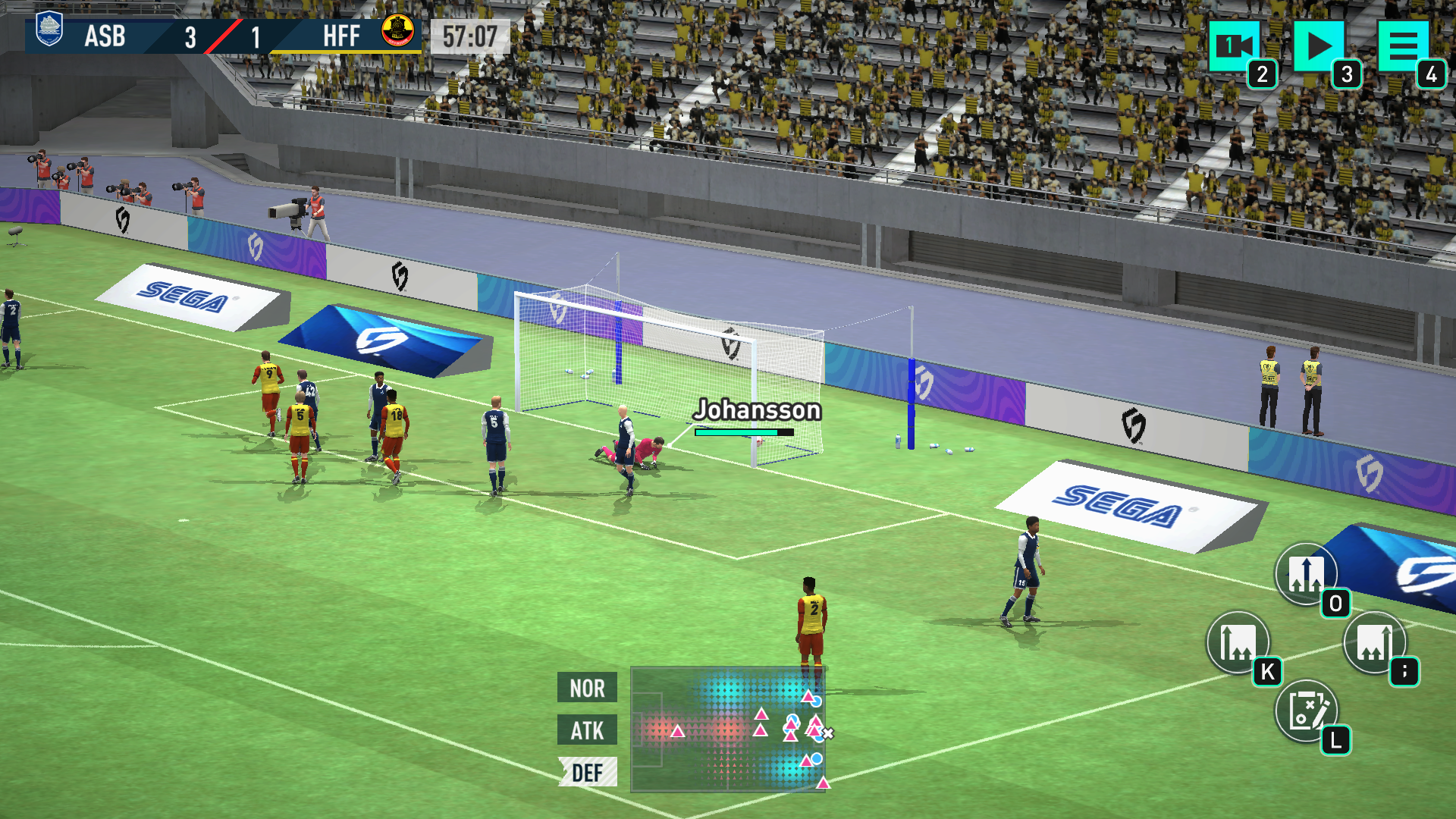
What is defending?
FCC’s database is certainly “powered by Football Manager”. Sometimes, it feels like parts of the match engine are as well.
Competent defending on this game is close to non-existent. Far too often, I’ve seen strikers brush past defenders like they’re not even there, or being left completely wide open.
Players also miss obvious passes, head the ball in unnecessary situations, and even teleport across the field whenever it’s convenient. Lastly, free-kicks are routinely given for what look like perfectly reasonable tackles. These are all issues that have blighted recent FMs.
Despite the general incompetence, scorelines somehow stay at a realistic level. Nonetheless, it’s bad enough that I prefer to simulate through most of my matches – and only watch one or two of our bigger games each month.
Then there are the ‘gacha’ elements, which are similar to the ‘legalised gambling’ you get on Ultimate Team. If you want to improve your players faster, you will need to upgrade training cards, which you buy with in-game currency. If you want better players, you collect cards from ‘loot boxes’, which (again) you buy with in-game currency. Alternatively, if you are rich and/or gullible enough, you could just spend real-life money to get them sooner.
From my experience, it is possible to play the game and make decent progress without spending a single penny. Sooner or later, though, you may hit a wall – and FCC will drive you towards paying to win. You’ll even have to fork out if you want to have more than one save slot in Career Mode. I get that freemium games need to make money somehow, but some of this feels a little unnecessary.
My biggest bugbear, though, is with the ‘always online’ element. I’ve had a few random connection issues interrupting my experience, even when doing something as simple as trying to open the menu that exits the game. Don’t trust live services, kids.
WE MUST TALK ABOUT…
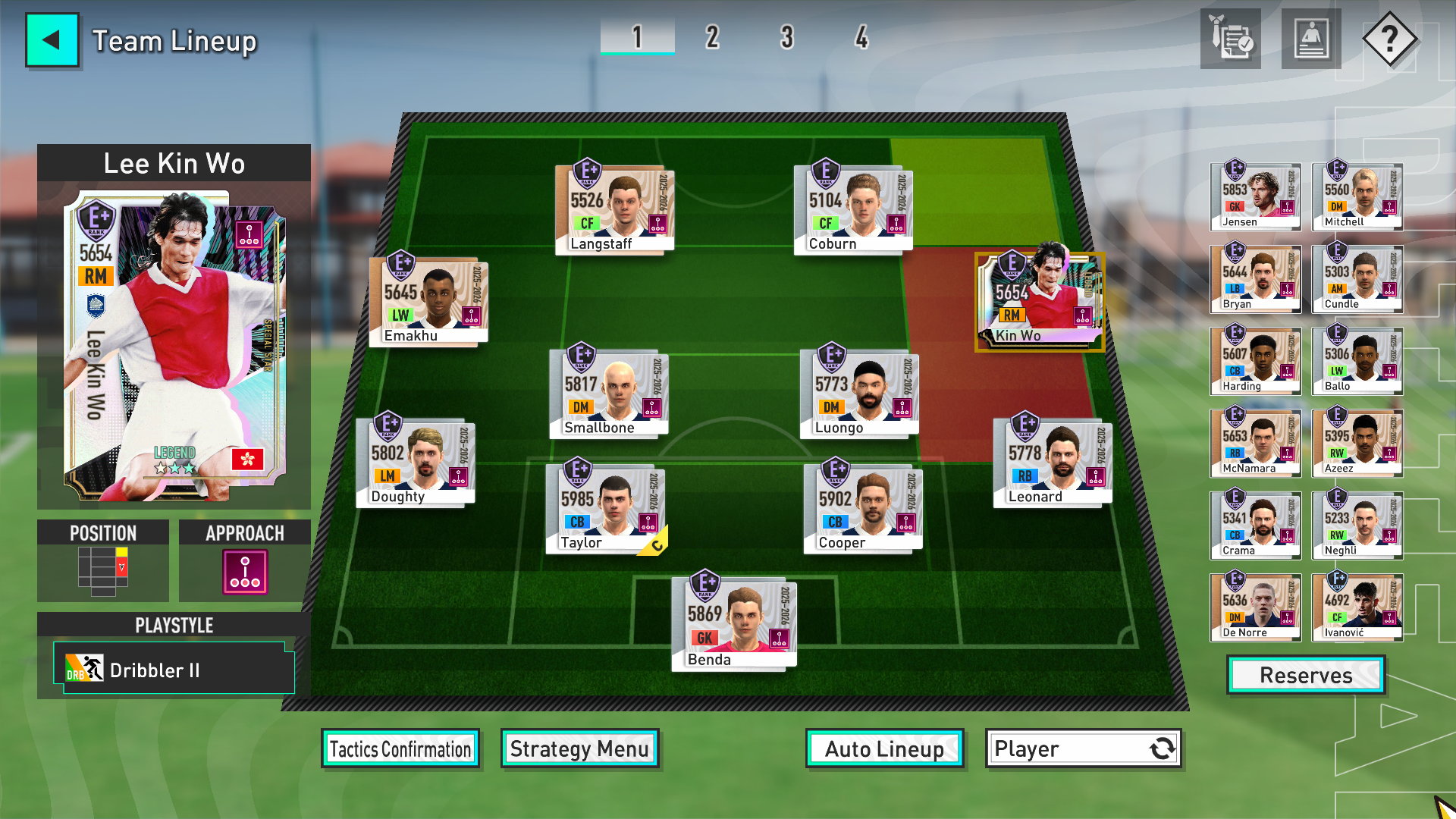
What do you mean, you’ve never heard of Lee Kin Wo – the legend of Hong Kong football in the 1990s?
Players.
As you progress through FCC, you can buy or otherwise collect player cards. Most of these will be modern-day stars such as Erling Haaland, Cristiano Ronaldo and… er, Kobe Corbaine? But you can also unlock legendary players from years gone by – including Asian icons like Keisuke Honda.
You can add up to two of these players into your Career Mode squad before the start of each season. The best players can greatly improve your squad, but they’ll also be very expensive additions to your payroll. They’ll also start off as young players who will need developing to realise their full potential. Even Ronaldo doesn’t come straight in as the finished article.
In fairness, it does feel gimmicky when you can add Lionel Messi to your Japanese third-division club and dominate the J3 League with ease. If you prefer, you can just ignore these and focus on developing what you already have.
SUMMARY
Sydie isn’t so Peck-ish these days.
It would be very easy to dismiss SEGA Football Club Champions as an unrealistic, free-to-play Ultimate Team clone. Personally, I don’t think FCC is that bad a game, and I certainly didn’t enjoy playing it any less than I did FM26. I’ll just say that… it’s an acquired taste.
This is obviously not a serious rival to Football Manager, but that completely misses the point. It’s an arcade fantasy game, not a gritty simulation. If you aren’t bothered about realism, and you just want a football game that you can progress through in short bursts without much hassle, then why not give it a shot?
FULLER FM RATING: 3* – Football League.
So there was my review of SEGA Football Club Champions. Did I mention that it’s “powered by Football Manager”?
I understand that this review might perhaps be more positive than you expected, but I’m happy to hear your own thoughts about this game – whether you love it or hate it. Feel free to drop a comment below, or contact me on Threads or Bluesky.
Hey, folks. It’s been a while. Anyway, here’s another Fuller FM ‘Retro Review’ – and this one is kind of a special request.
Today, we shall be going back to the innocent heady days of 2007, when a war-mongering Republican was in the White House, a team from the Midlands was hopelessly stinking out the Premier League, and Football Manager was an unplayable mess. Good times.
So sit back and enjoy this retrospective review of Championship Manager 2008…
BACKGROUND
After parting ways with Sports Interactive in 2003, publishers Eidos kept hold of the Championship Manager brand name, which they would use in a new football management game. Developed in North London by Beautiful Games Studios, Championship Manager 5 was released in March 2005 to a disappointed reaction. Nonetheless, the flagging CM franchise soldiered on for another four PC releases before becoming a mobile-exclusive game in the 2010s.
A couple of years ago, I revisited Championship Manager 2010 – the final CM game to be released on PC. Despite having a largely pretty user interface, I said it was a “poorly-executed mess” with a farcical match engine and bizarre AI logic. In short, this was an even more obvious franchise killer than Football Manager 26.
I had no plans to review any of the earlier Championship Manager games published by Eidos and developed by BGS. That was until early last year, when I received a message from a fella in Switzerland named Sven, who put forward his case that the BGS series was “extremely underrated”.
Sven recommended that I should test either Championship Manager 2007 or Championship Manager 2008, saying that that the earlier games “concentrate on the essentials without getting lost in unnecessary details”. In terms of the 2007 release, he said the “user interface takes some getting used to but the game is extremely fun”.
Thank you for the message, Sven. I’m only too happy to take up that offer. Just before Steam’s Christmas sale, I bought CM07 for the low, low price of 59 pence, and then loaded it up for the first time on New Year’s Day.
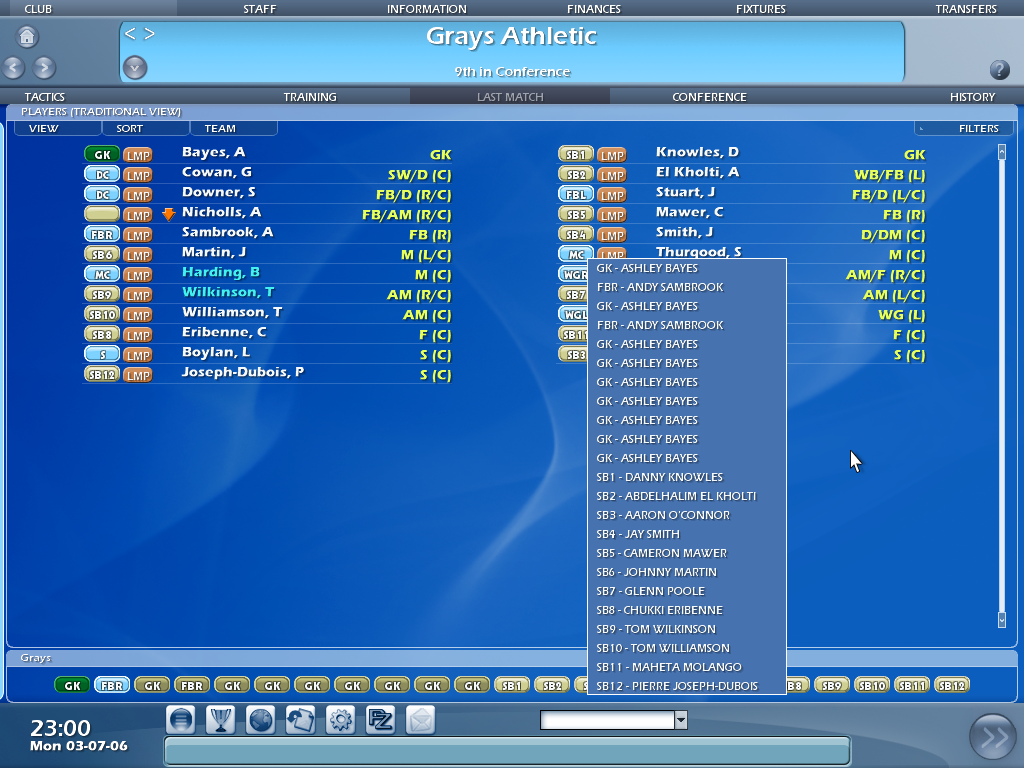
I lasted 20 minutes before I had to stop. Basically, there was a game-breaking UI bug that filled nine of the positions in my starting line-up with the goalkeeper (and two with my right-back). This made even basic squad selection a laborious process, so my only choice was to reset and quick pick my team before every single match – and that just wouldn’t cut it for me.
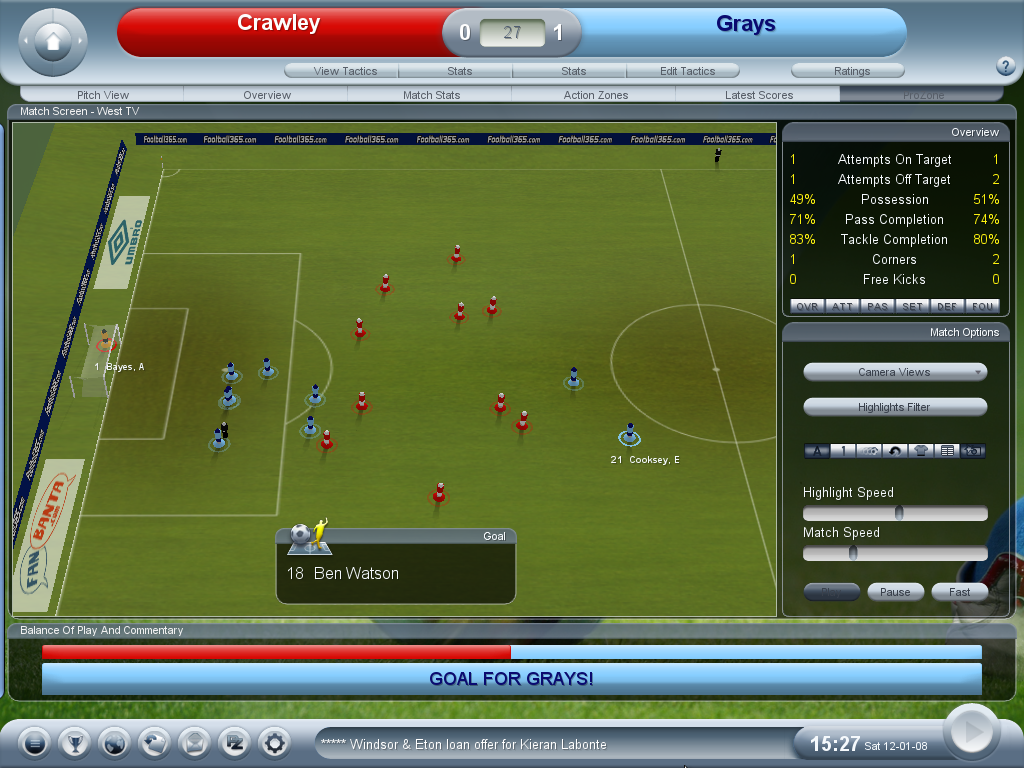
There’s only nine Ashley Bayes…es.
So instead, I’m going to play Championship Manager 2008. We’re in the 2007/2008 season, where José Mourinho has just had his triennial nervous breakdown at Chelsea, and Steve McClaren is about to become a national laughing stock. Meanwhile, my relationship with SI has hit its lowest ebb – one which would not be surpassed for another 18 years.
I really did not enjoy Football Manager 2008. Just like its predecessor Football Manager 2007, FM08 was incredibly unstable, with my saves frequently corrupting before I could complete a single season. In fact, it was such an awful experience that it put me off playing Football Manager again until 2011.
In hindsight, should I have bought Championship Manager 2008 instead? Let’s find out, shall we?
STARTING OUT
Cheers, Jamie.
CM08 allows you to load up to 64 leagues in 27 nations, with the English pyramid going as far down as the Conference North/South. If you don’t want to have every league playable, you can just select the leagues you want and then (optionally) have the remaining leagues simulated in the background.
You also have a limited number of preferences that you can change to improve your experience. The game rates player attributes on a 1-100 scale by default, though you can change this to 1-20 if you wish.
When adding your manager to a club, you can tick an option to be a “Club Benefactor”, thus giving yourself a larger transfer budget to play with. As tempting as it was to pump a load of oil money into Grays Athletic in the Conference National, I had to resist. After all, why spend millions on Robinho when I can just bring in future Sutton United legend Bedsenté Gomis on a free transfer instead?
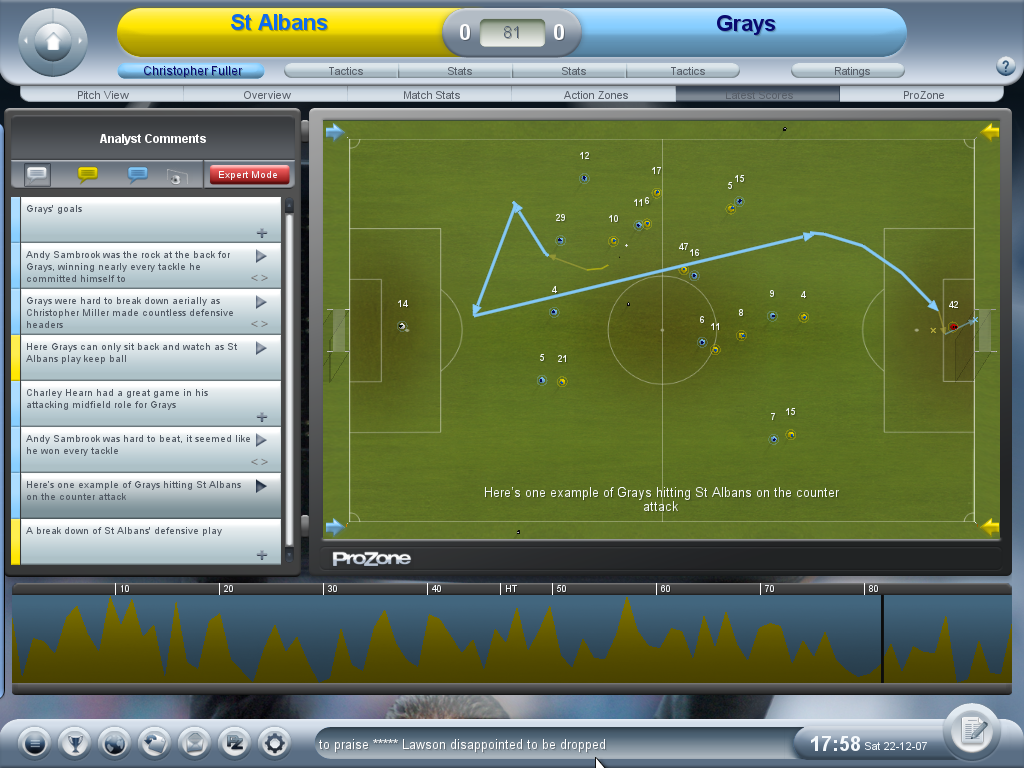
One new feature that BGS liked to make a big deal about was its Prozone analysis tool, giving feedback on how your players performed in a match. Back in 2007, Prozone was still considered groundbreaking technology – but on CM08, it is about as insightful and informative as Jamie Redknapp. You can probably just ignore it.
If you have played Championship Manager before (either the SI original or the later BGS versions), setting up a tactic is pretty straightforward. Just be aware that you will have to confirm any tactical changes you’ve made before you can change your starting line-up, even if you’ve only tweaked a single role or instruction. This can get a little annoying after a while.
WHAT I LIKED
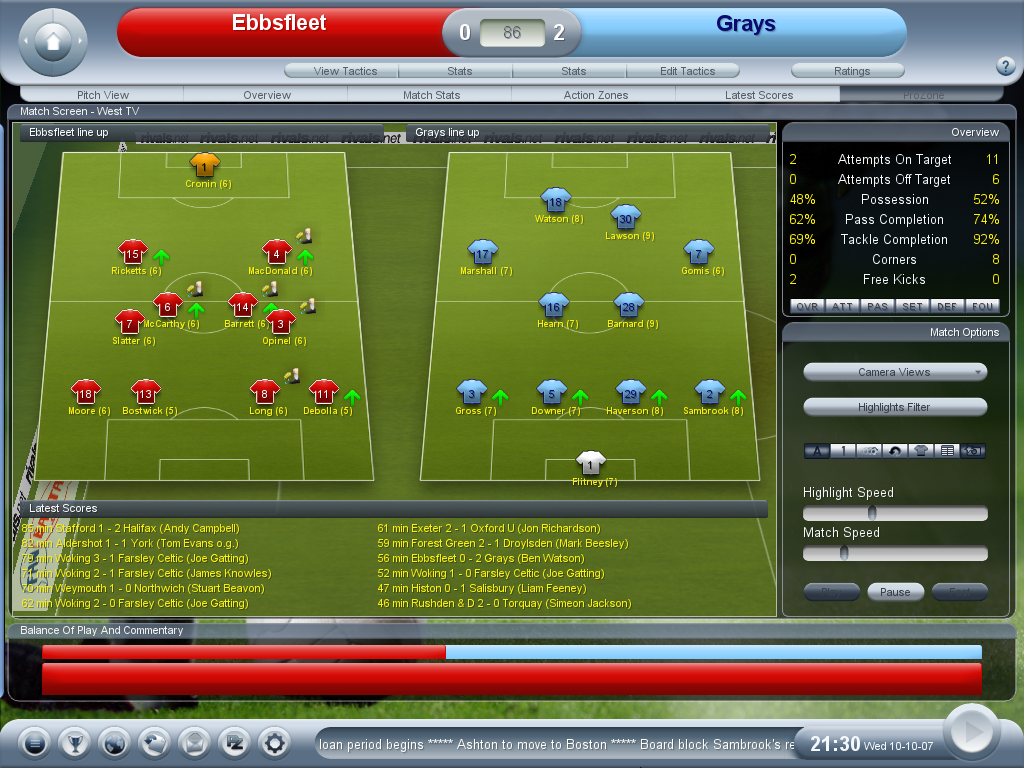
Ladies and gentlemen, Ebbsfleet will be playing 2-2-f***ing-4.
Well, for one thing, CM08 was much more stable than FM08 – at least from my experience. I never encountered any crashes or corrupted saves throughout this review.
The match engine looks pretty decent for its time. The 3D engine is obviously not as pretty as CM10’s – the players are represented by peg-like characters with bobbing heads – but it’s also not as frustrating to watch. Whenever players make mistakes or produce moments of magic, they feel more natural than it did on CM10, where basically every match felt like a Sunday League game.
AI managers also seem a fair bit smarter – and more tactically flexible. Admittedly, this flexibility can get a bit overboard. I’ve seen opposition managers go for an all-out attacking 2-2-4 when chasing a game, or switching to an impenetrable 5-4-1 when seeing a lead out. Of course, my simple 4-4-2 was usually enough to beat most teams, even if my wingers tended to get worse ratings than a James Blunt album.
I also like the visual indicators that show you when your players are high or low on confidence, or when they’re struggling for fitness. If you see the magic sponge next to a player, get them off ASAP. They’re knackered.
Another neat feature I like is that you can customise exactly which highlights you see. This is particularly handy if – for some reason – you don’t want to watch any goals but are obsessed with seeing each of your opponents’ free-kicks. You can even set different speeds for highlights and the matches themselves.
WHAT I DIDN’T LIKE
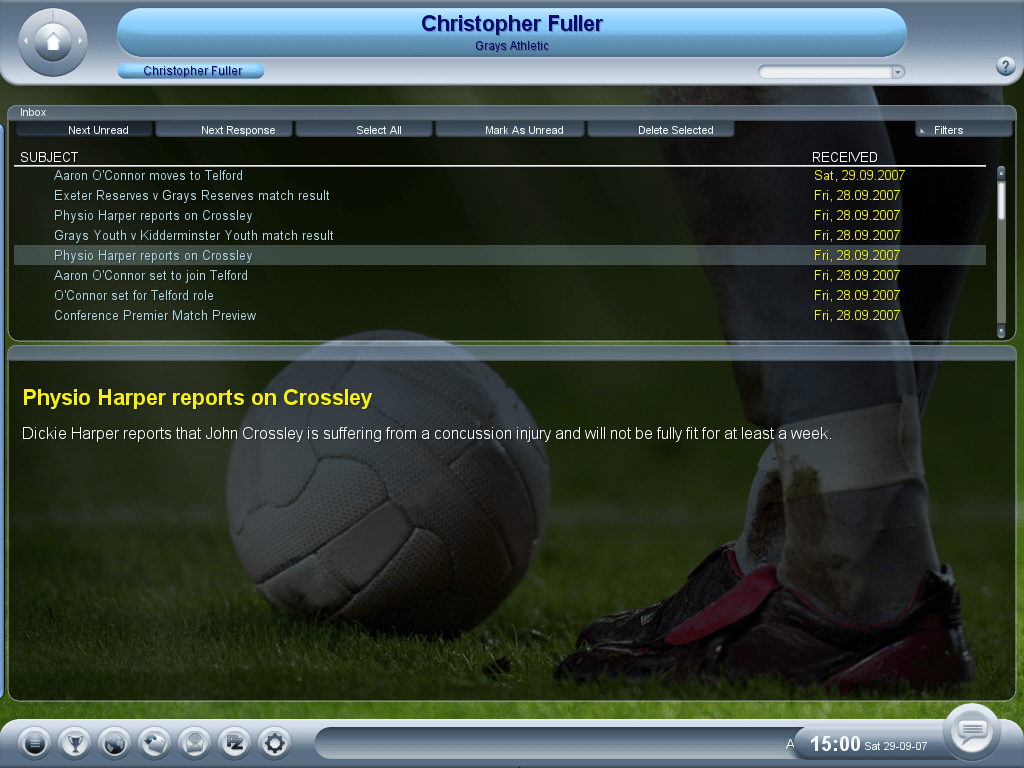
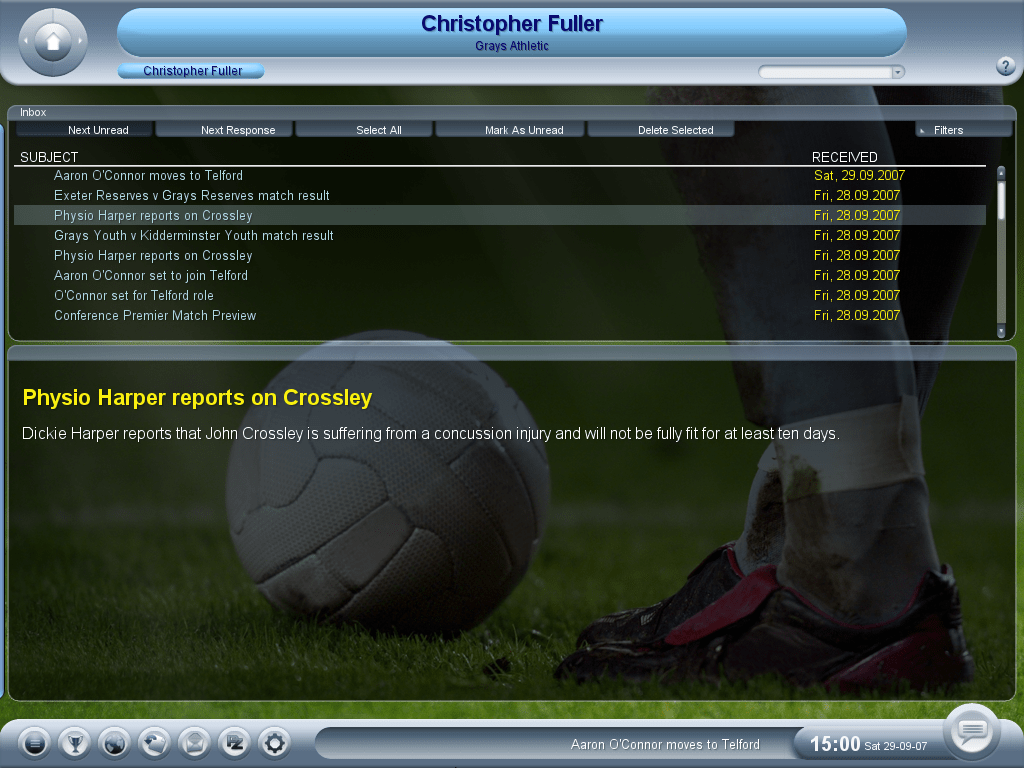
Just letting you know that John Crossley has concussion.Just letting you know that John Crossley has concussion.
It’s one thing having a user interface that is basic and simple to use. It’s another thing having a UI that looks basic and simple. CM08’s UI looks basic.
For one thing, it uses the Arial font (which I call the “Wonderwall” of typefaces, in that it’s an undeniable classic that has been gradually ruined by ubiquity). This only adds to my feeling that I could probably knock up something like this on Microsoft Paint in half an hour.
But in practice, what should be an intuitive interface is undermined by buttons that either don’t make it clear what they represent… or that are so small and blend into the background so well that it’s very easy to miss them. I’m not exaggerating when I say that it took me five minutes just to find the option to edit my tactics during a match!
Squad-building is a bit of a faff, which isn’t helped by the fact your scouts can only scout one player at a time. I had to resort to taking a load of random free agents on trial and hoping that at least some of them would be good enough and cheap enough. This started to feel like an exploit when I found a former Austria international who was happy to join Grays on just £100 per week (sadly, I couldn’t sign him because I was over my wage budget).
There’s also the usual array of annoying little things that add up to a generally odd experience. Stuff like the same player getting concussed twice in one day, or Cambridge United appointing some random bloke from the Netherlands Antilles as their new manager.
One particularly silly bug I encountered quite often was that some substitutions I made at half-time wouldn’t actually go through. If that bug sounds familiar, it’s probably because that was also a pretty common issue with Football Manager 26. Funny, that.
Even worse was when my Grays team beat Exeter in the Conference Premier Play-Off Final to secure promotion. The game barely even noticed the achievement. There were no post-match celebrations, and only a simple message from the club’s board saying “well done for beating Exeter”. I couldn’t help but feel a bit short-changed.
WE MUST TALK ABOUT…
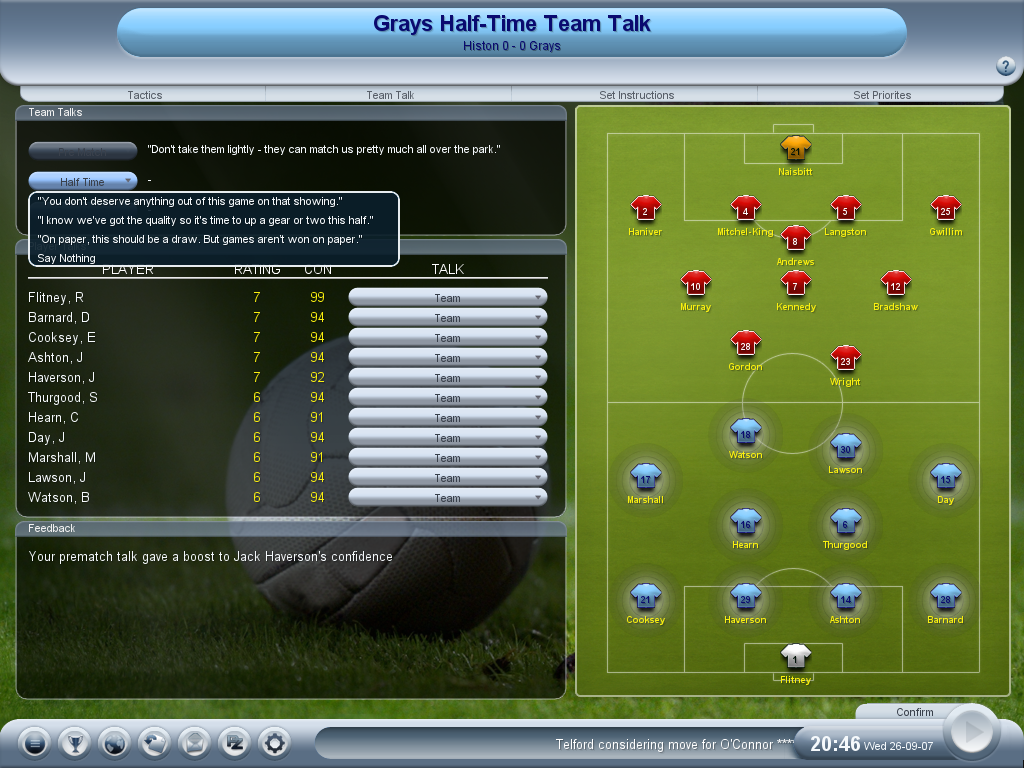
These team talks are about as inspiring as John Sitton.
Team talks. Yeah. I’m gonna talk about team talks.
Whether it’s at kick-off, half-time or full-time, you are only given a narrow choice of team talks, which usually follow this formula:
Option 1:“You’re all disgraces and your mothers should be ashamed of you.” Option 2:“Good luck.” / “You can win this.” / “Good effort.” Option 3: Same as Option 2, but with different words. Option 4: Say nothing.
Some options don’t even make sense. “On paper, this should be a draw. But games aren’t won on paper,” reads like Alan Partridge trying to be Ron Manager.
Individual player talks basically boil down to “You are terrible”, “You are great” and “You are alright”. A bit more variety here would be appreciated.
It’s at least reassuring that different personalities can react differently to the same talks. Some of my players responded better to sympathetic or encouraging messages, while others needed firing up. I can get a good sense of all the different characters in my squad, which isn’t always the case in football management games.
SUMMARY
You see, that’s the problem with Crawley’s defence. They only have one Ashley Bayes.
Championship Manager 2008 was a very frustrating game to play at times – and it wasn’t just down to the messy UI, either. My Gray team would switch from being utterly unbeatable for one month, to being borderline useless for the next month, and then back again just in time to win the play-offs.
And yet, on balance, I actually found this to be a better game than Championship Manager 2010. The match experience feels smoother and more fluid, and the game itself strikes a pretty good balance between simplicity and realism.
So this, then, was perhaps the pinnacle of latter-day Championship Manager. That’s not saying much, but it’s praise all the same.
FULLER FM RATING: 2.5* – Football League.
Thank you for reading this retro review. There are a couple of newer football games that I will be checking out over the coming weeks, so stay tuned for more reviews soon.
In the meantime, if there are any other football management games you’d like me to check out in the future, you can contact me on Threads or Bluesky.
Here we go again with another Retro Review on Fuller FM – and it’s time for something a bit different.
In the past, I’ve tended to focus strictly on football management games. Nowadays, however, I’m much happier to broaden my horizons and cover any football-related PC game that catches my eye. (This does not include action games where you control the players, so no FIFA or Pro Evolution Soccer reviews. Sorry.)
The game I’m going to discuss today is the reason why I’ve decided to relax the rules the little bit. It’s not really a management game, but its unique card-based gameplay had me hooked for weeks when I was a teenager. And while it was a fairly popular freeware game when it was originally released in the mid-2000s, it now seems to have been largely forgotten.
Well… it’s time to change that! It’s time to (re)introduce you to the pleasure of SoccerCards!
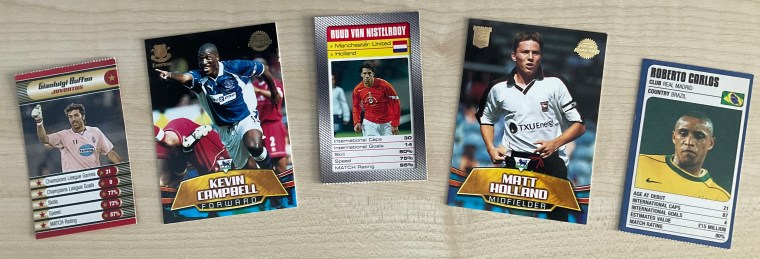
No, you idiot. I’m not talking about those!
BACKGROUND
There are plenty of football-related card games out there. But a football card game that you can play on PC? Now that’s a rarer kind of beast.
In 1992, a fella named Stephen Corry wrote a game for the Commodore Amiga titled Soccer Cards: FA Cup Championship. As the name suggests, this was a game where you would try to win the FA Cup – with each cup tie being determined by you and your opponents randomly drawing cards. Some cards would award a goal, some would not, and one card would end the game immediately.
The Amiga was a fair bit before my time, so I never played the original Soccer Cards. One person who did was Mike Douglas, who was disappointed that the game was entirely based on luck. Around a decade later, while he was at university, Douglas developed his own version of the game – one that would require at least some skill to beat.
And so, in 2003, Douglas released SoccerCards (or Soccer Cards; the space between the words appears to be optional) as freeware on his website at manwithnomouth.nildram.co.uk . Sadly, the URL is now dead but you can still access an old version via the Wayback Machine.
This was one of the many freeware or shareware football games that I tried during my early days on the interwebs. It was also one of the elite few – including Championship Soccer and Simsoc 6 – that I enjoyed enough to stick with.
Douglas later released a EuroCards spin-off for Euro 2004 before starting work on a sequel – SoccerCards 2, which came out in 2005. That was more in-depth than the original, but it was slower, less stable, and generally much less enjoyable. I also can’t find that version anywhere online anymore, so we’re sticking with SoccerCards 1 today.
Though the SoccerCards project now appears to be dead, you can still download the game via this link. (I’ve also provided an alternative download here.) You’ll also be delighted to read that the game still runs perfectly on modern operating systems!
STARTING OUT
Dagnabbit.
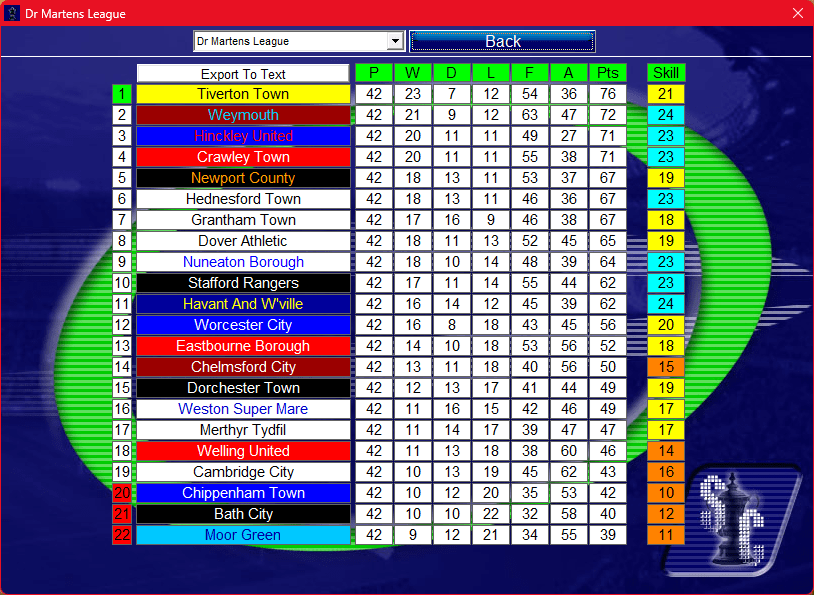
SoccerCards is set in the 2003/2004 English football season. You can play as a team in any of the top five leagues, from the Premier League to the Conference. In fact, you can even go all the way down to the Ryman League, the Dr Martens League or the Unibond League – which were the three regional feeder leagues to the Conference at the time.
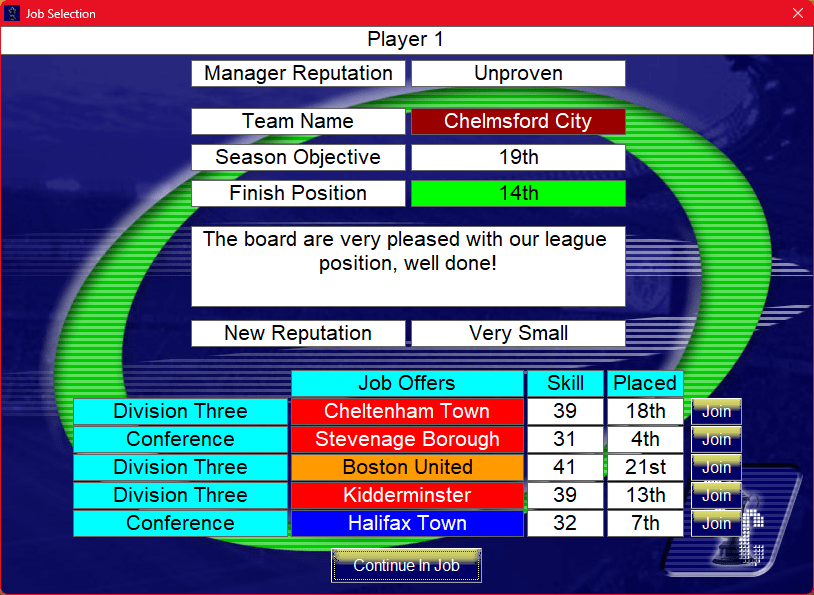
There are two career modes to choose from. “Career With Club Selection” will let you pick any club you want – even in the Premier League. “Soccer Cards Career Challenge” will randomly pick one of the worst teams in the regional leagues and then send you straight over there. Tonight, Matthew, I’m going to be managing Chelmsford City in the Dr Martens League.
Your goal from here is either to gradually build your team up through the leagues, or progress your career by jumping from club to club. At the end of every season, you may receive some job offers, depending on how you’ve performed. You’ll then have the option to either stick with your original club or jump ship for a new challenge – perhaps in a higher league.
Each team in the pyramid has a skill rating between 10 and 100, which affects their chances of scoring chances and keeping possession in matches. Higher-rated teams are more likely to play well against lower-rated teams, so Chelmsford (who start with a skill rating of 12) would probably struggle to beat Manchester United (skill rating 98).
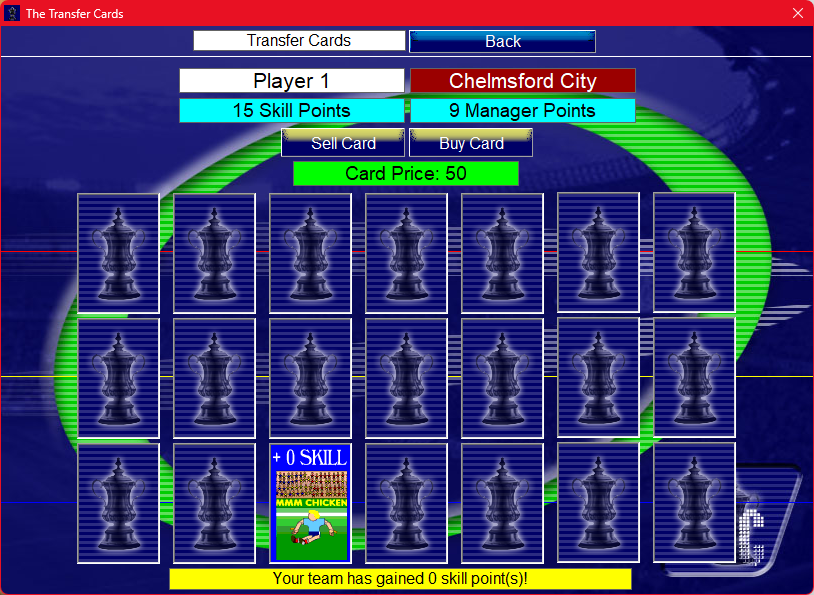
As you play matches and progress your career, you will earn manager points. You can spend these on the ‘Transfer Cards’ section, where you can make a transfer (pick a card at random) for the chance to improve your club’s skill rating. A lucky pull will earn you 1, 2 or even 3 skill points – but most cards will earn you nothing at all! It’s a gamble, but that’s the whole fun of it.
WHAT I LIKED (THE GAMEPLAY)
Sometimes, the cards go in your favour…
Oh… yeah. I should probably explain how the bloody game works now, shouldn’t I?
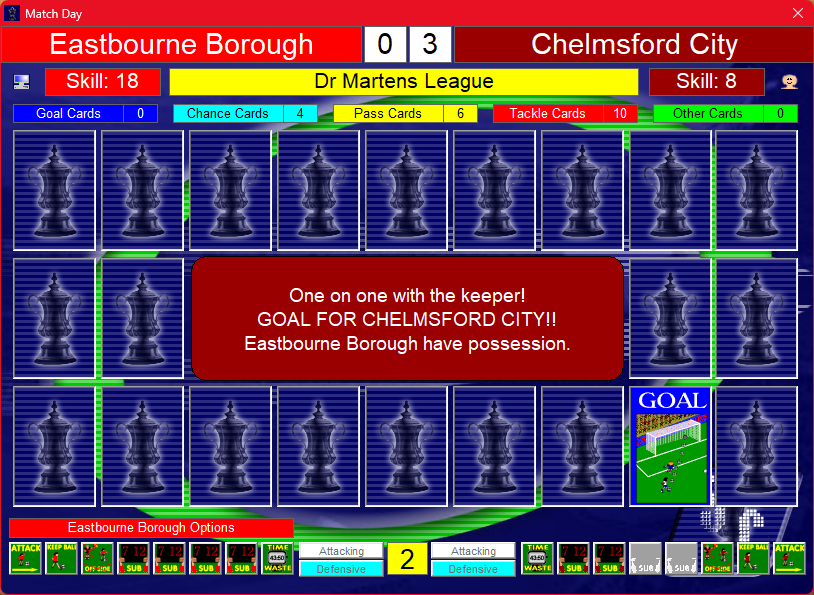
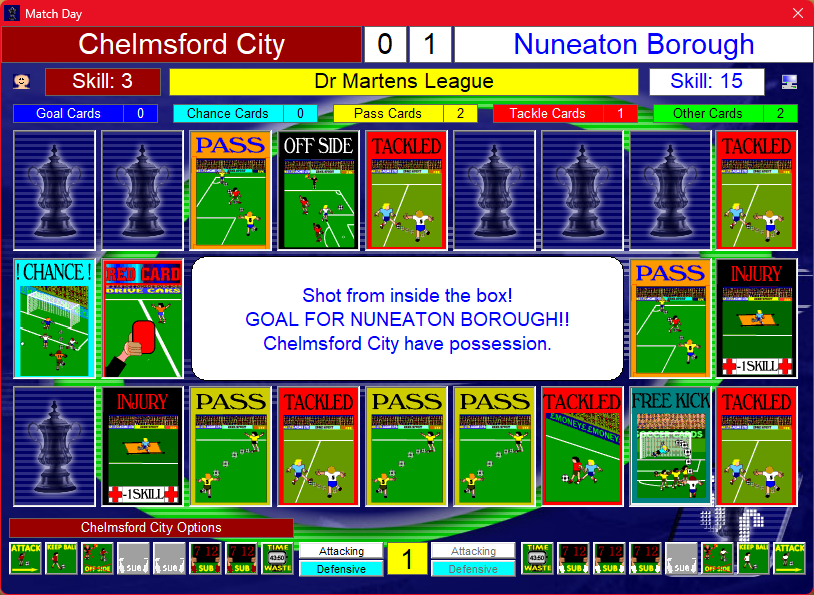
The rules take a little explaining, but basically, 22 cards are laid down at random before each half. When you have possession (i.e. it’s your turn), you can pick one card at a time to reveal it. Each card will have a different impact on the match, and it will also end with you either retaining possession for another turn, or giving your opponent the chance to pick a card themselves.
Selecting a GOAL card will guarantee you a goal, while a CHANCE card will give you a chance to score (depending on your team’s skill level, the quality of the chance, and your tactics). The OFFSIDE card will lose you possession immediately in most cases. If you pick a PENALTY card, you will play a penalty mini-game for the opportunity to score another goal. More on that later.
A PASS card will usually retain possession for another turn, though it can be intercepted. Likewise, a TACKLE card typically results in your team losing possession, though there is still a chance to retain the ball or win a foul.
The worst cards to pick are INJURY and RED CARD, which will cost you skill points and substitutions, thus weakening your team. Picking the END OF HALF card will end the half immediately, even if there are still several cards that haven’t yet been selected.
There are also tactical options you can use to try and weight the odds in your favour. For example, you can select either an Attacking or Defensive mentality. Selecting Attacking means you are more likely to you score chances, but also more likely to lose possession and be vulnerable to counter-attacks. On the flip side, going Defensive will reduce your odds of scoring chances, but you are more likely to keep possession.
You can make up to four Substitutions per match. If you use a sub on an Attacking mentality, you replace a random TACKLE card with a CHANCE card. The reverse happens with Defensive substitutions.
Other options allow you to Keep Possession (guarantees you keep possession for another turn, even if you’d normally lose it), go All Out Attacking (massively increases your chances of turning a chance into a goal), or Play For Time (replaces a random hidden card with an extra END OF HALF card). You can also Break The Offside Trap, which also increases your odds of scoring on the next turn – and if you pick an OFFSIDE card next, that automatically turns into a goal!
Higher-skilled teams will win more often, and major upsets are unlikely… but they are possible. When I first played SoccerCards almost two decades ago, my all-conquering Millwall team went through to an FA Cup Final against Division 3 minnows Mansfield Town. I replayed the match ten times until Mansfield finally beat us (on penalties) to win the FA Cup and qualify for Europe. What do you mean “match-fixing”?
WHAT I DIDN’T LIKE
…and sometimes, they don’t.
Though there is some strategy involved in SoccerCards, it is still essentially a game of chance. Don’t expect to win every game.
Sometimes, Lady Luck will swing your way, and you can score twice on the same possession or get an unexpected victory against much stronger opposition. Other times, you’ll pick up two red cards and an injury – cripping your team’s skill rating and effectively costing you a winnable match.
It’s also possible that you can pick the END OF HALF card with the very first turn of each half – resulting in the most boring goalless draw you’ve ever seen since George Graham was in his pomp!
There also isn’t much playability beyond the English leagues. Though you can play a standalone club or international tournament, there are no other playable leagues in SoccerCards. There is a pre-game editor, but it’s very basic and can’t really be used to create new leagues.
The non-English teams in European competitions are pretty static as well. For example, because Barcelona were not particularly good in 2003, they will only ever play in the UEFA Cup on SoccerCards. You’ll never see them in the Champions League.
WE MUST TALK ABOUT…
Keep in the green and out of the red. Nothing in this game for two in a bed.
Penalties. How do they work?
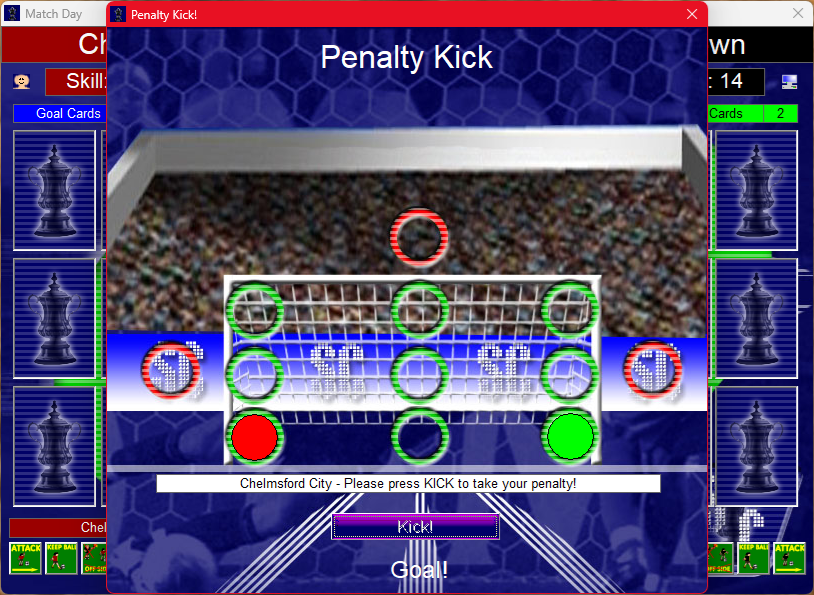
A pop-up flashes up on screen, with nine green targets inside a goal and three red targets outside of it. Each target then quickly lights up one by one until you click the “Kick!” or “Save!” button, depending on whether you’re taking or defending the penalty.
When you’re taking the penalty, your aim is to press “Kick!” when one of the green targets is flashing to score. Hit a red target, and you miss the penalty! However, one of the green targets will be lit up in red. If you press the button when that target is lighting up, the opposition will save the penalty.
When you’re saving the penalty, one of the targets will be highlighted to show you where the opponent has taken it. If it’s red, they miss the penalty and you don’t have to do anything else. If it’s green, you must press “Save!” when your flashing target is over the same target, so that you can make a save. There’s an 88% chance you’ll get it wrong and concede the penalty, but who knows – maybe you’ll get lucky.
SUMMARY
Chelmsford survive…and now I’m gonna bugger off to Stevenage!
I really enjoyed playing SoccerCards as a teenager, and that feeling is still there even today. Okay, so it’s not your typical football game, and results do often depend more on luck than skill, but it’s pretty simple to learn and difficult to master. You can easily complete a full season within an hour or so.
Though SoccerCards is still very playable on Windows 10/11, it’s a shame that nobody has yet developed a modern remake. I get the feeling that a card-based game like this would play especially well on mobile devices. So if there are any budding developers reading this, perhaps it’s time to give us a new version of Balatro – with balls.
FULLER FM RATING: 3.5* – Premier League.
Thanks for reading. Feel free to give SoccerCards a try yourself, and let me know your thoughts by leaving a comment below. You can also find me on Threads and BlueSky.
After the longest wait, Football Manager 26 is finally here… but is it any good?
That’s a question many people have already answered with an emphatic “no”. FM26 came out on 4 November to unprecedentedly negative reviews on Steam, with a 27% approval rating as I write this. Even the professional gaming critics who consistently heap praise on FM have been much more divided this time around.
So it was with some trepidation – and a little excitement – that I installed the FM26 demo to try out the new game for the first time. I’ve spent half a season managing Walsall in EFL League Two, while also dabbling around with Arsenal in the Women’s Super League.
Is FM26 a massive step forward that will bring the game to a wider audience? Is it a raging dumpster fire that risks the entire future of the Football Manager franchise? Or is the answer somewhere in between? Here are my thoughts…Continue reading “My thoughts on Football Manager 26”→
It’s the game everyone has been talking about in recent weeks… and, oh boy, hasn’t it been divisive?
An experienced team of British developers have been working on their latest football management simulation for years – and the reception has been quite mixed. Some people think the new graphics engine is a huge step forward. Others think the devs have completely sold out to the mobile market, and that they only want to grab your money instead of giving you the full managerial experience.
Well, folks. I’m sure you’ve been waiting to read my opinions on this… so here they are.
I moved into my new home one year ago today… and what better way to celebrate my first anniversary at New Fuller FM HQ, than with another of my Retro Reviews?
As a computer nerd with a particular fondness for the 90s, I enjoy revisiting old football management games and seeing if they can still hold up today. The game I’ll be looking at today has been on my shortlist of a very long time, so I’m excited to finally tick it off.
It’s time for another retro review of a football management game from years gone by. This one’s a bit obscure… but if you know it, you KNOW it.
The late 1990s was a golden age for independent shareware or freeware games – titles often made by nerdy (and usually amateur) programmers in their homes rather than by big studios. They might not have had as much substance or polish as those expensive major releases, but they could still be enjoyed by early online gamers for little or no cost.
Today, I’m looking at a freeware Windows game that I would describe as “an entry-level Championship Manager”. If you want a less intense experience than CM or Football Manager, with a healthy dose of nostalgia, this might be just what you’re after.
It’s March 2025, and after months of eager anticipation, FM25 has finally been released to the public! Well… kind of.
Of course, Football Manager 25 is dead and buried, leaving a huge gap in the market for this season. Could that gap be filled by one of Sports Interactive’s old rivals?
Although EA Sports’ FIFA Manager series was officially cancelled in 2013, the franchise has been kept alive by a devoted community of fans and creators who have been making their own updated databases for the past decade. So today, I will be checking out the 2024/2025 “season update” to see if it’s a worthy replacement for FM25.
We might have to wait until next season for a new Football Manager, but that doesn’t mean there’s a shortage of football games on the Steam storefront.
A few weeks ago, I looked at a bare-bones Championship Manager clone that didn’t stray too far from the standard formula. The game I’ll be reviewing today is… well, let’s just say it’s VERY different.
For this Retro Review, I’m going back to the year 2013 (i.e. the last time Manchester United were any good) to find out what happened when some Italians decided to make their own FM… with blackjack, and hookers. Literally.







 Fuller FM
You must be logged in to post a comment.