

In 2021, Sports Interactive announced that they were planning to incorporate women’s football into the Football Manager series.
After four years of extensive research and development, those plans will finally become reality on Football Manager 26. Last week saw SI reveal the first major details of what we can expect from women’s football on FM26, including which leagues will be playable.
Having first discussed this topic after SI’s original announcement, I think it’s time for me to jump back in and discuss what we know so far. I will also try to answer any other questions the FM community might have – some of which are sincere, some of which are… less so.
A LEAGUE (OR 14) OF THEIR OWN
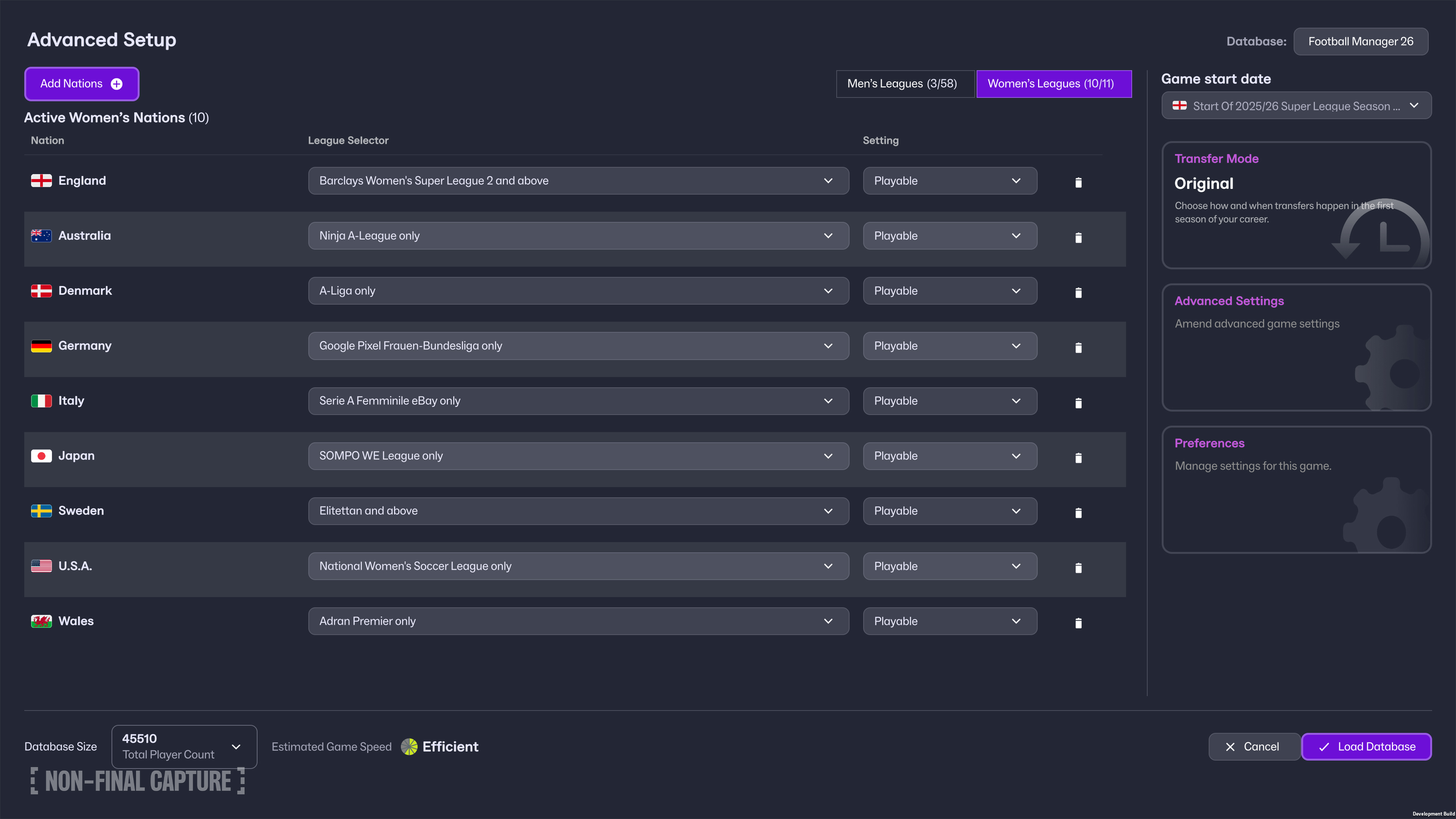
We now have a much clearer idea of how extensive the new women’s football database in FM is. A dedicated team of 40 researchers have collected data for around 40,000 players – and there will be 14 playable leagues in 11 nations.
In England, both the Women’s Super League and Women’s Super League 2 will be playable, with 24 professional clubs to choose from. You can also manage in the top two tiers in Sweden (which has had an established women’s league since the 1970s) and Spain.
Denmark, France, Germany, Italy and Wales also have playable leagues, though only the first divisions are covered. Three leagues outside of Europe are represented; these are the A-League in Australia, the WE League in Japan, and the National Women’s Soccer League in the United States.
I’m sure eyebrows were raised when they saw Wales on the list. By most accounts, the standard of the Adran Premier is quite low, even if Cardiff City, Swansea City and Wrexham all have teams there. People might speculate about the influence of Snoop Dogg and Ryan Reynolds, but credit must surely go to the incredible work done by the head researcher in Cymru.
Surprisingly, the Scottish Women’s Premier League is NOT on the list, even though it is increasingly popular (and competitive, with four different champions in the last four seasons). The Dutch and Portuguese leagues are improving too, and Norway has historically been a women’s football powerhouse, but they will all have to wait for their official FM debuts.
From a purely selfish perspective, I’m a little disappointed that you can’t manage below the top two tiers yet. I live in Telford, where Wolverhampton Wanderers (who play in the third-tier Women’s National League North) are based, so I would have liked the chance to manage them. Of course, there’s still the chance Wolves can be promoted to WSL2 in-game.

But as far as a first-year database goes, this is still pretty extensive. For context, EA Sports added women’s national teams to their FIFA series on FIFA 16, but they didn’t include any women’s leagues until seven years later – on FIFA 23. Even then, they originally only included the top flights in England and France.
SI were never going down the EA route of simply doing the bare minimum to cater for women’s football fans. FM’s database of female players is already TWICE the size of the ENTIRE player database on EA Sports FC 26… and it’s only going to get bigger and better over the coming years.
SAME SPORT, DIFFERENT GAME
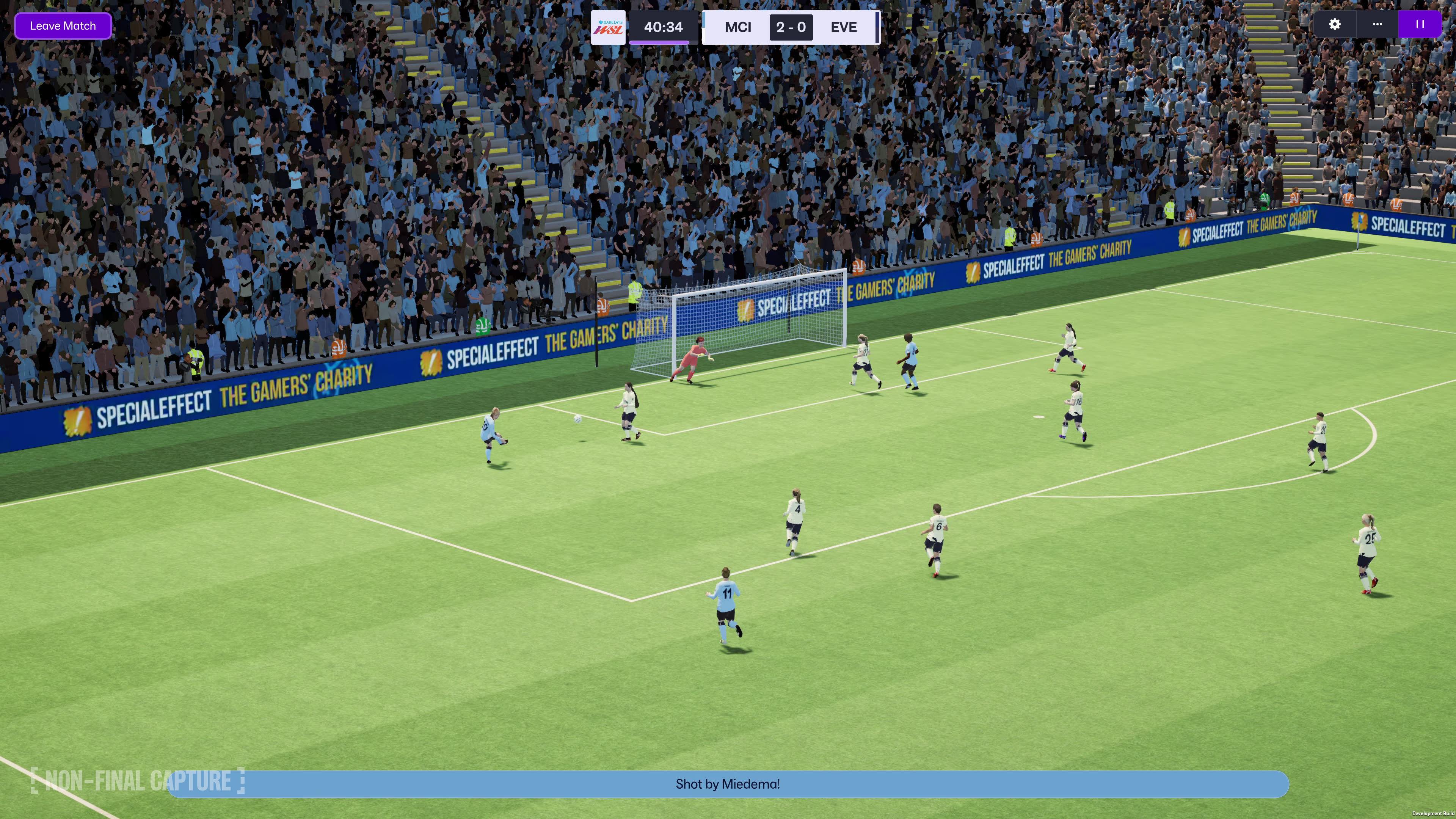
Some people might assume that incorporating women’s football to FM would just be a case of adding new leagues, changing pronouns, and giving more players ponytails. Of course, it was never going to be that simple.
For starters, the graphics engine needed new motion-captured animations that would reflect how female athletes move when they play football. As Miles Jacobson stated when he first announced SI’s plans for women’s football in FM, applying their existing male footballer animations onto female bodies would make them appear to “move like cowboys”.
SI have also needed to adapt their match engine for the women’s game. I would assume this means the most technically accomplished players stand out more from their peers than they would in the men’s game, and that the pace of the game might be a little slower. Likewise, a 6ft colossus like Wendie Renard or (ahem) Fran Kirby would be tall enough to an effective goalscoring weapon at set-pieces.
There will also be changes to the frequency of certain injuries in the women’s game. Female footballers are more prone to long-term cruciate ligament injuries than their male counterparts – something that, as an Arsenal fan, I know all too well.
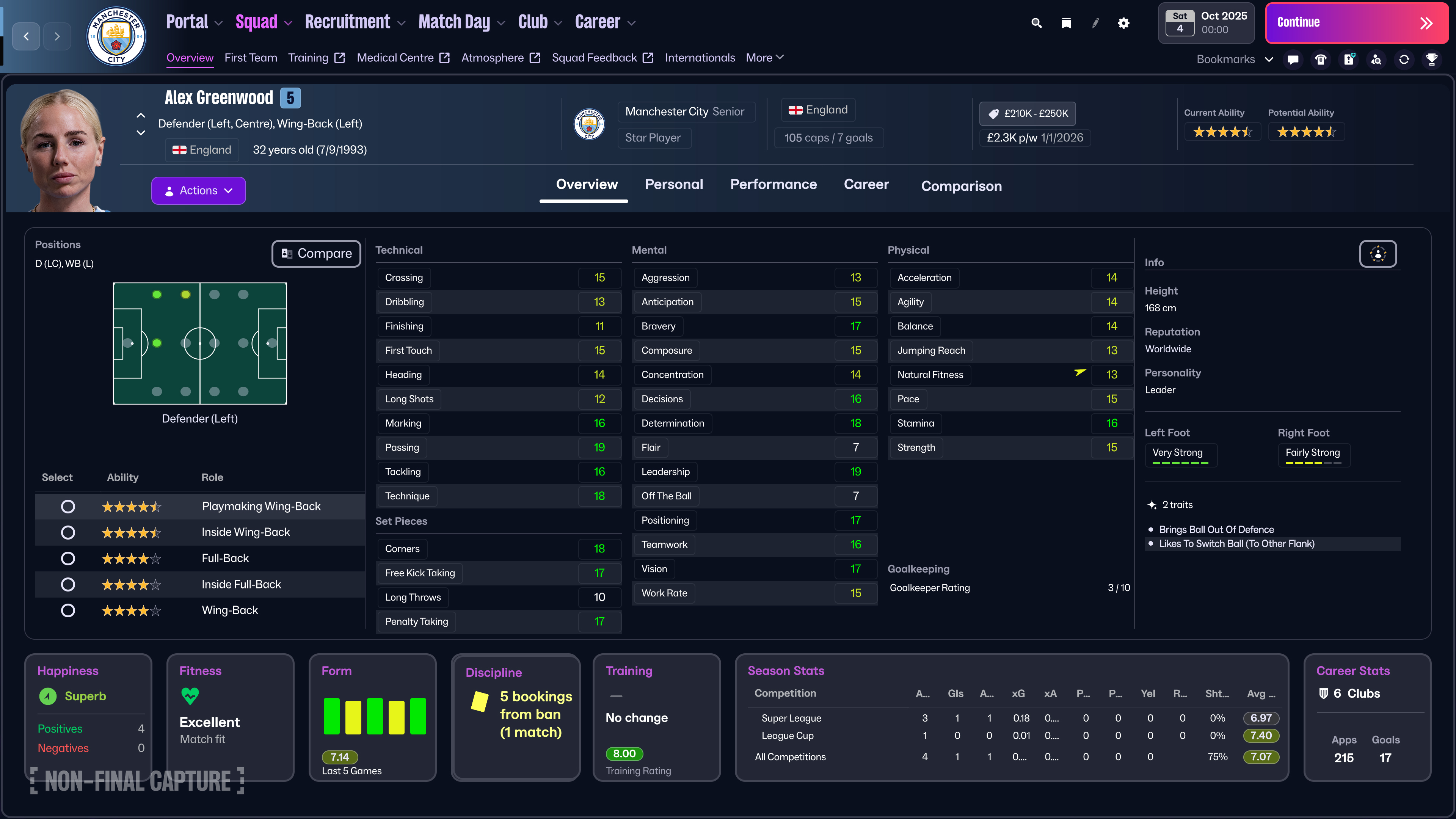
In terms of attributes, female players are rated on a 20-point scale – just like the men are – but this scale is relative to other female footballers. As such, a female player with 20 Pace would be the fastest that a player in the women’s game can be, though she would probably not be as fast as Micky van de Ven.
As you cannot pit a men’s team against a women’s team on FM26, you should NOT be comparing a male footballer with a female footballer. I’m sure some knuckleheads will still go, “Alex Greenwood is a better left-back than Alphonso Davies! That doesn’t make sense! Wrarghhh!” without understanding the context.
Some other people will ask, “Why can’t women play against men? They do it on EA FC.” Yes, they do, but Ultimate Team is a pure fantasy mode where you can have a front three of Diego Maradona, Kylian Mbappé and Sam Kerr, and nobody with half a brain cell would bat an eyelid. FM is a simulation, and competitive matches between genders are not realistic.
Female players are also likely to be more versatile and capable of slotting into various different positions. One example would be Aston Villa’s Rachel Daly, who plays as a striker but is also an accomplished left-back.
Financially, managing in the WSL will feel a world away from the gargantuan riches of the Premier League. It was only this summer that we saw the first £1million transfers in the women’s game – and going off the screenshots we’ve seen so far, Manchester City’s top players only earn around £2,000 to £3,000 per week.
Players will often be on shorter contracts too – not even Chelsea can get Naomi Girma on an eight-year deal just yet. As such, scouring the transfer market for players with expiring contracts could be even more fruitful. I suspect a lot of FMers will be trying to snare Alexia Putellas from Barcelona towards the end of the first season.
This is just speculation, but perhaps SI have included some mechanics that will see more money gradually flow into the women’s game as a save game progresses? Bigger sponsorship deals for the clubs, better money for the players, and longer contracts too. That would be great.
THE MANAGERESS
There are also changes to how managers and other backroom staff work in Football Manager. Some will work exclusively in men’s OR women’s football, while others would happy work on either side of the divide.
Take, for example, Emma Hayes – the current head coach of the USA women’s national team. Hayes has been a manager in the FM database since Football Manager 2019, frequently taking jobs in the English Football League across many of my previous saves.
But realistically, many of us suspected that Hayes would never walk out on an all-conquering Chelsea team in the WSL just to go and manage Lincoln City in League One. Indeed, she has stated that calls for her to take a job in men’s football are “patronising”, so it’s safe to assume she will stay at the top end of the women’s game.
The same goes for the top male managers. It would be very odd if Jürgen Klopp and Pep Guardiola renewed their PL rivalry in the WSL. However, someone like Neil Redfearn (who has managed Leeds United men and Liverpool women) would more readily take a job on either side.
As far as long-term saves are concerned, I hope this means that more female managers – real or newgen – eventually take jobs in men’s professional leagues. It would be cool to see more women follow in the footsteps of Sabrina Wittmann (who currently coaches Ingolstadt in the third tier of German men’s football) and Corinne Diacre (who managed Clermont in Ligue 2 for three seasons).
We can’t yet be sure how much impact reputations will have when managers wish to move between the men’s and women’s games – specifically human managers. Would winning a Women’s Champions League be enough to let you walk into a Premier League job, or would the requirements be stricter? It’s a tough balancing act that SI must try to get right.
WHAT ISN’T IN THE GAME?
One question that some FMers asked when women’s football in FM was first was this: “Can my players get pregnant?” In a recent interview with The Athletic, Jacobson explained why pregnancy WILL NOT be on FM26.
“There have been a lot of difficult debates we’ve had on different things, such as how we deal with pregnancy and the menstrual cycle. We don’t have those in the game because we wanted to keep it relatively simple for this year, but those are things that have to come long-term.
“Whether those are for real players or generated players within the game, we need to talk to lawyers about the way people are represented. But I’m also looking forward to a new army of people telling us what they want to see in the game.”
Which is fair enough. And as someone whose body has never had to deal with pregnancy or periods, it is not really for me to speculate on whether these real-life experiences should be on Football Manager. That is a question best posed to the female footballers who are being represented on the game.
International management was removed from Football Manager 25 prior to its cancellation, with the hope that it would be reinstated in the future. Sadly, given what we know so far, it’s probably safe to assume that it won’t be on FM26 either.
Just to clarify: international football has NOT been removed. Players can still be called up to their national teams, and there will still be international tournaments. You just won’t be able to manage those national teams at those international tournaments.
If that is true, then it will be a huge let-down. Unlike in the men’s game, international football is still regarded as the pinnacle of the women’s game. A casual football fan in England might be able to name most of the Lionesses who won Euro 2025, but they perhaps might not know which clubs they play for.
To me, adding women’s football to FM with no ability to manage a national team would be like if EA released a Madden NFL game that didn’t let you play in the Super Bowl. It just doesn’t feel like the complete experience. We can only hope that this will be rectified later in FM26’s release cycle – or, at the very least, for Football Manager 27.
ANY OTHER QUESTIONS?
“Do I have to load women’s leagues in my game?”
No. They are completely optional – just like any other league. If you want to manage in Germany, you can load just the men’s Bundesliga or the Frauen-Bundesliga… or, indeed, you can load both.
“I don’t want women’s football in my game because it’ll take up too much processing power. Can I remove it from my game?”
I don’t think you’ll be able to completely remove women’s football from FM26. However, I suspect that if you decide to only load male leagues in your save, then the game would not load in any female players. Therefore, the processing impact this would have on your men-only experience would be minimal.
“Was FM25 cancelled because of women’s football?”
No, it wasn’t. SI incorporating women’s football into FM coincided with them moving the game over to the Unity engine, but they had separate teams working on those. Indeed, SI hired new staff members specifically to work on women’s football; they did not take any resources away from the core game.
FM25 was cancelled because SI encountered several issues when transitioning to Unity – not least that the user interface was apparently in a huge mess.
“Does anybody even care about this? Will anyone want to play in women’s leagues?”
It’s clear that a lot of people do. Women’s football is becoming more mainstream, attendances are on the rise, and more young gamers (especially girls and young women) are wanting to play as and with their heroes.
And if you’re a Football Manager lover, having more leagues to choose from can only be a good thing. We’re also getting new playable men’s leagues in four new nations – with Egypt, Lithuania and Saudi Arabia apparently set to make their debuts this year.
You know what the average attendance in Lithuania’s A Lyga was last season? 554. And the average attendance in the WSL last season? 6,662. But I don’t see people on r/footballmanagergames moaning, “Urgh, nobody cares about Lithuania. What’s the point in adding the Lithuanian league?”
Solipsism is a common trait on the Internet. I don’t like this thing, therefore nobody likes this thing. If only people can snap out of this self-centred mindset and see the bigger picture.
Thanks for reading. If you have any thoughts on women’s football being added to FM26, please leave a comment below – or message me on Threads or Bluesky.
 Fuller FM