

I moved into my new home one year ago today… and what better way to celebrate my first anniversary at New Fuller FM HQ, than with another of my Retro Reviews?
As a computer nerd with a particular fondness for the 90s, I enjoy revisiting old football management games and seeing if they can still hold up today. The game I’ll be looking at today has been on my shortlist of a very long time, so I’m excited to finally tick it off.
I’ll tell you, honestly, I will LOVE IT if we play Premier Manager: Ninety Nine… LOVE IT.
BACKGROUND
Premier Manager used to be one of the UK’s most popular series of football management video games. First published by Gremlin Interactive and developed by Realms of Fantasy in 1992, it would see (more or less) annual releases for the next two decades until its demise in 2012.
I looked back at one of the franchise’s later titles in a previous Retro Review about five years ago. Released in 2009, Premier Manager 10 was an ugly, awful PlayStation port that was at least a decade past its prime. You can still buy it (and several other PM titles from the 2000s) dirt cheap on Steam, but I wouldn’t bother.
To relive Premier Manager’s true heyday, you need to go back to the late 1990s. It was in 1996 that Gremlin passed on development to Dinamic Multimedia – the Madrid-based software house whose PC Fútbol series had been enormously successful in their native Spain.
The franchise was in safe hands… at least for a while. Premier Manager 97 got mostly positive reviews and did quite well successfully, both on PC and consoles. That was followed up over the next two years by a couple of glorified season updates in Premier Manager 98 and Premier Manager: Ninety Nine (don’t ask me why they changed the name).
Gremlin was also developing its own series of Actua Sports action games, which served as a serious rival to EA Sports in the latter half of the 90s. Most notably, between 1995 and 1998, they released three versions of Actua Soccer, which shared some assets with Premier Manager.
Premier Manager drifted out of the spotlight in the new millennium. Gremlin were bought out by Infogrames and then absorbed into Zushi Games, who continued to pump out new annual releases with ever diminishing returns. As for Dinamic, I’m afraid they went bankrupt in 2001 – one of the biggest game developers to go bust in the dot-com crash.
As a young Championship Manager loyalist, I never got to enjoy Premier Manager in its full glory during its peak. But after keeping an eye on eBay for several months, I finally snagged a second-hand copy of PM99 earlier this summer for £2.62.
PM99 was released across Europe in 1999 and was endorsed by the then newly-appointed England manager Kevin Keegan, who was plastered all over the box art. A digitised version of Keegan’s face also appears on the CD case inlay. Football Manager’s newgens won’t look quite so scary when you catch a glimpse of this…

STARTING OUT

When you launch PM99, the start-up menu presents you with three options. The first one is a “Data Base”, which is just a database of player statistics and biographies. It’s actually quite cool, so I’ll write more about that later.
But first, let’s discuss the game modes themselves. “Manager League” gives you the vanilla experience where you can choose any club you wish from the top four tiers of English football and lead them to glory. Once again, I have decided to manage Millwall – a team that no one likes nor cares about.
If you want more of a challenge, you should try “ProManager League”. You will receive job offers from several Division 3 clubs, including Brighton (yes, that’s how long ago this was). Whichever club you start your career at, you’ll need to meet objectives to firstly keep your job, and then eventually get the opportunity to manage a better club in a higher league.
You also have several options to set up your save game exactly how you like it. You can be a ‘trainer’ who focusses on picking the team, an accountant who only takes care of the financial stuff, or you can even have an ‘arcade’ career where the AI takes charge of finances and team selection. If you want complete control over everything, that’s possible too.
All the teams and squads are from the 1998/1999 season, when Keegan was still managing Fulham in Division 2. I’m not sure when exactly PM99 was released; PC Zone magazine reviewed the game in May 1999, but all online sources say it didn’t actually come out until August. If the latter is true, it would have been well out of date when it hit store shelves!
WHAT I LIKED

Players on PM99 are rated on a small number of attributes, which can be easily trained by your coaches (better coaches can train more players at the same time). These attributes are also affected by a player’s fitness and morale. If he barely plays, his morale will suffer and his attributes will go down. He will then need game time to sharpen him up again, so be wary about consistently playing the same starting XI and neglecting your backups.
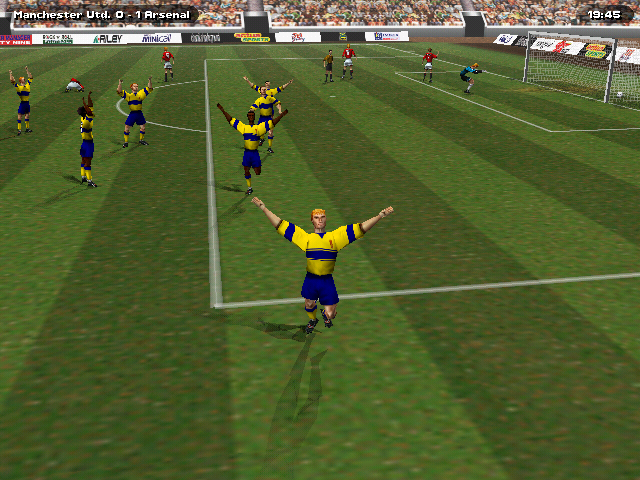
Matches can be watched in 3D, which actually looks pretty decent for its time. The player animations are a bit blocky like in FIFA 98, but they’re surprisingly smooth to watch. Unfortunately, the Windows 98 emulator I mainly played this game on couldn’t generate the pitch or stadium properly, so the teams instead played in a black void in outer space. (My Windows XP laptop, on the other hand, didn’t have these issues.)
My only gripe here is with the commentary, which was indeed lifted from Actua Soccer. Barry Davies was a legendary and much-loved commentator, but I never believed his gentle, headmasterly tones were particularly well-suited to video games. It also feels like PM99 plays some of his soundbites at random, with little regard for what has actually happened in the match.
“Oh brilliant! Absolutely brilliant! That was a breathtaking strike!” Ahem… Barry… the goalkeeper saved it.
The interface as a whole is more visually pleasing than CM’s spreadsheet simulator – with plenty of vibrant colours, snazzy kits, and most of the players having official photos. While barely anything had changed since Premier Manager 97, Dinamic clearly subscribed to the mantra, “If it ain’t broke, don’t fix it”… or whatever the Spanish equivalent is.
I especially like how cup draws are presented like they’re being conducted in a bingo hall, with revolving drum and yellow balls to boot. All the ties flash up on the right side of the screen pretty quickly, with the draw slowing down just before your team (and your future opponents) are drawn out.
So in terms of style and sophistication, Premier Manager was the David Ginola of late-90s football management games. But did it have the substance? Now that’s another matter.
WHAT I DIDN’T

Navigating through PM99 does take some getting used to. Even the apparently simple matter of quitting the game is confusingly hidden away under the “Resign” button. (Don’t worry, clicking “Resign” only takes you back to the start-up menu. Don’t forget to save your game first!)
And aside from the 3D ‘View’ mode, the other match modes don’t inspire me.
‘Results’ just generates an instant result, only pausing at half-time so you can make tactical changes and substitutions. ‘Brief’ at least allows you to watch the match play out in a 2D engine, though you annoyingly have to press the F1 button on your keyboard before you can bring on any subs. ‘Highlights’ is basically the same as ‘Brief’, except that all goals are also shown as 3D replays.
Watching your tactics play out in either 2D or 3D is quite satisfying, though realism is somewhat lacking. Even after setting up the most basic 4-4-2, I found it ludicrously easy to create goals, to the extent that my striker Neil Harris scored 56 goals across the entire season!
Transfers are a slog. Searching for a player in a specific position is almost impossible, so you’re often just hoping that a good (and cheap) player pops up on the transfer list. And even though you can offer a transfer fee to a club and offer a salary to their player at the same time, transfers can take several weeks of waiting and negotiating before you finally get your man (or, more likely, you get bored and give up).
I also don’t appreciate the game badgering me to order new food and drink every week. I’ll inevitably order far too much, and those poor punters at The Den are served up with cheap, out-of-date fish-and-chips on a cold weeknight against Stoke. Mmm… tasty. (But seriously, folks, this is why I usually leave such thankless tasks to the computer.)
WE MUST TALK ABOUT…
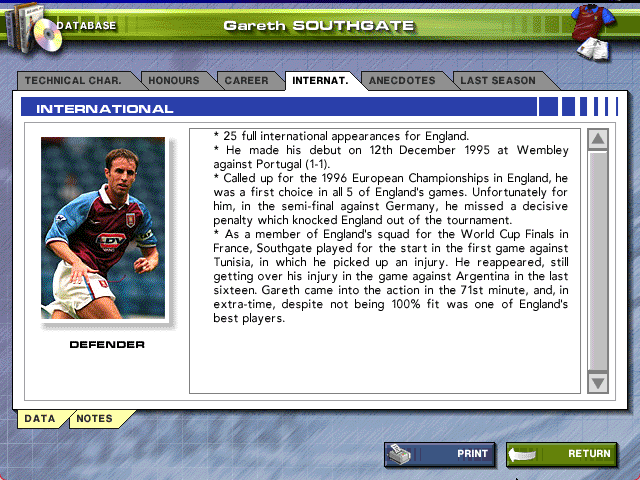
The ‘Data Base’. If you want a break from playing Premier Manager, you can take a dive into its extensive database of Premier League and Football League players. It’s basically a mix between the Rothmans Football Yearbook and Barry Hugman’s PFA Footballers’ Factfile, specifically for 90s nostalgia nerds.
Each of the 92 clubs has their own page with basic information such as their stadium, sponsor and year of foundation, plus all their league finishes from 1988/1989 up until 1997/1998. You can also look up any player in their squad and see their positions, birthdate, birthplace, nationality, previous teams, their height, AND their weight. (I might have made some Football Manager players very angry with that last one.)
Players in the Premier League and Division 1 are covered in even more detail – with season-by-season statistics, honours, international records, and descriptions of their playing style. The best players are also given extensive biographies, with cool titbits such as Freddie Ljungberg saying he wanted to train as a pilot when he finished training.
Sadly, the accuracy of some lower-league data is… less than stellar. For instance, Tim Cahill – the Millwall teenager who went on to become one of Australia’s greatest ever footballers – is listed as an English left-winger.
Does this ‘Data Base’ make any difference to Premier Manager as a game? Not really… but all in all, it’s pretty neat.
SUMMARY
Premier Manager: Ninety Nine has its charms – a sleek aesthetic, simple but rewarding gameplay, and even a decent 3D experience. Unfortunately, a messy user interface and a dodgy transfer system hold it back from promotion to the Premier League of football management games.
If you want to play PM99 today, any virtual machine or emulator that runs Windows 95, 98 or Windows XP should work fine. Just be prepared for any potential graphical issues.
FULLER FM RATING: 3* – Football League.
As Barry Davies would put it, “You have to say that’s… above average, actually.”
If you want to share your own memories from the Premier Manager series, or you have any suggestions for other football management games that I can review in future, please let me know by leaving a comment below. You can also find me on Threads or Bluesky.
 Fuller FM
Very interesting article on the English version of “PC Fútbol 7,” known as Premier Manager Ninety Nine in the United Kingdom and other European countries (such as France, Germany, and Italy). Interestingly, in Italy you can find “PC Calcio 7,” which is the same version as in Spain adapted to the Italian market. The same is true of the Argentine version of “PC Fútbol 7.”
I’m making a four-hour documentary about the closure of the Dinamic Multimedia studio, you can find it as “El fin de Dinamic Multimedia” (The End of Dinamic Multimedia) on YouTube. and I also mention the international versions and all the distribution work that Dinamic did in Spain (it was one of the main distributors of Spanish, French, English [Empire Interactive], and North American games).
According to the data I’ve, Premier Manager Ninety Nine was released in April in the United Kingdom, as PC Fútbol 7 was released in Spain on January 4, 1999, and in March in Italy. It’s true that in Argentina it was released in August due to a distribution problem, in order to coincide with the start of the “Torneo Apertura” in August.
Unfortunately for you, the English PC Fútbol games (Premier Manager 97/98/99) were always worse than the Spanish and Italian versions, as except for Premier Manager 97, which is very similar to PC Fútbol 5.0, the rest were outdated versions (PM 98 was an update of 97, while PC Fútbol 6.0 was a much better game). PM 99 has many features from PC Fútbol 6.0, but it is actually worse than its equivalent, PC Fútbol 7.
Apart from Premier Manager 97, which was almost an exact copy of PC Fútbol 5.0, after Gremlin was bought by Infogrames, the collaboration with Dinamic ended. Dinamic continued to produce two more PC Fútbol games, PC Fútbol 2000 and PC Fútbol 2001, removing the numbering of 5.0, 6.0, and 7.
Dinamic decided to independently publish the English version of PC Fútbol 2000 in the United Kingdom and Germany as “Euroleague Football” in March 2000. This version is exactly the same as the Spanish/Italian/Argentine version but translated into English. If you’re not familiar with it, I recommend playing it because it’s a high-quality game.
Unfortunately, PC Fútbol 2001 was only released in Spain, Italy, and Argentina, but it was one of the best games in the series.
Thank you very much for the detailed information, and especially for clarifying the release dates.
I only learnt about Euroleague Football shortly after I had finished writing the review. I actually seem to vaguely remember it when it first came out in 2000, but it somehow passed me by.
Unfortunately, I do not speak Spanish, but I will have a look for your documentary about the end of Dinamic. It would be interesting to learn more about what exactly happened to them.
Hello. Thank you very much for your reply. I plan to add subtitles to the documentary about Dinamic Multimedia, but it will take some time because it’s a slow process. Regarding the history, basically some partners who were brothers with the surname ‘Ruiz’ created Dinamic Software in 1984, selling many games in the United Kingdom with Gremlin. However, they had many financial problems with the arrival of Mega Drive and Super Nintendo (the change from 8 to 16 bits) and in 1992 they’re rescued by José Ignacio Gómez-Centurión, who was a very powerful press editor in Spain with his company called Hobby Press. Most video game magazines were published by Hobby Press during those years. José Ignacio retained 75% ownership of the new Dinamic Multimedia, and the Ruiz brothers retained 25%. In 1998, he sold Hobby Press to Axel Springer, a powerful German publisher, for €15 million.
Spain has always been a difficult country for developing video games, as there’s very little business infrastructure, and games such as the Commandos series by Pyro Studios are ‘almost’ a miracle. José Ignacio wanted Dinamic Multimedia to invest in Internet portals during the so-called ‘dot-com bubble’, so he bought 25% of Dinamic from the minority shareholders and ended up owning 100%. The arrival of Dreamcast and PlayStation 2 caused PC video game sales in Spain to plummet (PC Fútbol 7 sold 325,000 copies in Spain, and nearly 1 million when international versions and Premier Manager 99 are included, but PC Fútbol 2000 sold only about 220,000 in Spain). Football licences and development were very expensive, and this coincided with the dot-com crash in 2001, causing the company to go bankrupt. Its turnover fell from €18 million in 1998 to €6 million in 2000.