

While we have been waiting for the next Football Manager to be announced (any time now, Sports Interactive…), I’ve been trying to think of some fresh new ideas for FM content.
So… why don’t we have a little discussion about FM content?
Alongside writing my own Football Manager stories, I’ve watched hundreds of YouTube videos and streams, and read goodness knows how many blogs from other FM aficionados. While I appreciate that nobody is perfect (though MaddFM comes pretty damn close), I have developed some pet peeves that have been bugging me for a while.
And that’s what this is all about – discussing some of those little annoyances I have when it comes to FM content.
To be clear, this article isn’t supposed to be entirely serious. Think of this as some constructive but light-hearted advice from a long-time FM blogger whose website gets literally TENS of page views every day. I also won’t be critiquing how other FMers play the game – just how they present or write about it.
IGNORING SUBSTITUTE APPEARANCES
Sometimes when watching a live match on TV, you’ll hear a pundit or commentator say something like, “Ollie Watkins has scored 7 goals in his last 13 Premier League starts for Aston Villa.”
The word “starts” is very important; they’re not counting any matches where Watkins was a substitute, or any goals that he scored as a sub.
Some FM content creators also do this when discussing their top scorers… but they often make one simple mistake.

Here are my Nacka forwards’ match stats from the 2038 season. In the ‘APPS’ column, the number of starts is listed first, followed by the number of substitute appearances in brackets.
Goran Matijasevic has scored 6 goals in 16 appearances for Nacka, which isn’t bad for a teenager playing his first season at the club. But an FM content creator might ignore the number in brackets and instead say that Goran has netted “6 goals in 5 starts”.
The implication here is either that substitute appearances don’t count – or, even more falsely, that substitutes NEVER score. That is ridiculous when you think about the careers of legendarily prolific ‘supersubs’ such as Ole Gunnar Solskjær, Olivier Giroud and [ahem] Wout Weghorst.
In fact, exactly half of Goran’s goals were scored as a substitute. He came off the bench to net goals against Norrköping, Örgryte and Kalmar. He has actually only scored “3 goals in 5 starts”.

What about if there was a supersub who scored regularly as a substitute, but only started one or two matches? An FM content creator might say they scored “3 goals in 1 start”, which sounds like they bagged a hat-trick. In reality, that player might have scored one goal on their only start, with their other two goals coming from the bench.
Currently, there is no way to filter out players’ match statistics based on whether they were starting or used as a sub. If a creator wants to use the “X goals in Y starts” stat, they will have to manually go through every match the player featured in and then do the maths themselves.
I understand why creators would ignore the number in brackets, but it doesn’t make it any less silly. Just count up the total number of appearances – starts and subs – and use that!
THE ‘FLAT BACK SIX’

We all have those opposition formations that we love to hate. For most of us, it’s those cautious, defensive formations – usually with three central defenders – that the AI deploys to stifle the attacking efforts of a much better team (i.e. yours).
The formation above is described in FM as a “5-3-2 DM WB”, which just rolls off the tongue. But a certain YouTuber refers to this as a “flat back six”. There are a couple of issues with this:
- It’s not flat. (There are three players in the defensive strata, and three in the defensive midfield strata.)
- It’s not a back six. (Wing-backs can be counted as part of the defensive line, but defensive midfielders typically aren’t.)
I’ve also seen creators imply that every AI formation which uses three centre-backs and at least one DM is ultra-defensive, anti-woke nonsense designed purely to frustrate the opposition. I disagree with that.
In FM, the starting positions dictate the defensive shape of your team – and the players’ roles and duties will dictate the attacking shape. While a formation like this will naturally keep more players back when the team is defending, it is possible to turn it into a positive (counter-)attacking system based on the roles and duties you select.

This is a 5-2-3 – or a “flat back seven”, if you will. It looks incredibly negative, but it’s actually a slightly modified version of one of the pre-set Tiki-Taka tactics. It’s designed to play positive, high-pressing, possession football. If you’re the opposition, you might prefer to call it “death by a thousand passes”.
By the way, if you’re enjoying this article, don’t forget to hit the Like and Subscribe button, and turn your notifications on… no, wait, this isn’t a YouTube video.
Please scroll down and hit the ‘Follow’ button, and then follow me over on Threads and Bluesky. Or don’t. I’m not bothered either way.
Okay, next chapter…
MISUNDERSTANDING POSITION STAR RATINGS


A lot of FMers misunderstand player star ratings – often seeing them as unimpeachable factual information, rather than the opinion of a scout or coach. They might even dismiss players with less than 3* Current Ability as practically useless, even if their attributes suggest they can do a good job.
The star ratings given to a player’s positions, roles and duties can also be misread.
Firstly, a player can be natural in a position, but the role/duty combination with the highest star rating isn’t their ‘natural’ role. There is no such thing as a ‘natural’ Trequartista.
The role/duty with the best star rating is simply the role that your staff member reckons the player is best-suited to, based on their attributes. It doesn’t mean you HAVE to play them in that role to get the best out of them. Indeed, there’s a good chance they will play better in a different role that better suits your tactic.
Star ratings also don’t take into consideration any player traits that might contradict with a particular role.


Take a look at Joel Pérez – my central midfield wonderkid. His exceptional Passing, Technique, Balance, Stamina and Work Rate suggest that he would be a brilliant Mezzala… but he has the trait ‘Comes Deep To Get Ball’. A Mezzala is expected to drift wide, operate in half-spaces and make forward runs where possible, so a player who naturally drops deep will not work well in that role.
Instead, I started using Joel as a Deep Lying Playmaker on Support, where that trait would complement his creative abilities. However, we were struggling to create high-quality chances, so I switched him to a Central Midfielder on Support with some extra personal instructions. He (and the team) played much better after that, and we won the league at a canter.

Some FM creators will also say that players “want to play” in their highest-rated role (e.g. “He’s a Winger, but he wants to be an Inside Forward.”). I don’t believe they always want to play there, but that is indeed true in some cases.
Sometimes, when you are offering a player a contract, they will ask for a promise to play them in their ‘preferred role and position’. In this case, Mohammad Alipour expects me to play him as a Central Defender (the duty doesn’t matter), but I always use him as a Central Defender anyway, so that is fine.
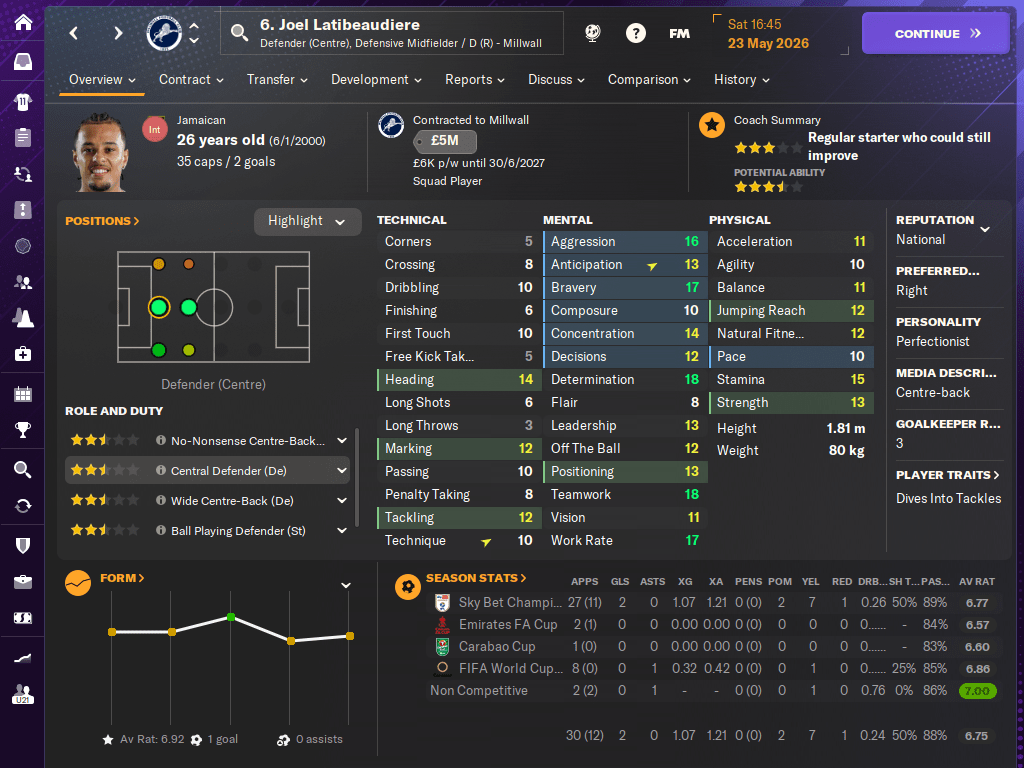

Players can also lose morale and perform worse if you don’t play them in a specific position – even if they are natural and well-suited to the position YOU want them in. When you go to the pre-match Briefing screen after selecting your team and tactics, and your player is ‘Upset’ about having to play in a ‘weak’ position, that’s a bad sign.
I had this on my previous save at Millwall, where I signed Joel Latibeaudiere as centre-back, but he wanted to be a ball-winning defensive midfielder. And here’s the thing – he would consistently make mistakes and get low ratings as a DM, but he would kick up a fuss whenever he had to play in defence, where he actually did much better. What gives?
HOW ORIGINAL…

If you’re a budding Football Manager YouTuber, there’s a great way to quickly get people to watch your videos and subscribe to your channel. Just fire up the in-game editor and make one of those totally unique FM experiments that people have been doing for years.
What would happen if I gave Tonbridge Angels £1billion?
We all know what will happen. The board will upgrade the training facilities, turn the club professional, and start paying ridiculously high contracts to mediocre players because FM’s AI is stupid. They might get a promotion or two, but they probably won’t shoot up the leagues like Wrexham.
And what about if I gave EVERY team in the Slovenian league £1billion?
Pretty much the same thing. Unless you also increase the clubs’ reputations, they won’t really make that much progress – certainly not enough to make Cristiano Ronaldo swap Saudi Arabia for Ljubljana.
Okay? So what would happen if I transferred Kylian Mbappé to Chorley and kept him there for 15 years?
We all know what will happen. He will score a lot of goals and piggyback his team up the league, but he’s not gonna bring Champions League football to Victory Park by himself. Heck, in this little experiment, Mbappé’s Chorley didn’t even make it further than League One in the first 10 years.


Don’t get me wrong. I don’t hate FM experiments; I’ve even conducted a few experiments of my own and written about them right here. I just think the FM community has been oversaturated with the same old videos about how ‘I Gave My Team £1billion’ or ‘I Put A Big Player At A Small Club’.
Why not mix it up and do something a bit more original, like Second Yellow Card? What would happen if you forced teams to play their home matches at 10,000 feet altitude? What if the FA Cup was open not just to clubs in England and Wales, but also the rest of the Commonwealth?
CHECK BEFORE YOU PUBLISH!

Lastly, some advice for the upcoming bloggers out there.
There is a lot of fantastic writing to be found within the Football Manager community. Indeed, some of the best English-language bloggers (such as FM Rensie) aren’t even native English speakers. But while not all of us can realistically aspire to be the next Hugh McIlvanney, it’s still important for any blogger to simply get the basics right.
Don’t forget to spell-check and/or proof-read your work before you hit that ‘Publish’ button. The odd typo here and there can be tolerated – you can probably find a fwe of them here – but if your post is littered with spelling mistakes, don’t expect readers to stick around for long.
While I try not to come across as a grammar national socialist, bloggers need to know the difference between “there”, “their” and “they’re”. Please write “could have/would have/should have” rather than “could of/would of/should of”. If you say “bare with me” instead of “bear with me”, you’re essentially asking the reader to take their clothes off… and you probably don’t want to do that.
And don’t forget to break your posts down into small, digestible paragraphs – ideally with clear headings and subheadings. The last thing anyone wants to read is a wall of text that will make them hit the ‘Back’ button.

Seriously, who wrote this garbage? [Ahem, YOU did… in 2011. -Ed] Look, we all started somewhere, alright?
If you have any content creator gripes, feel free to share them by leaving a comment below… but please try to keep the discussion light-hearted and civil.
In the meantime, I’ll keep on waiting for news about FM26.
 Fuller FM