
Welcome back to what’s guaranteed to be another exciting* chapter of my Football Manager 2024 series. This is my ninth season at Nacka FC, and it’s by far our biggest to date!
In case you missed it, the 2031 season was an unforgettable one at the Fisksätra, as a talented crop of attackers fired Nacka into the Allsvenskan for the first time in their history. We still can’t defend properly, but who cares?
So now the hard work truly begins. Can I build a team that can hold its own in the Allsvenskan… or will we be heading straight back down to the Superettan?
* Excitement not guaranteed.
STARTED FROM THE BOTTOM, NOW WE HERE
[Apologies to any Kendrick Lamar fans who might be reading this.]
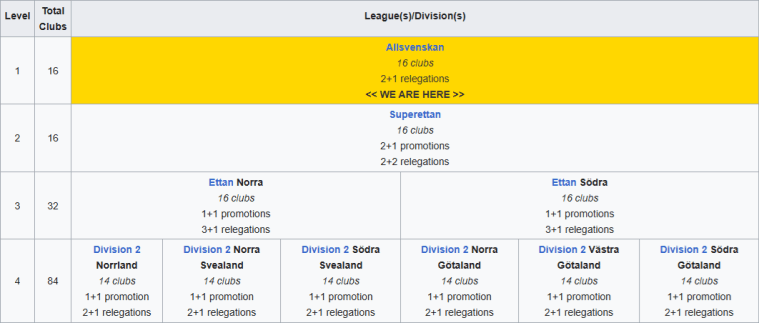
So… we’ve made it. In eight years, I have taken Nacka FC from Division 2 – the lowest playable Swedish league on FM24 – to the Allsvenskan.
Having reached the top of the Swedish football pyramid, I now have a lot more work to do – and there’s a lot more that I need to talk about. I’ve tried to stick to the ‘one season, one post’ rule that I’ve had since the start of “Nacka’s Yard”… but then this post would be about 5,000 words long and take over 30 minutes to read.
So I’m splitting this season into two posts. This chapter will cover our first six months as an Allsvenskan club, and then I’ll finish the campaign off in Part 2 next week.
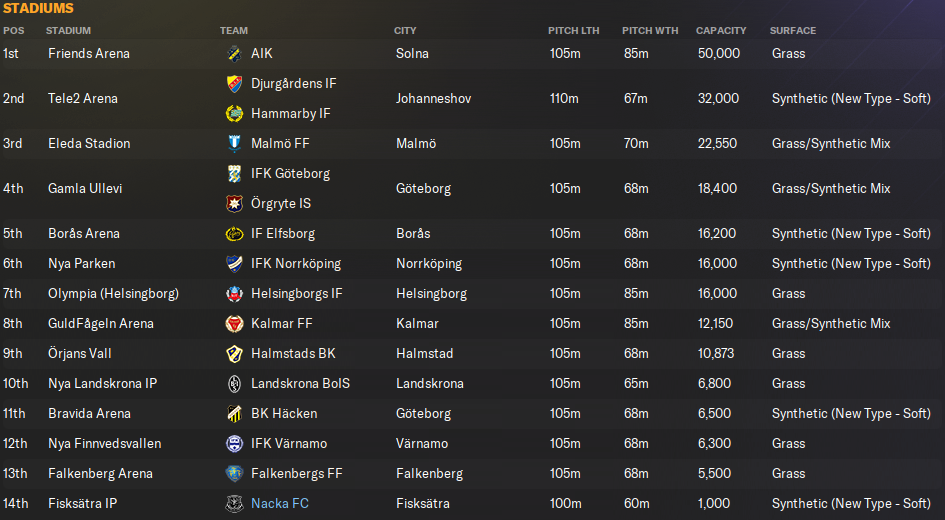
Now that we’re rubbing shoulders with the likes of AIK, Djurgården and Malmö, you’re probably expecting a big ol’ stadium expansion. The Fisksätra can only hold 1,000 spectators, and our average attendance last season was 964. Even in the Superettan, most of our home matches were sell-outs.
However… there has been no word of expansion from the board. For this season at least, we will be playing top-flight football in a stadium that would be more suited to the Isthmian League in England.
I’m honestly not too fussed right now. We make hardly any money off gate receipts anyway, but the TV revenue and prize money we’ll get just for being in the Allsvenskan will be more than enough to keep us afloat. I reckon that we could have as much as £2million in the bank by the end of the year.
My immediate focus is to assemble a team that can survive in the Allsvenskan. If we stay up, then I will ask the board about building a new stadium – and perhaps invest in better training facilities as well.
WINTER TRANSFER WINDOW
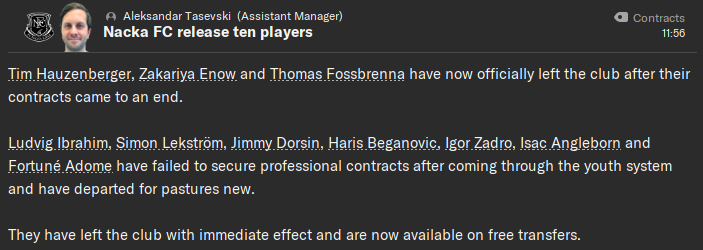
It’s the start of a new era at Nacka, which naturally means the end of the previous one. Two of our most influential players would not be following us into the Superettan.
Pacey winger Zakariya Enow was our four-time Player of the Year, and a genuine club legend (I’m still only ‘Favoured Personnel’, for goodness sake!). But after five wonderful seasons, I reluctantly let him go because he didn’t have the mental attributes needed to step up to the top flight.
We also waved off the last of my original players. Midfielder Tim Hauzenberger had been an integral player for Nacka since arriving in 2022, when they were still in Division 3. He played in a club-record 224 league matches (189 of them under my management), scored 39 goals, and made 40 assists.
Tim didn’t see much action in the Superettan last season, and he was definitely not up to Allsvenskan standard. Now aged 29, I decided to let him find another club in a lower division… or, knowing FM, retire from playing to become the world’s most incompetent scout.
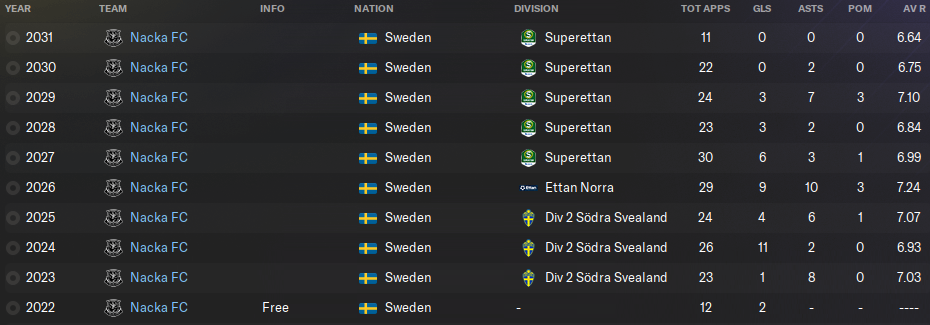
Our last survivor from Division 2 is left-back Elias Ziani, who first joined Nacka in February 2024 – just weeks after I became manager. Ziani signed a new contract to stay here for one more year, while playmaker Finlay Neat and winger Noel Wall triggered their contract extension clauses after promotion. Neat is still part of the first-team, but Wall has been sent on loan to Breiðablik in Iceland.
Holding midfielder Tim van Essema – who scored a crucial winner against Mjällby late last season – was sold to Täby for £6,000. We also loaned out a bunch of youngsters, including forward Ulrich Knudtzon and anchor man Furkan Öztürk. (Yes, they’re still here. No, they’re still not good enough for the first-team.)
The Nacka board gave me £1.3million to spend, and a weekly playing wage budget of £30,000 – almost treble our wage bill from last season. I used up most of that wage budget to build a competitive squad, but I still wouldn’t break the sensible wage structure I’d built over the years. I wasn’t going to pay any single player more than £1,500 per week – not even if Albin Rickborg came out of retirement.

First off, I signed a couple of former Sweden internationals to provide experience. Playing a 36-year-old Jonathan Augustinsson at left-back is a risk, granted, but I like his professionalism and technical abilities. In another universe, Augustinsson was also a reliable backup defender in my Rennes ‘unbeatables’ team on FM21.
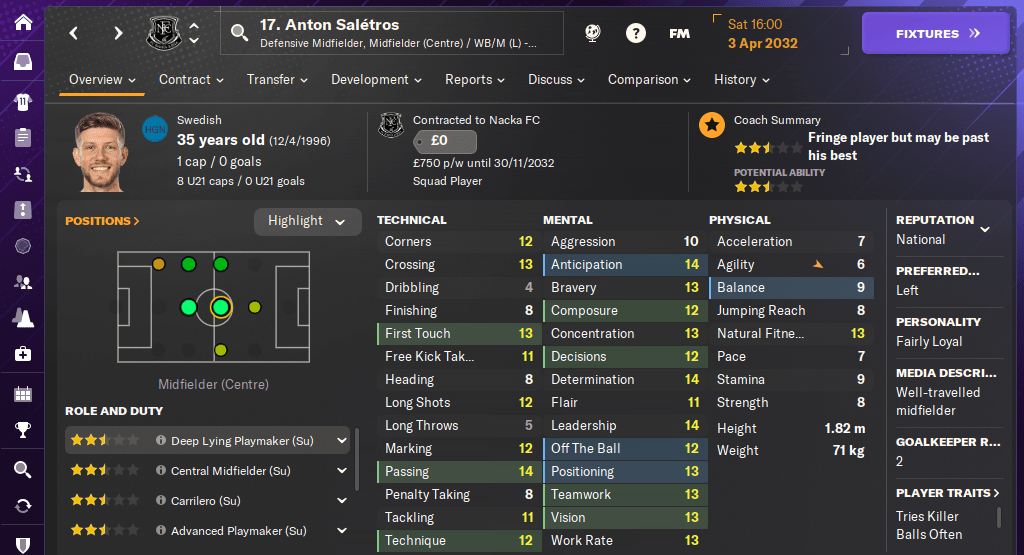
I am rather less familiar with 35-year-old former AIK midfielder Anton Salétros, but he is a mentally-strong carrilero who can provide cover when our wing-back bombs forward. Incidentally, Anton is the real-life boyfriend of Chelsea midfielder Johanna Rytting Kaneryd, but I won’t hold that against him.
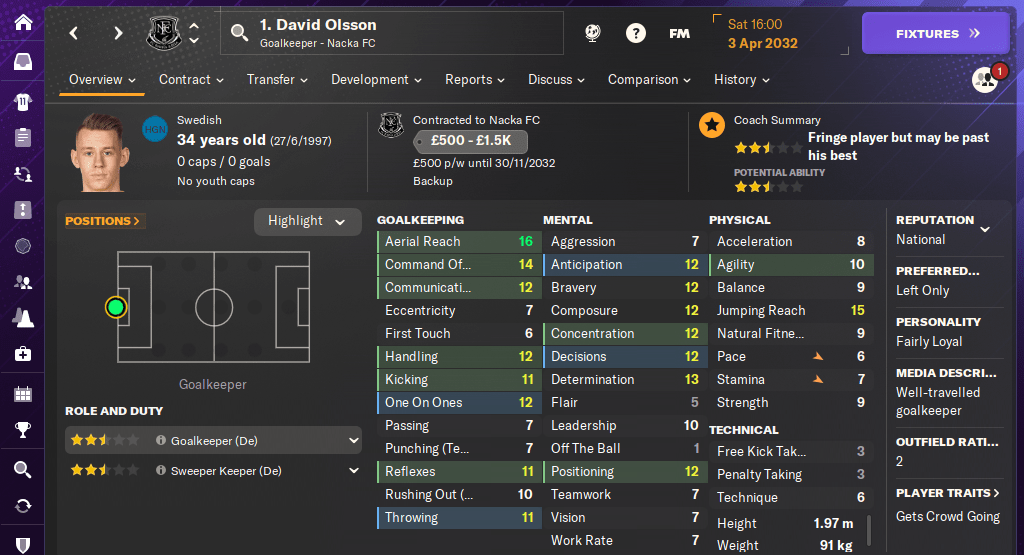


The last of our veteran signings is the giant 34-year-old goalkeeper David Olsson, who put in some decent Allsvenskan performances for Helsingborg last season. He will be backup to the much younger and more agile Joakim Hjelmberg, who joins us on a season-long loan from our now-former senior affiliate Hammarby.
We also have yet another new captain. The armband has now been passed on to 25-year-old Daniel Ulvestaf – a skilful central midfield runner and a Model Professional. He has also, er, never played in the Allsvenskan – spending most of his career at Varberg in the Superettan.


Given our defensive frailties last year, new centre-halves were a priority. I was delighted to bring back our tough-tackling former loanee Erik Melin, who has now signed a four-year contract at Nacka. Hopefully that will stop Häcken from recalling him two weeks before the end of the season… but this is FM, so you can’t be too sure.
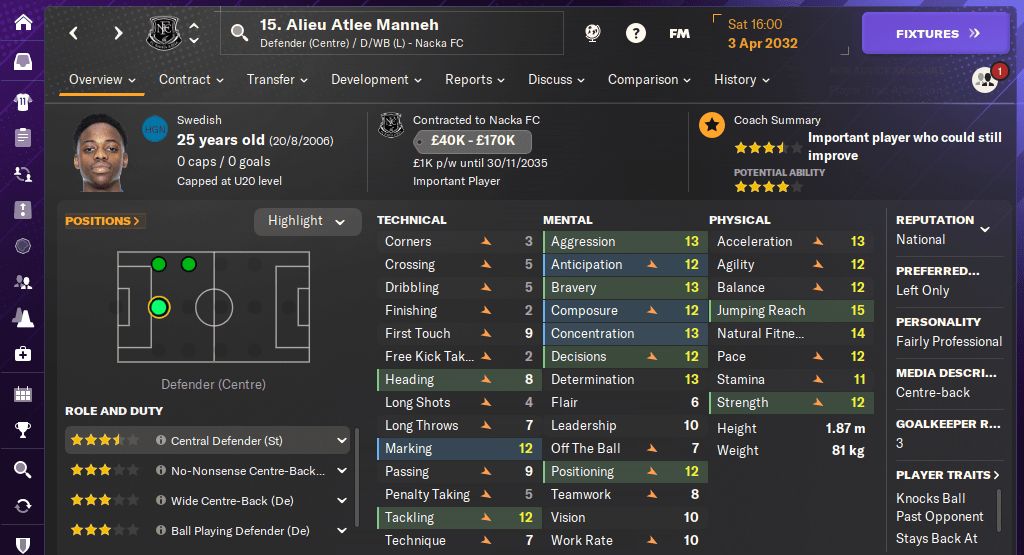
Melin’s main rival at right centre-back will be the more experienced Rasmus Andersson, who likes big games and LOVES jumping. On the left side, we have the cool, calm and collected figure of Alieu Atlee Manneh (no relation to Clement).
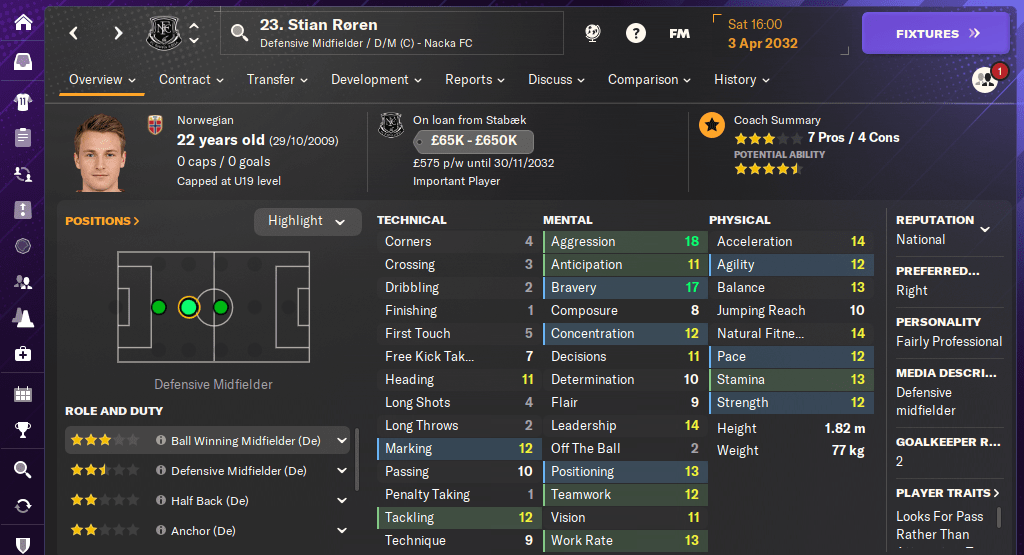


After scrambling for a new defensive midfielder for most of the transfer window, I took a stab at Stabæk youngster Stian Røren on a season-long loan. This no-nonsense Norwegian is brave and energetic, but I’ve also heard that he’s more aggressive than Vinnie Jones with a chainsaw… or Stefan Lindmark, for that matter.
And finally, we imported a couple of pearls from Mozambique on deadline day. I’m VERY excited about 18-year-old Nasser Mutambe – a flamboyant forward whose pace and dribbling ability will be put to good use on the right wing. He’s accompanied by Emílio Chamboco, who could be a long-term option at left-back… as soon as he learns how to defend.
SQUAD REPORT

How time flies. It feels like only yesterday – well, late November, at least – that we were playing part-time football in Division 2, and that our best players were earning £20 per week. Now a cosmopolitan bunch of cast-offs, imports and Aberdonians will be venturing into uncharted waters.
But before they do, let’s take another look at three of our key men:


I’m so glad we’ve kept hold of Ahmed Fouad, who was such a crucial addition at left-wing last year. He did kick up a stink when I triggered his contract extension clause, and then asked to leave again after I rejected a frankly pathetic offer from IFK Göteborg. Luckily, Ahmed calmed down once I improved the squad, and so he’s happy to stay for at least another year.
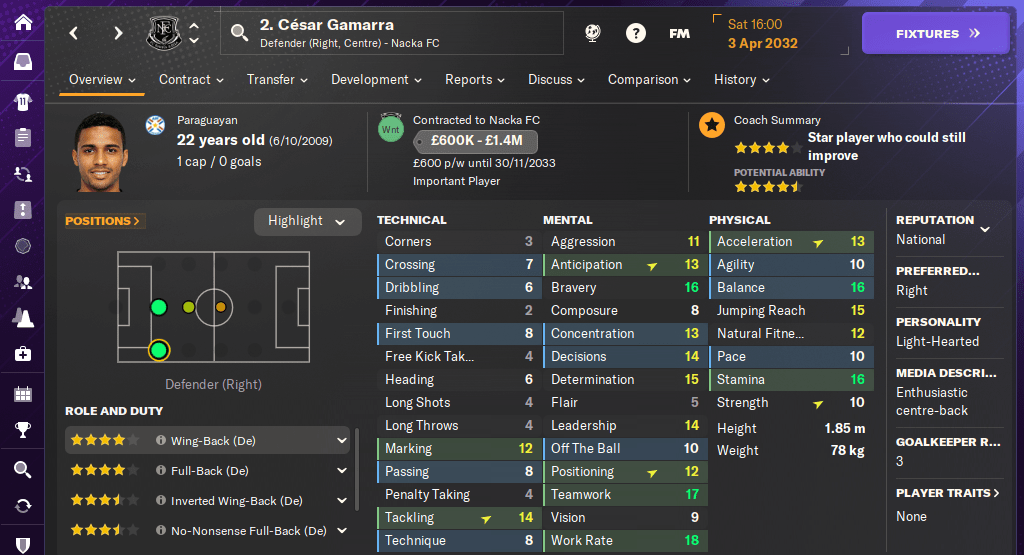
Noel Sergel – our top scorer in all competitions last season – is definitely here for the long haul, having signed a new three-year deal worth £1,300 per week. An equally vital player is Paraguayan right-back César Gamarra, who will be our vice-captain again. Having skippered us for the second half of our promotion campaign, poor old Hadi Noori has now been demoted to third-choice captain.


I’m keeping faith in the counter-attacking 4-3-3 that got us promoted, but with a few changes that will (hopefully) stop us getting slaughtered by much bigger teams.
First off, our midfield three all have different roles. The Defensive Midfielder will be slightly less rigid than the Anchor Man, while the Carrilero will offer better defensive cover for our wing-back than the Advanced Playmaker would. The Mezzala drifting wide has worked well for us, but I feel that the late runs a Central Midfielder on Attack makes into the box will give us a better option going forward.
I’ve dropped the defensive and engagement lines back a bit to help us cope better with the inevitable onslaughts we’ll face. That said, the high press could come back into play if we’re at home and are confident enough to take the game to our opponents. I’ve also got a second version of this new tactic which inverts the full-back and central midfield roles – this is mainly to benefit our new attacking midfielder and captain Ulvestaf, who is left-footed.
And we still have a 4-4-2, just in case any of our opponents get scared and put out a back-three tactic against us. But since we don’t really have a natural Segundo Volante anymore – that was Hauzenberger’s role in that tactic – I’m trying out a box-to-box midfielder instead. It’s wonky, and it’s a gamble, but I think it’s worth experimenting with.

In case you’re interested, here’s what has happened in the Allsvenskan since the save began.
The trophy got shared around between four different teams from 2023 to 2026 – but since 2027, Malmö have re-established themselves as the dominant force in Sweden. They’ve won four of the last five championships, the exception being that one year in 2028 when Brommapojkarna suddenly turned into Leicester.
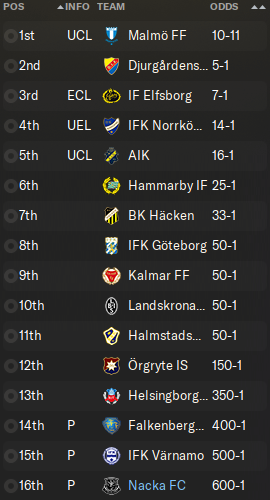
As things stand, the top two teams in the Allsvenskan will qualify for the Champions League… or at least the qualifiers of the Champions League. 3rd and 4th place will also get into Europe, and so too could 5th place, depending on who wins the Cupen next year.
But it’s the lower end of the table that we’re most interested in right now. The bottom two teams are automatically relegated to the Superettan, and the 14th-placed side will have to survive a play-off against the 3rd-best team in the second tier.
Considering that we’re a newly-promoted team, the Nacka board are surprisingly optimistic. Their expectations are to “avoid relegation”, which I believe means “avoid automatic relegation”. Ideally, I’d like to avoid the relegation play-off as well – especially because the last time I got into that situation in a Scandinavian league, it went HORRIBLY badly.
The media aren’t so confident. We’re projected to finish bottom – perhaps because our reputation is still so low compared to everyone else – but I reckon we actually have a stronger squad than our fellow promotees Värnamo and Falkenberg. We’ve definitely got a chance.
CUPEN

I also thought we had a chance of making decent progress in the Cupen Group Stage… but it didn’t exactly go to plan. We needed to come from behind twice to save a point at Östersund, who were relegated from the Allsvenskan last year. I was much happier with a draw in the Stockholm derby against AIK, though that match could easily have swung either way.
[Sigh] Then we went to Västerås, whose striker Deniz Gül – our eternal nemesis – scored against us for the seventh time in seven meetings. We couldn’t hit back this time, and so we suffered our first-ever Cupen defeat against a lower-league team.

Two points, 3rd place. Our wait to reach a Cupen Quarter Final continues.
Oh well. Bring on the Allsvenskan… I guess.
FIRST HALF
On April 2032, Nacka FC made their Allsvenskan debut at the Gamla Ullevi in Göteborg. Our hosts were perennial strugglers Örgryte, who were now managed by Jimmy Thelin.
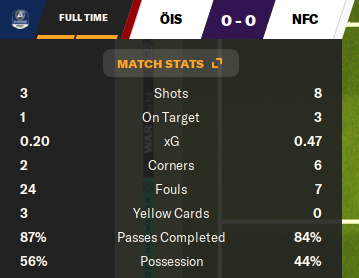
It was a nervy 0-0 draw – in front of THREE travelling Nacka fans. Talk about an underwhelming start.

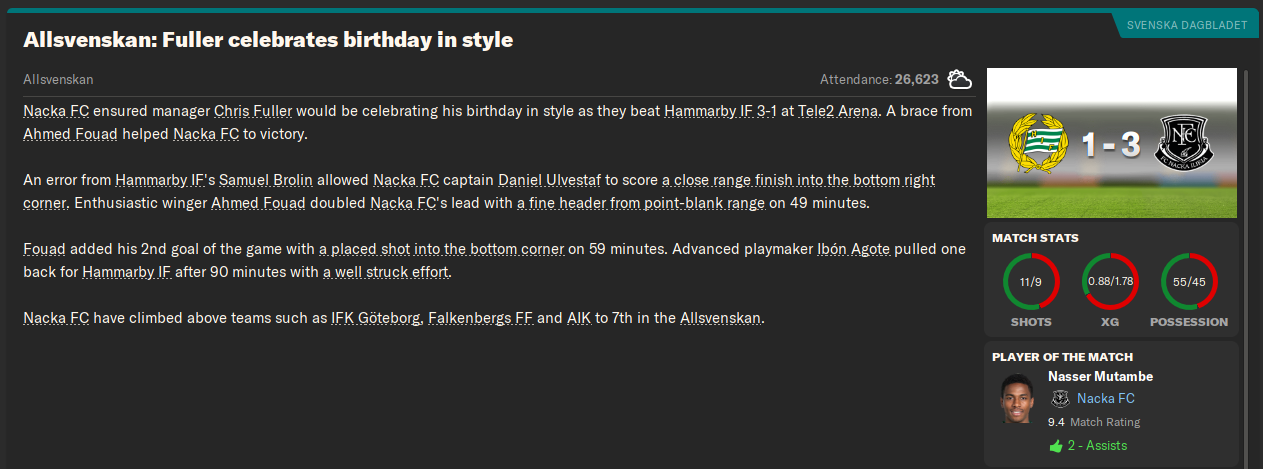
After a spirited 3-2 home defeat to Norrköping, we made it third time lucky – registering our first Allsvenskan win by hammering Hammarby 3-1. Fouad had netted four goals in our opening three matches… so, naturally, he wouldn’t score again until the summer.
Captain Ulvestaf also made a strong start, as his runs from midfield caused defences plenty of problems. Mutambe showed glimpses of his immense potential with two assists at Hammarby, before scoring his first goal in another impressive away win against Häcken.
But while our counter-attacking game got some encouraging results on the road, we were struggling to assert ourselves at home. As well as losing to Norrköping, we were comfortably beaten 2-0 by perennial contenders Djurgården, and barely scraped a 1-1 draw against a more middling IFK Göteborg side.
And then we welcomed defending champions Malmö to the Fisksätra. Malmö clearly weren’t taking us seriously, as they only bothered to name ONE substitute on their bench!

Okay, maybe that’s because of the Allsvenskan’s registration rules. You need to have at least NINE ‘homegrown in nation’ players in a matchday squad.
Because FM’s transfer AI sucks, Malmö managed to fill almost their entire squad with random foreigners and therefore couldn’t name enough homegrown subs! (Not that it mattered here; they still tonked us 3-1.)
Once we started playing teams closer to our level, we looked a little more confident. Our last two home games before the mid-season break were a couple of shut-out victories over Helsingborg (1-0) and Falkenberg (2-0).
The Falkenberg match was one to remember for 19-year-old Teodor Rönnberg, as the attacking midfielder from our 2029 youth intake scored his first ever league goal…

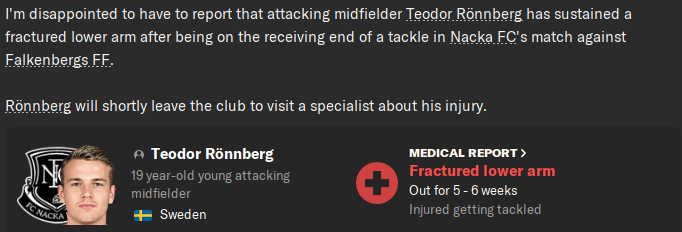
…and then broke his arm seven minutes later. Such is the way with FM.

So, with a dozen matches played, Nacka finish this chapter in 10th place in the Allsvenskan table – six points clear of the bottom three.
We’ve certainly found it harder to break open top-flight defences on the counter. Only Falkenberg have a lower xG than us so far, and if we hadn’t been quite as clinical with our limited opportunities as we have, we would really be struggling. We certainly need to see a lot more from Sergel, who has made just three goal contributions in nine league matches so far.
At the other end, it’s been a mixed bag. I’m certainly happy with Atlee Manneh, who has been very calm and collected at centre-back…
…well, apart from that one absolute howler at Halmstad. Despite that, he has managed to form a rock-solid central defensive partnership with the equally consistent Andersson. At left-back, Augustinsson has also shown plenty of drive and energy, considering that his career is almost over.
But once again, we have problems in goal. Hjelmberg has not lived up to expectations, only saving 58% of the shots he’s faced so far – and Olsson has fared little better. I’m prepared to give Hjelmberg another chance after the mid-season break, but unless the young lad shows more composure, I’ll have to look for yet another goalkeeper in the summer.
What’s Bob Hedman up to these days?
Thanks for your patience, folks. I’ve taken a couple of weeks off from blogging so that I don’t burn myself out again, but I’m still enjoying this save so much.
I also hope you’re enjoying the change of pace with these blog updates. I love fleshing things out and going into more detail about how I manage my team – so if there’s anything you’d like to see me discuss, please leave a comment below or message me on Threads or BlueSky.
As promised, I’ll be back next week with Part 2, where we’ll find out if Nacka can stay in the Allsvenskan for another season… or perhaps even qualify for Europe? [Don’t get ahead of yourself, Christopher.]
 Fuller FM
You must be logged in to post a comment.