

It’s time for another of my Fuller FM retro reviews… and today’s review is particularly poignant.
Sven-Göran Eriksson passed away in August last year at the age of 76, after an illustrious managerial career with the likes of Benfica, Sampdoria, Lazio and (ahem) Leicester City. He was also the first – and, to date, best – foreign-born manager of the England men’s national team, leading the Three Lions to three consecutive tournament Quarter Finals.
I’m publishing this post on what would have been the ice-cool Swede’s 77th birthday. To mark the occasion, I’ll be playing a somewhat obscure football management game from 2002 which bears his name.
This is Sven-Göran Eriksson’s World Manager.
BACKGROUND
In 1989, a young British-Italian video game developer named Dino Dini burst onto the scene with his new football action game Kick Off. Dini secured a publishing deal with Anco Software – a small company based out of Kent and run by Anil Gupta.
Kick Off was first released on the Atari and Amiga systems, soon becoming a critical and commercial success. Dini followed that up in 1990 with Player Manager, in which the gamer starts out as the player-manager (duh) of a Division 3 club.
Dini left Anco in 1992 to create a new title for Virgin Interactive (yes, Richard Branson did briefly branch out into video games!). Nonetheless, Anco continued to produce several sequels to Kick Off and Player Manager through the 1990s. In the early 2000s, they joined forces with a certain red-nosed Scotsman and released two PlayStation games under the name Alex Ferguson’s Player Manager.
Anco closed down in 2003 after Anil Gupta sadly passed away. The Kick Off and Player Manager series effectively died with him, though Dini did come back to develop a Kick Off Revival game in 2016. It was not well-received.
But let’s rewind back to 2002, when Sven-Göran Eriksson was at the height of his England tenure – as yet unsullied by sex scandals, penalty shoot-outs, or shock defeats in Belfast. In conjunction with publishing giants Ubi Soft, Anco developed not one but TWO international football games – both endorsed by Svennis himself, and both released during that summer’s World Cup.
So here’s where it gets a little confusing. Sven-Göran Eriksson’s World Challenge is a football action game based on Kick Off. Sven-Göran Eriksson’s World Manager – on the other hand – is a football management simulation that’s more akin to Player Manager, and this is what I’ll be looking at today.
STARTING OUT
All 204 national teams are playable on World Challenge, so you could attempt to win the World Cup with Kyrgyzstan if you wanted. Alas, this is World Manager, where the Three Lions are the only team you can manage. This game might as well have been called Sven-Göran Eriksson: England Manager – if a similarly-named film starring Ricky Tomlinson hadn’t hit the box office just a few months prior.
After buying a second-hand copy on eBay, and firing up my Windows XP laptop, it’s time to channel my inner Sven and lead England to glory. Or at least beyond the Quarter Final stage.
You have various options to choose from when starting a new game. You could manage the England Under-21s team alongside the senior side, if you have even more time to waste. ‘Population Attitude’ is essentially the difficulty setting, dictating whether the fans stay patient with you through thick or thin – or, more realistically, turn into an angry lynch mob when you fail to beat Macedonia.
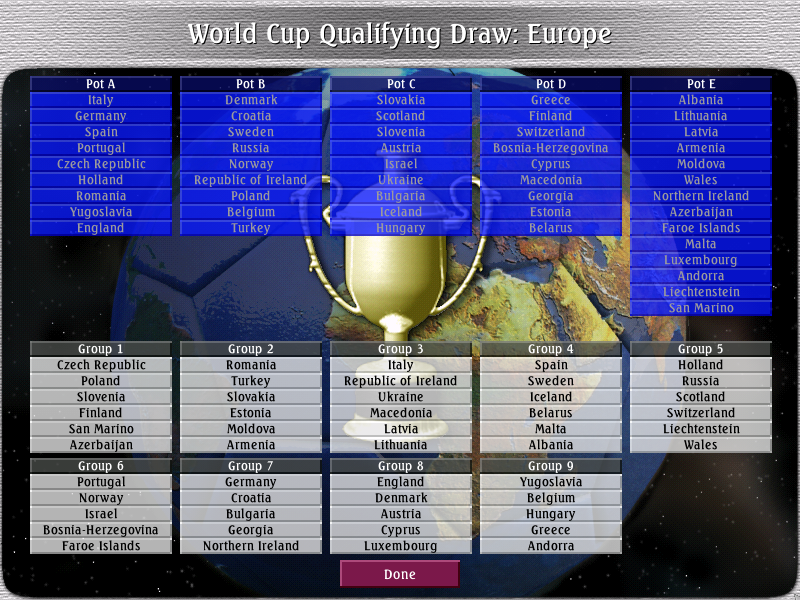
Your first job is to watch through the World Cup qualifying draws, which will randomly put you in a group with four or five other European teams. I wouldn’t have the opportunity to replicate England’s famous 5-1 win in Munich, but the draw did give us some tough fixtures against Denmark and Austria.
Once that’s done, you can begin selecting your squad. You have hundreds of potential England players to choose from – covering the top five leagues in the English pyramid, and quite a few players from overseas clubs. You can even give an England call-up to Italy’s future World Cup winner Simone Perrotta – the Chievo midfielder who was born in Ashton-under-Lyne.
WHAT WAS GOOD

Trying to keep track of your players’ club form can be daunting. Luckily, you can receive weekly updates on what the leading current or potential England stars get up to in their league and cup games.
Mind you, this feature is prone to breaking. I encountered several cases where – for example – David Beckham was playing (and scoring) for Manchester United in a dozen matches every weekend, including against such giants as Notts County and Gravesend & Northfleet. Seeing ‘Goldenballs’ rack up 82 goals in 71 matches by late November did seem a little extreme.
I also like how the backgrounds change based on recent results. You’ll see loads of cheering fans if things are going well, and a few grimacing faces if your last match ended in defeat. Of course, just like England’s players in a Panini World Cup sticker album, said supporters are wearing non-descript, copyright-free white jerseys without the Three Lions badge.
Watching the tournament draws are pretty cool too, and the World Cup finals draw does at least make some effort in terms of ensuring there aren’t too many continental rivals in the same groups. Unfortunately, that’s pretty much where the positives end.
WHAT WAS NOT SO GOOD
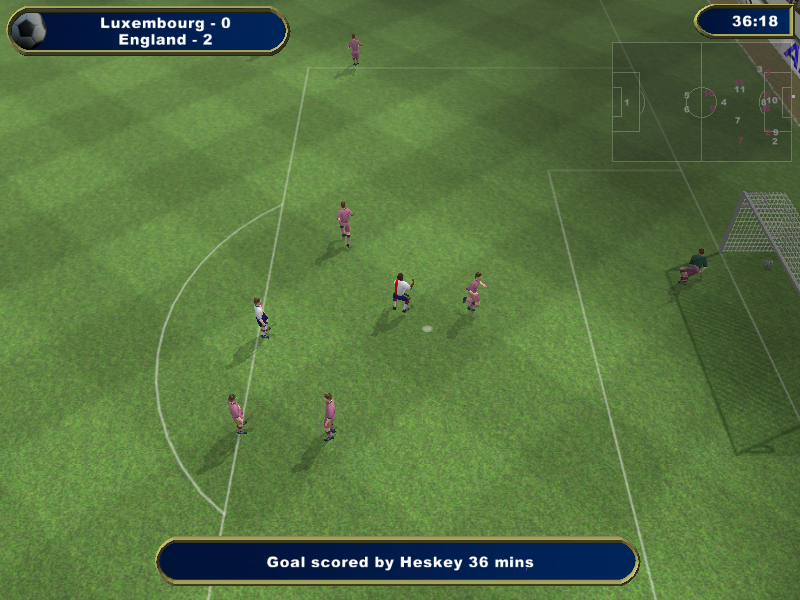
I encountered quite a few issues, even from the start. Our first World Cup qualifier against Denmark inexplicably clashed with the Charity Shield, which meant six Manchester United or Chelsea players withdrew from my squad before our trip to Copenhagen. Not that we needed them, as we somehow got a scrappy 1-0 win.
‘Scrappy’ also describes the match engine as a whole. Long balls are all the rage, and whoever is on the ball will often be pressed hard by three or four players – including one or two of their own team-mates! I would compare it to watching an Under-9s football match, but that would be an insult to schoolchildren.
Players will often run the ball out of play or punt it into touch, even if under zero pressure. As for the defending… you can barely even call it that! In two separate matches against Austria and Norway, our goalkeeper Richard Wright made a decent save, only for Sol Campbell to then smash the ball straight into his own net!
Sorting out tactical instructions is pretty messy. You can set various player instructions, but the user interface doesn’t give much of a clue as to what they actually do. It’s also impossible to change tactics during a match, so if you want to switch from a 4-3-3 to a more defensive 4-4-2, you’re out of luck.
When a player is flagged offside (which happens very often), the pop-up will always read “Offside against [HOME TEAM GOALKEEPER]”, no matter which team committed the offence. And on the 15 or so matches I played on this game, I cannot recall witnessing a single foul. Not one!
Even outside of matches, World Manager is a nightmare to play from a UI perspective. There are so many useful or even critical options – including selecting your set-piece takers – that are hidden behind right-click menus. Meanwhile, advancing from one match to another often involves more clicks than a murmuration of starlings.
WE MUST TALK ABOUT…

The player profiles.
Your players are rated on numerous different attributes – 22, to be precise – on a scale of 1 to 100. The main ones to look out for when selecting your squad are Keeping (for goalkeepers), Heading and Tackling (for defenders), Passing (for midfielders), and Shooting (you get the idea). Anyone who scores at least 90 in any of these attributes is probably a wise pick for the England squad.
Some of these attribute scores are pretty realistic, but others are… not. For example, David Beckham – THE England captain of the Eriksson era – is a perfect 100 at Dead Balls but only scores a pathetic 25 in Leadership. Instead, I had to give the captaincy to Michael Owen, who in real-life probably couldn’t lead his team-mates out of an empty Walkers crisp packet.
These attribute scores don’t really change either, even though the game’s manual suggests otherwise. That screenshot of Owen’s profile is from May 2001, but I could have also posted his stats from 12 months later and you won’t have noticed any difference.
And just one more thing – transfers don’t exist either. Leeds were relegated after the first season, which meant Rio Ferdinand – probably the strongest England defender on the game – had to play Division 1 football in a World Cup year. No £30million move to Manchester United for you, I’m afraid, Rio.
It’s safe to assume, then, that World Manager was not designed with long-term playability in mind.
SUMMARY

After finishing 2nd in their qualifying pool behind Austria, England barely scraped past Russia in a play-off to book a place at the World Cup. Despite drawing 0-0 with the mighty Thailand, we then beat both France and Congo to qualify for the last 16… where we lost on penalties. To Greece.
Although World Manager can let you play on into Euro 2004, one tournament was enough for me. A messy interface, a slew of bugs, and the fact you are only allowed to manage one nation made this a miserable experience all round.
Frankly, slapping Eriksson’s name and face on such a shoddy game was nothing more than a cash grab. Anco had clearly fallen so far since their 1990s heyday, and although they released one last Player Manager game in 2003, their reputation would never recover.
[P.S. Iran won the World Cup Final after beating Colombia on penalties. That sums it all up.]
FULLER FM RATING: 1* – Sunday League.
So, that was my tribute to Sven-Göran Eriksson… if you can call it a tribute. Anyway, if you also played this game back in the day, then please share your thoughts in the comments below. You can also find me on Threads and BlueSky.
And now, to sing us out, please give it up for Bell & Spurling!
 Fuller FM
You must be logged in to post a comment.