


Football Manager isn’t just about the elite teams. Many FMers like to take a part-time team in a lesser-known league and gradually build them up into a dominant force at domestic and continental level.
A lot of us also like to take a provincial club from the lower leagues and take them up to the top flight. That’s what I’m doing right now on my Football Manager 2024 save with Nacka FC. After leading Nacka through consecutive promotions to the Superettan – the second tier of Swedish football – we have now reached an exciting but turbulent point.
This semi-professional club is about to turn fully professional for the first time. That means our players and staff can now work throughout the week… but it also means that we’ll be spending a lot more money from now on.
So, how can we best prepare for these challenges, so that we can continue to make progress? Here are my tips for turning professional on Football Manager… no, not like Lollujo or WorkTheSpace.
WHEN CAN YOU GO PRO?
The ‘easiest’ way to turn your semi-professional club pro is to get promoted to a league where every team has to be full-time. The lowest fully-professional league in England is League Two (although most National League clubs are now professional anyway). In Sweden, my club Nacka turned professional immediately after winning promotion to the Superettan.
In some mid-level leagues, you are only required to go pro when you reach the top division – for example, the Eliteserien in Norway. This is not always the case in weaker leagues, where even the top tiers contain mostly part-time clubs, with only the very top teams having the resources to go full-time.
If you’re managing a semi-professional club in a weaker league such as Iceland or Wales, even winning the title for multiple seasons in a row may not be enough. You might need to have a few decent runs in Europe before you can generate enough revenue to pay your players full-time wages.
But what if you’re an ambitious lower-league club with plenty of cash to burn, like Wieczysta Kraków in Poland? How much money do you need in your bank balance to convince the board to take the plunge?
There isn’t a specific amount of money that you require; it often depends on the league you’re in and the income you can generate. If you really want a rough figure, turning professional will generally cost at least £1million.
Some semi-pro managers might try to save as much money as possible, and only spend as much as they need to improve the team gradually before they can sustain professional wages. Others may just want to splash out and rise through the leagues – or get that sweet Champions League money – as quickly as possible.
In my Nacka save, we did a bit of both. I kept a very strict control on finances (no transfer fees, no paying more than £75 per week to a single player) and saved most of our sponsorship money (around £150,000 per year). But we also rose through the leagues much quicker than expected – winning the Division 2 title in my second season, and then unexpectedly finishing 2nd in the Ettan Norra before somehow winning a promotion play-off!
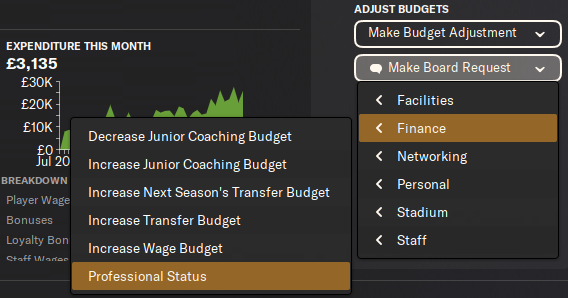
You can also ask your board to turn professional at any point. Go to the Finances page, then open up the Make Board Request menu and click Finance > Professional Status.
The board will then get back to you after you next click Continue and inform you of their decision. If your chairperson is ambitious, they might be willing to accept your proposal… but more often than not, expect to be disappointed.
As well as having plenty of money, your club will likely need to generate plenty of money. In the Ettan Norra, my Nacka team had an average home crowd of around 200 fans – each paying roughly £7 for the privilege. Nobody can run a professional football club on barely £1,000 of gate receipts every fortnight, so for us, promotion was literally the only route to professionalism.
Of course, you could just wait for a mysterious foreign tycoon to buy out your club and throw money at you. I’m sure there’s some random American billionaire knocking around in Chelmsford…
PLAYER CONTRACTS
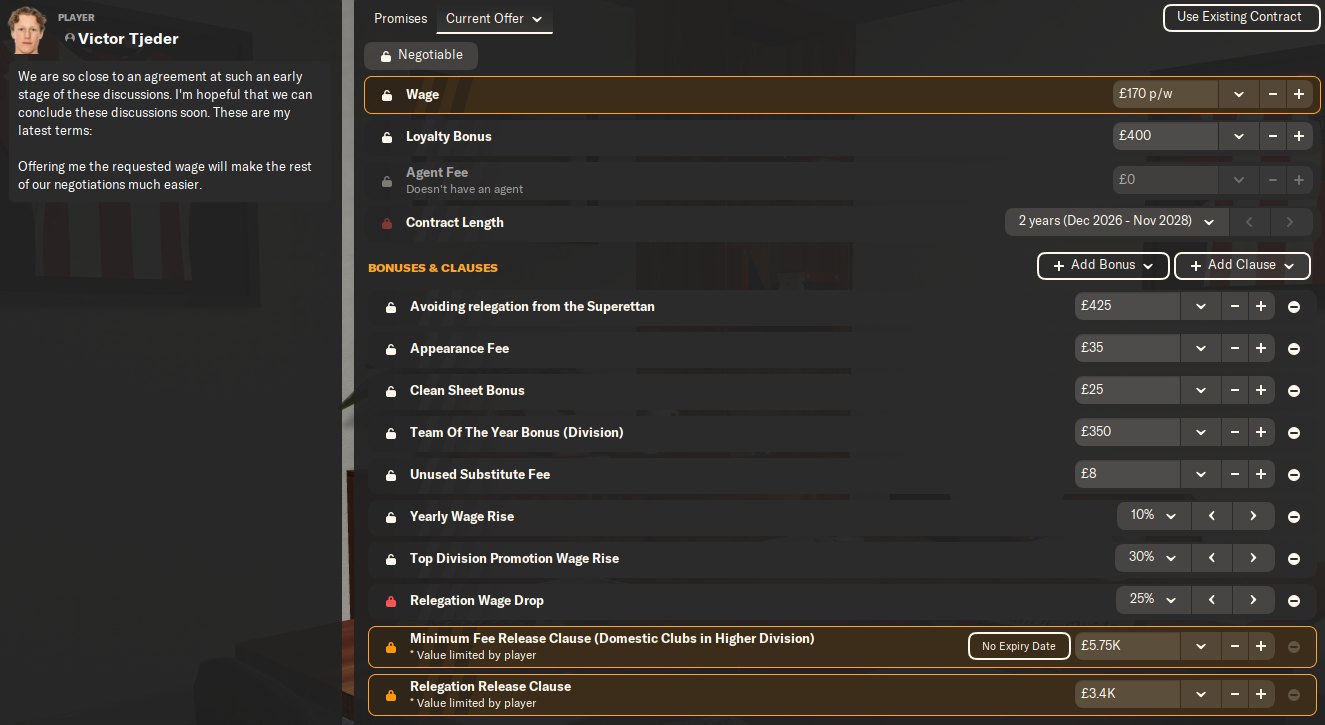
When your club turns professional, players and staff on part-time contracts or non-contract deals WILL NOT be converted to full-time deals straight away. Eventually, you will have to negotiate new full-time contracts with them.
You don’t need to hand out new contracts as soon as you turn pro. If that happens in the off-season, you can save a bit of money by waiting until just before the start of pre-season training. But if a player specifically asks for a new deal, or they’re attracting interest from bigger clubs, it’s probably best to tie them down quickly.
Part-time players will typically only train on two days a week (in real-life, this usually happens in the evenings after work). They will not be available for training every day until they go full-time. They can, however, still play in competitive matches.
Of course, if these guys are going to quit their day jobs and become professional footballers, they will need professional wages. The minimum salary for a full-time footballer in England is around £250 per week. In Sweden, it’s £100 per week… but for some reasons, I can sign staff to full-time deals for as little as £1 per week! (I suspect that might be a bug.)
So don’t be surprised if your top players demand new contracts on twice, thrice or even four times their original salary, if not more. To give an example, my top scorer Albin Rickborg went from earning £75 per week to £250.
When you’re negotiating new contracts, don’t forget to put in Relegation Wage Drop clauses of at least 25% – especially if you expect to struggle next season. If they don’t like that, offer some higher bonuses or signing-on fees to sweeten the deal. That way, if the worst does happen and your team is relegated, the reduced wages will soften the financial blow.
But be discerning with who you give professional contracts to – and be prepared to make some difficult cuts before the new season. As sentimental as it would be to reward those players who’ve risen through the leagues with you, don’t waste money on them if they’re clearly not up to professional standard.
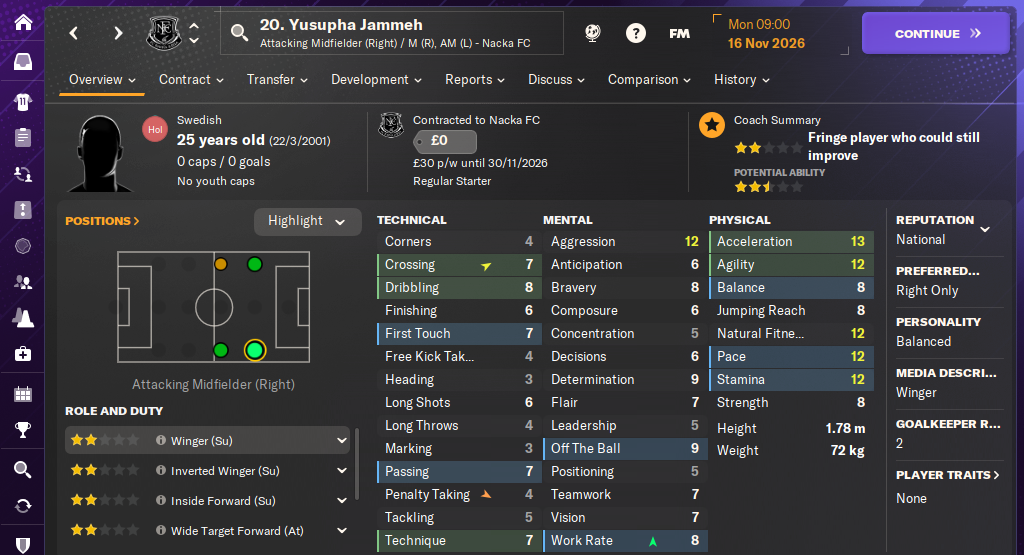
Take Yusupha Jammeh – the explosive right-winger who was our Player of the Season in my first two years at Nacka. He enjoyed a great start to the following season in the Ettan Norra, but his form collapsed from September onwards. My assistant also says he’s only a “leading Division 2 player”, with not much more potential to improve.

Jammeh was the first guy to bang on my door asking for a new contract after we were promoted to the Superettan. I love the guy, but bearing all this in mind, I believed the next step up really would be too much for him. I reluctantly set Yusupha for release, freeing him to look for another part-time club while we searched for a better right-winger.
Lastly, when you’re renewing your stars’ contracts, remember that no player should be bigger than the club. Don’t break your wage structure just to keep one or two big egos happy.
At Nacka, our sponsorship deals have gone up to £300,000 per year, and we’ll make at least another £300,000 in prize money at the end of the Superettan season. I’ll use those figures as a guide when deciding how much I’m willing to spend on player wages.
A weekly player wage bill of £5,000 works out at around £250,000 per year – and we’ll probably pay out another £50,000 in bonuses. Much of the remaining money will cover other expenses or be put inside for future infrastructure improvements. With all that in mind, I’m not going to pay anyone more than £350 per week in our first season up – that’s my red line.
TRANSFERS & SCOUTING
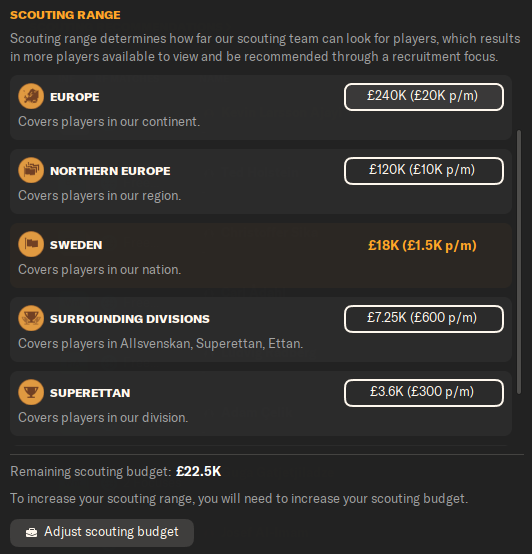
One significant benefit of turning professional is that the board will be more willing to expand your scouting network, allowing you to attract more players from abroad. You can set the scouting range on the Scouting page.
After turning professional with Nacka, I was allowed to expand our scouting range into Northern Europe, which encompasses all the other Nordic nations. Our scouts then spent the next three months looking for free agents or loanees in Denmark, Norway and Iceland who could improve my team without breaking the bank.
When you’re a newly-professional club, you should still be mindful of not wasting money necessarily, so only expand the scouting range as and when you need to. Once the transfer window closes, switch back to the package that covers players in your nation – or even the one that just covers the surrounding divisions.
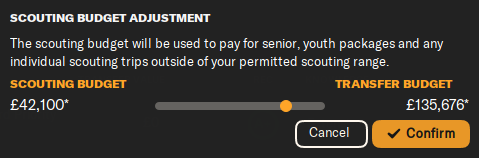
But what if your board sets you a tiny scouting budget that can barely cover your national scouting for a year? Not a problem.
If you have enough money in the bank, the board will probably have given you a healthy transfer budget that’s much higher than you actually need. Let’s be honest – nobody is going to spend £150,000 on transfer fees in the Swedish 2nd tier.
Instead, you can divert some of your transfer budget into your scouting budget. You can then expand your scouting range and scout other nations in your region, even if it’s only for a few months during the transfer window.
On the subject of not wasting money necessarily, try to stay clear of language courses – at least to begin with. An intensive language course on FM typically costs around £500 per week per player, which is a drop in the ocean if you’re an elite team, but that works out at £8,000+ for a 16-week course. If you’re a newly-professional club and you bring in several players from overseas, these language courses can really eat into your finances.
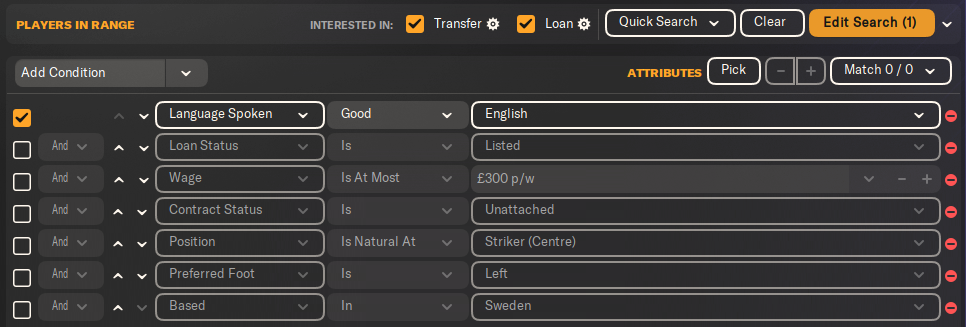
Although Nacka are based in Sweden, English is the ‘lingua franca’ at this club. Therefore, any incoming signings I make will have to speak English to at least a Good level. I have set up a search filter on the player search screen to this effect.
TEETHING PROBLEMS
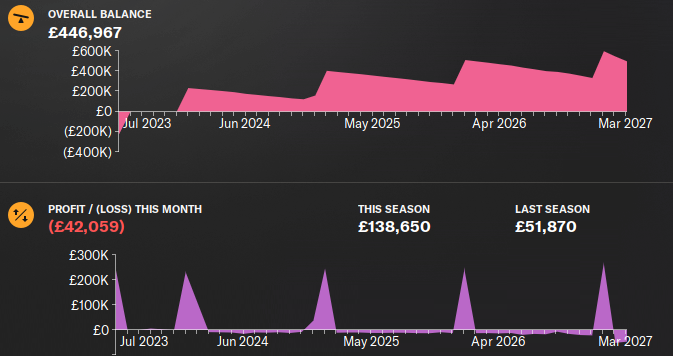
Lastly, you should be wary about any growing pains your club might have when you first turn professional.
With higher wages and other operating costs, it may take a few years to make your club financially self-sufficient. But as long as you can keep delivering results on the pitch and continue progressing (whether that’s with a few more promotions, or a couple of deep runs in continental competitions), you shouldn’t have to worry too much about finances.
In the Swedish lower leagues, most of our money comes through sponsorship deals, so there’ll be a huge spike in our bank balance when they get paid out in December. Our balance will naturally decline gradually for the next 12 months, but so long as we don’t spend way beyond our means, we should still be financially okay by the end of the year.

I’ve been in a similar position before – on Football Manager 2019, when my Lyn team were promoted to Norway’s Eliteserien. The big difference is that on FM19, Lyn did not officially turn professional until the season changeover date, which meant I only had about TWO months to build a full-time squad that could survive in the top flight (spoiler alert: we didn’t).
Sometimes on FM, if you get multiple promotions in a short space of time, your club’s reputation doesn’t grow quickly enough to catch up with your new level. That often means that any players who might significantly improve your squad will demand a lot to join your club – and that’s if they’re even interested in the first place.
This was perhaps the case at Lyn, who got promoted twice in three years. I found it quite difficult at the time to build a competitive Eliteserien squad and ended up scrambling for players who were frankly not top-flight material.
Fortunately, things have improved on FM24 – at least in one respect. Nacka went pro as soon as we were promoted, giving me just over four months to plan for life in the big leagues. Our lowly reputation was still holding us back a bit in terms of new signings, but by the end of pre-season, I had still built a squad that I felt could at least be competitive in the Superettan.
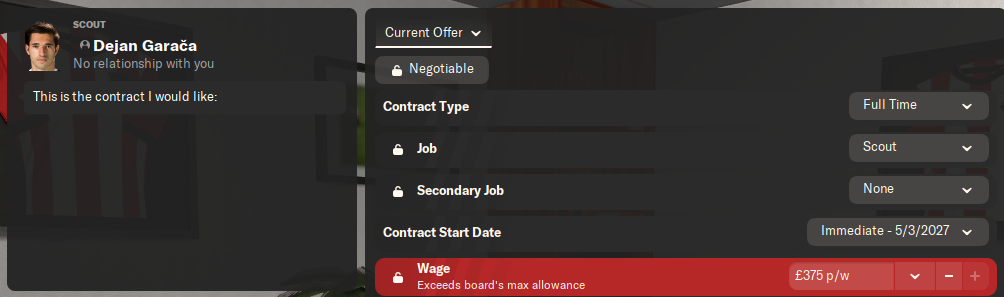
That’s not to say I haven’t been caught off guard. Player wage demands have gone up – and, naturally, so have staff wage demands.
I’m not exaggerating when I say that every single unemployed staff member in the game was demanding at least £350 per week to join Nacka – even those that were absolutely useless at their jobs! (By comparison, my new full-time contract as manager pays me only £325 per week!)
This meant I had to retain basically my entire backroom staff from our part-time days. That’s not great news in terms of my coaches’ training workload, but at least I can improve them by sending them on coaching courses. In the long run, that might actually be cheaper than just hiring brand-new coaches.
But you don’t need to completely overhaul everything and chase that next level as soon as you turn pro. If you’ve risen through the leagues rapidly, a few seasons of relative stability might not hurt. The goal for my first professional season with Nacka is simply to survive in the Superettan, which means staying clear of the bottom four – or winning a relegation play-off, if need be.
Sometimes you have to take a step back in order to take two steps forward. Turning professional may cause you a few headaches and setbacks, but if you can prepare for those challenges and survive them, who knows how much further you can go in the long run?
This was my guide on turning professional – and handling the challenges your club will face. If you have any tips of your own, feel free to share them in the comments below. You can also contact me on Threads or BlueSky.
 Fuller FM
You must be logged in to post a comment.