


After months of planning, at long last, it is time to kick off my new Football Manager 2024 story on Fuller FM!
It’s been a while since I went off the beaten track and managed an obscure lower-league club on FM. For this challenge, I will start off all the way down in Poland’s fourth division with Wieczysta Kraków. If you want to learn more about the club and why I chose them, please take some time to read the prologue.
“The Cracovian Chronicles” will follow the adventures of sisters Kamila and Joanna Deyna as they begin their coaching careers at their childhood club. Where will the journey take them, and how far can they take Wieczysta?
CHAPTER 1: A NEW ERA AT WIECZYSTA

Monday 12 June 2023. A week had passed since Wieczysta Kraków had parted company with another head coach – their third in barely nine months. The club’s secretive millionaire owner Wojciech Kwiecień was frustrated that their rapid ascent up the Polish leagues had stalled, with a 3rd-place finish in the III Liga.
That morning, Kwiecień had called the coach of Wieczysta’s youth team into his office, close to the Chałupnika stadium. At just past 9 o’clock, Kamila Deyna arrived with her younger sister (and assistant) Joanna – both in matching black-and-yellow tracksuits.
After being called into the room, they sat down at Kwiecień’s desk. The chairman was reading through the Przegląd Sportowy newspaper and could be heard muttering, “Nkunku? €60million? How many forwards do Chelsea need?”
Kamila politely coughed and asked, “Mr Kwiecień, sir?”
Kwiecień calmly put his newspaper down. “Please. It’s Wojtek.”
The sisters smiled warmly as they exchanged handshakes with Kwiecień, who greeted them, “Mila, Joanna, I am so happy to have you this morning.”
“I have always strived for success, and always for that next level. And who better to take this club to that next level than you? You’re passionate, dedicated, intelligent… and, of course, you’re Wieczysta fans. You understand as much as I do how important this club is to our community.”
Kamila nodded, “Wojtek, I am so grateful you have given us this opportunity. I would be delighted to work alongside you as head coach, and with Joanna by my side.”

The sisters smiled as they signed their contracts. There was some mild awkwardness when Joanna’s pen started to fall apart in her hand as she applied her signature. Clearly Kwiecień’s substantial investment had not yet extended to stationery supplies.
Joanna laughed, “I hope the defence won’t fall apart like this pen!”
Kwiecień remained unflustered. “I expect it won’t. Last season did not end as we had hoped, but this year, we want to promote to the II Liga. Then we can dream of the I Liga, the Ekstraklasa… Europe.”
“You are an ambitious man, Wojtek,” Joanna smiled.
“Many years ago, I built Słoneczna up from nothing. Now we have 200 pharmacies across Poland. Likewise, when I bought this club in 2020, Wieczysta were playing in the Kraków city league. Now we’re one promotion away from the national leagues.”
“And that is our first goal,” Kamila said. “Win promotion, and then build from there.”
“I expect nothing less, Mila. We cannot fail in the league again.”

“Oh yes, and with regards to the Puchar Polski… I want us to reach the Quarter Finals this season.”
Kamila’s eyes widened. “Wait… what?“
SQUAD
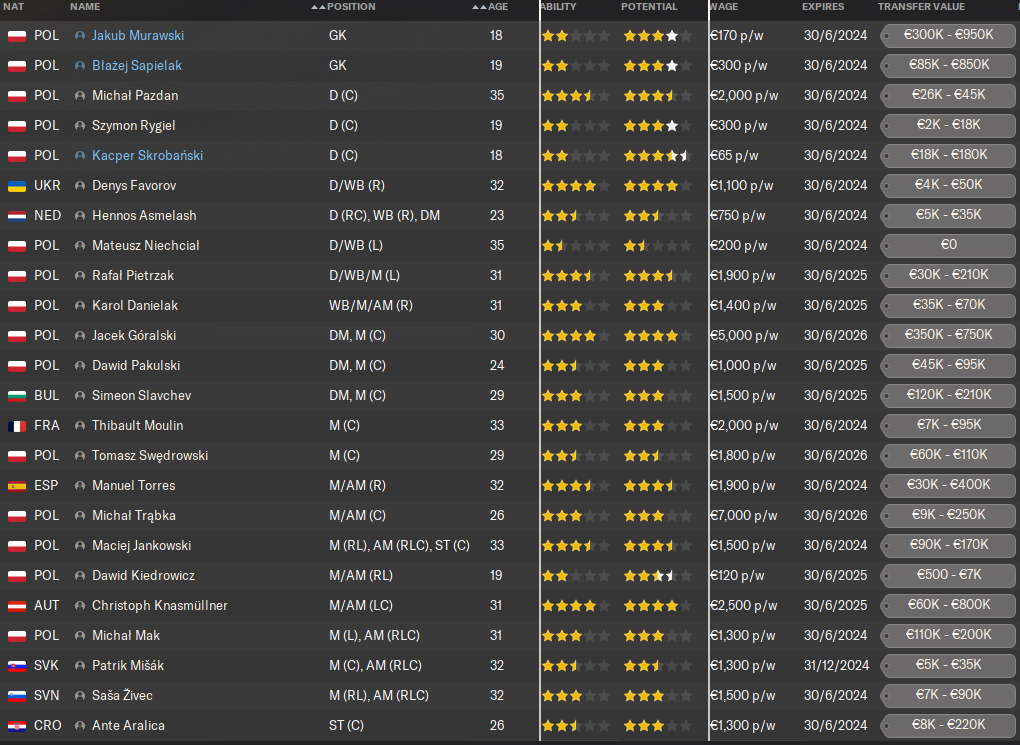
Thanks to Kwiecień’s millions, the Deynas had inherited a strong team full of players who (quite frankly) were far too talented to be playing fourth-division football. Four former Poland internationals had been lured to the project, along with several other players with top-flight experience.
Kwiecień’s immediate goal was to rise up the leagues as quickly as possible. Thus, Wieczysta had the oldest squad in their regional division – with 13 of their players being aged 30 or over.
This was a potential headache for Kamila. She also needed to bear in mind that teams in the III Liga needed to have at least TWO Polish Under-21 players on the pitch at all times.


One of those Under-21 spots would be taken up in goal, which was by far Wieczysta’s weakest area in terms of experience and quality. They had loaned in two teenagers who would jostle for the number 1 spot. Odra Opole’s Błażej Sapielak was the older of the two and a more commanding aerial presence, though Legia’s Jakub Murawski was perhaps a little more well-rounded.
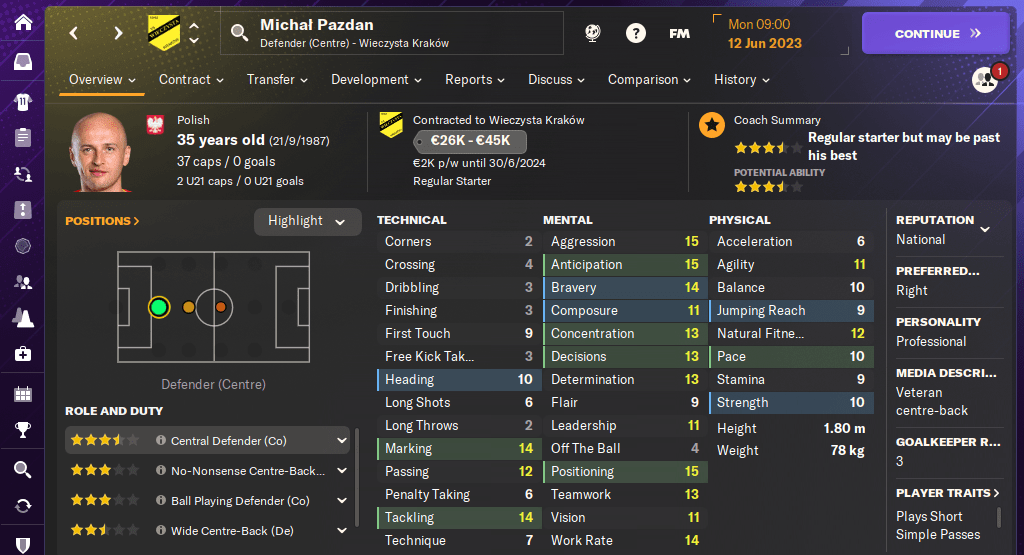

The most famous name in the squad was captain and ball-playing defender Michał Pazdan – a veteran of three major tournaments with Poland. While the 35-year-old was mentally resilient, he had noticeably slowed since his peak, and his aerial ability wasn’t the most convincing.
Pazdan would likely be partnered in central defence by another Under-21 player to fill the quota. There was a good chance that man would be 18-year-old Kacper Skrobański, who had arrived on loan from Wisła after making three league appearances for them last term.


Former Zoria Luhansk right-back Denys Favorov had moved to Kraków the previous summer after war broke out in his native Ukraine. Favorov was rated as a good Ekstraklasa player and was coveted by 48 clubs across Europe. It seemed certain that he would leave at some point in 2024.
At left-back was the first of the ex-Poland quartet. Attacking wing-back Rafał Pietrzak had dropped down from Lechia Gdańsk to join this project, in which he would play a critical role. The next-best player in this position was 35-year-old Mateusz Niechciał, who’d been with the club since 2016 but was really not of professional quality.

Fearless holding midfielder Jacek Góralski was playing Bundesliga football for Bochum last season, but the 21-cap Poland star had signed a three-year contract with Wieczysta while still in his prime. With his big-match experience and selfless play, he would provide a critical link between defence and attack.
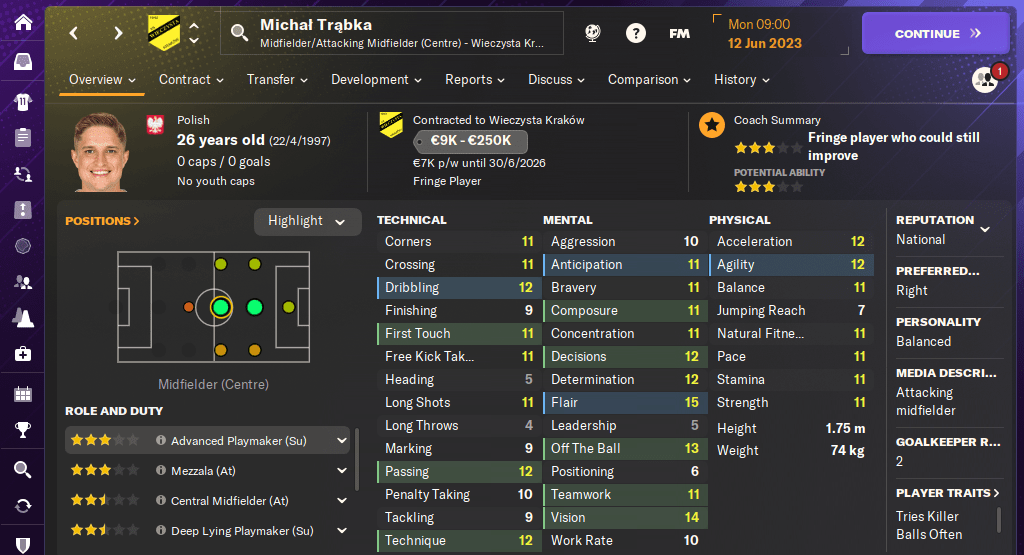
The highest-paid player in the squad was 26-year-old playmaker Michał Trąbka – a club-record €350,000 buy from Stal Mielec. Trąbka’s flair and creativity had the potential to unlock stubborn defences, though he was also regarded as inconsistent and injury-prone.
There were two other high-quality midfielders to look out for – both of whom had very brief stints in England several years ago. Bulgarian ball-winner Simeon Slavchev made just a single appearance for Bolton Wanderers in 2015, while the more attack-minded Austrian Christoph Knasmüllner flopped at Barnsley in 2018.


Manuel Torres had provided plenty of Spanish flair and endeavour at Wieczysta, scoring 10 league goals in his first season at the club. The pacey right-wing playmaker was expected to contribute even more during their push for promotion.
Saša Živec was another experienced wideman, with the Slovenian international likely to be deployed as an inside-forward. Meanwhile, the enigmatic Slovak Patrik Mišák was one of the first foreigners to join Kwiecień’s project, signing in 2021. The youngest first-team player was Dawid Kiedrowicz – a pacey 19-year-old winger, formerly of Legia.
The skilful if erratic Michał Mak would be another option out wide, but he broke his leg last October and was unlikely to return before next year. French central midfielder Thibault Moulin was also nursing a long-term injury, having torn his knee ligaments in February.

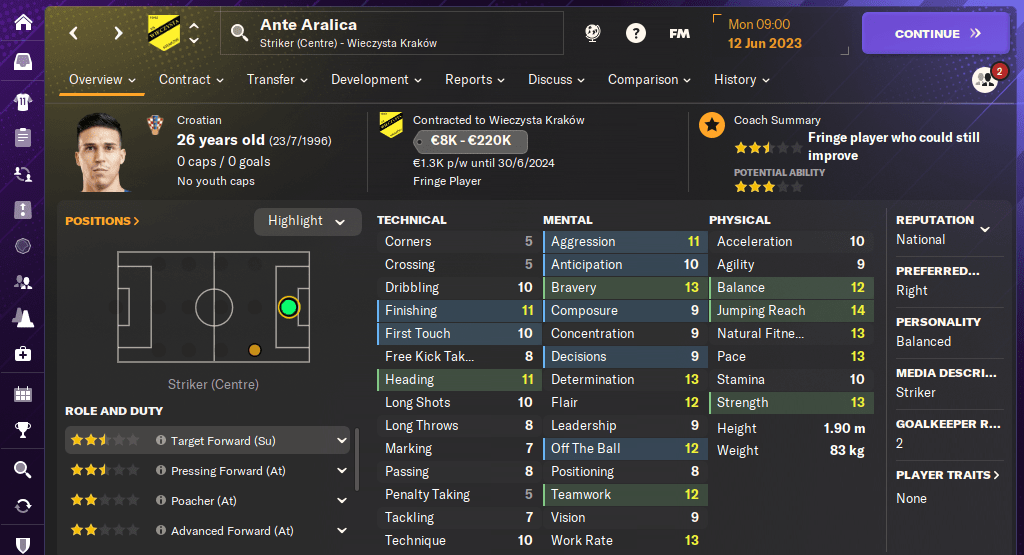
Capped once by Poland in 2011, Maciej Jankowski was also in his third season at the Chałupnika. Though most at home in an attacking midfield role, the veteran could also lead the attack as a deep-lying forward. Another viable option up front was the big Croatian target man Ante Aralica.

Wieczysta had even more options to choose from in their reserve squad, which itself could give most of their Grupa IV rivals a run for their money.
Veteran midfielders Łukasz Pietras and Mateusz Gamrot were among those who had been first-team regulars last season. Also in the reserves was a FIFTH Poland international – left-winger Piotr Madejski, who would soon celebrate his 40th birthday.


Wieczysta would start this season running a positive 4-2-3-1. As overwhelming title favourites, Kamila expected most of their opponents to adopt a cautious approach against them, so they would look to break down these ‘buses’ with vertical movements and intricate passes into space. Torres’ creativity out wide and Knasmüllner’s runs from midfield would be crucial.
For slightly trickier games, Kamila would switch to a 4-3-3, which would give a little more defensive protection without sacrificing too much of her team’s attacking threat.
STAFF & FINANCES


Kamila’s strengths as a coach were primarily tactical rather than technical – and with her experience of coaching the Wieczysta youth team, she could also build a rapport with younger players. With only a UEFA C Licence, she was not as qualified as any of her III Liga peers, though she would be looking to study for her remaining badges over the coming years.
Joanna was very much at the start of her coaching journey and would likewise be learning on the job. She was far more adaptable than her elder sister, and she was also a disciplined character who would keep standards high on the training ground.

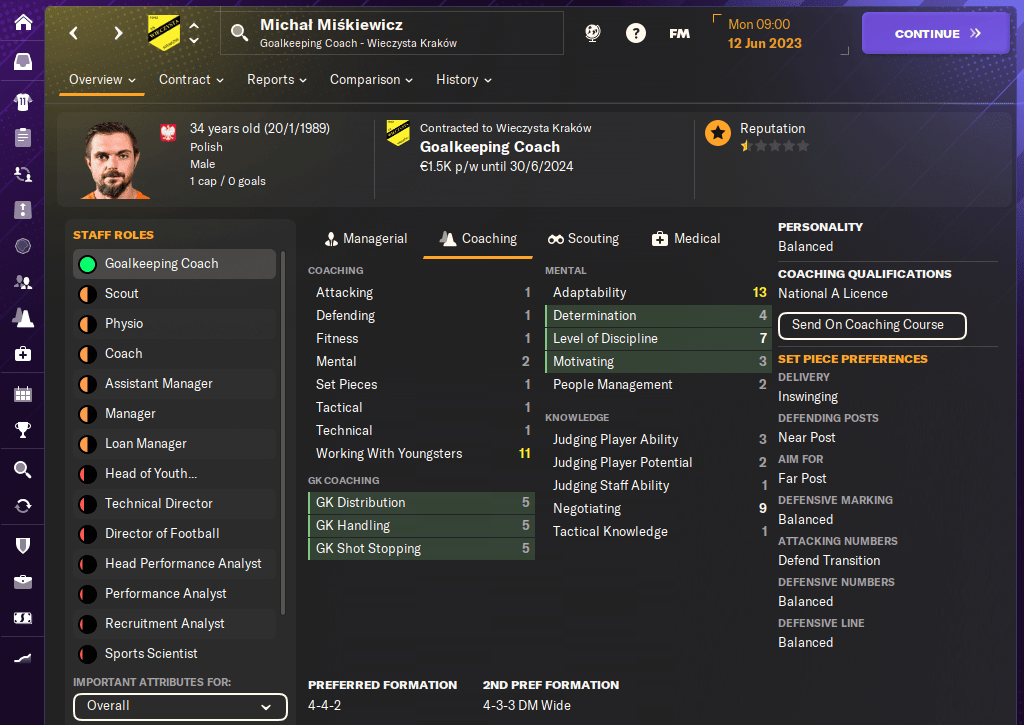
As well as two fitness coaches, Wieczysta had a couple of former players on the coaching staff. Adrian Frańczak was a decent enough technical coach, but Michał Miśkiewicz‘s goalkeeper coaching qualities were not as impressive. They were also still on high wages from their playing days, so it was perhaps unlikely either of them would be retained beyond this season.

Only four of the 18 clubs in the III Liga, Grupa IV were fully professional – and Wieczysta were in by far the strongest position financially. They began the season with €4.6million (or almost £4million) in the bank balance – more than enough to fund a strong promotion challenge.
Unsurprisingly, Wieczysta also had a wage bill that dwarfed all their rivals’. They were forking out €2.9million per annum to their squad – more than some Ekstraklasa clubs! To compare them to the other professional clubs in their group, Garbarnia Kraków had an annual wage bill of €525,000, while Siarka and KSZO Ostrowiec were each paying out just under €400,000 to their players.
Clearly, a club of Wieczysta’s stature could not sustain this heavy spending off the pitch unless they followed it up on it. Many sides had crashed and burned while chasing the dream.
Promotion would obviously be the short-term focus for Kamila, but she would also be mindful of cutting costs to make the club’s finances more sustainable in the long run. While Kwiecień was a wealthy businessman, his resources were not infinite.
PRE-SEASON

On paper, Wieczysta’s experienced squad was expected to walk through Grupa IV – being quoted as 91-1 ON to win the league and secure promotion to the II Liga. Kwiecień had gone all-out to continue their ascent, but the constant upheaval on the pitch and in the dugout had come at a cost.
With so many signings coming in over the summer, Wieczysta looked more like a Polish Nottingham Forest than a cohesive football team in the first few weeks of Kamila’s tenure. The new manager had a little short of two months to build up her squad’s cohesion through intensive training – and an equally busy schedule of pre-season friendlies.
There was no time to waste for Kamila, who stated, “Put in the effort now, and you will reap the rewards later.” Though a few players would grumble about doing too much quickness training, most were on board with the new regimen.

The honeymoon lasted a little over a week… until a training match turned into a disaster, and Aralica’s leg snapped in half under a robust challenge. The Croatian would miss the entire first half of the season.
Slavchev’s pre-season would also be over before it began, as he suffered a lower back stress fracture two days later and was ruled out until September.

Later that weekend, Wieczysta’s pre-season got off to an even less auspicious start at Unia Oświęcim, who took the lead after just 80 seconds. The Żółto-czarni did start playing some more convincing football later in the first half, going on to win 3-1, but it would clearly take time for this team to fully gel.
They were a little more convincing in their first home game, against Czech visitors Uherský Brod. Experience and youth led the way as 33-year-old Jankowski and 20-year-old reserve striker Przemysław Kapek scored twice apiece in a 6-1 victory… but the result was soured by another devastating injury blow.

Two minutes into the second half, Živec tore his Achilles while trying to run onto a cross. The creative Slovene had now become the FOURTH Wieczysta player to be sidelined with a long-term injury. While they certainly weren’t short of backups, every major injury was giving their rivals more hope for the new campaign.
Despite suffering a few more injury setbacks later on, Wieczysta continued their relentless form throughout pre-season, winning nine straight matches. Their toughest test was against Legia Warszawa II, but even then, they dominated possession and raced into an early lead before triumphing 3-1.
Creating and converting chances was no problem at all, with 38 goals being scored across those nine games. ‘Magic’ Jankowski led the way with seven goals, followed by Gamrot on five (which included a late hat-trick at Resovia II).
Defending seemed to be more of an issue, especially early on. Though they limited their first five opponents to just eight shots on target, they conceded six of them – raising serious questions about whether their young loanee goalkeepers were ready for regular senior football.
Kamila remained cautiously optimistic heading into the new season. “It will take time for this team to operate as a unit,” she told Joanna after the 4-0 win at Wolania. “But we’re getting there.”
Thank you for reading. Click here to read Chapter 2.

 Fuller FM
You must be logged in to post a comment.