

Ladies and gentlemen, it’s Retro Review time again!
This year marks the 25th anniversary of me playing Championship Manager for the first time. It was back in 1999 that I first discovered Championship Manager 3 – the game that started a lifelong addiction for me.
I will revisit CM3 in more detail later this year. Today, though, I will fast-forward a decade to 2009, when the Championship Manager franchise was on the decline. Could Eidos really make a good game without Sports Interactive?
This is Championship Manager 2010.
BACKGROUND
Long-time FMers will know about the early history of their favourite franchise. Originally developed by the Collyer brothers in their Shropshire bedroom, Championship Manager was first published by Eidos Interactive (then known as Domark) in 1992. After a decade of success, the Collyers’ Sports Interactive split from Eidos in 2003.
While SI retained the rights to the game’s engine and (importantly) its database, Eidos kept hold of the Championship Manager name. They then decided they were going to build their own game – with blackjack and hookers. Okay, maybe not, but they set up a new company in North London named Beautiful Game Studios to develop the next version of the CM series from scratch.
After various teething problems and delays, Championship Manager 5 was finally released in March 2005 – more than four months after SI’s Football Manager 2005 had come out to critical and commercial acclaim. By contrast, CM5 was horrendously bugged, and missing various important features from previous games. The reception was… not good.
Championship Manager 2006 also hit shelves months behind its Football Manager counterpart – and from that point, it was clear that SI had resoundingly beaten Eidos in the football management game stakes. CM limped on for a couple more years, but skipped the 2008/2009 campaign in order to come back stronger a season later.
It might surprise you to read that Championship Manager 2010 was released before Football Manager 2010 – in September 2009. At this point in my gaming life, I was disillusioned with the FM series, so I tried out the CM10 demo and actually quite enjoyed it. However, many other players didn’t seem to agree, and their negative reviews were enough to put me off buying the full version.
CM10 was the final Championship Manager game to be released on PC and Mac. Eidos (now Square Enix Europe) shifted their focus to mobile gaming, releasing several CM games for iOS and Android – including a couple of Championship Manager Legends spin-offs – between 2010 and 2016. However, Square Enix blew the final whistle on the series in May 2018 and withdrew all those titles from sale.
And so Championship Manager 2010 stands as the last meaningful hurrah for this once-great franchise. Surprisingly, it is still on the Steam store, costing as little as 89p during the last winter sale. So, what better time to revisit CM10 and see if it really was all that bad?
STARTING OUT
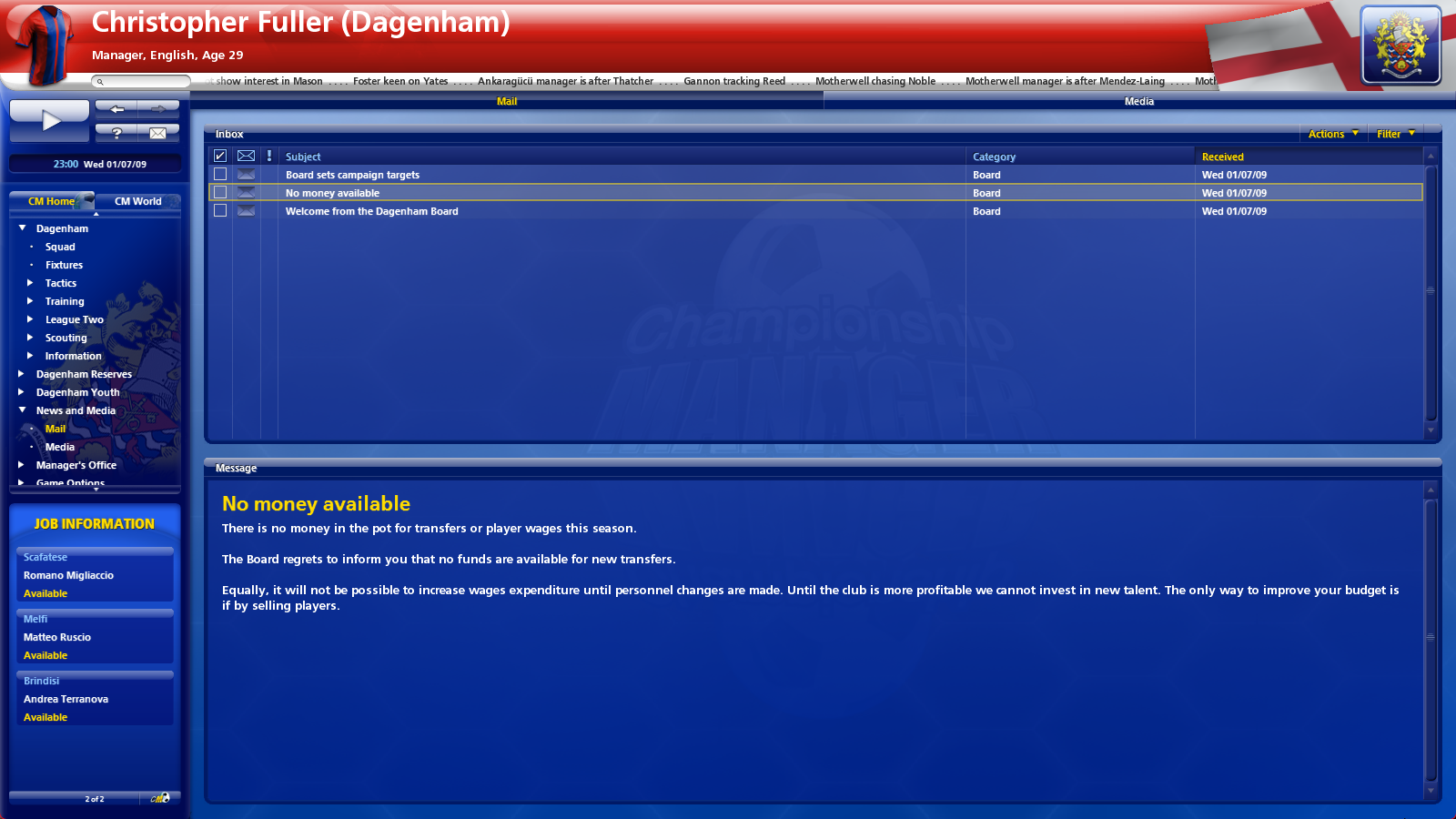
While the latter-day CM games were often criticised for having an inferior database to FM, there’s still plenty of depth to be found here.
You can load leagues in up to 32 nations – and if you’re in England, you can even choose to manage in the 7th-tier regional leagues (the Northern Premier, Southern Premier and Ryman Premier leagues). More than a decade later, those leagues are only playable on FM if you download a custom database.
If you have played any of the previous Championship Manager games – or SI’s early Football Manager titles – you’ll be familiar with most of the basics. There are a few differences worth noting, however.
Player attributes are rated on a scale of 1-100, rather than 1-20. They are also divided into FIVE categories – including Temperament, where you can see a player’s Versatility and Consistency. If you’re wondering why your striker plays like Didier Drogba one week and Savio Nsereko the next, now you’ll know why.
Classic CM fans will be more pleased to see that you can instruct players to make specific runs – and set their positions both in and out of possession. However, you can also select which team-mates you want your players to ‘feed’ the ball to. These are denoted by the red lines you see on the screenshot below.
WHAT I LIKED
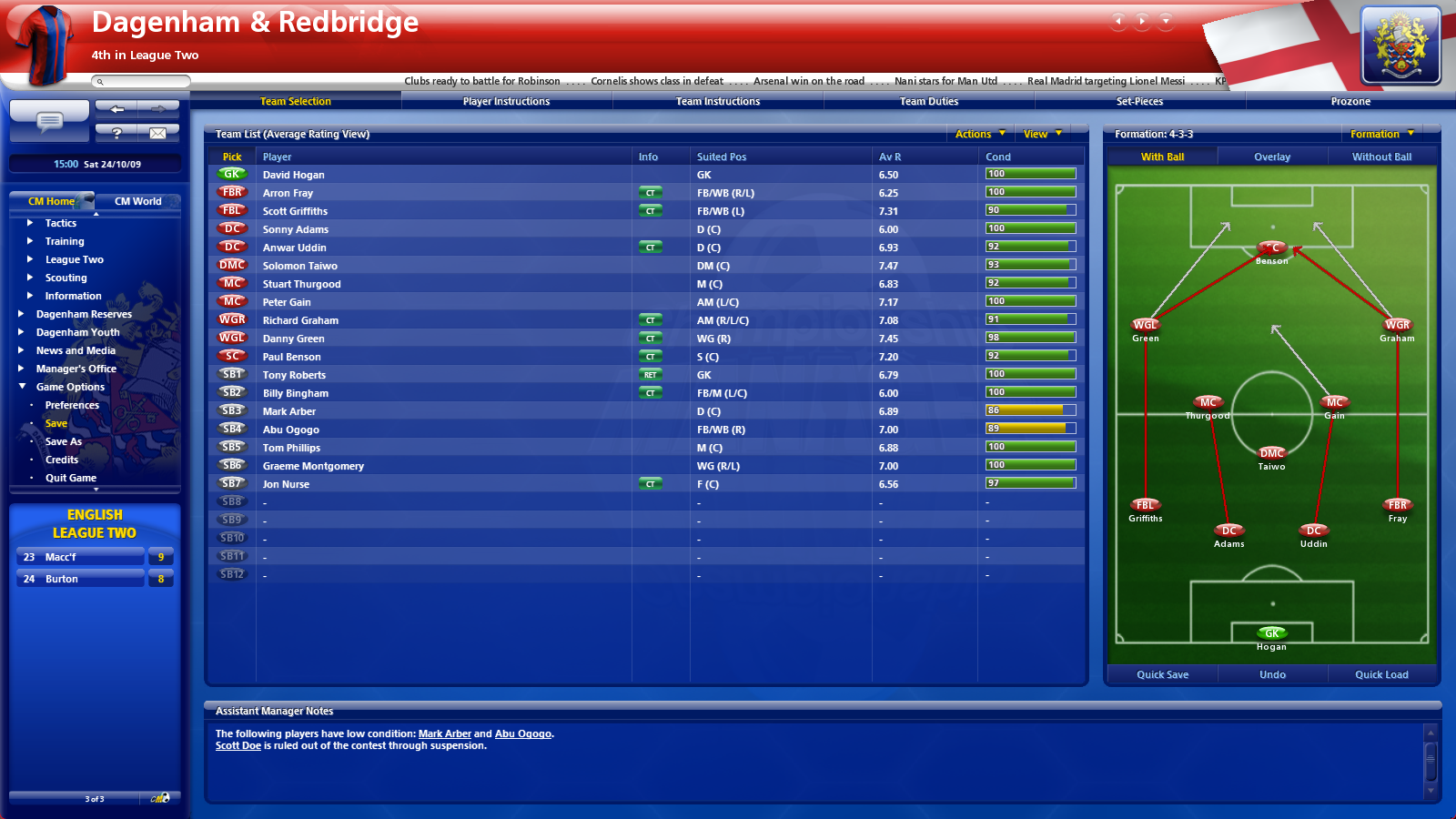
After several underwhelming releases, Eidos and BGS at least tried to push the boat out with CM10. The extra development time allowed them to add in some intriguing and game-changing new features – some of which didn’t make their way into Football Manager until several years later, if at all.
Take, for example, player interactions. If a player has an issue (e.g. they feel the club lacks ambition, or they want more first-team football), you can talk to them to try and address it. You can tell them there’s nothing to worry about… or alternatively, you can make them a promise that you’ll be expected to keep to.
Then there is the set-piece editor. This allows you to set up various free-kick and corner routines step-by-step. You can even watch your team practice these routines, so you can get a good idea of how they might work in matches.
You’ll also get plenty of feedback from the board about your performances. It’s a nice touch, sure… but expectations were so low at Dagenham & Redbridge that my chairman would praise me quite often, even after losing 2-0 at home to Port Vale. He was even kind enough to wish me a happy birthday when Virtual Christopher turned 30 in April!
It’s easy to keep in touch with what’s happening elsewhere too. The little widget on the bottom-left frequently updates with league standings and stats, and the ticker near the top of the screen gives you the latest news stories. CM10 is a game that encourages you to immerse yourself within its world.
WHAT I DIDN’T
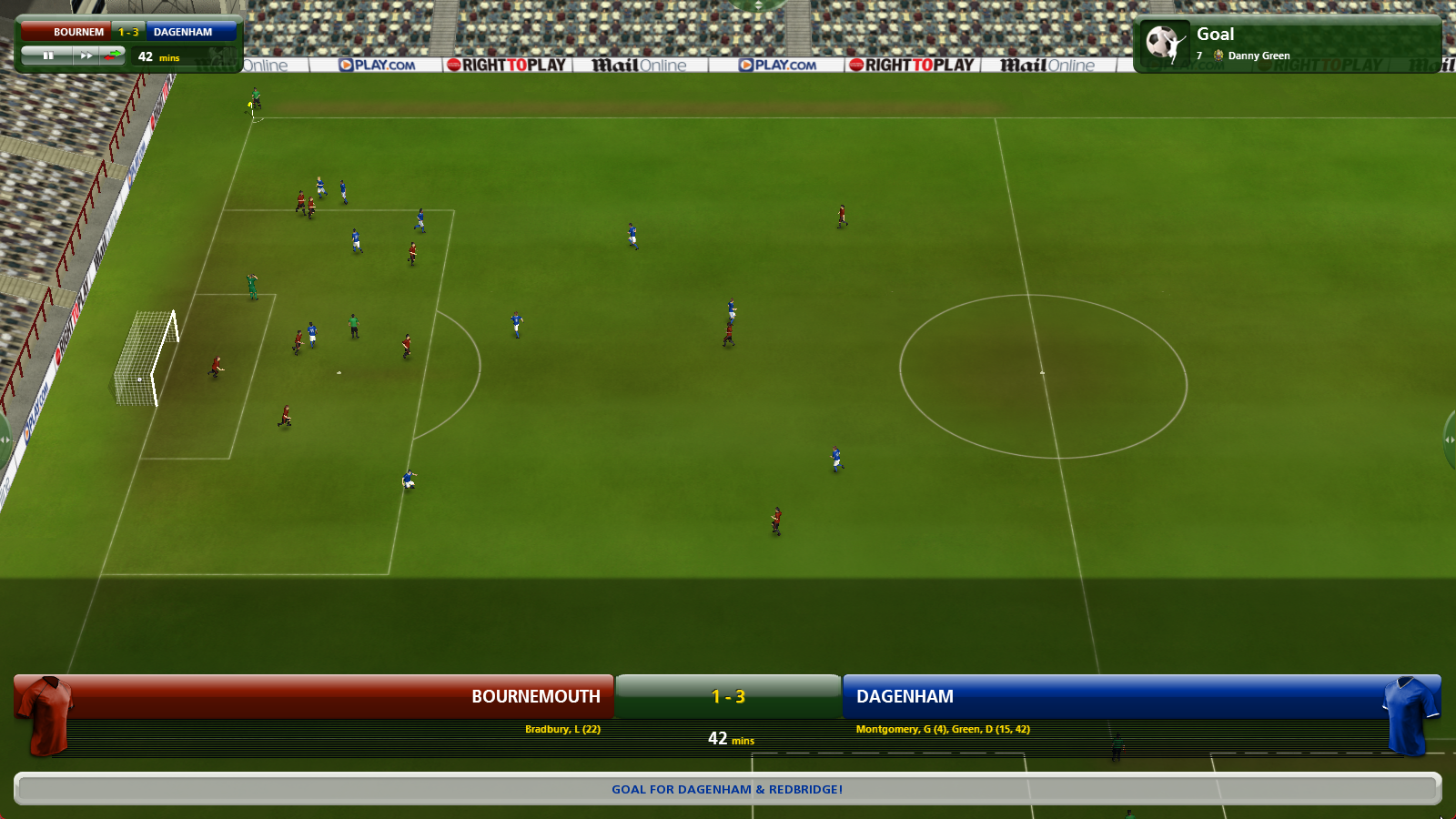
A poor match experience seems to be a common theme with these Fuller FM Retro Reviews, but CM10’s match engine truly is special. There are so many things that will either make you burst out laughing or sigh in exasperation – whether it’s goalkeepers flapping about hopelessly, or players controlling the ball as if their bootlaces have been untied.
Some issues will even be familiar to those of you who are frustrated with FM24. Defenders make too many suicidal passes and seem particularly incapable of defending against long balls to fast strikers. Many goals tend to come about more through luck than skill.
But while AI managers in FM24 can be reluctant to bring on substitutes, their CM10 counterparts are far too trigger-happy. Expect them to make substitutions within the first 5-10 minutes of a game, and change formations more often than Madonna changes her outfits.
Then there are the injuries. Good lord, the injuries. By the midway point of my first season with Dagenham, I was contending with one or two new injuries every week – with at least half my midfielders on the sidelines at any given time.
It’s even more frustrating when your assistant manager’s in-game advice is often confusing and contradictory. He’ll tell you that your player has picked up a knock but should be okay… and then BAM! 15 seconds later, my new signing Simon Johnson has to come off injured for the seventh time in three months.
Also, be prepared to witness A LOT of boring draws – especially if you’re not managing one of the elite clubs. Lower-league teams are so evenly matched (and so poor at finishing) that around 25-30% of matches end in ties, with some teams grinding out 20+ draws in a season.
Team talks leave plenty to be desired. While you can either laud or lambast your team for various reasons, I’m confused by the lack of neutral or sympathetic responses. In terms of individual player talks, you can only give generic praise, criticism or encouragement. I wish there was an Alex Ferguson option to kick a boot at that player whose mistake cost you the game.
Away from matches, the user interface looks nice and sleak in places, but the drop-down menus are a pain to navigate. Player profiles aren’t great either – with their attributes on one tab, and their value and wages on another, even though there’s enough space to fit them on the same page.
WE MUST TALK ABOUT…

Transfers. It’s always a challenge to build even a semi-realistic transfer system, but things can get particularly wacky on CM10.
Some of the craziest transfers I saw early in my save included ex-Tottenham striker Frederic Kanouté signing for Arsenal, and Birmingham bringing a 37-year-old Rivaldo to St Andrew’s. Then there was free agent Michael Owen turning down Manchester United to play for Chivas in Mexico! At least he didn’t end up running a drug cartel at Deportivo Cali like poor old Robbie Fowler!
Meanwhile, the news ticker once alerted me that Real Madrid were trying to sign Lionel Messi from Barcelona… though that one obviously didn’t happen. At least it’s good to know that groundless transfer rumours happen in-game like they do in real-life!
To end this review on a somewhat positive note, I found transfer negotiations to be realistic and not too simplistic, but also not dragging on for too long. Scouting players to unearth a hidden gem in free agency was also quite satisfying (especially compared to another football management game from 2009).
SUMMARY

Frankly, I’m not surprised that CM finally conceded defeat to FM after this release. Even the best version of the Beautiful Game Studios series is still a poorly-executed mess that barely resembles football at times.
Despite a promising start during my early days at Dagenham, CM10 only left me more and more frustrated as the first season passed by. I was impressed with the slick presentation and some innovative features, but the match engine slapstick wasn’t something I could persist with for the long haul.
Well… I guess that’s what 89 pence buys you these days.
FULLER FM RATING: 2* – National League.
That was my retro review of Championship Manager 2010. If you remember this game and have any thoughts you’d like to share, please post them below or tweet me @Fuller_FM.
Please come back to Fuller FM soon, when I’ll be playing another Championship Manager game – one of the GOOD ones, that is.
 Fuller FM
You must be logged in to post a comment.