

Being successful in Football Manager isn’t just about signing the right players and building tactics that best suit their skills. You also need to show good people management to keep squad morale high, while also ensuring that your players are motivated and confident.
Player interactions are becoming increasingly important in FM. It’s vital know how to praise your players when they’re doing well, encourage them when they need picking up, and even discipline them when they deserve it.
Any top manager knows how to strike a good balance between punishment and reward. Being too harsh on your squad can create discontent and destroy team confidence, while constantly showering your players with praise can make them complacent and maybe even see you as a soft touch.
If you are struggling to handle player interactions, I’m here to help. Today, I have some tips for building up player relationships through interactions, including quick chats and promises. I also have a word of warning for those of you who like to reach for the water bottles after a defeat!
DON’T PRAISE TOO OFTEN

Sir Brian May probably wasn’t thinking about Football Manager when he wrote “Too Much Love Will Kill You”, but that philosophy does apply to FM. To a point.
Some FMers tend to praise their players every time they have a good match or get a high training rating. At some point, the player might react negatively to all this positivity and actually lose morale. The manager might then wonder, “What the hell is wrong with them?”
The thing is… praise isn’t always good for everyone. Perfectionists typically have high expectations of themselves, and they might prefer to be left to their own devices rather than being showered with praise they feel they don’t deserve. A 7.0 match rating might be good enough for Dele Alli, but probably not for Zlatan Ibrahimović.
As someone who is on the high-functioning end of the autism spectrum, I can understand this. When I was at school, I would often be given work that I found far too easy and untaxing, and any praise I got from my teachers felt rather condescending. Later on, I would even feel embarrassed if I got a positive response to a college assignment when I felt I could’ve done more.
Overpraising can also have negative side-effects on players who aren’t perfectionists. It can breed overconfidence, which can lead to complacency, which can lead to unexpected mistakes and slumps in form. There is also no need to praise any player whose morale is already ‘superb’.
Usually, I will only praise a player for a good match performance (a rating of 7.5 or higher) once every three or four matches. Likewise, if I decide to praise a player’s training performance, I won’t repeat that praise for another three weeks. I might set the rating threshold a bit higher or a little lower depending on the player’s personality.

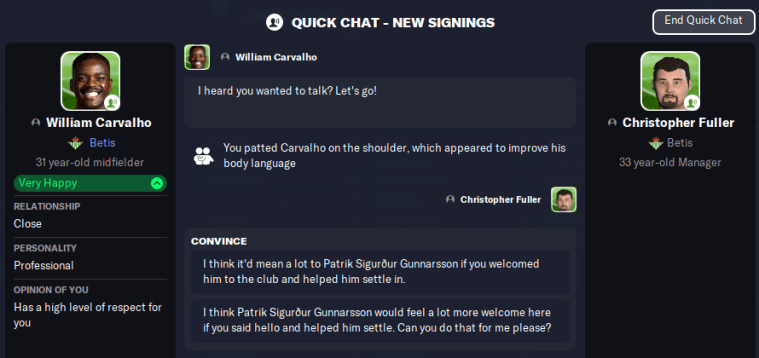 Whenever you’re chatting to a player, you can use a gesture to greet them. For example, if you want to praise their form, you might offer a handshake or put their arm around them. If used effectively, this can improve their body language, and perhaps make them more receptive to what you have to say.
These gestures were introduced in FM21, and I’ll admit that I have never really understood them. Thankfully, Rock’s End FM wrote a handy guide to player interactions on Dictate The Game last year, which gives some advice on which gestures to use in which situations.
For example, if you’re praising a younger player, you might want to greet them with an informal embrace. If you’re criticising them for something, a warmer gesture might soften the blow and help them accept the feedback.
With older, more established players, you might want to be a bit more serious. When you’re asking a team leader to do something for you (like welcoming a new signing to the club), a simple handshake or a pat on the shoulder will probably do.
DON’T BE TOO HARSH EITHER
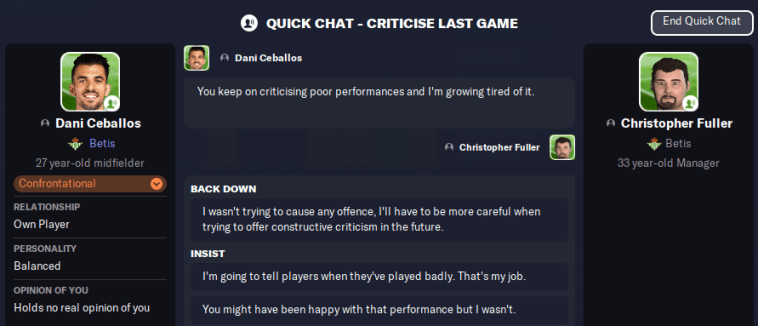
You should also be wary of going the other way – and criticising your players too much.
Chastising your players after a poor performance can motivate them to do better next time. However, they might bite back if they feel the criticism is unfair – perhaps because you singled out the wrong part of their performance, or because they felt their overall game wasn’t too bad. This could damage the player’s morale, and their relationship with you.
Just like with praise, criticism should be used sparingly to have a meaningful impact. I usually only criticise a player if they deliver a match rating or training performance of 6.4 or below – and I only do that a maximum of once every two weeks. Any more than that, and the player might turn into Alexander O’Neal, or complain about being treated unfairly. Nobody likes getting berated every week!
And just like with praise, a player’s personality plays a big part in how they respond to criticism. Professional players may take any negative feedback on board and up their game. A player with poor Temperament or Professionalism may become angry at being called out, so you may want to take a softer approach if they have a “Confrontational” or “Volatile” media-handling style.
You also shouldn’t be as harsh on younger players who haven’t yet matured emotionally, or anyone whose morale is particularly low. If you have to comment on their poor form, just reassure them that you “have faith” in them, instead of threatening them with the bench.

You could go a step further, by warning or even fining players for poor performances (a 6.5 match rating or lower). This can instantly increase their Determination, Work Rate or Professionalism, and thus be more effective in the long-run than simply criticising them in a quick chat.
I find that issuing a warning is usually enough punishment for a bad game. I will only consider fines for particularly bad performances (a rating of 6.0 or lower), and only if the team fails to win. I also NEVER dock players more than one week’s wages.
The maximum fine you can give your players is two weeks’ wages. In real-life, that is usually reserved for the worst offences (e.g. violent conduct, going AWOL, animal cruelty). Docking your star striker a fortnight’s pay because they missed a sitter or misplaced a few passes is rather draconian, even by Warnock standards.
In FM, a two-week fine for a poor performance almost NEVER works, and it will only make your player VERY unhappy. After all, how would YOU feel if your boss caught you slacking off at work (or reading a mediocre blog from a football video-game enthusiast) and refused to pay you for a fortnight?
DON’T LOSE YOUR BOTTLE
When it comes to team talks, you have several gestures to choose from to emphasise your message to your players. The angriest gestures you can use are ‘Thrash arms’ and ‘Throw water bottle’.
If you’re a long-time reader who followed my FM21 journeyman series, you might remember just how frequently my manager would reach for the water bottles after a defeat. At first, I thought that option was just an extreme version of thrashing your arms… but it’s not that simple.
‘Thrash arms’ is the standard aggressive team talk. It’s best used for chastising your players after a very poor result and performance, as long as your players aren’t too nervous and morale isn’t too low.
‘Throw water bottle’ is more of a shock tactic – a motivational tool designed to combat complacency. If your team is making heavy weather of much weaker opposition at half-time, and several players are looking complacent, that’s the ideal time to send a water bottle in their direction. If that doesn’t shake ’em into life, nothing will!

While you can hurl plastic at your team after a defeat, you should do this very sparingly – and only in the right context. Doing this after losing a long unbeaten run might be cathartic at least, but doing this after a 4-0 defeat at Manchester City when you’re fighting relegation would be like throwing petrol on a bonfire.
Bombarding players with bottles will not improve their morale – after all, the idea is to fire them up and keep them alert. Don’t be too surprised if some of your less professional players take offence and complain. They might even ask you to tone down your team talks if they believe you’re being too harsh too often.
Naturally, I would advise against throwing too many water bottles when you’re in your first season at a club. Too many angry team talks can seriously damage your managerial support, and your players may resent playing for you. Losing the dressing room early on will cost you a lot of matches – and, eventually, your job.
BUILDING RELATIONSHIPS
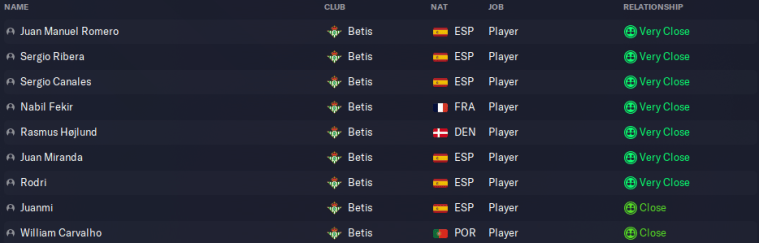
When you start a new job, your players will not have any particular opinions of you. As you interact with them and get to know them, relationships will form – and your players will become closer to you if your conversations go well, or drift further away if they don’t.
Players who have a ‘Close’ or ‘Very Close’ relationship with you may be more open to informal, friendly gestures. They may also be more understanding of any criticism you level at them.
On the other hand, if too many interactions with a player go badly, they might become ‘Distant’ from you. You’ll then have to tread carefully in future conversations to win them over, otherwise they could become an ‘Adversary’ who won’t enjoy working with you – or worse, a ‘Rival’ who shows utter contempt towards you.
It’s usually best to get rid of any adversaries ASAP to avoid upsetting the apple cart. But if you really want them to stick around and grow to like you, plenty of time and patience is required.
When I was managing Győr on FM21, I signed a Romanian goalkeeper who sat on the bench for the first half of his first season, got very annoyed, and became an ‘Adversary’. George Kovács eventually got his chance in February, quickly becoming one of our most important players – and his relationship with me had shot up to ‘Close’ by the time Bayer Leverkusen met his release clause a year later.

While we’re discussing player relationships, I thought I’d address one of the most popular memes in the FM community. That meme where you congratulate your players on making their international debuts (or scoring their first international goals), and they react as if you had vomited on their mothers’ graves.
To be honest, I can’t say I have noticed this reaction very often on my FM saves – probably only once or twice in the last decade. Most of my players (like Basel’s Raul Quevedo from FM21) will say they are grateful for the praise and proud to have represented their countries.
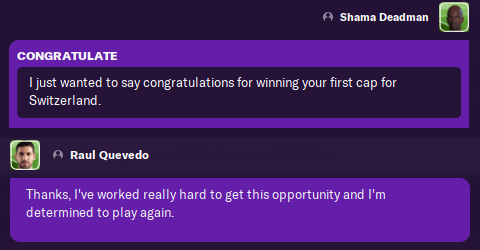
There are a few reasons why certain players might react badly to this conversation. If you’re a new manager with a much lower reputation than your international star, they might not respect you enough to care about your praise. Because of this, I won’t congratulate any international debutants until I’m in my second season at my club and have established a rapport with my squad.
Certain players with poor Professionalism and/or Temperament might feel they are being patronised. They might also be rather grouchy if they had to wait a particularly long time for their first cap. This is not an unusual situation on FM23, where good players from top nations are rarely even considered for international duty until they turn 23.
At any rate, congratulating a player on their first cap won’t suddenly make them hate you and request a transfer, no matter how much you balls it up. However, the same cannot be said about this next feature…
PROMISES, PROMISES

“It’s got me going insane, I think it’s happening again…”
Occasionally, you might have to make certain promises to your players. They might have certain demands when joining your club or renewing their contract, or you might have to promise them something to keep them around if they become unsettled. You’ll then have to meet that promise within a certain timeframe.
If you fulfil a promise, the player will trust you more. If you break it, however, they might become upset or ask to leave – and influential players might even unsettle some of their friends in the dressing room. Breaking multiple promises could completely destroy a player’s relationship with you.
Some of these promises are pretty simple to understand, like “Qualify for UEFA Champions League” or “Fair increase in playing time”. You can also promise to sell a player if they have been unsettled by bigger clubs… but the player can also cancel that promise if their potential suitors seem to have lost interest.
Unfortunately, the goals for meeting other objectives are rather less clear – perhaps even broken. I don’t think anyone knows just how close to the league leaders you have to be to “challenge for the title”. Four years after Federico Chiesa moaned about my FM19 Fiorentina team losing out on the Serie A scudetto by just six points, I’m still none the wiser.

Another promise that can trip you up is when you tell a player you will “improve the squad” in a certain position. If you’ve promised to strengthen your defence, it’s not clear exactly how good your new defenders need to be – or how many better defenders you need to sign.
Likewise, you shouldn’t promise your new goalkeeper that you will strengthen the goalkeeper position. The player you’ve made the promise to WILL NOT consider themselves to be strengthening their position. I made this rookie mistake on FM17, when I signed Crewe’s goalkeeper Ben Garratt for my Millwall team, upset him immediately, and then had to sell him to Reading just six months later.
To be honest, Football Manager’s promises system is so messy that I would be cautious before offering or even accepting them. DO NOT make a promise unless you are totally confident that you can – and will – keep to it. If you’re negotiating with a player and their agent has locked in a promise that you’re not sure about, just walk away and look elsewhere.
If this guide has been useful to you in any way, feel free to leave a comment below. Perhaps you might want to offer up some tips of your own. You can also find me on Twitter @Fuller_FM… so long as Elon hasn’t destroyed everything by the time you read this.
 Fuller FM
You must be logged in to post a comment.