

It’s time for another Fuller FM ‘Retro Review’, where I replay a classic football management game from years gone by. I’m particularly excited about this, because it’s an absolute doozy!
Today, I will be looking back at a game that many people who grew up in the late 1990s still remember very fondly. This was regarded as a serious contender to Championship Manager, even daring to go places where Sports Interactive would not.
We’re going back to the year 1998 – a time when northern punk anarchists Chumbawamba were getting knocked down (and getting back up again), and when Dennis Bergkamp was doing Dennis Bergkamp things. This is Ultimate Soccer Manager 98.
BACKGROUND
USM98 was published by Sierra Entertainment, and developed in the UK by Impressions Games. Older readers may know Sierra and Impressions for their classic ‘City Building’ series – including titles such as Caesar, Pharaoh and Zeus: Master of Olympus – which allowed you to construct cities in great ancient civilizations. Sadly, plans to develop a similar game based in Sunderland never got off the ground.
Impressions’ first football game was Kenny Dalglish Soccer Match, which was released on various systems in 1990. Their next such title – and their first attempt at a management sim – was 1995’s Ultimate Soccer Manager. That was moderately successful, as was the following year’s sequel, imaginatively named Ultimate Soccer Manager 2. However, it was the third iteration that really lifted the series to cult status.
USM98 was first released in early 1998, covering teams, players and statistics for the 1997/1998 season in five European leagues. Later that year, an update disk was released which fixed some bugs, added two more leagues, and updated the data for the 1998/1999 season. I have played the updated game for the purposes of this review.
Unlike the previous two games (which ran on MS-DOS), USM98 could be played natively on Windows 95 and Windows 98. The game was often included in software bundles that came free with new Packard Bell PCs around this time, which certainly helped build a loyal fanbase.
Sadly, there would be no follow-up to USM98. The fourth installment, which was said to have had “an all-new 3D match engine with advanced Artificial Intelligence”, was planned for release in late 2000. However, Sierra’s UK branch canned it after they lost patience with Impressions’ development process.
Both publisher and developer went out of business in 2004, which means that USM98 has essentially been abandonware for several years now. While you can freely download the full game on *ahem* certain websites, I managed to find a second-hand copy on sale for just 4 quid.
STARTING OUT

When launching the game, you are met with a disclaimer message that partially reads, “This is a fantasy game. The use of real names for players, managers and clubs does not imply and should not be taken to imply… that any of them have engaged or are liable to engage in any corrupt practice.” Bear that in mind for later on.
You then have the option to play as either a manager or a coach, though bear in mind that you cannot change this later. The big difference is that a manager in this game can rebuild their club’s stadium, set food and merchandise prices, and negotiate with sponsors. A coach is only in charge of transfers, training and squad management.
In the original game, you can manage any league club in England (down to the Conference), France, Germany, Italy or Scotland. The update disk also allows you to manage in the Netherlands or Spain. You can add up to eight human managers in the same save, on the off chance that you either have seven friends or A LOT of time to kill.
Having created your manager and chosen your club, the last option you have before entering the game is to select one of six difficulty levels, ranging from ‘Grandmother’ to ‘Real Hard’. Simply put, it dictates your starting transfer funds. The easiest setting gives you a £20million kitty, which would allow a lower-league manager to go nuts in the transfer market. The hardest setting leaves you penniless and having to make do with your current squad.
All players have a preferred position and are rated on various attributes. Essentially, the key attributes for each position are Keeping (goalkeepers), Tackling (defenders), Passing (midfielders) and Shooting (physios… er, forwards).
When viewing your squad for the first time, you will have to spend some time reorganising the starting line-up, as all your players will be jumbled up in the wrong positions. An unwitting new Manchester United manager might dive straight into the first game of the season, only to realise that David Beckham is keeping goal and John Curtis is up front!
WHAT I LIKED
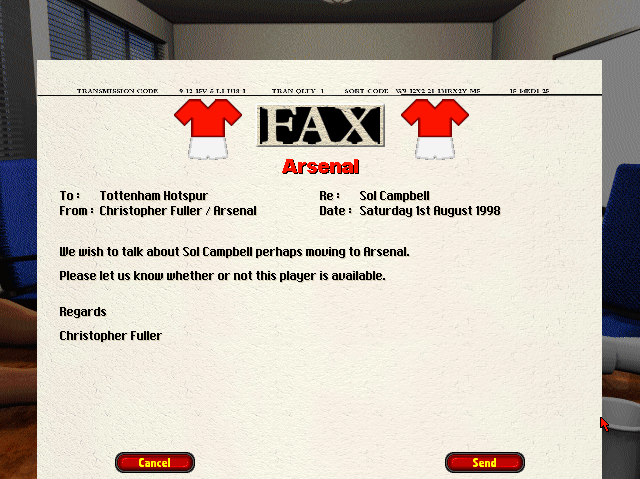
While the rival Championship Manager series was heavily text-based, USM’s big selling point was its graphical interface. Screens are presented as if you are actually at the stadium, with various rooms allowing you to undertake certain actions. For example, you can conduct transfer business in the boardroom, and you can set your matchday squad in the dressing room before going down the tunnel for kick-off.
Entering your office allows you to view your team’s fixture list and take phone calls from the chairman, who’ll usually berate you after a poor result. Clicking on the TV activates ‘teletext’, where you can view league tables, player statistics, et cetera. (If you were born in this century, ‘teletext’ was a bit like the Internet, only without as much porn, banter or Katie Hopkins.)
On USM and USM2, transfers could effectively be completed in a day, but that wasn’t the case on USM98. To buy a player, you have to exchange faxes with the club over several in-game days to negotiate a fee. Then you must wait a few more days before the player’s agent faxes you to open contract negotiations (if the player is interested in joining, of course). The longer process might be frustrating, but it adds to the sense of realism.
It’s worth keeping a close eye on the transfer list, because every now and then, you may find a quality player who could be available on the cheap. Keeping tabs on any player whose contract is expiring might also be a good idea. While they won’t immediately become a free agent when their existing deal expires, you will be able to approach them directly and potentially get them through the door without coughing up a transfer fee.
Nearly 25 years on, the usage of obsolete technology such as teletext and faxes really dates this game. Back in 1998, however, they made for a visual treat that gave budding football managers a serious alternative to the admittedly bland CM. Some people would even argue that it looks better than Football Manager does today… but hey, let’s not get into that debate!
One other neat feature CM lacked was an ‘Instant Result’ function. Instead of having to watch every match live, you can simply go through the right-hand door while in the tunnel, and the game will quickly simulate the outcome. From personal experience, instant-resulting matches tend to simulate more realistic results than watching them live, where goals seem harder to come by at both ends, no matter which tactics you use.
WHAT I DIDN’T

Unfortunately, it’s during the live matches themselves that USM really lets itself down. Animations are incredibly basic, with players often moving in straight lines. There is also only one goal celebration, with everybody from Alan Shearer to Hednesford Town’s right-back insisting on sinking to their knees as soon as their shot find the net.
Like in most football games outside of the FIFA series, the voice commentary is appalling – imagine a hyperactive Mark Pougatch – though that can be easily switched off in the settings. Now that I think about it, you might also want to turn off the quintessential 90s music as soon as you can, otherwise you’ll be hearing the same tune over and over (except for when you’re in a match).
Results sometimes feel a bit random and bewildering, as became clear during my time as manager of defending Premiership champions Arsenal. We lost to Middlesbrough at Highbury, but recorded a couple of wins over Manchester United, who romped to the title without losing any league games against other AI teams. Oh yes, and we lifted the League Cup and the European Cup – two trophies that famously eluded Arsène Wenger. Go figure.
Also, while it is possible to move clubs in USM98, you can only do that at the end of the season. If you are sacked before then (which – thanks to an unfortunate bug – could happen if you are too successful), the game will end. In that case, you will have to reload from an earlier point if you want to continue your save.
There are a few other glitches that can damage long-term saves. Generated youth players never become as good as the originals, and the name pools get horribly jumbled up, so expect to see various English regens with names like Bjørn Tore Hamilton. An even bigger bug in the original release meant that save games would consistently crash during the 8th season, though this was later patched out.
WE MUST TALK ABOUT…

Bungs. Remember that disclaimer? Impressions had to put it in there because – uniquely among football management games at the time – there was a function that basically amounted to match-fixing.
If you are playing as a manager, you can use the mobile phone in your office to place bets on your next match. Theoretically, you could bet on your team to lose a match you’re expected to win, and then field a weakened line-up to ‘throw’ said match and generate a tidy profit. Don’t do this too often, though, otherwise you might be exposed – and sacked in disgrace!
Even more controversially, you can also offer an opposing manager a ‘bung’ to either deliberately lose a match (à la Marseille in 1993) or sell you a player (think George Graham at Arsenal). Again, you run the risk of losing your job if you get found out, though I have never tried this personally.
Imagine if this was a feature on Football Manager 2023. Then imagine all the lawsuits Sports Interactive would face from dozens of players, coaches and clubs. Now you can probably understand why this never caught on!
SUMMARY

For all its flaws with regards to the AI, Ultimate Soccer Manager 98 is a very fun, quirky game that looked and (often) played great at the time. The somewhat dated graphics retain a lot of charm and will transport you back to an era before the Internet became mainstream or mobile phones served multiple purposes.
While this game simply will not work on Windows 10 or 11, you can get it running again using a Windows 95 or 98 virtual machine. Aside from the odd minor graphical glitch, I had no problems with that method.
FULLER FM RATING: 4* – Premier League.
Those were my thoughts on Ultimate Soccer Manager 98. If you played this game back in the 90s, feel free to share your memories below or tweet me @Fuller_FM.
 Fuller FM
You must be logged in to post a comment.