
While the Football Manager 2023 hype train has started, my FM22 series with Arsenal is still going strong – and things are arguably just heating up!
Today’s chapter takes us through the first half of the 2025/2026 season, which I previewed in the last installment. Unfortunately, we lost the Community Shield to Liverpool, but that won’t matter if we can finally knock them off their Premier League perch.
There are plenty of questions that need to be answered. Can we continue to frustrate the bigger teams? Can we find some consistent scoring form against the weaker teams? And is 19-year-old Sean Fallon ready for the Premier League?
RESULTS: AUGUST TO DECEMBER 2025
PREMIER LEAGUE

Our league season began with a 3-1 win over Fulham that was less convincing than the scoreline suggests. We were once again wasteful in front of goal, with captain Declan Rice having to come off the bench to secure the points late on. Oh, and this happened…
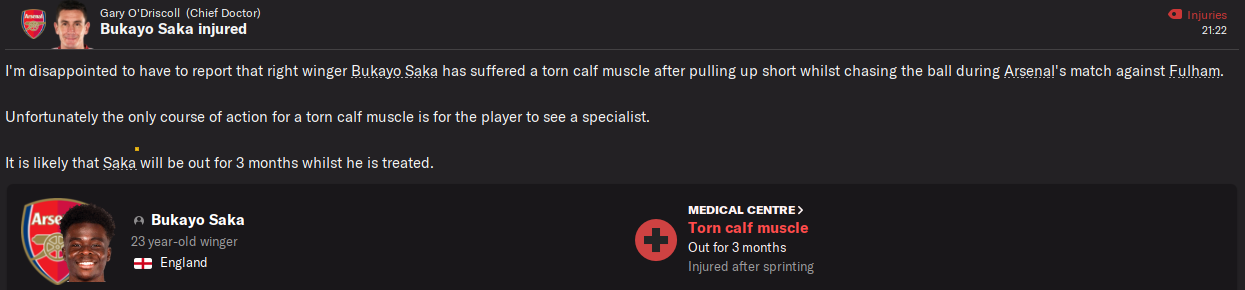
That’s Bukayo Saka out until November. Can he ever catch a break?
For the next two months, our form was fantastic at home but frustrating on the road. At the Emirates, we put SIX goals past Brighton, FIVE past nemeses Southampton, and FOUR past Wolves. Away from home, we slipped to three successive 1-1 draws, and needed an injury-time screamer from right-back Takehiro Tomiyasu to save a point at Everton.
Despite that, we were flying high in 2nd place and still undefeated… until we ran head-first into the ‘Big Two’. Liverpool outclassed us 2-0 at the Emirates, while a single Karim Adeyemi strike was enough for Manchester City to win at the Etihad. The final score could have been more than 1-0, but for some other-worldly goalkeeping by Aaron Ramsdale…
Next up, Tottenham away. Our defence shut the Spuds out while Eddie Nketiah tore theirs to shreds, and everything was going swimmingly as the referee blew the final whistle on a 2-0 Arsenal win… and then my computer switched off.
Yeah, there was an unexpected power cut at Fuller FM HQ – an odd way to mark the one-week anniversary of the Queen’s death, if you ask me! Anyway, I had to replay the match, and we won by a two-goal margin again, though the final score was 3-1 rather than 2-0. Ah well.
We left it late in our next three games, starting at home to Leeds, who stubbornly held firm for 78 minutes until a fit-again Saka scored one of three late Arsenal goals. We then needed a couple more late strikes from Folarin Balogun and a fit-again Yunus Musah to save 1-1 draws against Newcastle and Manchester United, before a similar result at home to Chelsea.
2025 ended with three high-scoring away wins against bottom-half opposition, giving Eddie the chance to fill his boots again after a patchy run of form. Credit also to our playmaker Martin Ødegaard, whose hat-trick turned things around against Bournemouth.
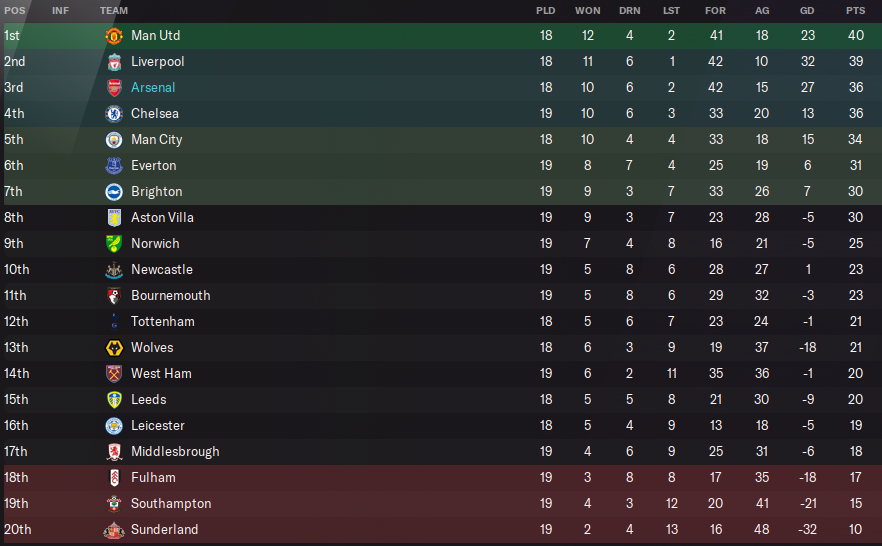
We head into the second half of the season sitting in 3rd place – four points off the lead. We’re the joint-top scorers in the league behind Liverpool and have played like genuine contenders at times, but we’re also dropping too many cheap points away from home.
Manchester United have not won a major trophy on this save yet, but with Erling Haaland scoring a ludicrous 18 goals in 16 games, their fortunes might be about to change. Mind you, Liverpool are only a point behind United – their only defeat coming at Manchester City, who’ve been suffering their own away-day blues.
Meanwhile, it’s turning into another hilarious season at Spurs, who’ve sacked Roberto Mancini after slipping to 12th. Rumour has it that Thomas Tuchel will be next in the Tottenham hotseat – and he’s got to turn things around quickly, else they could be dragged into a relegation scrap.
CHAMPIONS LEAGUE

Huh… that was easy.
While we were struggling to score consistently at home, we were blowing all our Champions League opponents away. We won all of our first four group games, scoring four goals in each of them – even doing it home AND away against top seeds Porto.
That home win over Pep Guardiola’s Dragons was the most satisfying. Musah announced he was back to his best with a hat-trick, and a 4-1 demolition was rounded off with some classic Wojciech Szczęsny goalkeeping!
Having secured 1st place with time to spare, I used the final two group games to rotate my team and blood some of our younger talents. Though they were held to a 1-1 draw at Galatasaray, they produced a great comeback from 1-0 down to demolish Dynamo Kyiv 5-1 – with Mexico teenager Diego Rizo scoring THREE goals on his first Arsenal start!

Now that’s what I call emphatic – six matches, 16 points, 22 goals! Only Liverpool (26) and Juventus (25) scored more than us in the Group Stage. And what was our reward for such an impressive record?
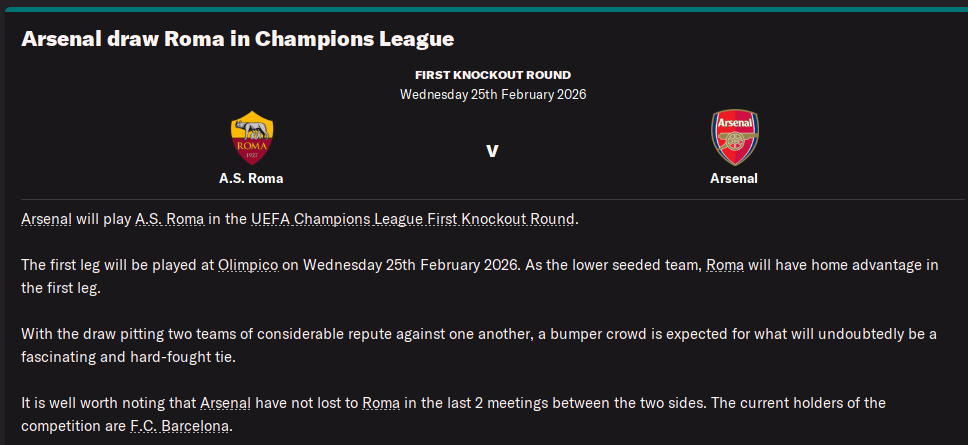
A Round of 16 tie with Roma, whom we beat twice on our route to the Final three seasons ago. The Giallorossi are mid-table in Serie A, and have just hired Zinedine Zidane to replace Tuchel as their head coach. I’m not too worried about them.
EFL CUP

There was nothing easy about our EFL Cup campaign. Once we were drawn away to Liverpool in Round 3, I knew we wouldn’t be in this year’s competition for long.
A 19th-minute Balogun penalty got a second-string Arsenal team off to a good start, but then Liverpool’s greater class began to show. They were already 3-1 up on the stroke of half-time when Anton Plećaš was sent off for a two-footed tackle. Charlie Patino also saw red late in the second half, so we finished the game with NINE men – and a 4-2 spanking.
Look… let’s just pretend this never happened, alright?
TACTICS & STATS
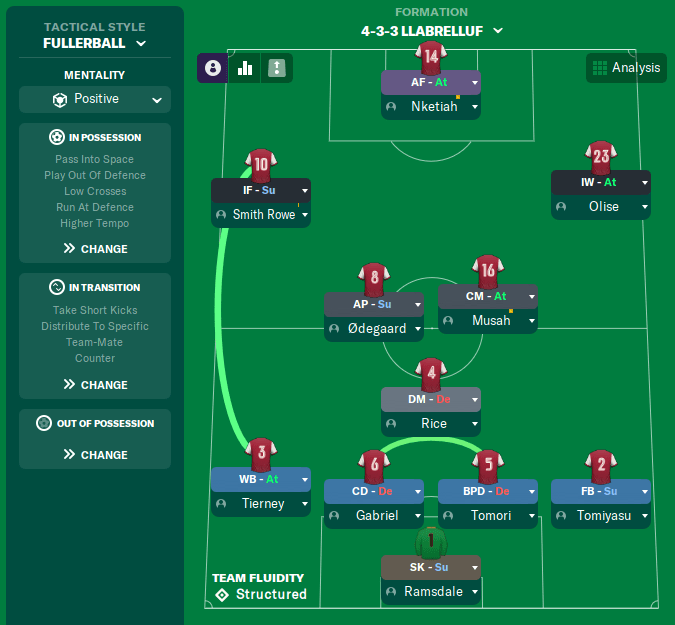

I know, I know… I’ve been messing around with tactics for too long now, but the good news is that I’m almost there. Flipping my tactics around (e.g. having the attacking full-back on the left, and the attacking wide forward on the right) seems to have solved most of our attacking problems.
For one thing, these new tactics seem to be making more use of our right inverted winger. Since recovering from injury in late November, Saka has made five goal contributions in his last six matches. His backup Michael Olise has also been effective in the Champions League, grabbing two goals and four assists in the group phase.
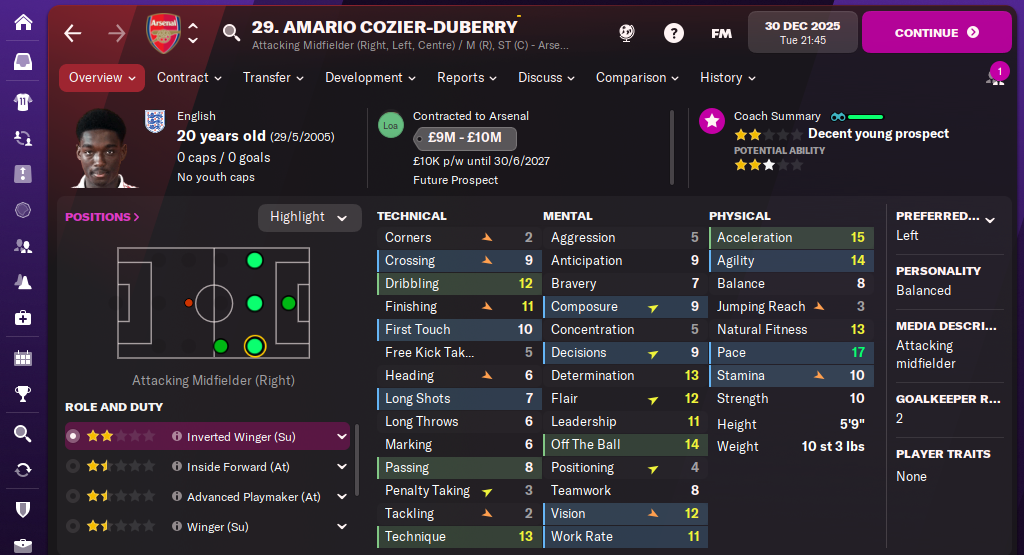
Even 20-year-old Amario Cozier-Duberry plays well whenever called upon, scoring three goals in nine games so far. Amario wasn’t an obvious hot prospect when I started this save, but he’s developed into a pretty handy winger who could yet make it in the Premier League. Another loan spell (perhaps at a top League One club) could do his development the world of good.
These changes haven’t done too much harm to his colleagues on the left wing either. Though Emile Smith Rowe isn’t as much of a direct attacking threat, he’s still contributing enough to satisfy me. Emile also gets plenty of support from the attacking left-back, with both Kieran Tierney and his young protégé Sean Fallon catching the eye.
Nketiah and Balogun haven’t scored as often as I’d have liked, but I feel like it’s only a matter of time before they’re back on top form. While they can be quite effective as Deep-Lying Forwards, it’s a role that neglects their exceptional pace and acceleration, which are their biggest strengths. Our counter-attacks also aren’t as effective when they’re dropping deeper instead of running onto Saka’s crosses.
I don’t think it’s an accident that Eddie got three goals and two assists in his last three games since reverting to an Advanced Forward role. It looks like fast, direct counter-attacks are the way to go with this team.

The undisputed star of this half-season, though, is our attacking central midfielder Yunus Musah. After breaking his leg in April, the US international has returned with a vengeance – 19 matches, 9 goals, 5 assists, and a 7.46 average rating!
But while Musah is fulfilling his very high potential, Patino is still some way off. The 22-year-old playmaker already has more assists than he got last season, but he’s too wasteful with possession and rarely gets any match ratings in the 7s. For someone who was supposed to be Ødegaard’s heir apparent, Patino has flattered to deceive too often.
I should also add that our defence is not as watertight as it was last season, though I’m prepared to sacrifice some solidity for being more prolific at the other end. However, there is one statistic I’m quite worried about…

In the first four seasons of this save, my Arsenal team picked up just FOUR red cards. Less than three months into the fifth season, we had already doubled that tally.
Our issues began in late September, when Plećaš and Patino both saw red in the EFL Cup defeat to Liverpool. In October, Gabriel picked up a pointless second yellow against Wolves in the 93rd minute, when we were already 4-0 up. And a month after that, Scott McTominay tried to cripple Kevin De Bruyne, ending any slim hopes we had of a comeback at Manchester City.
There’s no way to explain the sudden red mist. We’re not a dirty team at all – we have the fewest yellow cards in the PL, and I always make sure to calm down or substitute anyone who gets into the book.
Following his dismissal, I dropped McTominay to our Under-23s for the next month before recalling him for the home game with Chelsea. The Scotland midfielder duly repaid my trust… by losing his head again and conceding the penalty that gave Chelsea a draw. I was not impressed.
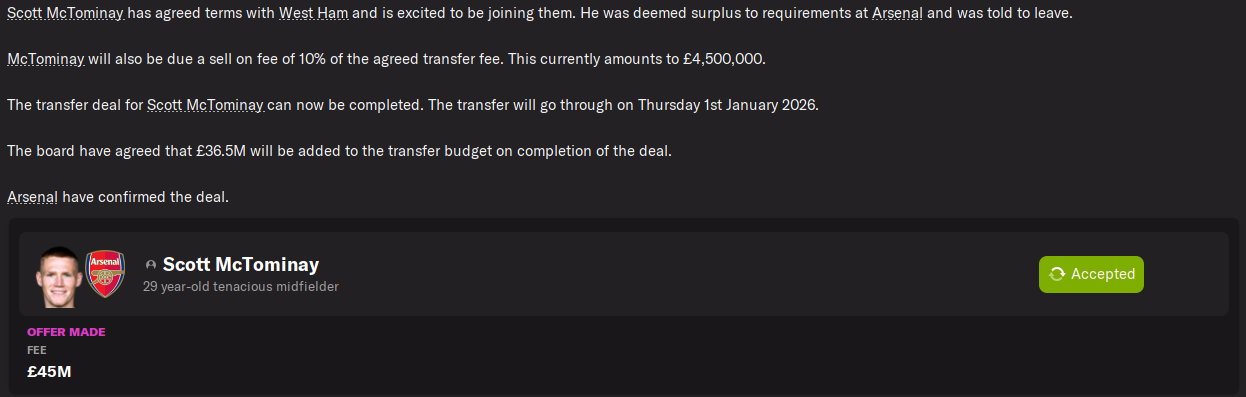
Good riddance, Scott. I always thought you were overrated, anyway.
TRAINING
To end this chapter, I thought I’d let you in on what I’ve been doing behind the scenes, to help get more out of my players on the training field.
Throughout this save, I’ve always managed my team’s training schedules – from the senior team right down to the Under-18s. However, I’ve noticed lately that many of my first-teamers have stagnated, even those who haven’t yet reached their prime years. Even more worryingly, several youth players have either shown very little improvement or even regressed over the last 12 months.
Let’s get things straight. Training on FM22 is nothing like it was on FM21, where you could basically fill your youngsters with military-grade Weetabix and transform them into overpowered monsters before they turned 23. That just does not happen in real-life (*cough*), and player progression on FM22 is much more realistic (e.g. slower).
That said, I felt I could be getting more out of training… so I decided to try out some of Zealand’s training schedules. After making a few tweaks to suit my team’s specific needs, here’s what I’ve been going with:

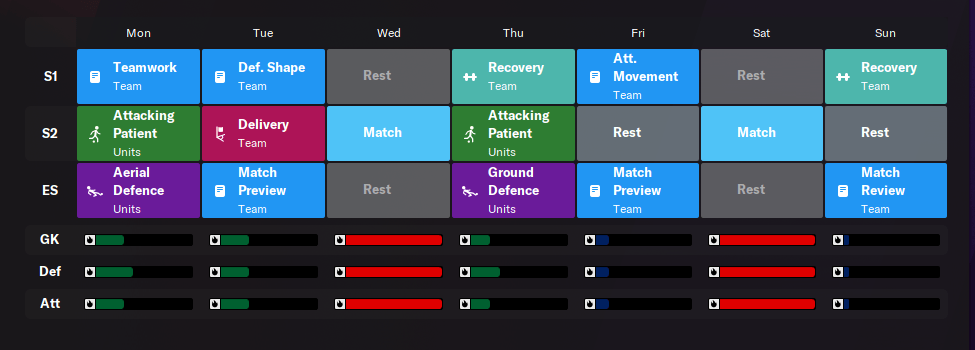
These are the two training schedules I mainly use for my senior and Under-23s teams, switching between them depending on whether we’re playing one or two matches in a given week. I try to give equal attention to the defensive and attacking units, while also making sure the goalkeepers have enough to work on too.
Of course, I might make a few changes from week to week, depending on what the situation needs. If our upcoming opponents struggle to defend set-pieces, we might work on our attacking corners or free-kicks – while if our forwards are struggling with chance conversion, you can be sure we’ll do plenty of Defensive Shadow Play. Hold on, that last bit’s not right…
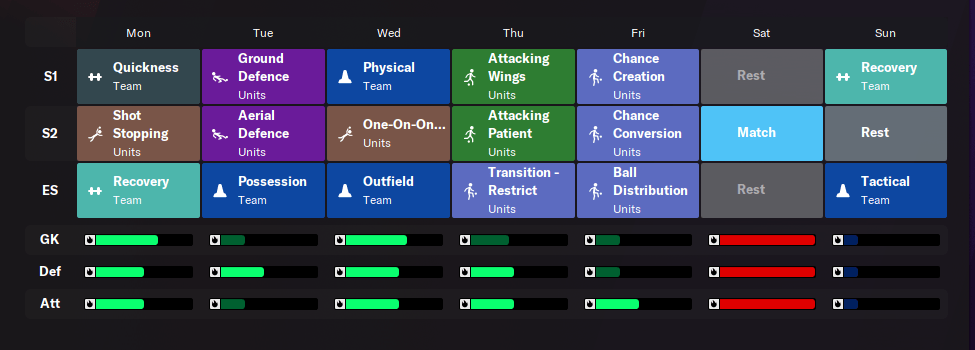
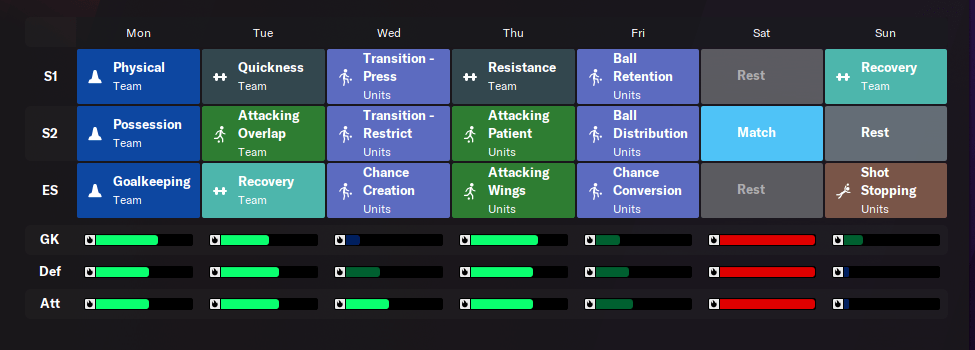
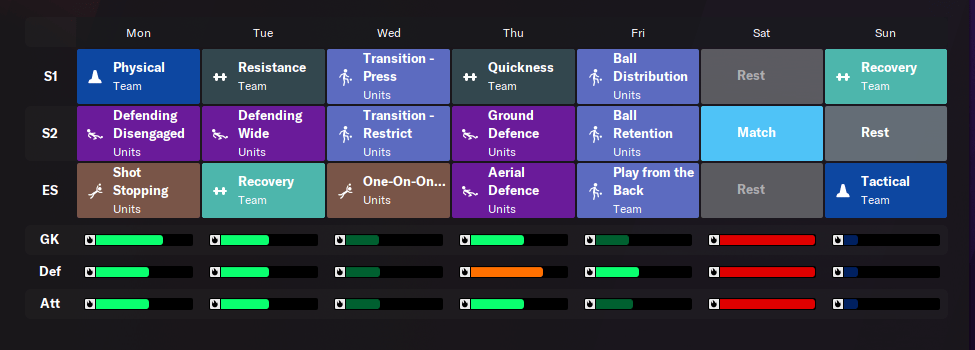

With the Under-18s, I like to mix it up a bit more. They rotate between FOUR schedules – one generic schedule, and three others which respectively focus on developing the attackers, midfielders, and defenders.
All these schedules have a few sessions dedicated to physical training, as physical attributes tend to improve faster while a player is still in their teens. I also make sure that the goalkeepers get some attention too.
After just six months of using these schedules, early results look promising. Our younger first-teamers have got their development back on track, and most of our youth-teamers are starting to make big strides physically. I’d even say we’ve got about three or four players in the Under-18s who could do a decent job at League Two level already.

These training regimes are rather more intense than my previous schedules, so I also needed to give the players much more intense physical training in pre-season. One noticeable side effect is that we’ve picked up more injuries in the first half of this season, compared to last term.
Mind you, that doesn’t tell the whole story. Only 14 of those injuries are described as ‘moderate’ (1+ week out) or ‘major’ (4+ weeks out), while we picked up 17 of those in the first half of last season. Most of the additional injuries our players are picking up are slight knocks or minor training injuries, which may put them out for a single match, but no more.
It’s also worth noting that last season’s injury problems mainly happened from January onwards. I hope that a intense pre-season training will better prepare our players for the second half of this campaign, and help them last longer without getting injured or jaded. The last thing we need when we’re chasing major honours is another of my traditional late-season collapses.
If you want to download Zealand’s original training schedules and try them out for yourself, you can find them on the Steam Workshop using the links below:
- Pre-Season
- 1 Match Per Week
- 2 Matches Per Week
- Youth Defensive
- Youth Technical/Midfielder
- Youth Attacking
- Youth General
To add a custom schedule into your game, navigate to Training > Schedules, open up the drop-down menu, then go to Custom Schedules and click Import Schedule. Load the schedule you want to import, make any changes you want, and then save it.
Your saved schedule(s) will now appear on your list of Custom Schedules, ready to be selected for any game week you want. Don’t forget that you can edit any saved custom schedules from the Schedules tab, or even delete them if you don’t need them anymore.

After a promising first half to the campaign, do Arsenal’s young guns have what it takes to go all the way? Find out next week, right here on Fuller FM!
 Fuller FM
You must be logged in to post a comment.