

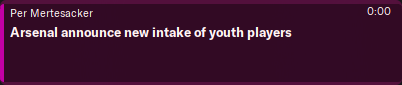
It’s youth intake day, and you’re hyped for a potential golden generation. You’re dreaming about bringing through a 200 PA striker who will make Erling Haaland look like Yaya Sanogo. Then you open up that inbox message…
“Pfft, the best players only have 3* potential. They’ll never make it. What’s our Head of Youth Development doing – rounding up random kids at bus stops?”
Back in 2020, I wrote an FM Mythbusting article about youth intakes, where I explained what a ‘golden generation’ exactly is, and why even the best academies don’t churn out wonderkids every year. I also gave some advice on improving your academy and increasing the chances of your club producing quality talent.
Today, I’m going to expand on that. I’ll show you how to assess your intake players and decide which ones are worth signing – and why you shouldn’t blindly trust the star ratings. There’ll also be some tips on how to develop your new talents, even those who don’t immediately look like hot prospects.
YOUTH INTAKE PREVIEW

About three months before a youth intake, your Head of Youth Development will deliver an early assessment of what to expect. This preview includes a grading of all the various positions in the intake, a diagram showing the distribution of players by their preferred position, and a star rating showing how good (or not) the HoYD thinks this intake will be.
But how accurate is all this information? Going off my experience from my Arsenal academy save… it’s hit and miss.
The position grades and the star rating often contradict each other. Your HoYD might be bigging up a 5* star ‘golden generation’ intake, except that no position has higher than a C grade. On the other hand, the HoYD might give A or B grades to lots of positions when the star rating suggests it’s an average intake.
Personally, I would disregard the star rating. It doesn’t seem to be an accurate indicator of how good the intake actually is – and by the time the intake arrives, the HoYD’s overall assessment might have changed significantly.
I would give a bit more consideration to the position grades. They may not be totally accurate at projecting how good your best newgens will be, but they can tell you which positions they will play in. If our HoYD gives A grades to your Goalkeepers and Strikers, you can confidently expect a goalkeeper and a striker to be top of the pile. If they’re predicting TWO good wingers, look out for a couple of wide attackers.
The preview is also fairly reliable at predicting the distribution of your players by their preferred position. It’s worth noting that a player’s preferred position may not always be their best position, but I’ll explain why a little later.
So don’t write off your new youth intake based only on what the preview says. At least wait another few months, until FM’s equivalent to Christmas Day.
THE INTAKE ARRIVES
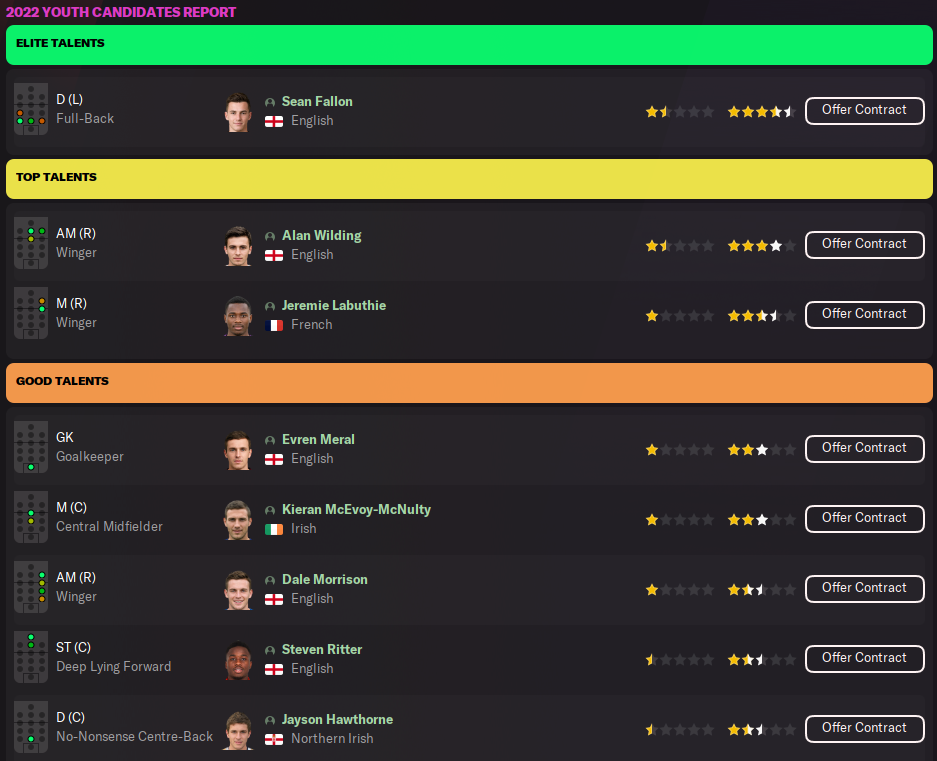
So, the big day has arrived. 16 or so players have generated at your club, and your HoYD has rated their ability and potential.
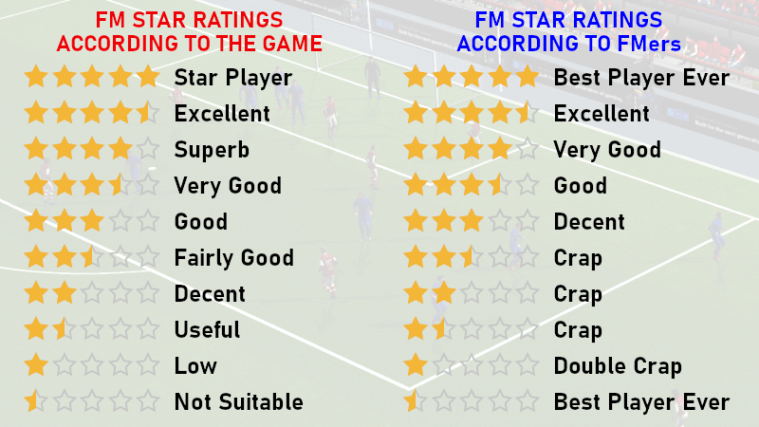
These players are sorted into groups, based on their potential star ratings (as rated by the HoYD). The ‘Elite Talents’ group shows players with at least 4.5* potential, while ‘Top Talents’ have 3.5* or 4* potential, ‘Good Talents’ have 2.5* or 3* potential, etc.
A lot of FMers get disappointed when they see their best prospects are only considered ‘Good Talents’, with that orange bar at the top. We humans have been conditioned to believe that green = good, yellow = okay, orange = bad, and red = even worse. FM’s colour-coding of youth intakes goes against that idea, and perhaps even makes your intakes look worse than they actually are.
Then again, many FMers make exactly the same mistake on intake day – every single year, without fail.

No, Chris Martin! DON’T look at the stars – or at least don’t take them as gospel.
Star ratings are relative to the ability of your squad. If your team isn’t very good and/or is playing at a very low level, you might get several players with 4* or even 5* potential. That doesn’t mean you’ve unearthed a golden generation in Spennymoor; it just means your youngsters might become better than what you have now.
A regular starter might be rated at 3* ability, so a youth player with 3* potential could eventually get to a similar level. You might only be interested in anyone with at 3.5* potential or higher, but don’t write off those with lower star ratings; they could still be useful.
Let’s say you have a team full of elite superstars that dominates your league. A world-class player might be rated at 3* ability, and any young players will be rated accordingly. In that case, anyone expecting 4* intakes every year will often be disappointed, as only elite players would be rated at 4* or higher.
Also, as I’ve explained before, even the best youth systems don’t consistently produce wonderkids every year. Some elite academies can even go years without unearthing a top talent!

And while staff members with high ‘Judging Player Potential’ can do a good job of predicting a youngster’s potential, they’re not always right. Star ratings can fluctuate from month to month, depending on various factors, such as a player’s ability and their current rate of development. This is especially true when rating players under the age of 18.
Once a player turns 18, your coaches will have a firmer idea of a player’s potential (e.g. their coach report says they could be “potentially EFL Championship standard”). At around 21 or 22, they can go into more specifics (e.g. “decent EFL Championship player”).
Even so, there is no surefire way to know a player’s true Potential Ability rating… unless you use the in-game editor or a third-party program like FM Genie Scout to look it up for yourself. But where’s the fun in that?!
ASSESSING YOUR PLAYERS
Shortly after intake day, the candidates will play a friendly match against your youth team. Your HoYD will then recommend which players you should sign to youth contracts. You can offer out contracts yourself – or you can leave that to your HoYD or even your Director of Football, if you have one.
You may not just want to offer contracts to the players your HoYD recommends, or even those players with high potential? It’s worth at least having a look at all the players’ attributes and profiles first, and then decide which ones are worth developing.

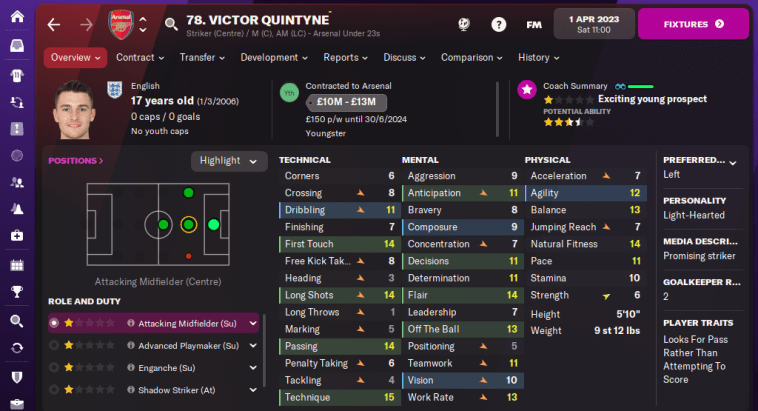
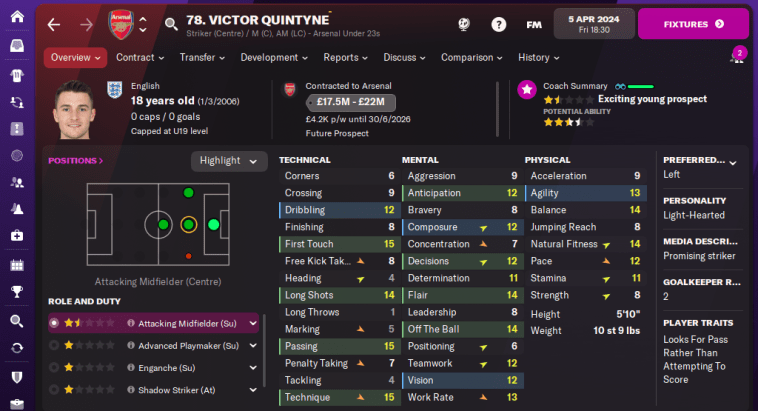
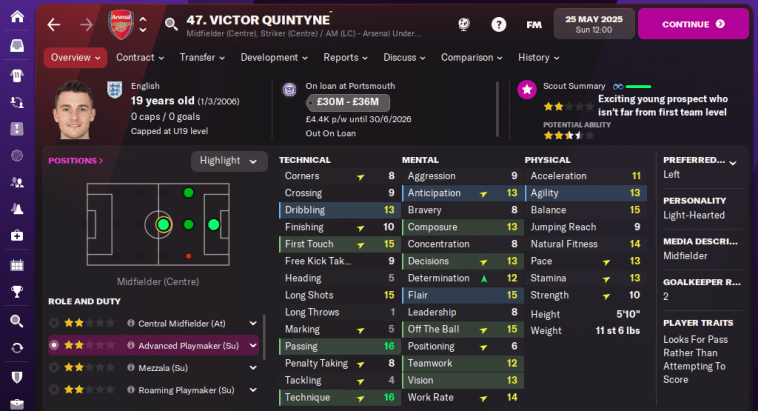
It’s possible that a player may slip under the radar and not be highly-rated by your HoYD, despite having some promising attributes. Someone like Victor Quintyne, for example.
Quintyne was from my 2022 intake, but he was initially considered a ‘Decent Talent’ with 2* potential. Although Vic was a natural striker, his 6 Finishing meant he wasn’t ever likely to lead our attack effectively. That said, he was an accomplished attacking midfielder with some strong attributes for an advanced playmaker, and my coaches seemed to rate him pretty highly.
I took a chance on Quintyne and focussed on training him in midfield. The screenshots above show his development over his first four seasons at Arsenal. By the time he was 19, he was rated as a Championship-level player, with the potential to be a first-team player in the PL.
And my HoYD once said he had 2* potential.
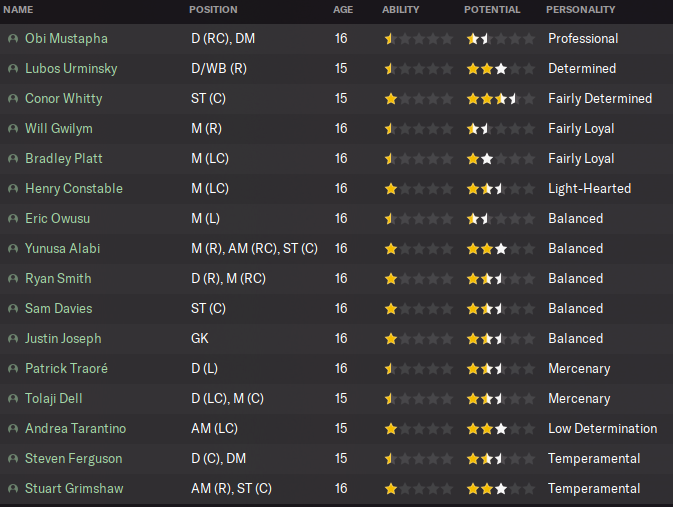
It’s also worth looking at your players’ personalities. A 5* potential youngster may not amount to much if their personality stinks, while a less talented player with a more professional attitude may at least have a better chance of hitting their potential.
Even having a youth setup full of ‘Model Professional’ coaches may not get you an intake full of upstanding 16-year-old citizens. They’re basically children who still need to mature, and many of them will steadily mature over time.
Professionalism, Ambition and Determination are all key to player development. A player who scores low in any of these departments may struggle to reach their full potential. These attributes can be improved in various ways, including mentoring, discipline, and even being positive influenced by their team-mates.
There are some personalities that should be avoided. ‘Slack’ players have rock-bottom professionalism, ‘Spineless’ players are abysmal under pressure, and ‘Temperamental’ players hate being criticised and need constant mollycoddling. Perhaps the worst personality is ‘Casual’, which applies to players who have poor determination, professionalism AND temperament.
‘Mercenary’ and ‘Fickle’ personalities aren’t actually that bad. It just means those players are not very loyal and can be easily swayed by bigger, richer clubs who can pay them more.

So, how many players should you sign from your intake? It depends. If you’re a part-time club, it makes sense to save money and only sign the players who have any chance of getting into your first-team. At the highest level, you can easily afford to sign all your intake players, even those who don’t look particularly special.
In my Arsenal save, I sign most of my intake players. Anyone who I think has at least a good chance of becoming an EFL professional gets a youth contract. Only those with poor personalities and no obvious strengths get rejected.
TRAINING YOUR PLAYERS
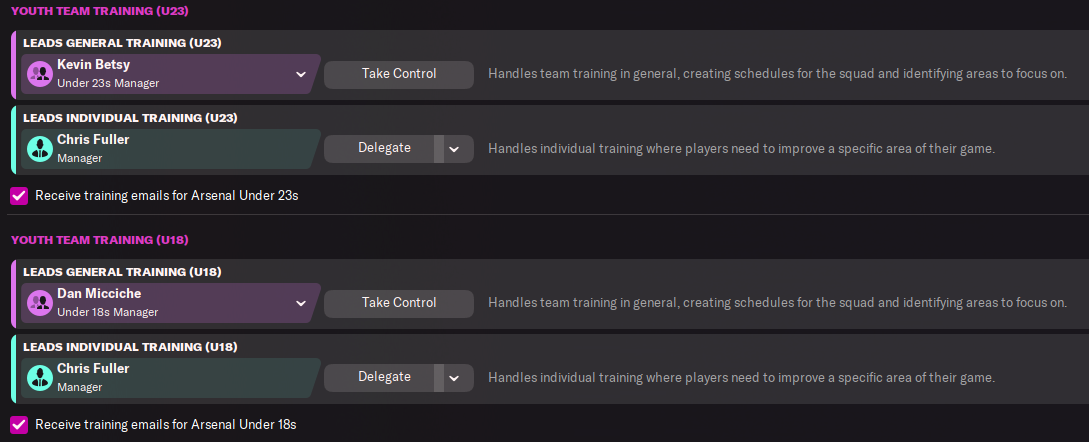
Of course, you’ll want to make sure all the basics are in place to make your youth training as effective as possible. For starters, your training facilities should be at as high a level as you can get them. (Your Under-18s/19s teams use the same facilities as the senior squad. The youth facilities are used by your hidden junior teams and influence the quality of your youth intakes.)
If possible, you should have plenty of specialised youth coaches, ideally with a low workload and focussing on only one or two training categories. They should obviously have high attributes for Working With Youngsters, but good ratings for Determination, Level of Discipline and Motivation can also be useful.
If you want more direct control over your new youth players’ development, you can manage parts of their training. If you go to Staff > Responsibilities > Training, you can choose whether to take charge of your youth team training or delegate that to a member of your staff (e.g. your Under-18s manager).
Leading individual training will allow you to manually change your players’ training focus, and the position/role/duty they train in. If you choose to lead general training as well, you have full control over the youth squad’s training schedules.

Another thing I might do is manage the squad’s training intensity. Go to Under-18s/19s > Training > Rest, and then set the training intensity based on their fitness levels, just like you would with your first-team. Training at double intensity can improve your players faster but also increases the risk of injuries, so try not to push your kids too hard.
(Also, my Arsenal Under-18s are apparently playing against Arsenal Under-18s in a week’s time. There’s no way this could possibly be another typical FM22 UI bug!)

Lastly, you can manage your players’ individual training by clicking on their name and going to Development > Training. It’s always good practice to train a player in a position/role/duty in which they will play in your tactic, especially if your youth teams use the same tactics as your first-team.
You can also set an additional focus if a player needs to develop in a specific area. Bear in mind that physical attributes improve much faster while a player is still a teenager, with the big technical and mental improvements coming later. As such, you might want to beef up a nippy winger’s Strength before focussing on their Attacking Movement or Ball Control.
Sometimes you’ll get a few players who play in positions you don’t normally use. Your Head of Youth Development typically brings through players who fit into their preferred formation. If your HoYD prefers a 3-5-2 wing-back system, but you always use a 4-2-3-1, you may get some WBs who don’t slot naturally into the FB slots, or you may be short of attacking midfield options.
That’s where retraining your player comes in handy. If a youth player is ‘natural’ in a position/role that you don’t use, but their attributes suggest they could play in a different position/role that you do use, it’s time to retrain them.


Here’s Jeremie Labuthie – a right-sided midfielder with good crossing, technique and athleticism. Unfortunately, I don’t use wide midfielders, and I rarely play with out-and-out wingers. If I was to retrain him as an inside-forward on the left, I would be neglecting his crossing abilities.
Instead, I retrained Labuthie as a right back, in the Wing-Back role with an Attack duty. One common complaint about FM22 is that newgen full-backs are poor at Crossing, so Jeremie already has an advantage there. His Tackling and Positioning aren’t great, and he has almost no Flair, but those are only preferred attributes for a WB role. All that matters to me is that the key attributes (e.g. Technique, Pace, Passing) can be developed to a decent level.
Training alone won’t develop a player into a new position; they also need to play there to become natural. It’s always a good idea to pay attention to your youth manager’s team selections – and you can even change them yourself just before a match if you have to.
Not every player develops into a new position at the same rate. Players with high Versatility can become natural in only a few months, while less versatile players may take a year or two, if not longer. New positions can also eat into a player’s Current Ability, so don’t panic if all their attributes take a slight dip once they become Accomplished or Natural in a new role.
MENTORING: A WORD OF WARNING
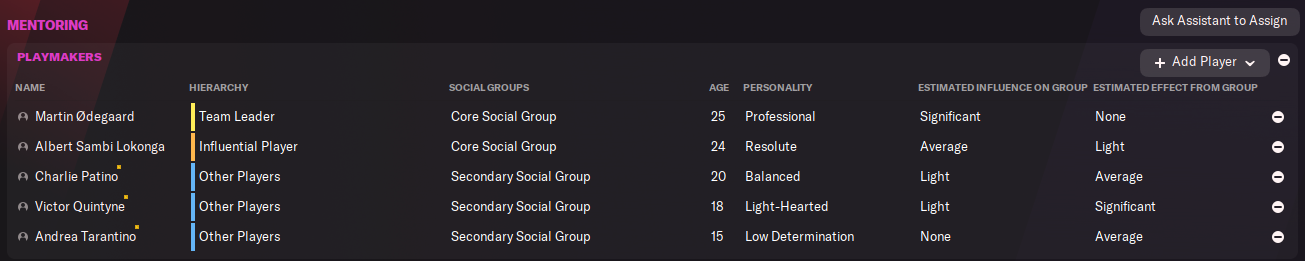
Putting a promising youngster in a mentoring group with experienced first-teamers can be an effective way of improving their personality and picking up useful traits. For this to work, the mentee has to be in the same squad as their mentor(s). In other words, you cannot simply ask Harry Kane to mentor Tottenham’s Under-18s strikers.
Some FMers like to promote their 5* prospects straight from the Under-18s into the first-team just for mentoring, while still making them available to play for the Under-18s. However, there is a significant drawback to this.
While your young mentees will be playing for the Under-18s, they will be training to the first-team schedules. If those teams play matches on different days, this could cause issues.
Let’s assume that your Under-18s usually play one match a week on Tuesdays, and your first-team plays one match a week on Saturdays. A typical Under-18s player’s training schedule might look like this:

That’s a match day, followed by a recovery day, then five days of meaningful training before the next match. Sounds good, right?
But if your player is training with the first-team while playing for the Under-18s, their schedule gets a bit out of whack:

Because there is no training on match days, unless your raw 16-year-old is actually playing for the first-team (which they’re probably not ready for), they’ll be doing nothing on Saturday – a day when their youth team-mates are hard at work.
They’ll also go straight from playing a match on Tuesday to a potentially intense training session on Wednesday, when their injury risk will be heightened. Any useful recovery sessions may not come in until Sunday, after the first-team has played a match.
Manually resting your youth player on the Wednesday would give them just THREE proper training sessions a week, as opposed to FIVE if you just left them in the Under-18s. Over a full season, all those lost training sessions may outweigh the benefits of early mentoring and actually stunt their development.
I hope this article has been useful to you. If you have any questions or indeed want to share any tips of your own, feel free to drop a comment below or tweet me @Fuller_FM. Thanks for reading.
 Fuller FM
You must be logged in to post a comment.