


In Football Manager 2021 – and in most previous FMs – many people complained about older players’ attributes declining too quickly. Once a player turned 32, their physical attributes would fall so fast that they’d be almost worthless by their 35th birthday.
This isn’t always the case in real-life, as better nutrition and advances in sports science are allowing elite footballers to keep playing into their late-30s and beyond. Cristiano Ronaldo is scoring Premier League hat-tricks at 37. Zlatan Ibrahimović was capped by Sweden at 40. Gianluigi Buffon was shutting out Lionel Messi in the Champions League at 42.
FM22 reflects this a lot better. Players now decline more slowly, especially those with high Natural Fitness and Professionalism. Anyone lacking in those departments will still struggle to continue past their mid-30s, but it’s now quite common for super-athletes like Romelu Lukaku and Thomas Müller to play top-flight football until they’re pushing 40.
At the other end of the scale, on FM21, young players could develop so quickly that they could easily peak at 21 or 22. This has been significantly slowed down on FM22, and so a top prospect generally won’t realise their full potential until they’re around 25 to 29. Much more realistic, right?
However, some FMers believe that these changes have gone too far the other way. There’ve been reports that too many top players stay at the top for too long – and that young talents struggle to even break into an elite club or national team, let alone become a regular starter.
Are the changes to player development working as intended, or are these concerns justified? Is it too hard for youngsters to break through on FM22? Let’s investigate…
THE EXPERIMENT

I’ve set up two save games in which I’ve loaded all the ‘Big Five’ European leagues – the Premier League, Ligue 1, the Bundesliga, Serie A and La Liga – and all European international players, giving me a database size of just under 30,000 players. I’ve then holidayed up until the start of the 2030 World Cup, to see how the in-game universes have changed since July 2021.
On my first test save (Save A), I’m loaded just the standard Winter Update database with NO add-ons, other than sortitoutsi’s Real-Name Fix.
On my second test save (Save B), I’ve added the “Increase Realism” Megapack by the brilliant Daveincid. As the name suggests, Dave’s megapack makes some significant changes to improve FM22’s long-term playability.
For example, several countries have better youth ratings and improved training facilities. In addition, older players start off with lower Natural Fitness, injury rates have increased (which could hasten any declines). As such, we should see youngsters improve their attributes and reputations more quickly – and older players should drop off a bit sooner.
CLUB TEAMS
First up, I’m going see how the average ages of Europe’s top teams change over time. For this test, I’ll be looking at the ‘Big Six’ Premier League teams, plus three major clubs in each of the other major European leagues. I’ve taken the top 22 players at each club – sorted by Current Ability – and recorded their ages.
At the start of a typical FM22 save on the Winter Update, the average age of a top European team is around 26.3 years. The youngest squad by some distance is Arsenal’s, who have an average age of just 23.6 (their only player aged 30+ is Alexandre Lacazette). Tottenham, Monaco and RB Leipzig also have averages below 25.
There are a few teams who prefer experience – most notably Inter, who only have four under-25s in a squad with an average age of 28.8. Atlético Madrid, Manchester United and PSG are three other clubs who like to lean quite heavily on older players.


Fast forward nine years, however, and the picture changes significantly. On Save A, in the summer of 2030, the average age of all the squads put together is 28.8 – the same figure as the ageing Inter squad of 2021. Every single club in this database now has more 30-somethings than they had nearly a decade prior.
Even more remarkably, the two youngest teams in 2021 – Arsenal and Monaco – now have two of the oldest squads in 2030. Arsenal’s situation isn’t that surprising, as many of today’s top young Gunners (Ødegaard, Ramsdale, Saka, Smith Rowe, etc) stayed at the Emirates and now in their prime. However, Monaco’s squad has changed dramatically – all but six of their senior players are in their 30s, and their youngest is 24.
The only club whose average age actually went down in this test was Manchester United – and only by half a year, to 27.2. Only Marcus Rashford remains from the original team, which has been refreshed with the likes of Florian Wirtz and Benjamin Šeško (both 27), and a few newgens have broken through too.

Using Daveincid’s megapack on Save B, we do still have a lot of ageing teams in 2030, though the problem isn’t quite as bad. The overall average age is 27.4 – slightly down on 27.8 in Save A.
Monaco’s squad is still just on the wrong side of 30, though they do have a couple of young talents coming through aged 21 and 23. Meanwhile, Chelsea’s pensioners are living up to their old nickname, retaining Édouard Mendy and N’Golo Kanté even into their late-30s.
Indeed, golden oldies like Mendy and Kanté are quite common in 2030. When you start a new save, those 18 major clubs have 18 players aged 35 or over. Nine seasons in, that number has jumped to 27 on Save A – and 29 on Save B!
However, Borussia Dortmund are an outlier where Save B is concerned. Half of their 2030 squad is under 25, and Ismaïla Sarr is holding the Werther’s Originals at the ripe old age of 32. Dortmund’s new wonderkids aren’t quite as young as Jude Bellingham and Giovanni Reyna are today, but it’s a start.
NATIONAL TEAMS
Now I’m going to see if the top national teams still give youth a chance. For this test, I’ll be focussing on arguably the 10 most prominent footballing nations today – Argentina, Belgium, Brazil, England, France, Germany, Italy (lol), the Netherlands, Portugal and Spain.
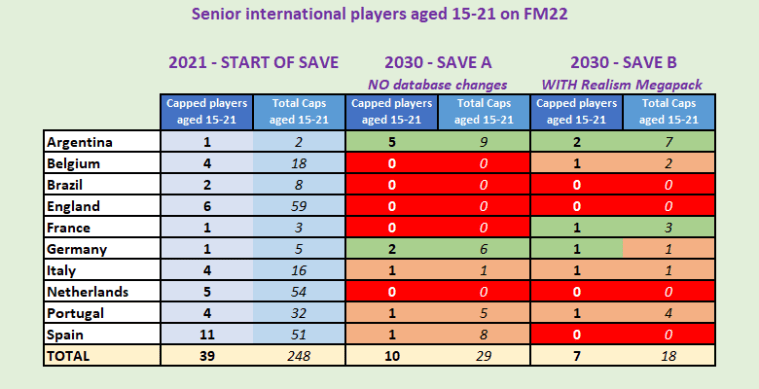
When you start a new FM22 save, those 10 nations have given over 1,300 caps to a total of 165 players who are under the age of 25. Indeed, 39 of them are aged 21 or under.
Spain have more young internationals than the other leading nations (31), but they’re an outlier. Spain’s senior team had a COVID outbreak just before Euro 2020, which meant they played a friendly against Lithuania with their Under-21s, who all got official senior caps.
Gareth Southgate has been particularly generous with capping youngsters for England. At the start of FM22, there are 23 players who have not yet seen their 25th birthdays but have already pulled on the Three Lions jersey. Let’s see if Southgate and his successors can continue that trend into the next decade…
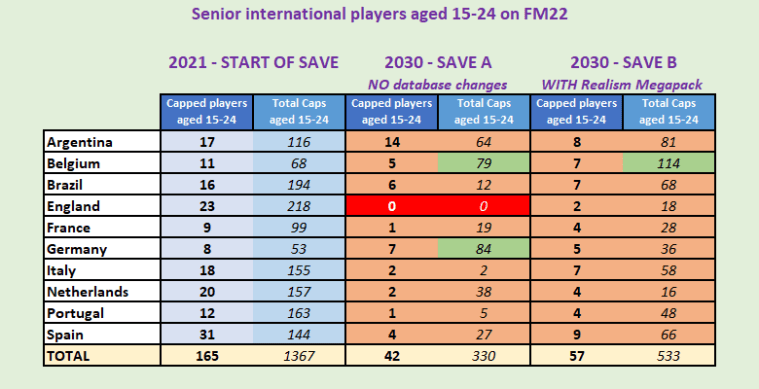
Erm… no. By the time we reach 2030 on Save A, not a single English newgen has played for the Three Lions! The youngest players in the database with ANY England caps are 25-year-olds Lewis Hall (a Chelsea academy midfielder in real-life) and Thierry Small (a left-back at Everton). They each made their debuts when they were 24.
Indeed, it’s become much more difficult for any youngster to break into a major national team. Only 42 under-25s have been capped by any of those top 10 nations, and just TEN players under the age of 21. Many of those newgen internationals come from Argentina (they’ve got to replace Messi somehow).
However, I found only ONE newgen from a major European nation who was capped as a teenager – David El Mamouni, who made his Belgium debut aged 19 and already has over 50 caps. So while it’s not impossible for a wonderkid to break through, it seems that you have to be the next Vincent Kompany…


The megapack paints a slightly better picture on Save B. Nations are slightly more keen to try out young players, though only seven players aged under 22 have been capped by the big guns. The English and Dutch talent wells still run dry, and even the Argentinian well has to some extent.
There’s a particularly farcical situation in Belgium. The youngest goalkeeper in the Red Devils’ 2030 World Cup squad is 37 – and all three are retiring after the tournament! It sadly doesn’t help that the best young Belgian keeper in the game is… well, let’s say that Boris Van Camp is hardly the next Thibaut Courtois.
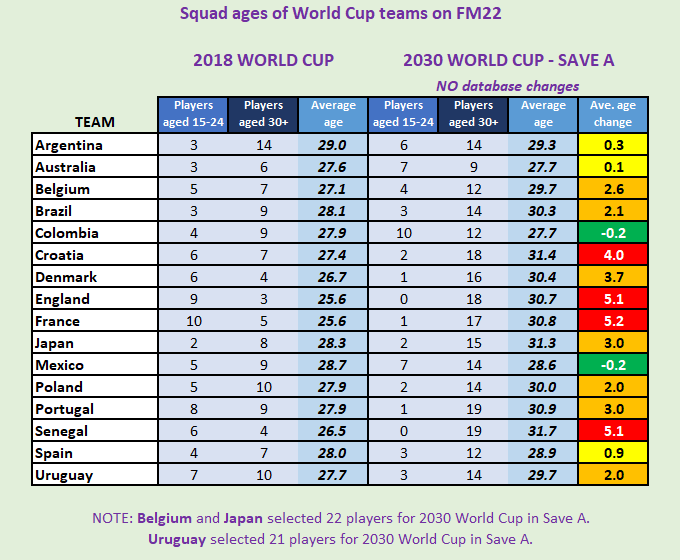
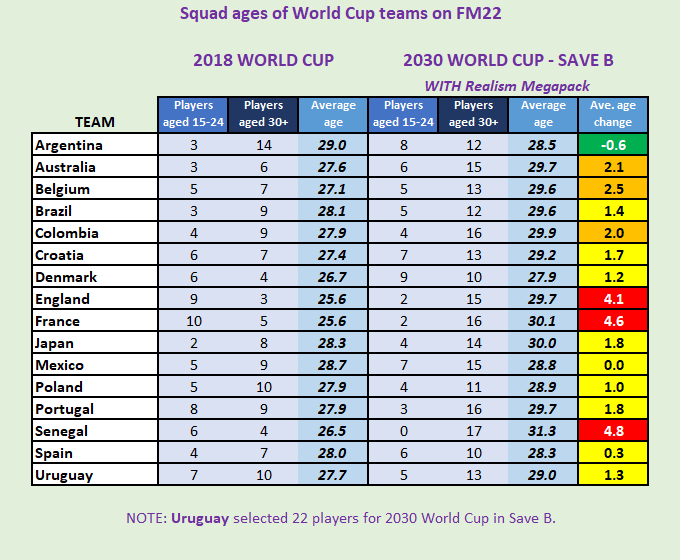
While we’re on the subject of national teams, let’s look at the average ages of the in-game World Cup squads. I’ve picked out 16 nations who qualified for the 2018 World Cup – and who were also present at the 2030 World Cup in both test saves. (Germany failed to qualify in Save B, so they’re not shown.)
At Russia 2018, the 16 teams shown here had an average age of 27.5 – hardly surprising, as experience is even more valuable at a big tournament. But FM takes that to the extreme at the 2030 World Cup, where those 16 nations had an average age of 29.9 on Save A – and 29.4 on Save B!
Our test group selected only 52 players aged under 25 on Save A, compared to 86 at the 2018 finals. That means on average, just THREE players in a 23-man squad were aged 15-24. Those same teams also selected a whopping 237 players aged 30 or over – an average of 14.8 players per squad.
England and France each saw their average squad ages jump from 25.6 to almost 31. Portugal were even more geriatric, picking only FOUR players below 30. However, the most extreme example was Senegal, who in both test saves had an average age well over 31 – and whose youngest players were 28!

So, why are clubs and nations not putting enough trust in their youngsters? Are young player reputations growing too slowly? Are they not developing fast enough? Is it a bit of both?
REPUTATION
When you first go to the Player Search screen on FM22, players are automatically sorted by World Reputation. This star rating basically shows how famous a player is worldwide. A player with 4 gold stars or higher is generally considered a global superstar, while a 3* player has a good chance of being considered for a major national team.
In the original FM22 database, there are six players under the age of 25 with a 4* reputation. Three of these – Alphonso Davies, Phil Foden, and obviously Erling Haaland – are 21 or under. Matthijs de Ligt, Jamal Musiala and Jude Bellingham are among the youngest players with 3.5* reputation.
At the start of a save game, there are 591 under-25 players (and 161 under-22s) with a reputation of at least 2.5*. How many young high-rep players will there be when we fast forward nine years?

When we get to 2030 on Save A, the results are startling. There are only THREE under-25 players with a 4* reputation. In terms of under-22 players, you’ll find just ONE who is rated at even 3.5* reputation – a 20-year-old winger from Real Sociedad – and another six with 3* rep.
If you move the threshold down to 2.5* rep, you’ll find a total of 128 players aged 15-24, which is a 78% decrease on the equivalent figures for 2021. Indeed, only 21 players aged 15-21 are at 2.5* reputation – that’s an 87% decrease from nine years prior!

The results are slightly better on Save B. The megapack buffs the reputations of certain youth competitions and awards, so youngsters should grow their own reputations faster by winning them. It seems to work well at the top level, as there are as many young 3.5* superstars in 2030 as there were in 2021 – though only one is under 22 (a Swedish right-back at Bayern München).
At lower reputation levels, however, there are still not enough young players meeting the 2.5* threshold. There’s at least twice as many of those as we were seeing in Save A, but there remains a dearth of highly-rated talent compared to the original database.
I think we can conclude, then, that young players’ reputations are not growing fast enough on FM22. But what about their ability levels?
CURRENT ABILITY
As you may know, every player on FM has a hidden Current Ability rating between 1 and 200. If you consider 170 to be a good benchmark for a world-class player, there are three under-25s in the original database who can be regarded as world-class: Haaland, Rúben Dias and Kylian Mbappé.
In the 160s, you’ll find a number of top wonderkids such as Davies, Foden and Vinícius Júnior. A CA of 140+ is generally considered good enough to play in the Premier League – and a total of 213 young players meet that threshold.
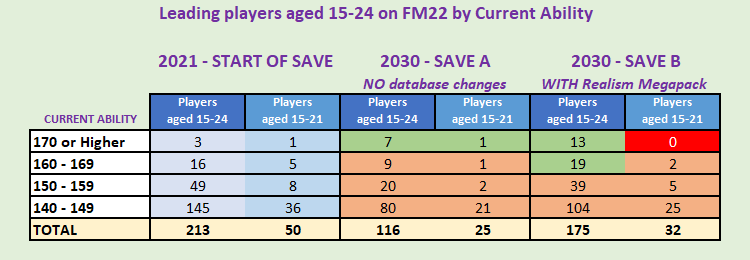
Interestingly, on Save A, we actually see more young superstars in 2030 than we had previously. Seven players aged under 25 have a CA of 170+ (incidentally, they’re also spread out between seven different nationalities and seven different clubs).
The problems lie further down the food chain, as we see a large reduction in youngsters rated between 140 and 159. While we saw 50 players aged under 22 meet the 140+ CA benchmark in 2021, that number has been cut in half by the time we get to 2030.

The better youth ratings and facilities in Dave’s megapack should improve the abilities of youth players across the board on Save B. As you can see, this has a particularly huge impact on the top level.
Incredibly, the 13 young players you see on that list above all have a CA of 170+. Another 19 players are in the 160s, though only two of those are aged 21 or under. And while aren’t quite as many talented youngsters in the 140s or 150s as we were seeing at the start, they are at least closer to the original figures.
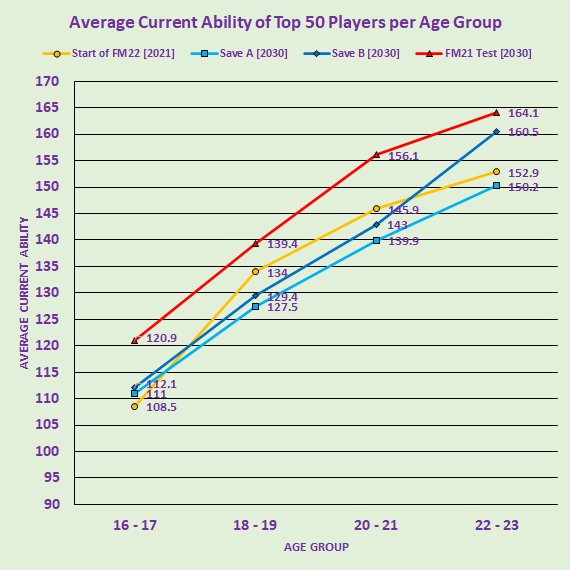
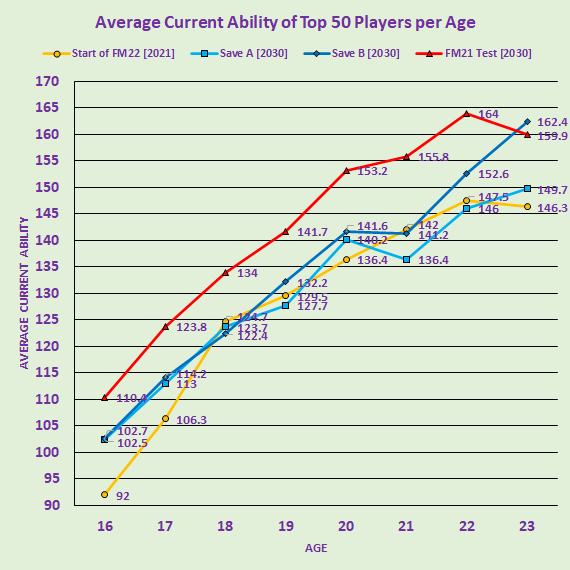
For my final test, I looked at the Current Ability scores of the top 50 players from four age brackets: 16-17, 18-19, 20-21, and 22-23. I then graphed the average CAs from each age brackets in both test saves, and compared them to the average CAs of the best youngsters in the original database.
On both test saves, the players aged 16 to 17 actually have a slightly higher CA than their original counterparts. However, while there’s a huge increase in CA between the 16-17 and 18-19 brackets on the original database, the newgens on Save A cannot match this growth, and they continue to lag behind until their mid-20s.
On Save B, it seems that the megapack changes help players to improve faster for longer. Indeed, by the time these players get to 22-23, their average CA is much higher than the original players of the same age.
I also ran one more test save on FM21 – using a similar database setup, and again holidaying until the 2030 World Cup – to show just how rapidly players developed on that game. As you can see, the top players in the 16-17 age bracket have around 10 more CA points than their FM22 equivalents. These CAs also increase much faster, particularly up to the age of 21, by which point many of them are already at an elite level.
SUMMARY

In conclusion, young players develop much more steadily – and realistically – on FM22 than they do on FM21. I won’t complain about that. However, there are some major issues that would impact on my enjoyment of a long-term or even a medium-term career.
Firstly, AI teams do not develop or use their young players as effectively as they could. Many top clubs stack their squads with veterans in their 30s – even those clubs like RB Leipzig and Monaco who have long track records of investing in youth.
On one of my test saves, the average ages of all the Premier League teams in 2030 ranged between 27 and 31. At the start of FM22, Arsenal have the youngest squad (with an average age of 23.6) and Burnley the oldest (at around 29).
In addition, player reputation doesn’t grow fast enough – and often doesn’t keep up with a player’s ability level. This is perhaps the biggest reason why many good youngsters from major countries are being overlooked for international duty, in favour of more experienced but less talented stars.
In one of my saves, Ill-Han Stalph was a Bayern regular with 31 goal contributions and a 7.24 average rating – but the 23-year-old still hadn’t been capped by Germany. How could Stalph be overlooked for another attacking midfielder as relatively mediocre as Jonathan Burkardt, apart from that Burkardt had 3.5* reputation compared to Stalph’s 2.5* rep?


On my longest FM21 save, Germany won the 2030 World Cup with over HALF their team being made of newgens (the oldest of which was 25). On FM22, Die Mannschaft might only pick one or two newgens for that same tournament – maybe three at most. While newgens would only take 8-10 years to dominate an FM21 save, many of them have to wait much longer to emerge on FM22, as today’s stars cling on into their mid-30s, if not longer.
Developing Football Manager is a tricky balancing act – and trying to fix one issue can often end up with the developers overcorrecting it. How often have wing-backs switched between being too “overpowered” and being “almost useless” over recent FMs?
Sadly, it’s too late for Sports Interactive to fix the issues with AI youth management and reputation growth on FM22 – but I really hope these are addressed for FM23. It would be great if SI could strike a good balance that allows rising stars and veterans to have realistic career trajectories without making AI teams too young or too old.
In the meantime, if you want to start a new long-term FM22 career, I’d highly recommend using Daveincid’s Realism Megapack. As well as creating a more realistic in-game universe, it mitigates some of FM22’s flaws with reputation and squad-building, even if it doesn’t fix them entirely. Unfortunately, there is only so much the modding community can do.
I hope you’ve found this interesting – perhaps even enlightening. I’m sure there are some things I missed while doing my research, so if you have any suggestions for a future investigation, I’m all ears. You can drop a comment below or tweet me @Fuller_FM.
Thanks for reading.
 Fuller FM
You must be logged in to post a comment.