

Let’s talk about retro databases in Football Manager.
When we discuss which features we most want to see added to FM in the future, one of THE most popular requests is for Sports Interactive to add official historic databases.
The ability to manage a football team at any point in history – or even just during a specific time period – is something that appeals to many FMers. I’m sure some of you would like to go back to the 1970s or 1980s, or perhaps to the start of the Premier League era in 1992. Even the 2000s hold plenty of nostalgia for those of us who grew up at the turn of the millennium.
Unfortunately, despite numerous requests over the years (and indeed decades), it seems that SI won’t allow us to manage in the distant past for the foreseeable future. There are just too many legal and technical issues that stop this feature from being a viable addition.
In this post, I will try to explain why adding historic databases to FM is an awesome idea… but also an impractical one.
INTRODUCTION
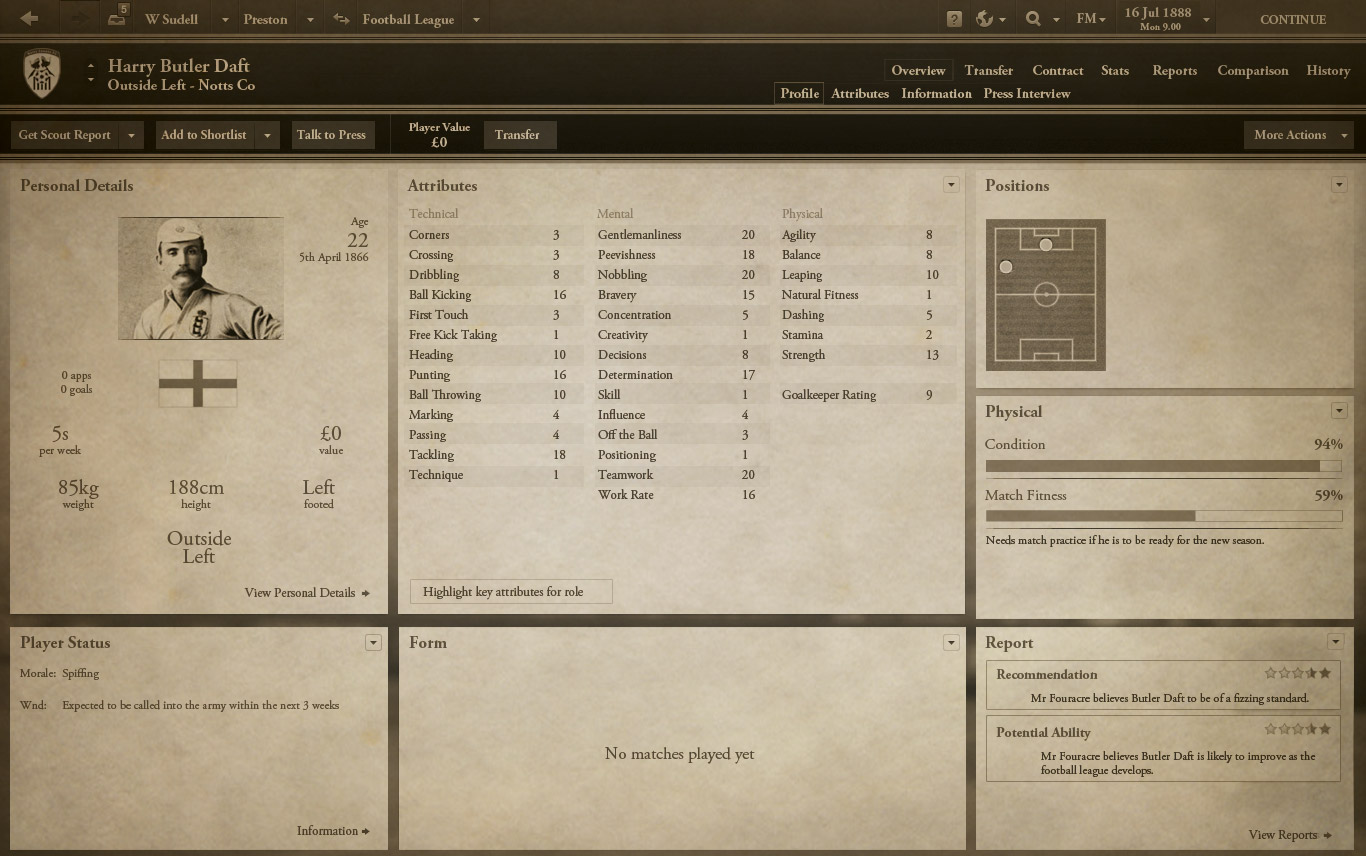
On 1 April 2013, Sports Interactive proudly announced a historic new addition to the FM franchise – Football Manager 1888.
Celebrating the 125th anniversary of the Football League, FM88 would take you all the way back in time to the league’s inaugural 1888/1889 season. Complete with a sepia-toned interface and 19th-century terminology, managers had the chance to recreate history with Preston’s ‘Invincible’ squad of exotic Scottish professionals – or perhaps even rewrite it altogether with lowly Accrington.
Just one small problem: Football Manager 1888 didn’t exist. In case you didn’t notice the date, this was an April Fool’s prank.
Nonetheless, this elaborate joke actually built up a serious desire amongst some FMers to see a proper historic version of our favourite franchise. Who wouldn’t love to manage England’s 1966 World Cup winners, or relive Arsenal’s epic last-minute title win over Liverpool in 1989… or even replicate Lincoln’s great escape from relegation in 1958?
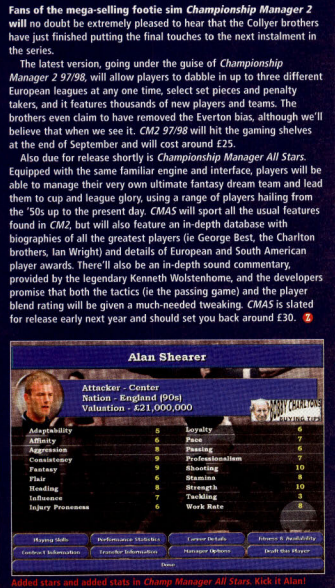 Believe it or not, SI did try to do something along these lines before. In 1997, they were working on a game called Championship Manager All Stars, where you could build your own team of legends from the 1950s onwards. Alas, despite appearing in an issue of PC Zone magazine, CMAS was never completed.
After the split from Eidos in 2004, SI’s former publishers (now called Square Enix Europe) released a couple of new 1970s and 1980s-themed Championship Manager mobile games – together with accurate squads and rules. Unfortunately, these games were removed from sale when Square Enix ended the Champ Man series in 2018, so you can’t play them anymore.
There are a few games out there which try to recreate old-time football – like the promising but sadly unfinished Retro Football Boss. For mobile gamers, there’s Retro Football Management (which is available on iOS and Google Play).
When it comes to FM, the community is always on hand to create its own unofficial retro databases… with limitations. One of Football Manager 2021‘s most popular databases recreated the 1990/1991 season, with future stars such as David Beckham, Lionel Messi and Kylian Mbappé gradually entering the game as ‘newgens’ over the next 30 years.
Unfortunately, the start date cannot be changed in the editor, so you’re still technically beginning in 2020 rather than 1990. It’s also very difficult to set realistic transfer fees (which would stop Blackburn signing Gary Lineker for £100million+) or make other immersive changes that would reflect what football was like 30 years ago.
All those are things that only the developers can handle. However, SI have consistently stated that they don’t plan to release any official historic FM databases, and there are several reasons why they probably never will…
THE DATABASE
Olivia Rodrigo has no problems obtaining licences. Good for her, perhaps… but for Sports Interactive, licences are the first (and arguably biggest) obstacle to them releasing a historic Football Manager database.
Why couldn’t SI just re-release their old data from FM21 all the way back to their first Championship Manager game from 1992? I’ve never worked for SI and know very little about the licencing industry… but from what I can gather, SI’s licences for each game apply only to the relevant season. That may explain why shortly after a new FM game is released, the previous title is removed from sale.
So, SI cannot reuse their old 2020/2021 season database from FM21, let alone the data from Football Manager 2005. Also, because Square Enix still own the rights to Champ Man, SI can’t use anything from Championship Manager 93 (the first game with real players; all CM92 players were fake) to Championship Manager 03/04, even if they wanted to.
SI could in theory try to recreate Football Manager 2005‘s database by obtaining licences to use individual players… but where would they begin to get them? Lower-league players may be cheaper to licence but much tougher to get hold of, especially when it comes to players who have sadly passed away.
As for superstars, their image rights can be prohibitively expensive. EA’s bottomless pit of money allows them to add Pelé, George Best and Lev Yashin to their FIFA Ultimate Team mode as Icons – but even they have had legal problems around Diego Maradona’s inclusion.
Goodness knows how SI would be able to feature ‘El Diez’ in their game without giving him an unlicensed name. They’ve already had such issues with Oliver Kahn (aka Jens Mustermann) and Juventus (whose head coach Massimiliano Allegri is named Gabriele Milano on FM22).
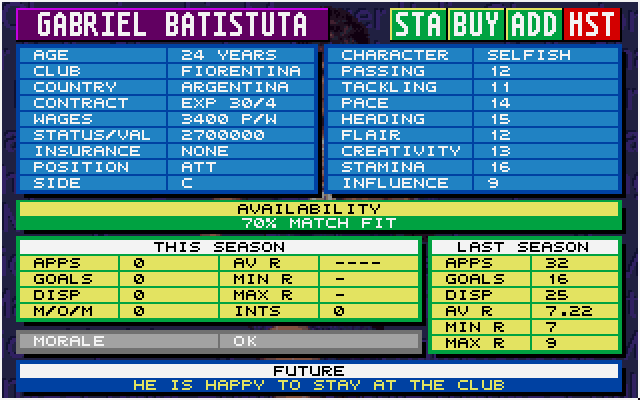
But even if licencing wasn’t a problem, the CM93 database would be practically useless to SI now. Back in 1993, CM only rated players on a small number of attributes (indeed, some key attributes such as Finishing and Technique didn’t even exist). If you wanted to reliably recreate a CM93 player on a modern FM game, you’d need to rebuild most of the data from scratch.
Even if you’re only going back about 20-30 years, and only focussing on a small number of leagues, you’re still taking about an obscene amount of research that needs to be done. Where could SI find any researchers who could even remember obscure lower-league players who retired decades ago, let alone provide accurate ratings for them?
Ceating an actual Football Manager 1888 database would be a job for a serial masochist. You’d struggle to find more than the most basic information about nearly all the players who featured in the inaugural EFL season. Good luck trying to rate Stoke winger Billy Hutchinson, who played one league game in January 1889 before dropping into non-league.
Now… if any of you have played Out of the Park Baseball before, you’ll know that they have a HUGE baseball database which allows you to take charge of any major team from the past 150 years. Why can’t this be done in Football Manager, you’re probably asking?
For one thing, baseball is VERY different to football. There are fewer major leagues in baseball than football, and historic baseball data is more readily available, making research much easier. North American sports buffs really do take their stats very seriously – and have done for much longer than us Europeans have.
Although many football clubs have records of all their previous players, for a long time, the only stats they recorded were for appearances and goals. In-depth statistical analysis and record-keeping has only really existed in football for the last 25 years or so.
PLAYER DEVELOPMENT & POTENTIAL
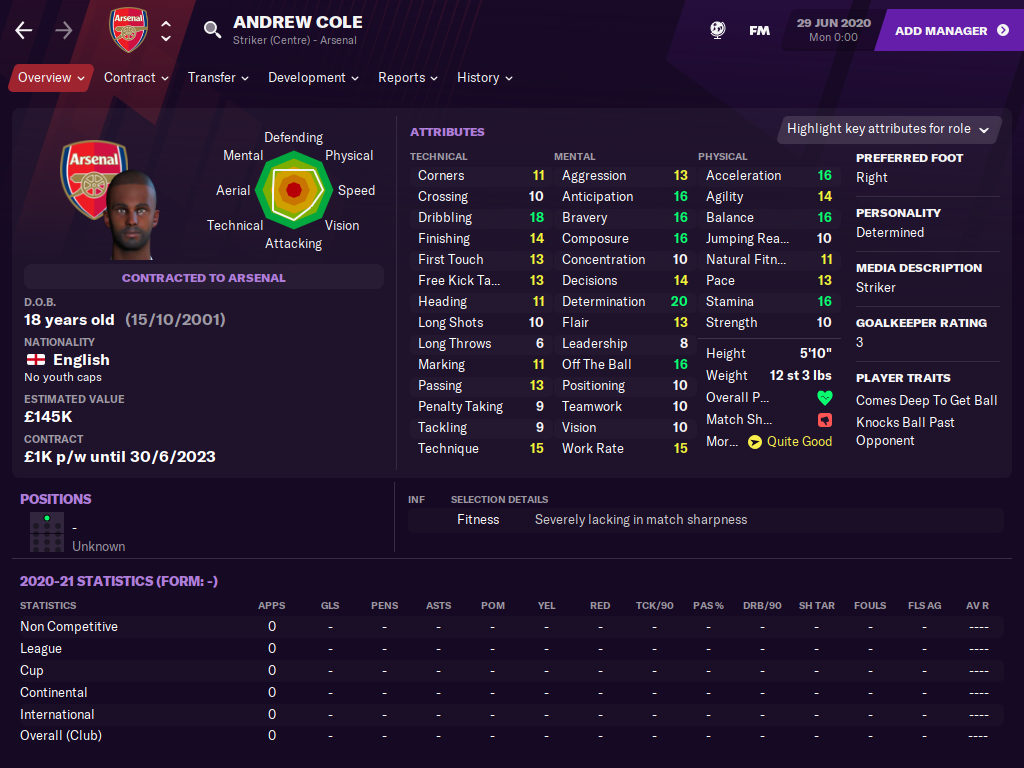
Let’s assume SI did have all the data they needed to release a huge database going back to the 1990s. How would player intakes work – and how would development work in general?
Firstly, you’d need to consider what happens when a young player comes through at a club in very different circumstances in real-life. If Everton were a lower-league club in 2001, would Wayne Rooney have still come through their youth system? Would it have been realistic for a wonderkid of Rooney’s ability and potential to be dominating third-division teams when he was barely out of school?
Or would Rooney have emerged at a bigger club instead? Would he even have gone straight to Manchester United aged 16? How would FM even handle dynamic youth player movements, without massively bloating some youth teams or leaving others with very few players?
OOTP don’t have this dilemma. There is no promotion or relegation in Major League Baseball, where young talents are generally drafted from college rather than coming through club academies. As such, when it comes to historical OOTP simulations, players don’t need to necessarily start their pro careers with the same team where they began in real-life.
On the other side of the coin, how would FM handle those players who didn’t become megastars? Or those clubs who have traditionally not been a hotbed for future talent?
Take Hull City as an example. Nowadays, Hull have perhaps one of the most productive youth systems in the EFL – but until very recently, you would struggle to name any Tigers graduate who became a first-team regular.
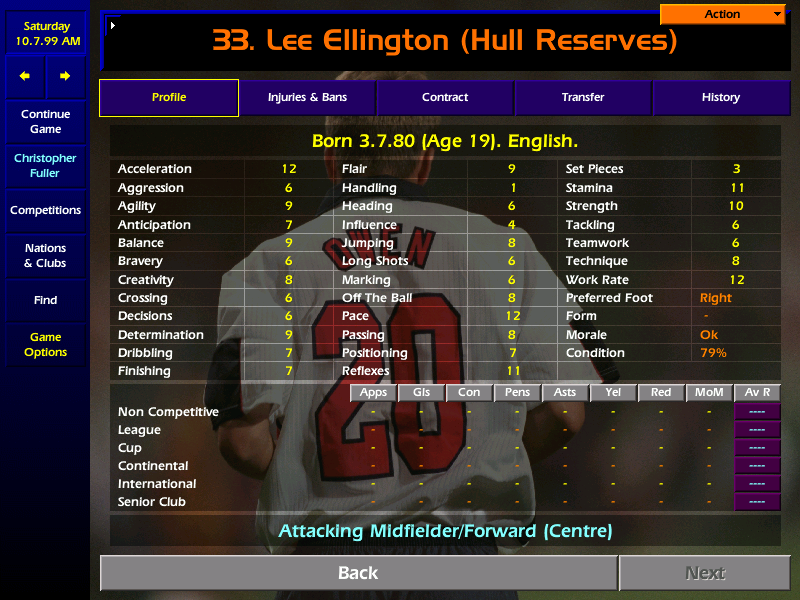
If you took a 90s Hull team into the Premier League, how would you handle their intakes? If you gave players dynamic potential (based loosely on club stature and facilities), you might see Hull youngsters from that era like Steve Wilson, Lee Ellington and Gary Bradshaw far surpassing their modest real-life careers. But if player potential was static, there’d be almost no point in developing your youth facilities.
And as an FMer, you would have a huge advantage over the AI: the benefit of hindsight. If you were scouting a couple of teenagers in the 1990/1991 Cannes team, you could probably guess that Zinedine Zidane is a better signing than Fabrice Monachino. Indeed, if you had enough money, you could also buy Kahn, Maldini, Figo, Batistuta and Warhurst, and your squad would be set for the next decade!
Finding the best lower-league gems would be like shooting fish in a barrel. The first thing any Football League manager in 2003 would do is sign a 16-year-old striker called Jamie Vardy – or, if they were managing Sheffield Wednesday, get him on a pro contract ASAP!
If you knew straight away who the best wonderkid signings were in any given year, then where’s the fun in playing?
RULES, RULES, RULES
There’s another big difference between baseball and football, which makes historic databases more viable in OOTP than FM.
While football has undergone a number of radical changes since the 1870s, baseball’s rules have not changed quite so radically over the past 150 years. Those rules which have changed are relatively minor, and they are quite adaptable in OOTP (which even allows you to customise some of them to your heart’s content).
If SI were to replicate how football was played over the years, they would need to set up various different match engines for each era. Here are just some of the rules that they would need to change:
- Penalties were introduced in 1891, but penalty areas weren’t marked out until 1902 – and the first penalty shoot-outs to decide drawn matches didn’t happen until the 1970s.
- Goalkeepers were allowed to handle the ball anywhere on the pitch until 1912, when handling was restricted to their penalty area. They could also pick up deliberate backpasses from their own defenders until 1992.
- Substitutes for injured players were first allowed in the 1950s, and tactical substitutions were permitted a decade later.
- Yellow and red cards were first used in 1970. Of course, players could still be cautioned or sent off before then, but the Antonio Rattín incident in 1966 showed the need for clearer communication.
- Professional fouls have only been red-card offences since 1990, and violent tackles from behind since 1998.
And then there’s the countless changes that have been made to the offside rule!
SI would also need to reflect how tactics and formations have changed over time. At the start of the professional era in the late 18th century, many teams went for a very attacking 2-3-5 shape. This gradually evolved into a 3-2-5 and then a 3-3-4, before 4-4-2 and 3-5-2 became popular alternatives in the 1970s and 1980s. (And now 4-2-3-1 gegenpressing is all the rage!)
By most accounts, OOTP have replicated the century-long evolution of their sport quite well. There’s absolutely no reason why a company with SI’s resources and talent can’t do the same… but it’s a big ask.
Even if they didn’t wish to go any further than the 1990s, SI would need to put a lot of time and resources into a historic FM database. As awesome as such an idea sounds, it’s not likely to become reality any time soon – especially not while SI are working on adding women’s competitions into the series. Sorry, folks.
So those are my thoughts on retro Football Manager databases. If you would like to anything to the conversation, feel free to drop a comment below – or tweet me @Fuller_FM.
 Fuller FM
You must be logged in to post a comment.