

One of the most exciting aspects of any Football Manager career is when you develop young prospects to reach their full potential. Bringing through an academy wonderkid into the senior team and on the road to superstardom is one thing… but what about developing your coaches?
When starting a new save, many FMers like to overhaul their backroom staff, bringing in the very best coaches, scouts and physios they can afford. But hey, what’s the fun in that when you can reap the benefits from growing your own coaches?
In this guide, I will give you some advice to help you successfully move your veteran players from the pitch to the touchline – and even educate a new crop of managers to take football by storm.
FROM PLAYING TO COACHING
There is no surefire method for finding which players would make the best coaches. Players will typically carry over their Determination and personality attributes after hanging up their boots, but their current and potential coaching ability will be randomised.
It’s true that successful players don’t always make successful managers. For every Pep Guardiola or Zinedine Zidane, there is an Alan Shearer or Lothar Matthäus. On the flip side, there are plenty of top managers whose playing careers were unremarkable or were cut short by injury, or who never played senior football at all.
For me, a determined player with a strong personality – and perhaps high Leadership – would be a good candidate for a future coaching role. There is also a simple way to find out what a player wants to do when they retire…

Any player aged 29+ will have a long-term plan (shown on the Information page on their profile) which will give you hints about their future career. One player may be “seriously considering” going into coaching or management, while another may prefer another backroom role. Some players may even want to leave football altogether once they’ve stopped playing.
You can talk to a player about their future plans by viewing their profile and going to Discuss > Advice > Recommend Possible Future Staff Role. If the player agrees with your suggestion, it could increase the chances of them taking up that role in the future. However, telling your captain that they should forget about management and become a physio instead probably won’t go down too well.
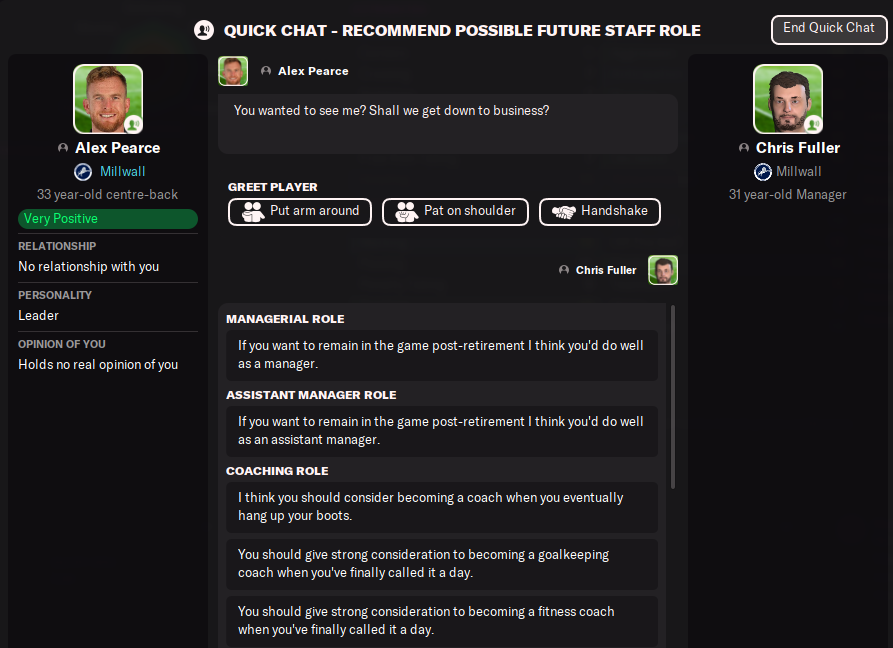
The player might even make themselves available for a coaching role immediately. If you agree, this will add non-playing attributes to their profile, though you will need to offer them a new contract to give them a non-playing job (you can’t just add a staff role to their current deal).
A veteran player may also gain non-playing attributes naturally, without you recommending a role first. This usually happens when they announce their plans to retire from playing. You can then give them a new non-playing contract, which will take effect at the end of the current season.
At first, your new coach’s attributes may be quite low, especially if they have few (or no) coaching badges. Those attributes should improve in time, but you may want to start them off as a reserve or youth-team coach, rather than throwing them straight into management or senior coaching.
If you micro-manage your training assignments, you may also want to give them only one or two assignments, working alongside a more experienced coach. It’s not a good idea to give a coach a high workload, or spread them too thin over too many assignments.
DEVELOPING NEW COACHES
Coaches will typically make gradual improvements as they gain experience, but their biggest jumps in development will come from gaining coaching badges. There are seven different coaching badge levels, listed below from lowest to highest:
- National C Licence
- National B Licence
- National A Licence
- Continental C Licence
- Continental B Licence
- Continental A Licence
- Continental Pro Licence
Any coach who doesn’t yet hold a Continental Pro Licence can be sent on a coaching course. To do this, go to their profile, open up the Overview tab, and click Send On Coaching Course.

The club’s board must agree to fund the course, which will cost between £600 (for a National Licence) and £6,000 (for a Continental Pro Licence). A big and wealthy club will typically accept straight away, though a cash-strapped semi-professional outfit may be more reluctant.
Alternatively, the coach can choose to pay for the coaching course themselves. (You sadly do not have this option as a manager, which can be a pain when you’re managing a lowly team who either cannot fund a course or don’t want to risk losing you once you get your next badge.)
Once sent on a coaching course, the coach will usually spend between 4 and 12 months studying for their next badge. Once that time is up, they will hopefully have completed the course and gained that new licence.
Some coaches may struggle on the course and be given more time to complete it – or worse, they could fail it completely and have to restart. If a coach is often struggling or failing on courses, it may suggest that they have already maxed out their potential ability. You might want to consider letting them go when their contract expires.
A coach who is studying for a new badge will be less effective in training while they are on the course. As such, you may want to think carefully before sending several members of your coaching staff on courses at the same time.

Older players can also study for their coaching badges early, which will give them better coaching attributes when they make the transition. However, you will not be able to give them an Additional Focus in training while they are on a coaching course (the same thing applies when they are on a leadership course).
DEVELOPING A MANAGER
It’s one thing to develop coaches at your club, but some of those may have ambitions of forging their own careers as managers. It can be a rewarding experience when you give a young coach their first job, and then let them fly the nest when they’re ready to go into management.
Football has loads of stories of managerial masters bringing through an apprentice before they moved on to successful careers. There’s Sir Bobby Robson and José Mourinho. There’s Arrigo Sacchi and Carlo Ancelotti. There’s Sir Alex Ferguson and, er, Ole Gunnar Solskjær.

When you’re looking for someone to manage your reserve or youth teams, you should obviously assess their attributes first. Determination, Level of Discipline and Motivating are the big three mental attributes to look for.
Working With Youngsters is an important coaching attribute for reserve/youth managers, as it can affect the quality of training for players aged 23 or under. People Management (formerly Man Management) has a similar impact on senior players (aged 24+), so a top-level manager will eventually need a good score for that attribute.
There are a few other characteristics that you should look at when considering a coach for a managerial role:
- Personality: Obviously, a Model Citizen or a Perfectionist would be best, but any strong personality such as Model Professional, Iron-Willed or Resolute is fine.
- Tactical Style: What it says on the tin. Do they favour Gegenpressing, or are they more of a Catenaccio connoisseur?
- Preferred Formation: Which formation do they use the most? And do they have a second formation that they turn to in certain situations?
- Playing Style: This is basically their favoured passing style. Do they like shorter passing, or do they prefer a long-ball game?
- Tendencies: Players have traits; staff have tendencies that can influence their tactical and transfer decisions. One manager might tend to rely on set-pieces and sign youth players, while another might tend not to select a substitute goalkeeper.
It’s unlikely you will find a manager who perfectly fits your style of play, but if most of their characteristics fit, they’re probably worth giving a shot. Just stay clear of those total outliers; don’t employ a long-ball merchant if you want ‘tiki-taka’ football.
Some of a manager’s characteristics can change over time. I’m not sure if your tactics can directly influence the development of your reserve or youth manager’s traits, but as far as I can tell, they probably carry at least some weight.

If you want your development teams to play the same tactics as your first-team, you can set this in your Development Centre. Doing this will override the manager’s preferred formation, though their other preferences can still impact the decisions they take in matches.
With all that in mind, perhaps you’d like to go a step further – and set up your very own ‘school of thought’. In this post on Dictate The Game earlier this year, Rock’s End FM brilliantly goes into more detail about how you can replicate Red Bull’s football network, which has recently developed managers such as Marco Rose and Jesse Marsch.
CASE STUDY: THE CAMBRIAN BOYS
To finish this article, I’m going to give you some examples from my FM21 journeyman save, in which I helped develop three of my former players into successful coaches in only a few years.
My first job was at Cambrian & Clydach – a semi-professional team in the Welsh second tier. My starting squad included right-winger Lewis Ellis, centre-back Jarrad Wright, and ball-winning midfielder Ceri Morgan (who was my captain until he defected to Goytre United, but let’s not talk about that!). They were all mediocre part-time footballers in their late 20s, but their best years were actually ahead of them.
Five years later, in 2025, my managerial journey had taken me to Hungary’s second division. Győr was the first club where I had the financial security to assemble the backroom I wanted – and start developing a new generation of coaches.
Ellis and Morgan had just retired from playing and were ready to begin their new careers. We still had strong friendships from our time at Cambrian, so they were happy to travel over 1,000 miles east to Hungary and join my new coaching set-up.
Ellis became our Under-19s manager, with Morgan working alongside him as an attacking coach. Though their attributes weren’t amazing, they had plenty of time to improve through studying for badges (they each arrived at the club with Continental C Licences). The plan was for one of them to eventually become my assistant, once the time was right.
Fast forward two years to 2027. Győr had been promoted to the first division, and Morgan had blossomed as a coach, getting big improvements in several attributes after receiving his Continental B Licence. Ceri was ready to step up, so I fired my old assistant manager and gave him the job instead.
Ellis was making waves as a manager, having led our youth team to 2nd place in the Under-19s league. Morgan’s promotion left a vacancy in the youth backroom, so I brought over another Cambrian old boy – Jarrad Wright, who was a more defensive coach than the other two.
Two years later, in 2029, my Győr team missed out on the Hungarian championship by a single goal. I was soon headhunted by Basel, and I took Morgan with me to Switzerland, where we would win back-to-back Super League titles and reach the Europa League knockout rounds.
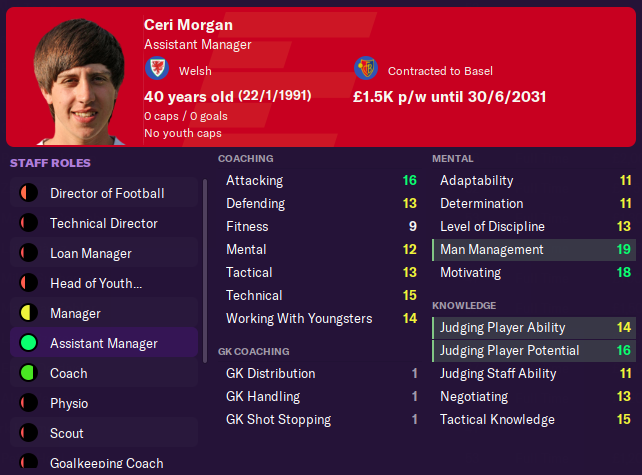
It’s now 2031. Morgan has just turned 40 and is now a 4* attacking coach with a Continental Pro Licence. This master motivator has become my irreplaceable right-hand man – the Peter Taylor to my Brian Clough, the Ian Woan to my Sean Dyche.
Ellis and Wright both decided to stay at Győr after my move to Basel. In fact, Wright was promoted to first-team assistant manager by my successor – Péter Czvitkovics, who was brought in from our local rivals Gyirmót.

Czvitkovics’ reign was a disaster, and he was sacked after only eight months, with Győr battling to stay clear of relegation. Ellis was appointed as caretaker manager, kept the team up, and got the job full-time!
Unsurprisingly, Ellis decided to keep Wright as his assistant. These two former Cambrian team-mates would prove to be a fantastic management team at Győr, with Lewis often employing a 4-2-3-1 counter-attacking system similar to what I used when I was managing them.
Győr led the league for much of the 2030/2031 season, and it looked like they’d even go much better than me – and bring the championship trophy to ETO Park. Sadly, Győr faded late on and eventually finished 3rd. Despite that, Ellis was voted the league’s Manager of the Year.
Following Ellis’ progression from a part-time player to a rookie coach to a top-division manager made me feel like a proud father. And with those 20s in Man Management and Motivating, who’s to say – if I continued the save past this point – that he wouldn’t enjoy more success in the future?
If you’ve found this guide useful, or you would like to share any other tips for developing coaches in Football Manager, feel free to drop a comment below. You can also find me on Twitter @Fuller_FM.
 Fuller FM
You must be logged in to post a comment.