


After a quiet few weeks, Fuller FM has returned for another season! I took some time off from blogging after finishing my journeyman series, partly to recharge my batteries, and partly because of a family crisis, but now I’m ready to get going again!
Football Manager 2022 has been officially out for just over a week now. Unlike last year, I decided to forego the beta and not pre-order the game straight away. The demo came out alongside the full game on 9 November, so I waited for that so I could try before I buy.
I’ve now spent the past week or so playing through half a season with Millwall, seeing for myself how FM22 has changed – for better or worse. These are my initial thoughts on the new game…
FM22 IN BLUE
For my six-month demo save on FM22, I returned to a club I know very well. Millwall have been my second team since I watched my first live football match at The Den when I was 12. They’re also my most-managed team in the entire Championship/Football Manager series, though this was actually my first Lions save since FM17.
In real-life, Millwall are a solid mid-table Championship team who consistently punch above their weight with their own style of no-nonsense direct football. After taking the reins from Gary Rowett, I decided to stick with the tried-and-trusted Lions formula, often playing a 4-4-2 counter-attacking system.
I also made some minor changes to the squad, selling target forward Tom Bradshaw and ball-winning midfielder Ben Thompson so that we could sign a couple of full-backs. Wales centurion Chris Gunter signed from Charlton, accompanied by an England international who spent many years at Arsenal. Of course, I’m talking about… erm, Carl Jenkinson, who came on loan from Nottingham Forest.
So, how did I fare?

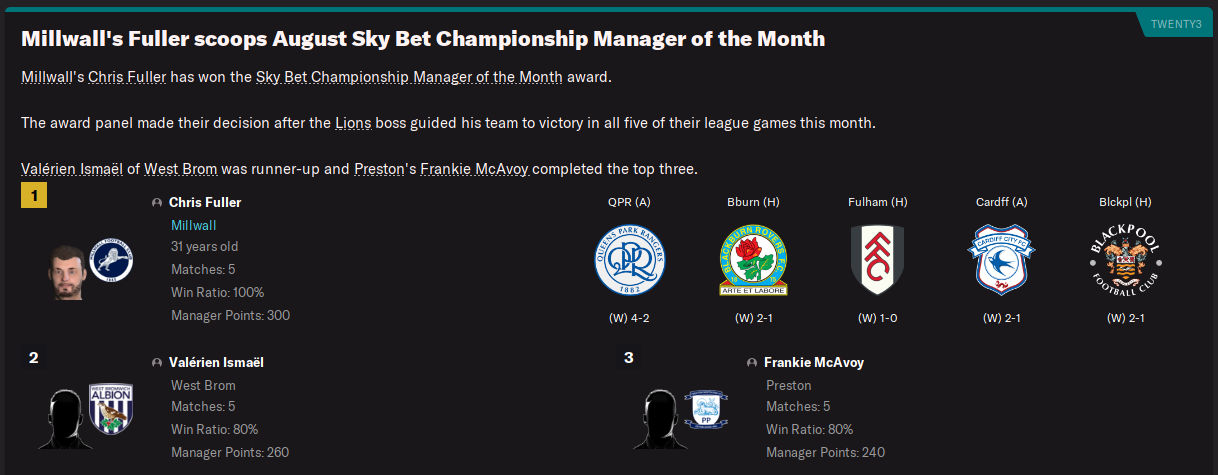
Surprisingly well! We stormed to the top by winning our first five matches, including back-to-back injury-time victories over Fulham and Cardiff (incidentally, the latter were managed by Eddie Howe, who apparently didn’t fancy a £200million war chest). Peterborough knocked us out of the League Cup, though, so it wasn’t all good news.
There certainly wasn’t much good news in September. The goals suddenly dried up and we lost four games out of five, briefly dropping out of the top six as a result. I’d spent a few weeks tinkering my tactics (including experimenting with a 5-2-3 with Jake Cooper playing as one of those fancy new ‘wide centre-backs’), but it was clear we needed more stability.
After returning to the 4-4-2 and sticking with it, our form improved so much that we took 27 points from 13 games, only losing twice (3-0 at Huddersfield, and 3-2 at home to leaders Bournemouth). This kept us in 6th for quite a long time, until we leapfrogged Sheffield United into 5th before Christmas. At the halfway stage, we were six points clear of 7th, and only four off the automatic promotion places!
One key factor behind our success was the fearsome strike partnership of 6ft 7in pressing forward Matt Smith and advanced forward Benik Afobe, who netted 18 goals between them. They received some excellent service from out wide, with attacking left-back Scott Malone and right-winger Jed Wallace regularly chalking up assists. Even Jenkinson set up a few goals – and he’s hardly played since 2016!
Our defensive record wasn’t the greatest, partly due to the erratic form of goalkeeper Bartosz Białkowski. That said, I was impressed with our centre-back duo of Cooper and captain Alex Pearce, who looked solid at the back while also being imposing from set-pieces. Naturally, the chairman sold Cooper to New York City behind my back, but at least Jake stayed until the new year, when the demo was almost over.
But enough about that. Let’s talk about the actual game!
NEW FEATURES

With every new Football Manager, the big list of headline features seems to become more… underwhelming. It could be argued that FM already has so much depth that there are few genuinely major additions Sports Interactive could make now (apart from women’s football, which IS coming soon, but not before FM23).
That said, FM22’s big new announcements do seem quite minor. That is perhaps understandable, considering this is the second successive version to have its development seriously affected by the pandemic. On the positive side, it came out about a week-and-a-half earlier compared to FM21, and the beta also arrived way ahead of schedule, so you’ve got to give SI credit for that.
The one feature many players were most excited about was the Data Hub. Considering how buggy analysis tools were on FM21, we were pleased to see that the statistical side of the game had been given a much-needed makeover.
The Data Hub is your one-stop shop for stats and data, which your analysts will compile throughout the season. You can access various charts and graphs to help you identify your best performers as well as any tactical and personnel weaknesses. The Hub can be daunting to navigate at first, but this article is a pretty good starting point.

I’m a bit more sceptical about the new staff meetings. Rather than getting all your coaching, recruitment and development advice in one inbox message, you now go to a new screen where it is given to you piece-by-piece. While your staff will provide more context with their advice, these new meetings often turn into time-consuming clickathons, which may not delight casual managers.
Meanwhile, the Deadline Day experience has been made much more immersive. It’s easier to catch up on all the last-minute transfer dealings in your league (and beyond), and you’ll have more opportunities to finalise your squad with bargain signings and loans. And what’s more – the sidebar now turns yellow!
And for the very long-term FMer, there are new dynamic youth ratings. This means the average quality of youth players in a nation can now change, based on its performances in club and international competitions. Basically, it’s easier to build up a nation like Bulgaria or China into a football superpower on a par with Brazil or France, given enough time and effort.
WHAT I LIKE ABOUT FM22
FM22 also has a new animation engine, which allows players to move on the ball more realistically. Dribbling in particular has become much more fluid, with some new skill moves added to the game (including the ‘Cruyff turn’). Meanwhile, the days of players ‘sliding’ to receive passes are hopefully behind us.
Pressing has undergone some radical changes, giving players a better idea of when they should press and when they shouldn’t. For instance, they’re now aware of their sprint capacity (linked to their Stamina attribute), which tells them when they can sprint and when they need to conserve energy. As far as I can tell, these changes work pretty well, though I’ve noticed a few instances of defenders strolling to a loose ball when they could perhaps show more urgency.
More generally, FM22’s match engine is pretty fluid – and potentially the best yet. For one thing, crossing has become effective once again, after all the issues we had with blocked crosses on FM21. As I’ve already alluded to, most of my Millwall team’s goals have come through assists from my full-backs and wingers.
But that’s not to say central play has been nerfed. Through-balls and quick short passes can still be effective – as our defence often found out the hard way. I would usually counter this by replacing one of the strikers with a defensive midfielder when seeing out a narrow victory.
And though I never experienced the ‘joys’ of VAR in the Championship, the general consensus is that it has improved on FM22. While nearly every goal that went to VAR on FM21 was disallowed, it is much less predictable now, with more decisions going in the scorer’s favour.
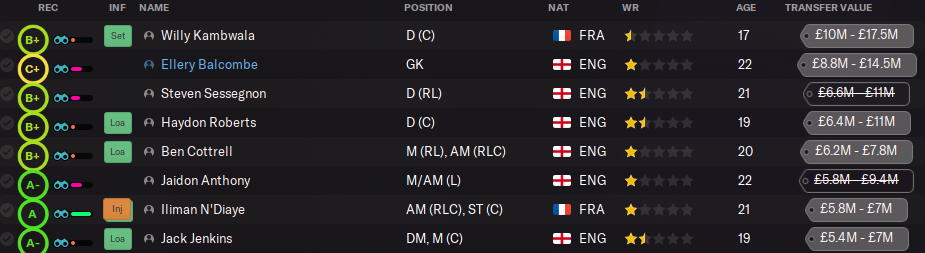
Off the pitch, I like the changes to player values. Previously, a player was given one value, which would often be way off what his club was actually prepared to sell him for. Now, you will see a broad transfer value range, which will narrow down as you learn more about the player. These values will also fluctuate at certain points of the season (transfer-listed players may become much cheaper on deadline days, whereas key players will be much more expensive in mid-season).
You can get an even clearer idea of how much a player will cost you by talking to his agent. Unlike in FM21, when the agent told you everything immediately, the amount of information they disclose depends partly on how interested you are in the player. Just be careful about declaring your interest too eagerly: if you don’t follow it up with an offer, the agent may be less willing to reveal their demands to you in future.
WHAT I DON’T
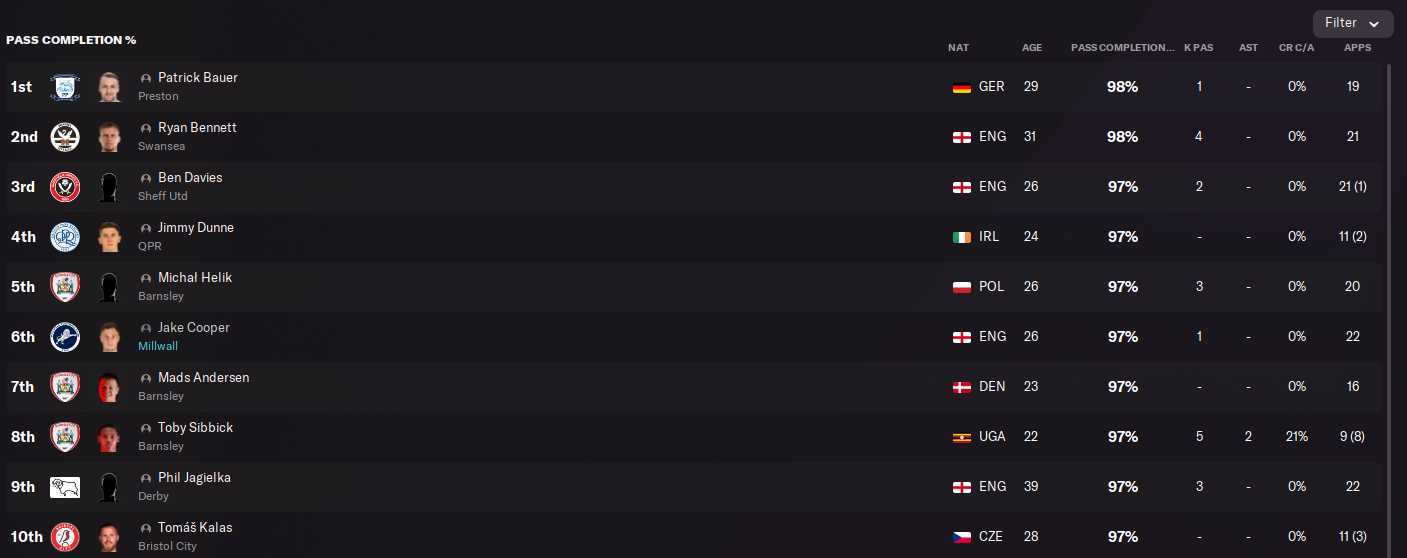
Unfortunately, the new pressing triggers still need some fine-tuning. When defenders are on the ball deep in their own half, opposition forwards are very reluctant to put them under pressure, which means they can keep the ball unchallenged and pass it around the backline for quite a long time.
This has a huge knock-on effect on statistics. Even in the lower leagues, you’ll often see defenders with pass completion rates over 95% (perspective: Rúben Dias and John Stones were the Premier League’s top passers in 2020/2021, completing 93% of their passes). This also results in cautious, weak teams like Norwich hogging the ball more than Manchester City – and bizarre match-ups where one team can have 60%+ possession and still get smashed 6-0.
Of course, possession isn’t everything (after all, scoring goals is MUCH more important), but this is an immersion-breaking bug. SI have been made well aware of it, so hopefully there’ll be improvements in a future update.
I hope they take a closer look at set-pieces too. Admittedly, Millwall are strong at set-pieces anyway, but it did seem ridiculously easy to score near-post corners, especially with the AI defending them so poorly. I’ve also read reports of long throws being overpowered, with even the most useless ball-throwers transforming into Rory Delap-shaped trebuchets.
In terms of the UI, there’ve been more cases of SI ‘fixing’ things that weren’t broken. In particular, I really dislike those redesigned report cards in your scouting centre, which removed the ability to view a player’s attributes at a glance. You have to click on their name (or hover over the little icon beside it) to do that, which isn’t exactly intuitive.

Ah, yes, and just look at those newgen faces – with their comical pipe-cleaner beards, their even shoddier hair, and their thousand-yard stares! I could go on about just how bad they are, but that’s a discussion for another day…
But I also have gripes about things that haven’t changed. Your assistant still gives you contradictory and counter-productive ‘advice’. Journalists still ask you irrelevant questions about Jón Daði Böðvarsson scoring his fourth goal for Iceland, or Preston’s manager putting a fifth-choice striker on the transfer list. International management is still the same old sterile experience it was five years ago.
And by all accounts, the pre-game editor still sucks.
SUMMARY
Football Manager 2022 is, essentially, an improved seasonal update of Football Manager 2021. I do not mean that in a cynical way. Quite the opposite, in fact.
FM21 was a great game (after all, I did pour 750+ hours into it), but it never really lived up to its 5* potential. Certain statistics were not properly recorded, player animations were too erratic, wide play wasn’t all that effective – and there were also a number of bugs that affected the playability and immersion of long-term saves As far as I can tell, most of these issues have been addressed on FM22, while other areas have had a nice lick of paint.
Okay, there aren’t any huge innovations that will have casuals drooling with excitement, but the new-look data hub is a godsend for FM geeks. Being someone who leans towards that side of the spectrum, I’m willing to give SI a pass there.
In its current state, the match engine has its critics, particularly those who call it a ‘crossing simulator’. But once SI can sort out the pressing and possession bugs (particularly when it comes to low-ranking teams being more conservative than a milk-snatching, Rashford-hating Old Etonian with multiple jobs), this ME looks like being an upgrade on FM21’s.
So, if you haven’t played FM for a few years and want to scratch that itch again, I would recommend giving FM22 a go. If you played FM21 and enjoy the statistical side of the series, then the new game certainly sounds like a good upgrade for you. But if you’re still on the fence, you can always play the demo to help you decide if FM22 is worth your money.
Personally, I’ve quite enjoyed my experience with FM22 so far and am definitely hungry for more. Now I just need to decide on a long-term save…
Oh, gosh darn it, SI! I was gonna take a year off until you hooked me in again!
You can buy Football Manager 2022 now on Steam or the Epic Games Store (but not Stadia – apologies to the seven of you who still use that service). A demo version is also available to download on both platforms.
If you’ve found this review interesting and would like to leave add your own thoughts on FM22, you can leave a comment below – or you can find me on Twitter @Fuller_FM.
 Fuller FM
You must be logged in to post a comment.