

Against all the odds, Shama Deadman has completed his first decade in football management – and he’s finally added a trophy to his CV!
After taking over at Basel in the summer of 2029, Shama led ‘Die Bebbi’ to Swiss Super League glory in his first season. You can read about that first season in full by going back to Part 39, Part 40, Part 41 and Part 42.
But now it’s time to find out if Basel can do it again. Today’s post is the 2030/2031 season review, where we will see how Shama sets about taking his Swiss champions up to the next level.
TRANSFER WINDOW
Can you believe it’s been almost 10 years since I started my managerial career with Cambrian & Clydach Vale? Back then, I was coaching semi-professional footballers who spent their weekends sliding on mud-bath pitches deep in the Welsh valleys while I desperately tried to explain to them how the offside rule worked.
It’s fair to say I’ve come a long way since then. Well… we have come a long way, Ceri Morgan and I. My former Cambrian captain has followed me as part of my coaching set-up for five years now, firstly with Győr in Hungary – and now with Basel in Switzerland.
After winning the Super League, we were given a whopping £50million transfer budget to take this great club into the Champions League. Even qualifying for the Group Stage would guarantee us another £20million, which is huge for a club who rarely even get a chance to dine at Europe’s top table.
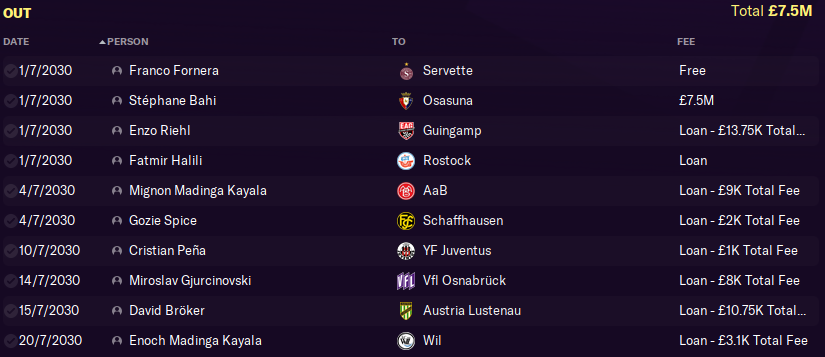
In terms of outgoings, it’s actually been a pretty quiet transfer window for us so far. We did well to get £7.5million from Osasuna for right-back Stéphane Bahi, who somehow got called up to Switzerland’s World Cup squad despite being like a rabbit in headlights in our big matches. I wasted little time in lining up his replacement, whom you’ll meet later.
The only other permanent departures were a couple of reserve defenders. Centre-half Franco Fornera joined Servette after his contract expired. I also released right-back David Ranzoni (who’s not on that list above) when he rejected a transfer following a successful loan in Portugal.
Several young prospects went out on loan. Macedonian left-back Miroslav Gjurcinovski couldn’t keep Wil in the Super League, but he’ll hope for more luck in his next loan spell at VfL Osnabrück. Fatmir Halili – an 18-year-old Kosovan playmaker who got a few first-team opportunities – has also been sent to the German second division to play for Rostock.
After a promising start to his senior career last term, right-back David Bröker has returned to his homeland to play top-flight football for Austria Lustenau. We’ve also agreed a deal to loan striker Dennis Zaugg to Sint-Truiden in Belgium’s First Division, where he’ll hopely get to play regularly without two generational talents blocking his path.
Now, you’re probably thinking that we’ve gone on a big spending spree with all that milk and honey lying around. Yeah… actually…

…we’ve signed two players so far. Yep, you read that right. TWO.
The first man in was Damiano Manzella – a technically gifted and selfless right-back who arrives from Cagliari for an initial £13million. Manzella has very solid ratings in nearly all his key attributes (as you’ll see later), and at 23, his best years are surely ahead of him.
Another Italian arrived a few weeks later. 22-year-old goalkeeper Gianmarco Nesti signed on a free transfer after his release by Milan, where he was Gianluigi Donnarumma’s understudy last season (indeed, he’s literally been dubbed “the next Gigio”). While I was quite happy with Philipp Köhn‘s performances last term, I felt we needed a younger, better goalie who could be gradually eased in to take his place.
I’m very much in the market for a left-back and have already identified several options. However, I won’t spend big yet until I can sell José Emiliano Cruz, who’s got plenty of ability but has the same big-match jitters that Bahi suffered from. The best offer I’ve had so far is £19million from Rangers (yes, really), but ideally, I’m looking for something closer to £25million.
Are there other areas where I might want to strengthen over the coming weeks? Of course. We could maybe do with another midfielder or two – perhaps an experienced playmaker and a bruising ball-winner. Further depth at centre-back and centre-forward might not hurt either.
SQUAD REPORT

So, here’s your refreshed Basel squad for 2030/2031. Let’s take a look at last season’s champions – and the two new boys who’ll be helping them defend their title.

Köhn kept 26 clean sheets and conceded only 34 goals in 51 matches last season, with his excellent form earning him an overdue call-up to the Switzerland squad. However, the spirited veteran’s place could soon come under threat from rising star Nesti, who can expect plenty of gametime in the cup competitions as he settles in.
36-year-old Yvon Mvogo is still around, but the former Swiss international has now dropped to third-choice goalkeeper. He’s in the final year of his £30,000-per-week contract and will probably retire once it’s expired.

As mentioned, Cruz is still kinda our first-choice left-back, but his selfishness and his fragile big-game mentality are huge drawbacks. Once I can sell him for a decent fee, I’ll look to sign a more reliable option to challenge 19-year-old Javier Murillo, who initially struggled for consistency last season but improved steadily as the campaign wore on.
Slotting in at right-back is new boy Manzella – a smart and technical defender who works very well within a team. The Italy Under-21s international will be backed up by the versatile and experienced Jordan Lotomba, who is another player in the last year of his current deal.

Alessandro Buongiorno shows no signs of slowing down as the Basel captain enters his TENTH season at St Jakob-Park. The resolute and strong Italian was an inspiring presence when it mattered most and remains an integral part of our defence. His fellow stalwart Jan Bamert is rather less reliable and may not be with us for much longer.
A couple of Romanians complete our central defensive quartet. Fearless ball-playing defender Haralambie Despa has so far justified his £12million transfer fee with some solid performances and is also becoming more of a threat from set-pieces. And don’t let the star ratings fool you: Eduard Ciubotaru has generally played quite well whenever he’s been called upon.

Raul Quevedo was one of our breakout stars from last season, utilising his silky-smooth passing and eagle-like vision to provide plenty of killer balls and assists. Ulf Ericsson also looks like a pretty handy playmaker, but the young Swede’s performances have not yet lived up to his attributes. I haven’t ruled out sending him on loan later this summer and signing a more experienced backup to Quevedo.
The multi-faceted Alexandre Jankewitz has continued to thrive as a box-to-box midfielder. His main rival for that role is energetic ball-winner Vincent Barbier, who can also be used in defensive midfield or even at centre-half. Brazilian youth graduate Matheus will also be determined to establish himself after a promising half-season loan with Servette.
Whenever we’re playing a 4-3-3, I usually play either Salifou Diarrassouba or Nicolas Janvier as an attack-minded ‘mezzala’. It’s a role that is perhaps more suited to fan favourite Janvier, who still has plenty of pace and technique and thrives in big matches. Meanwhile, vice-captain Salifou desperately needs to rekindle his best form, having gone from 46 goals/assists in the 2028/2029 season to just NINE last term.

Question marks hang over our two left-wingers as we head into the new campaign. The enigmatic Sead Hakšabanović was magnificent last term, but having turned 31, is it all downhill from here? If it is, then we need the pacey but wasteful Jean-Pierre Bodin to fulfil his potential. Me calling him by his actual name instead of ‘Jean-Philippe’ would probably help.
Matteo Santarsiero broke into the starting XI last season after Pierfrancesco Landi’s departure. Despite having more than his fair share of injury problems, Matteo has the ability to change games with his pace and crossing skills. Jesper Sjögren offers a more flamboyant if slower alternative, and the very exciting 17-year-old Manuel Wolf may get more opportunities to impress.

We’re blessed with two outstanding attacking wonderkids who could take by Europe by storm over the next decade. First up is Sanel Ibric – the Bosnian poacher whose agility and lethality can terrify defences. Though Sanel is most at home as an advanced forward, I’m retraining him to play out wide, cutting in from the left wing.
Ibric got 10 goals after arriving in January, but our main man up front is still very much Ertan Yalçın. In his first full senior season, Ertan got 22 goals and 11 assists, and there’s surely more to come from a centre-forward who can do just about anything on a football pitch. Apart from tackle… which I guess makes him the Turkish Paul Scholes?
But if anything happened to those two, who would be our attacking options, especially if Zaugg went on loan? Salifou has played up front in the past, and Sjögren has the attributes to be a handy ‘false nine’. And though he’s not quite ready for regular Super League football, 19-year-old Dane Louis Engell is a clinical finisher who may get some chances off the bench.
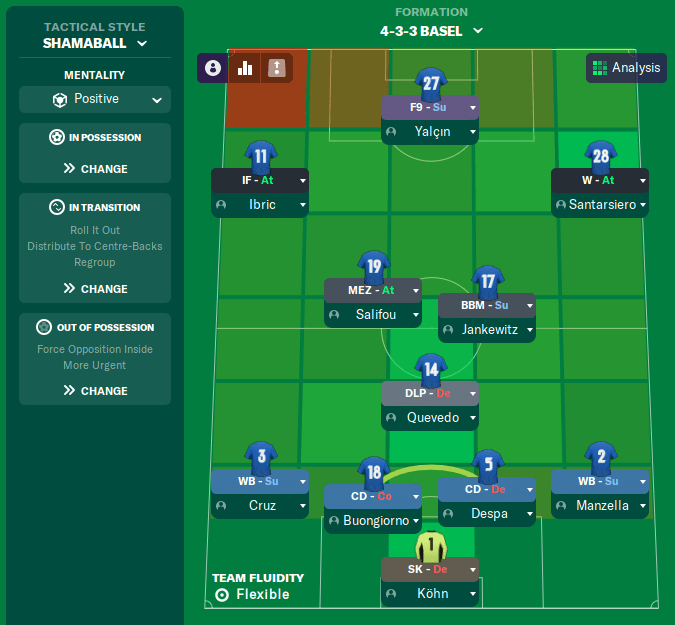

We’ll mainly be using a 4-3-3 again this term. There’ve been a few changes from last season’s version of ‘Shamaball’, as we try to be a bit more patient – and more potent – from our attacks.
My big question mark is about the inside-forward and mezzala combo on the left-hand side. I think they combine well together, but is having both of them on ‘Attack’ duties overkill? Should I maybe switch one of them to a ‘Support’ duty to stop our left-back being too exposed? Let me know what you think…
The 4-4-2 will be our alternative tactic. In the example above, our wingers have been pushed into the AML/AMR stratas to provide more of an attacking threat (though I may move them back into the ML/MR stratas, depending on the strength of our opponent).
I’ve also pushed up the defensive line and have even experimented with counter-pressing in recent months… with mixed results. Just like most of my tactics in general, this is still a work in progress. Yes, I’ve been a football manager for 10 years now and I still haven’t got a grip on tactics!
PRE-SEASON & EXPECTATIONS
The off-season in Switzerland is… quite odd. We broke up for the summer holidays on 26 May after winning the league title, but they were then called back to pre-season training on 10 June.
The players literally got TWO WEEKS off. In another country, they might be on holiday for two months, if not longer! Personally, I would’ve let them had a much longer break, but the Swiss football season is so long that there isn’t really anything I can do about it.

The short break didn’t hamper our pre-season results, though. We completed a clean sweep of six victories, including a couple solid home wins over Club Brugge and Rapid Wien. Meanwhile, we only conceded one goal – in our opening fixture against Karlsruhe in Germany.
The match that really stood out to me, though, was our last one. Yverdon play in the Challenge League, and though they’re one of the weaker teams in the second tier, I still didn’t expect us to thrash them 8-0! Manuel Wolf was particularly deadly, grabbing two goals and two assists from the right wing.

Though we’re the defending Super League champions, the board have reassured me that I don’t need to do it again this season. They’d be satisfied with another strong title challenge, even if it doesn’t end with us lifting the trophy.
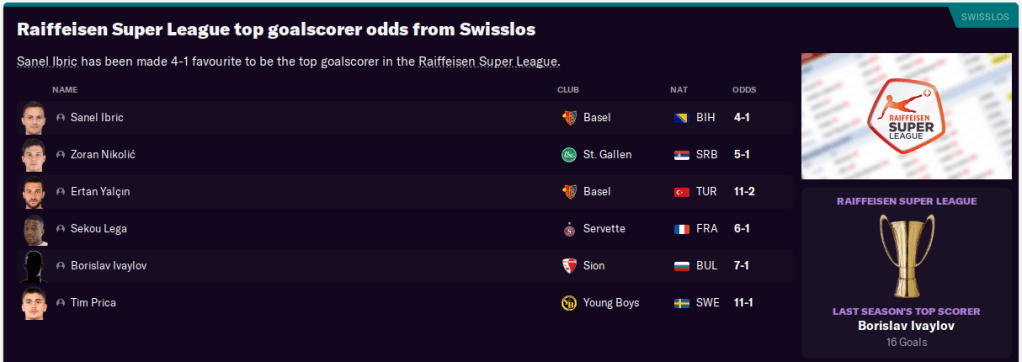
The pundits see things rather differently, though. Our squad is apparently so strong that we have EIGHT players in the Super League’s media dream XI (the odd ones out being two players from Young Boys and one from St Gallen). We’ve also been made 7-5 favourites to defend our crown… and the oddsmakers clearly expect big things from Ibric this term!

As far as the Champions League goes, we need to get through two qualifying rounds to reach the Group Stage. We’re among the top seeds in the qualifiers, so unless we get a really unlucky draw, that shouldn’t be a problem. If we do trip up, though, we are at least guaranteed to be playing in the main stages of a European competition of some kind.
Finally, there’s the Swiss Cup, where the board want to see us go a step further than last season’s Semi Final. I just want us to hold our nerve when it matters – and not suddenly forget how to defend set-pieces, like we did against Zürich in April. Even after winning the league, that still rankles with me.
So, can Basel follow up last season’s success with back-to-back Super League titles? Check back soon to find out!
And here’s the usual new-season reminder that you can stay updated whenever a new blog post goes live by hitting the ‘Follow’ button below, and/or following me on Twitter @Fuller_FM.
Thanks for reading!
 Fuller FM
You must be logged in to post a comment.