

As great as the Football Manager series is, it’s sometimes worth having a look at the other football management games on the market. That’s why I’m back today with another of my occasional reviews.
My first game review on Fuller FM was two years ago this week, when I had a look at Soccer Manager 2019. I didn’t think much of that game, and neither was I too keen on Soccer Manager 2020 when I reviewed that last year.
Now, though, I think it’s time to find out whether the latest title in this free-to-play series is a major improvement, or another underwhelming experience. This is my honest review of Soccer Manager 2021…
BACKGROUND
Anyone who’s read my previous Soccer Manager reviews will likely know about this series’ history already. Bearing that in mind, I won’t bore you with too much detail.
Based in Preston, Soccer Manager Ltd have been active since 2005, when they launched a multiplayer management game now known as Soccer Manager Worlds. However, the developers have largely neglected this once hugely-popular game since 2014, when they released their first single-player title – Soccer Manager 2015.
As you can probably work out, Soccer Manager 2021 is the seventh title in this series – and the first to be endorsed by a real-life manager. Arsenal’s FA Cup-winning boss Mikel Arteta is the official face of SM21, with his image appearing on the main menu and in the tutorial. I’m a lifelong Gooner, but rest assured – Arteta’s presence won’t impact on my review of this game.
SM21 is free to download on PC (via Steam) and on mobile devices (via Google Play and the App Store). As ever, I am reviewing the PC version of this game.
STARTING OUT

When launching SM21 for the first time, you will first be asked to name your manager, and then select one of these handsome fellows. You can’t customise any of them, which is a shame, but they each have different managerial styles. A suit manager will increase your team’s starting balance, a tactical manager will increase your players’ set piece and aerial abilities, and a training manager will give you extra training slots.
These managerial styles have different ‘traits’, which you can upgrade as you gain Manager Points by winning matches. Fortunately, you can upgrade traits in any of those three categories, so your Tony Pulis-esque tactician can still be a Marcelo Bielsa-type beast on the training pitch.
You also don’t have to worry about selecting specific leagues when creating a new game. You just need to decide whether you want to manage in Europe, Asia or the Americas, and the game will load all the available leagues in that region. After that, you just pick your club, and you’re ready to go.
Unlike Football Manager 2021, SM21 offers you a complete escape from a certain global pandemic. All European leagues kick off in August 2020 in front of full crowds, more clubs are financially healthy, and former Southampton strikers won’t bother you with crazy conspiracies about Bill Gates killing African presidents. (Thankfully, that doesn’t appear in FM21 either, but still…)
And one more thing: you should also be wary about occasional pop-ups pointing you towards the Soccer Manager shop, where you can use your hard-earned credits to buy players without using in-game cash (and your harder-earned real-life money to buy extra credits and cash). Let’s swiftly move on…
WHAT I LIKED

SM20’s user interface was a massive overhaul on SM19’s, and there has been a lot of change for SM21’s too. The ultra-futuristic grey-and-green UI has been replaced by a cleaner interface that looks modern yet also evokes some nostalgia in this 90s kid. Most important to me is that the sidebar menu now has more tabs that are clearly labelled, which makes navigating the game more straightforward.
The tactics screen looks sleeker and is laid out rather well. It’s definitely easier to select your instructions and set-piece takers through drop-down menus, instead of having to click through each option until you find the ones you want. You can also save up to three custom tactics, which will save you plenty of time setting everything back to how it was after trying a different system.
Players are still rated on several attributes and given an overall rating, but they also have a chemistry rating. Stalwarts will typically have much higher ratings than new signings, so this will make you think twice about completely changing your squad and expecting immediate success.
These players seem to have more personality now as well. If they’re worried about not playing enough matches, they will come to you with a request, whereby you can either promise them more gametime or tell them to be quiet. These conversations won’t affect morale or player-coach relations as much as they do on FM, but it’s a start.
I must also mention that you can use your cash and credits to upgrade various facilities, which improve your weekly training routines, youth intakes and scouting set-up, etc. There’s also a pretty cool stadium builder, which will excite a certain section of the game’s player base, even if I can’t imagine David Moyes personally rebuilding the London Stadium!
WHAT I DIDN’T

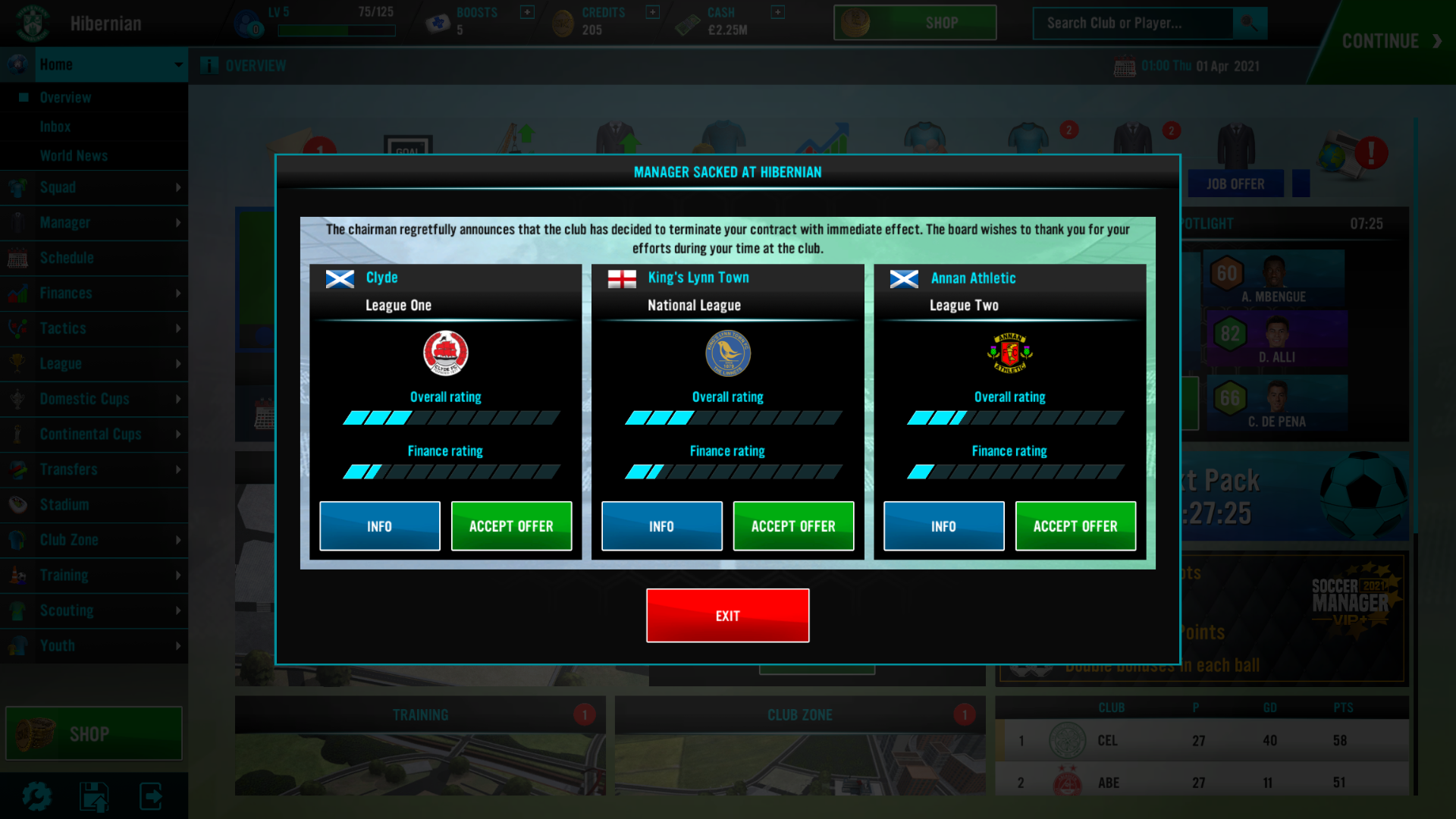
Your chairman will set you a number of expectations when you take your job. These include short-term goals (challenge for the title, make a 10% profit in the current season) and longer-term ones (increase your squad value to £40million by the 2022/2023 season). If you fail to achieve any of those goals, you can expect a pretty swift sacking, which is a problem because certain targets can be… a little tricky.
When I decided to manage Hibernian, I was under the assumption that I would just be expected to achieve a top-half Scottish Premiership finish. But when I went into my inbox, my chairman said that my goal was to “win the title”! Talk about unrealistic expectations!
The transfer market is also a bit lacking on the realism front, as a lot of elite players (forwards especially) tend to move clubs just because they can. I saw Barcelona sign both Kylian Mbappé and Marcus Rashford, while Raheem Sterling and Thomas Müller went to PSG, Robert Lewandowski shacked up at Manchester City, Lautaro Martínez signed for Manchester United, and Richarlison swapped Everton for Wolves. And all that was just in the first season!
I’m still not keen on ‘boosts’ either. You can use these to artificially improve your players’ morale or chemistry, reduce injuries, remove bans, and even to increase their attributes for a single game. The actual impact these have are negligible, but I appreciate that you can now use ‘boosts’ for any of those purposes rather than having separate ‘boosts’ for specific situations.
And if you’re one of those managers who thinks Football Manager’s match ratings are too harsh, SM21 might be more up your alley. Then again, match ratings arguably suffer from the opposite problem of being too generous!
Play through a few games, and you’ll notice that several players from both sides often end up with ratings of 8 or above, even if the match was a drab 0-0 draw or a 5-0 curb-stomp. Indeed, nearly all players will score a 7 at worst, which will make you wonder just how bad that odd player out with a 5 rating was!
WE MUST TALK ABOUT

The match engine. Again.
Okay, so it’s not quite as bad as it was on SM20. For starters, you won’t see quite so many one-on-ones, and players actually seem to know how corner kicks work. Unfortunately, they still don’t understand the offside rule, which remains conspicuously absent from this game.
Defenders tend to leave huge spaces that their opponents could easily exploit if they had any kind of intelligence. While there are odd sparks of genius from the attackers, they’re almost as likely to play odd backwards passes as go for goal when they’re in promising positions. In addition, set-pieces often lead to bouts of ‘head tennis’ in and around the penalty area.
The animations are a little naff too. Players still ghost through opponents, and when you make all your substitutions at once, your three subs will morph into some freakish hydra creature before breaking up and entering the field one-by-one. Also, when players go to ground after a soft tackle, they can take such a long time to get up again that even Neymar would tell them to get a grip!
And then there’s the cameraman, whom I could politely describe as “a little tipsy”. The camera will periodically stray from the action, focussing on a certain area of the pitch either a few seconds early or a few seconds late.
I’ve put together this compilation of some of the worst SM21 highlights I’ve seen. Once you’ve sat through that, you’ll be as grateful as I am for the ‘Quick Play’ option, which processes matches much faster and only shows you the key moments.
SUMMARY
Soccer Manager still has a messy match engine, still has dodgy transfer mechanics, and still pesters you to pay for microtransactions. Yet for the first time since development began six years ago, I sense that the developers are finally steering this game in the right direction.
While the match experience desperately needs an overhaul, SM21 feels a little more like a serious simulation, while retaining some of its goofier, more divisive features. If you want a cheap alternative to Football Manager and are prepared to put up with all those faults, then give it a try. It’s actually not that bad.
FULLER FM RATING: 2.5* – Football League.
If you’ve enjoyed reading this review and have your own thoughts on SM21, feel free to leave your thoughts below. You can also find me on Twitter @Fuller_FM.
 Fuller FM
You must be logged in to post a comment.