

If you’ve been playing Football Manager for a while, you might have a good idea of what works and why. But there are always a few gaps in our knowledge – a few areas where we can still learn. Hey, I’ve been playing since Championship Manager 3 in 1999, but I couldn’t tell you what a carrilero does!
If you are rather newer to the series, though, there are some things about FM you might believe are true when they actually aren’t. A player with 6 Finishing isn’t necessarily a bad striker. Three minutes of injury time doesn’t always mean three minutes. And of course, having more shots doesn’t mean you should score more goals.
In today’s post, I’ll be discussing nine common Football Manager misconceptions and misunderstandings. Most of these are specifically about FM, but there are also a few rules and regulations from real-life football that some FMers may not fully understand.
Just to be clear, I’ve not written about anything related to tactics. One of the tactical gurus on the Sports Interactive forums has already written about 20 common misconceptions when building tactics in FM, so please give that a read as well.
ATTRIBUTES WORK IN ISOLATION
No, they don’t. Football Manager isn’t a game where one single attribute can make the difference between a bad player and a good one. It’s not like Top Trumps, where a player with 15 Determination beats one with 13 Determination.
Attributes work in conjunction with other attributes. Simply having 20 Passing doesn’t make your midfielder the next Andrea Pirlo. To be an effective playmaker, they also need to have good ratings for Decisions, Teamwork and Vision, amongst others.
On the flip side, a player having a low Long Shots attribute doesn’t make it impossible for them to score from distance (Vincent Kompany says hello). They can still pull it off if they’ve got good Technique and/or Finishing… or even if they just take a punt and get lucky. Even a Sunday League player can score a 30-yard worldie on their day.
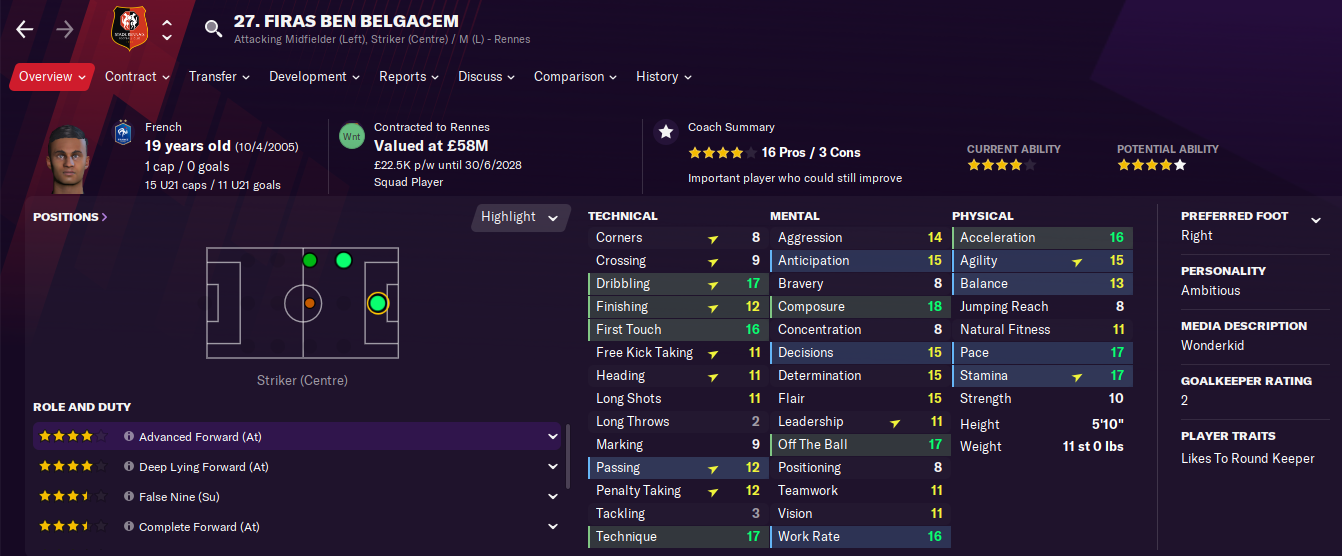
Look at my wonderkid striker from my Rennes save. Firas Ben Belgacem might ‘only’ have 12 Finishing, but he’s a fantastic dribbler, has ice-cool composure, is superb off the ball… and he’s rapid, which allows him to round the keeper more easily. In the season we won the French double and reached the Champions League Final, he scored 25 goals in all competitions – as a teenager.
Another point I need to stress is that the attribute scores from 1 to 20 are relative to other professional footballers. An FM player with 20 Pace is probably not as fast as Usain Bolt at his peak, and an FM player with 1 Pace is still likely to be quicker than me after a hearty meal.
A WONDERKID IS A 5* POTENTIAL PLAYER

“Run like a killer in the wind; rage like a Red Bull wunderkind.”
‘Legend’ is a greatly overused word in modern football, and so is ‘wonderkid’ in Football Manager circles. That 5* potential striker in your latest youth intake is a wonderkid. That 16-year-old Serbian defender you always sign because he always becomes world-class is a wonderkid. I’m a wonderkid and so is my wife!
Actually, FM’s definition of a wonderkid is much more specific. It’s just a media description given to any player aged 21 or under who has a high reputation and high current ability for their age.
The tag has nothing to do with potential ability, so it’s not a guarantee that a ‘wonderkid’ will develop into an elite player. I’m sure some of you remember when Alan Smith and Francis Jeffers were two of England’s best young strikers – and look at what happened to them.
Ansu Fati IS considered a wonderkid on FM21 because he already has exceptional ability for a 17-year-old. His Barcelona team-mate Ilaix Moriba is also 17 and has huge potential, but because his ability isn’t high enough yet, he IS NOT a wonderkid – at least not at the start of a new save.
GOAL DIFFERENCE IS ALWAYS THE FIRST TIEBREAKER

Every now and then, someone will ask on Reddit or Twitter why they’ve been knocked out of the Champions League, even though they’re level on points with 2nd place and have a better goal difference. That’s because UEFA competitions use head-to-head results first when separating teams on the same number of points.
In the example above, Paris Saint-Germain were level on points with Shakhtar and Feyenoord. Goal difference would have put them through in 2nd, but this points tie is decided by the results between only those three teams (disregarding any games involving group winners Chelsea).


In the Champions League, head-to-head tiebreakers are based on points, then goal difference, then goals scored, and then away goals scored. If teams are still level after all head-to-head criteria are used, only then do we consider the goal differences from all matches.
- Shakhtar: 7 points, +1 Goal Difference, 4 Goals, 3 Away Goals
- Feyenoord: 7 points, +1 Goal Difference, 4 Goals, 0 Away Goals
- PSG: 4 points
So that’s why Shakhtar qualified in 2nd place, Feyenoord dropped into the Europa League, and PSG crashed out of Europe altogether.
Quite a few FMers (usually British FMers) seem to think that goal difference decides all points ties. While GD is the main tie-breaker in most countries, there are also many nations that use head-to-head results instead. Some prefer to separate teams based on the number of games won, or even the number of goals scored.
I have made a simple FM Tiebreakers ‘cheat sheet’, showing which tiebreakers are used in certain nations and competitions – and in which order. Have at it.
PLAYERS MUST ‘DECLARE FOR NATION’ AFTER COMPETITIVE DEBUT

Here’s a more subtle rule that some FMers might have missed. In the past, playing in any competitive international permanently tied a player to that national team, even if they were eligible for another nation. Because Munir El Haddadi played in one Euro 2016 qualifier for Spain when he was a 19-year-old Barcelona wonderkid, the striker (now at Sevilla) wasn’t allowed to switch his allegiance to Morocco later.
However, in September 2020, FIFA made a change to the rules. A player can now declare for another nation as long as they played no more than three competitive matches for their first national team before their 21st birthday – and as long as they never played at a World Cup finals or continental tournament. This will mainly benefit players like Munir, who briefly played for a major European nation at a young age but now want to represent their ancestors’ homeland instead.
Unsurprisingly, this new rule is active on FM21. In the example above, Arsenal’s young forward Folarin Balogun has won two caps for the United States, debuting in a Gold Cup qualifier against Guatemala. However, as Balogun is still only 19, hasn’t yet made four competitive appearances for Team USA, and hasn’t yet featured in a major tournament, he is still eligible to play for England or Nigeria.
That first screenshot was taken on 1 July 2021. A few weeks later, Balogun did indeed play at the Gold Cup tournament, thus forever committing himself to the United States and putting him beyond England’s reach. Better luck next time, Gareth.

A HIGHER xG MEANS YOUR TEAM PLAYED BETTER

FM21 saw the introduction of ‘Expected Goals’ (or xG), which is a fairly new metric for evaluating your team’s performance. Every shot is given a score from 0 to 1, depending on the likelihood of that shot being scored, and then… oh, you already knew that, didn’t you?
Some FMers used to judge their teams’ performances by the number of shots or clear-cut chances (a stat which has always been buggy, even on FM21). Nowadays, they go by the xG. This is misguided, as having a higher xG than the opposition doesn’t mean you played better. It might just mean you were more effective at creating scoring chances…
…but even that is flawed. Say that Team A has 20 shots at goal for a total xG of 1.40, and Team B has 5 shots for a total xG of 0.90. Team A had more shots, but the average xG for each shot was 0.07, which isn’t great. On paper, Team B’s shots appear to be higher-quality, producing an average xG of 0.18.
But then again, what if one of Team B’s shots was a penalty? As each penalty is given a very high xG of around 0.78, winning one or two spot-kicks can make a team’s attacking performance look much better than it actually was. If we disregard the penalty, Team B’s average xG from four shots would be a pitiful 0.03.
And of course, more defensive-minded teams who face a lot of shots will likely have a lower xG and a higher xGA (‘Expected Goals Against’) compared to their opponents. It’s not a sign that they’ve played badly, especially not if they’re well-organised and don’t concede many goals. When it comes to these stats, you’d much rather be an Atlético Madrid than a Brighton.
THERE ARE TOO MANY INJURIES ON FM

This isn’t true. If anything, there aren’t enough injuries on Football Manager. Sports Interactive have consistently said that the amount of injuries suffered by players in FM is around 80% what they are in real-life.
Indeed, some FMers have created ‘realistic’ mods that not only increase the amount of injuries, but also change how certain injuries are treated and how long they take to heal. This is one area where the base game is lacking. Should you really treat a bruised thigh with injections? And when was the last time a player missed a Champions League match with blisters?
But to get back on topic, injuries are part and parcel of football. You can’t eliminate them completely, though there are a number of things you can do to stop your treatment room being overwhelmed:
- Get pre-season right with plenty of intense physical training and friendly matches.
- Strengthen your medical department with the best physios and sports scientists you can get.
- Rotate your squad where possible; don’t rely on the same starting 11 all the time.
- Keep an eye on your players’ injury risks, and consider resting those at a higher risk.
TOO MANY GOALS ARE SCORED FROM SET PIECES

I’ve seen a few people quip that FM21 should be called ‘Set Piece Manager 2021’ because a lot of goals seem to come from dead-ball situations. They argue that goal highlights almost always start with a set-piece of some sorts.
It’s true that most match highlights on FM21 begin with a free-kick, a corner, a throw-in or a goal kick. It’s not like watching ‘Match of the Day’ on BBC One, where they’ll usually jump into a highlight with the ball in open play.
But when an FM highlight starts from a set-piece, it doesn’t necessarily mean that a goal is imminent, even if you’ve selected ‘Key highlights’. If there is a goal, it might not arrive until a minute or so into the highlight, when some might have already forgotten about that set-piece!
As far as I can tell, the percentage of goals scored from set-pieces is usually given as being around 20 to 30%. But how do you judge when a goal has been scored from a set-piece? Is it when it’s scored directly from the set-piece, or by the first connection to the set-piece? Is it when the goal comes within the first five seconds after the delivery? Or within 10 seconds?
You have to draw the line somewhere. If your team has a throw-in deep in your own half, but you score a minute later, it’d be pretty hard to argue that your goal came from the throw. If you were to use that argument, then you could also claim that all goals are scored from dead-ball situations – or, to put it another way, that 100% of the moves which lead to goals begin with a dead ball.
Anyway, if you were to compare real-life stats to those in an average FM save, you probably wouldn’t see too much difference. Of course, if you have a squad of set-piece specialists (e.g. Tony Pulis-era Stoke) and/or your players can’t defend dead balls very well (e.g. any-era Arsenal), you might see more goals being scored from them – or shortly after them, at least.
3 MINUTES INJURY TIME = EXACTLY 3 MINUTES

We’ve all been there. Your team is about to get a draw at Old Trafford, as the three minutes of injury time are up. However, play carries on, and you watch on in horror as Manchester United score in the 94th minute to steal victory. Some things never change.
Is this another example of the game ‘screwing you over’? Well… there’s a reason that whenever the fourth official raises their board to show how much injury time has been added, the PA announcer and the commentators always state that “there will be a minimum of X minutes”.
Yep. The allotted injury time is the minimum given, NOT the maximum. The referee can add on more time to account for any stoppages during this period, especially if there are any goals or injuries. The ref can even choose to end the game a little early, saving us a few extra seconds when Burnley and West Brom are slogging out another 0-0 draw, though this never happens on Football Manager.
So just because there are three minutes of injury time doesn’t mean the referee has to call time after exactly three minutes. If there have been any significant stoppages after the initial 90 minutes are up, don’t be surprised when the referee prolongs your agony.
PLAYER SHOULD TRY TO SCORE REBOUND IF THEIR PENALTY HITS WOODWORK
One of the most-reported Football Manager ‘bugs’ is actually a simple misunderstanding of the rules. Let’s say you’ve won a penalty, but it hits the woodwork. The ball ricochets back towards the taker, who just stands there, not making any attempt to score from the rebound.
That’s not because he doesn’t want to convert from the rebound. It’s because he isn’t allowed to.
According to the IFAB Laws of the Game, under Law 14 – The Penalty Kick, “the kicker must not play the ball again until it has touched another player”. If they touch the ball again before it touches another player (such as the opposition goalkeeper) or there is a stoppage in play, the opposition are awarded an indirect free-kick.
See the example above, which is from a Ligue 1 match between Lille and Montpellier in 2015. Montpellier midfielder Ryad Boudebouz fires the penalty against the post, but gets to the rebound and puts it away, only for the referee to disallow his goal and give a free-kick to Lille.
That explains why a player doesn’t score from their own penalty after it has crashed back off the post. But why does the taker turn into a statue instead of trying to get out of the rebound’s path? Now there is a question for Sports Interactive…
Those are just some of the most common misconceptions and misunderstandings people have when playing Football Manager. If you have any others that I haven’t mentioned here, feel free to leave a comment below or tweet me @Fuller_FM. Who knows, I might discuss them in a future edition of FM Mythbusting!
 Fuller FM
You must be logged in to post a comment.