

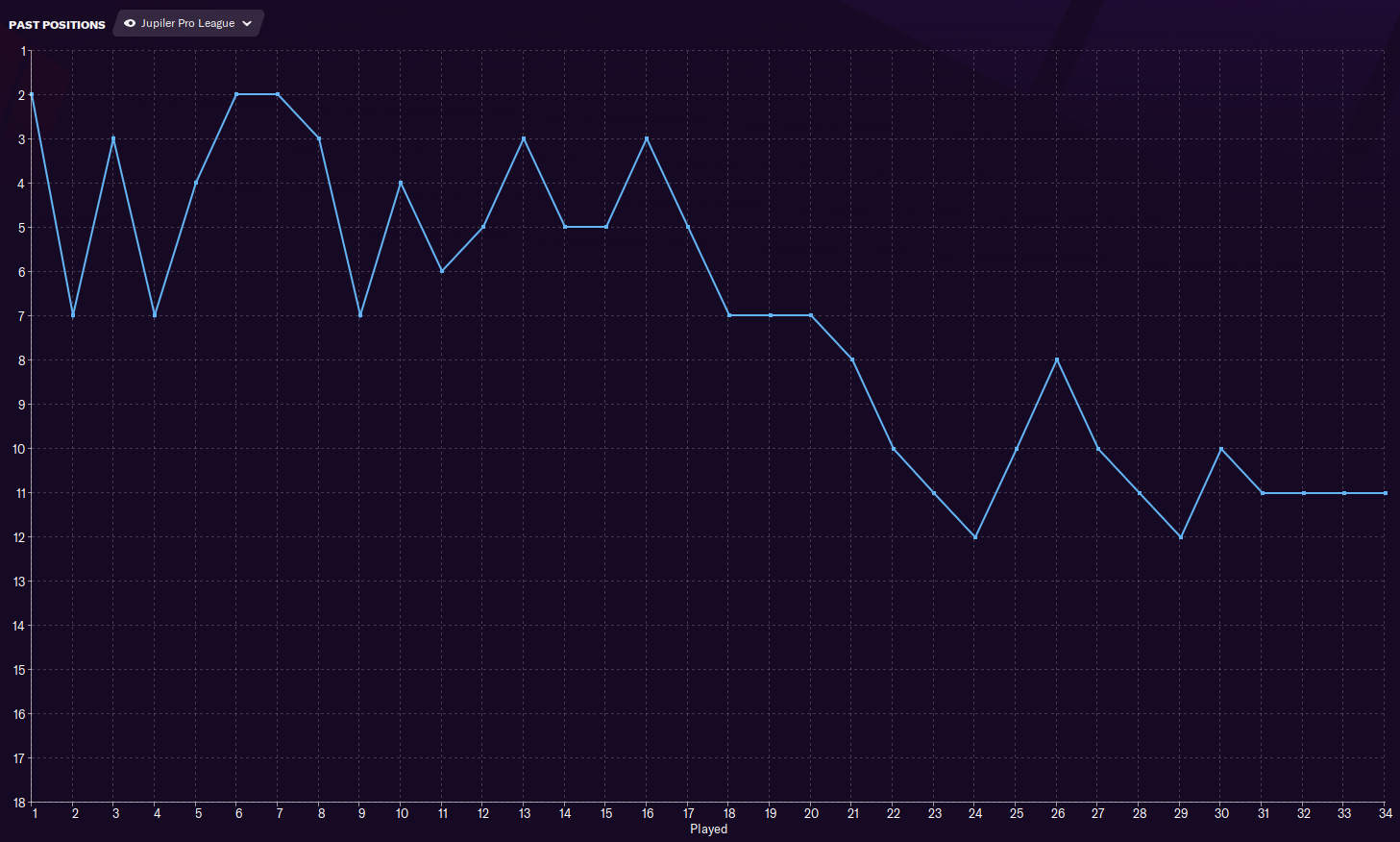
Imagine this Football Manager scenario. You are halfway through the season, and your team is flying near the top of the league after an incredible run of form that’s confounded all expectations.
And then… bam. As soon as you enter the second half of the campaign, your team suddenly stops playing, and you hit a shocking run of losses that send you tumbling down the table.
Some people in the FM community might say that the game is programmed to generate more drama to stop your team running away with a league title. Some might even claim that it’s ‘scripted’ to trip your team up if things are going too well.
What if I told you that these mid-season slumps are fixable – and even avoidable? In today’s edition of FM Mythbusting, I will explain how and why teams can go off the boil after making a strong start. I’ll then give some advice on what you can do to stop this happening to yours.
‘THE SLUMP’ IN REAL-LIFE
Well… it’s not as if mid-season slumps are exclusive to Football Manager. Just like big teams having loads of shots and still losing against relegation fodder, it is possible for sides to blow hot in the first half of the season and then cold in the second.
Look at Liverpool right now. When 2020 ended, the Premier League champions were three points clear at the top, having been beaten in just ONE of their first 16 games – a ‘freak’ 7-2 loss to Aston Villa and their overpowered English striker Ollie Watkins.
Since the start of 2021, however, the Reds have lost FIVE out of eight league games. After going nearly four years unbeaten in the league at home, they have now suffered three successive defeats at Anfield. As I write this, they are down in 6th place and have fallen 16 points adrift of Manchester City.
And surely you still remember the previous Premier League season, right? Leicester were flying in the first half of 2019/2020, taking 38 points from their opening 16 fixtures. For quite a while, it seemed like Brendan Rodgers’ Foxes were the only team who could keep pace with the Reds at the top.
But they couldn’t. Leicester won just six of their next 22 league matches, even losing at home to a Southampton side they had tonked 9-0 at St Mary’s earlier in the season! After being in the top four for almost the entire campaign, defeats to Tottenham and Manchester United in their final two games saw the erstwhile contenders finish 5th and miss out on a Champions League place.
I’ll finish this section by giving you an even more extreme example – from Iceland’s top division in 2003. Þróttur led the Úrvalsdeild at the halfway point of an 18-game season after taking six wins from their first nine. However, after taking just four points from their next nine games, they plummeted to 9th place (second-from-bottom) and were relegated!


‘THE SLUMP’ IN FM

So, why can something like that happen to your FM team? Have opposition teams suddenly ‘figured out’ your tactic? The AI may be smarter than ever on FM21, but it hasn’t quite reached that level of sophistication yet.
Here’s what usually happens. Initially, opposition teams will assess your team’s threat level in terms of your reputation and your pre-season league prediction. If the media is tipping you for a mid-table finish or lower, the better teams are more likely to play a more positive or attacking game against you, as they don’t take your threat seriously.
Around halfway through the season, the game will recalculate your threat level. If you were predicted to have a strong season but are underachieving, opponents will start treating you more like minnows and attack you a lot more (unless they’re Steve Bruce’s Newcastle, that is).
Conversely, if your team is performing way above expectations (e.g. you’re battling for the title rather than for 11th place), they will react by treating your team as more of a danger. They might play more cautiously at home, or even ‘park the bus’ in the penalty box when they arrive at your ground. Basically, if an AI team fields the dreaded 5-4-1 with two DMs against you, that actually means they’re scared.
Even a simple change of mentality from the AI could appear to ‘break’ your tactic. If you were regularly exploiting spaces in the opposition defences, your attackers may struggle to find them now. They might end up running into defenders, if not firing shots straight at them. You might also be more vulnerable to counter-attacks, especially if you throw too many men forward.
You could carry on as you were without making major changes and hope that the situation will eventually fix itself. That is not the best strategy. That would probably allow things to spiral completely out of control and perhaps even get you sacked.
If things were going very well and then suddenly take a dramatic turn for the worse, I’d suggest watching a few highlights from recent matches to see what issues – if any – have sprung up lately. Unfortunately, FM21’s analysis tools are so buggy and frustrating to use that it sometimes feels like Sports Interactive don’t want you to properly analyse your games.
But lengthy analysis isn’t for everyone anyway. Perhaps you’re a manager who just want to get through matches quickly instead of going all Carragher and Neville on every little detail. There are still plenty of things you can try in attempting to arrest your slump, which I’ve written about in the section below.
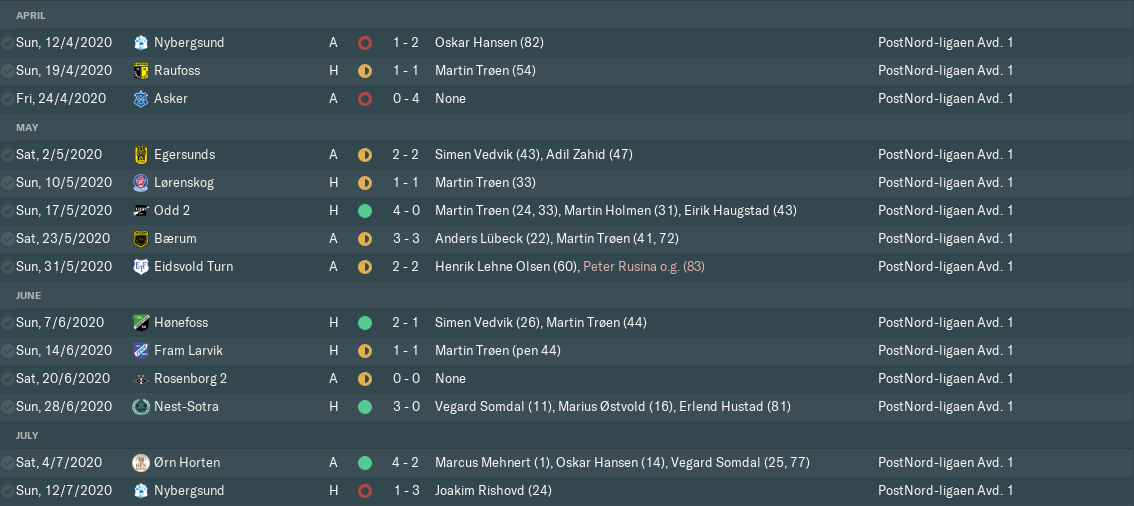
Luckily, I haven’t had a mid-season slump on FM21 yet. My last one was during my second season at Lyn 1896 on FM19. In the summer of 2020, which was almost as rotten in-game as it was in reality, we went from being a solid mid-table team in Norway’s third tier to battling against relegation.
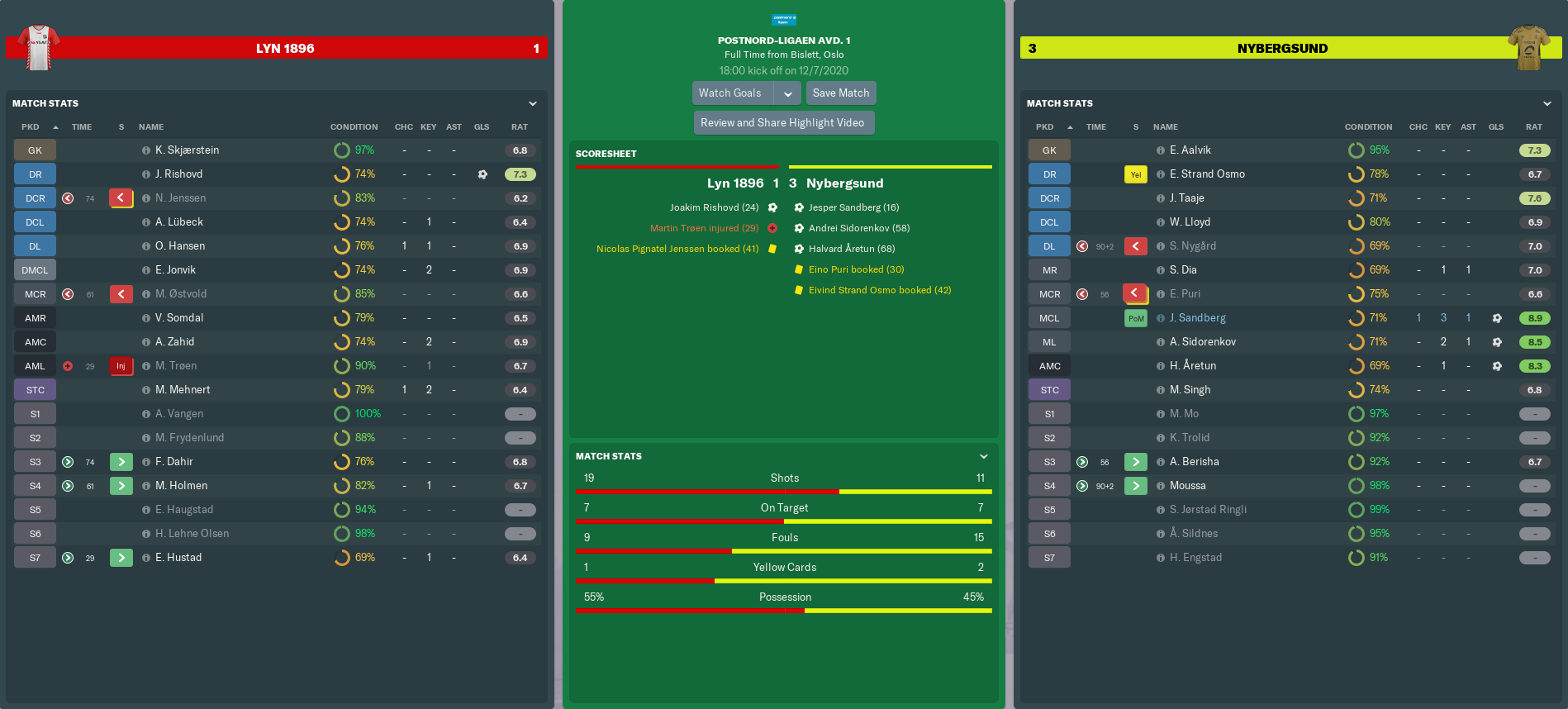
Our first game in the second half of the season was a 3-1 home loss to Nybergsund. That match highlighted some major defensive frailties, which I regrettably didn’t resolve until much later in the campaign. We came within two defeats of being relegated – and my in-game manager losing her job. The advice I’m about to give could help you avoid a similar disaster.
FIXING A SLUMP
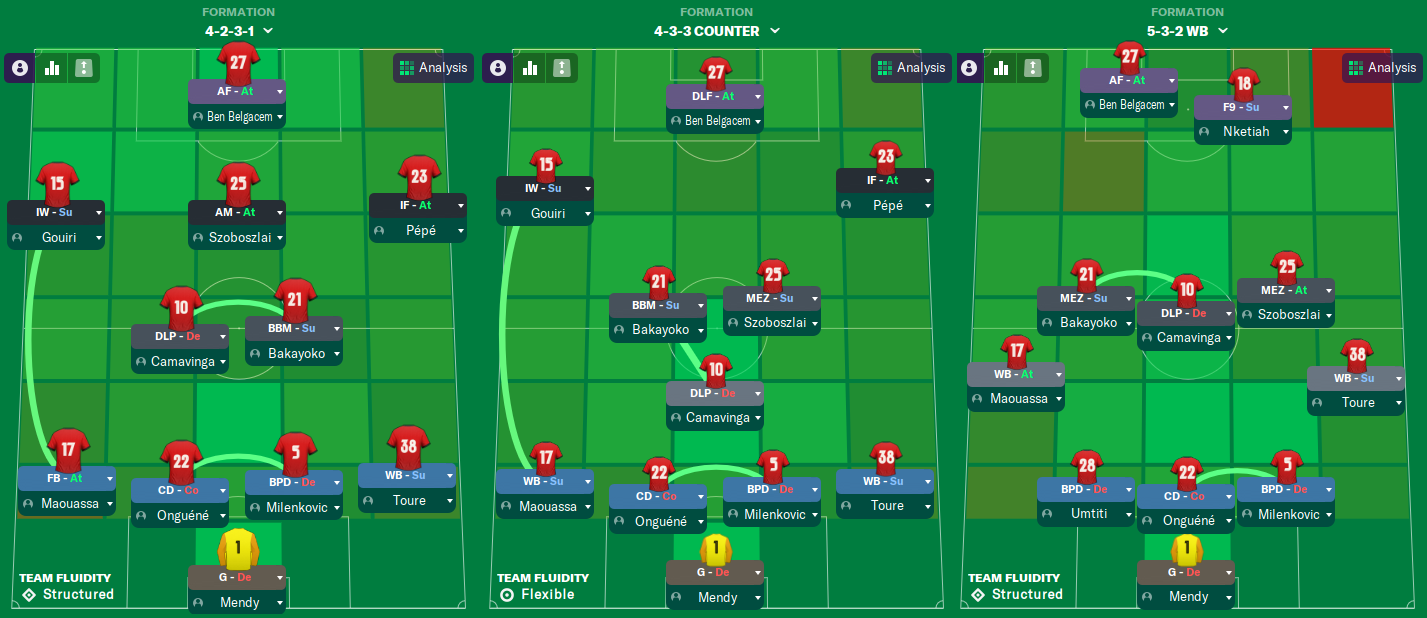 Quite often, the main cause of a mid-season slump is a tactical one. Perhaps you’ve stuck rigidly with one system for too long, and the opposition – while not actually ‘figuring out’ your tactic – are now wiser to your plans. You really should have THREE different (but similar) tactics set up, so you can adopt certain plans for particular situations.
This doesn’t mean you should bin off the tactic you previously had success with. Instead, you might want to change a few tweaks to address any specific tactical issues. If you’re leaking goals, focus on shoring up the defence. If you’re struggling to break down the opposition backline, make changes to create more space going forward.
Also bear in mind the impact that weather can have on tactics. If you’re managing in Britain, possession football might work very well in the summer, when it’s sunnier and warmer. But once winter arrives, the weather usually gets rainier and windier, and the pitches may become a bit… less pristine. Tiki-taka is unlikely to be as effective on mud bath pitches, where more direct tactics may be more suitable.
Another common problem FMers have at this time in the season is morale. Some say that morale has too much of an impact on Football Manager, but it’s true that happier teams win more in real-life.
If your team is down in the dumps, you can hold an emergency team meeting, where one or two good choices can massively increase morale. On an individual basis, you can praise your players’ conduct and training performances – if merited, of course. Mario Balotelli might get away with a 5.0 training rating, but you really shouldn’t give out praise for anything below a 7.0.

For another quick morale fix, you can arrange a friendly against a much weaker team, where a big win should boost your side’s confidence. My problem with this is that thumping a bunch of part-timers 14-0 isn’t exactly preparing them for tougher competition. Nor do I think it’s realistic for José Mourinho to send his Tottenham superstars to Hornchurch for a glorified practice session on a rainy Wednesday night.
That said, I do like to use my reserve and youth teams for a similar purpose, making available those first-team players who most need a confidence boost. If your reserve team’s league has restrictions in terms of how many overage players you can select, set up some friendlies for them instead.
You could also consider morale when selecting a team for the next match. Take out those players who are especially low on morale and/or form, and bring in some replacements who perhaps aren’t quite as talented, but are more confident and playing better. Promoting one or two young prospects for a few games might be worth a try too.
Lastly, if your slump coincides with a transfer window, be wary of changing too much too soon. By all means bring in some fresh blood in those areas where you most need to improve, but don’t use a few defeats in a row as an excuse to tear the whole team up. Even doing that in the off-season is very risky.
Don’t just change for the sake of change either. When my Millwall team on FM17 went through a slump during our second year in the Championship, I sold Lee Gregory (one of my best and longest-serving forwards) to Bolton for £575,000. I replaced him with Brett Pitman – a target man of similar age and ability to Gregory who was a bit cheaper, but who turned out to be absolute garbage. What a waste of a January signing that was.
AVOIDING A SLUMP
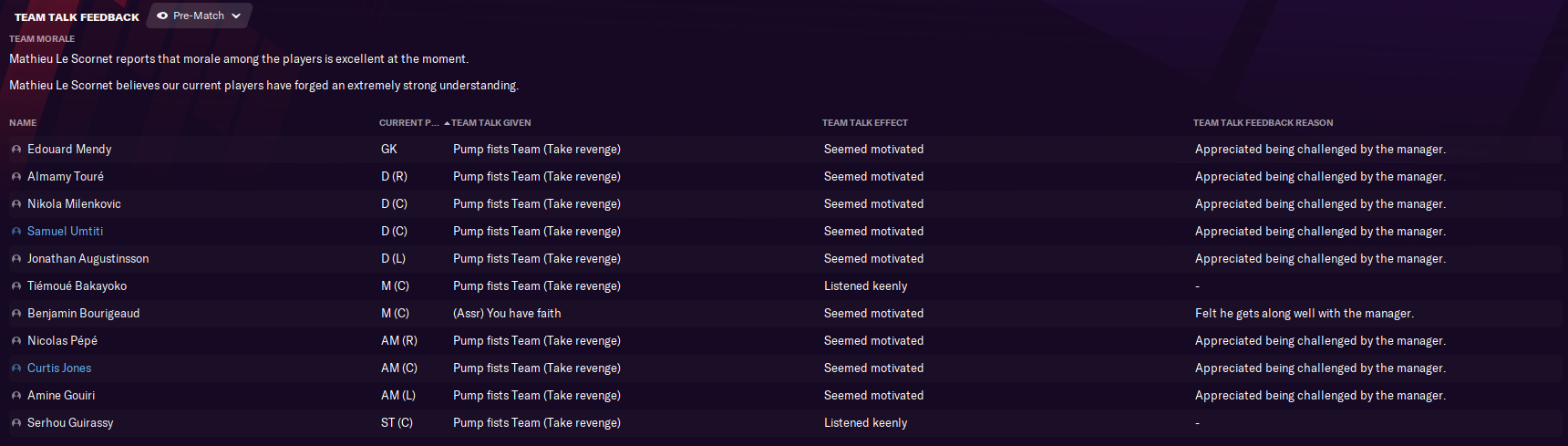
It’s a good feeling when you halt your slide down the table and get back on track, but do you know what’s even better? Stopping a slump from developing in the first place.
Slumps don’t just happen because opposition teams put up their defences against you. They can also happen if your team gets so high on confidence that it turns into arrogance and complacency. When players feel smugly satisfied about their performances instead of striving to do better, they can lose focus or overestimate their abilities, which can easily lead to mistakes.
When your team is on a hot streak, you may need to be more demanding with your team talks. Telling your players that they need to keep their performance levels up – and criticising them more when they slack off – can help stop complacency from setting in.
Players with high scores in the hidden Professionalism and Pressure attributes often react better to those team talks, but those with a low Pressure rating may become more stressed, so handle them with more care. And while you’re increasing expectations, you may also need to lower the impact of pressure across the team. I don’t do this by using “No Pressure” team talks or shouts; instead, I do this through press conferences.

In my fourth season at Rennes, when we were halfway towards an unbeaten league campaign, I demanded more of my players in private meetings and team talks. In the public eye, though, I took a very different attitude.
When it came to press conferences, I made a habit of tempering expectations and downplaying our championship credentials, mainly to ward off complacency and pressure. Even if we were playing Dijon or Amiens near the bottom of Ligue 1, I’d say things like “I expect a struggle” instead of boasting that we should win easily. Think Roberto Mancini when he led Manchester City to their first Premier League title in 2012.
Teams can also drop off mid-season if the manager doesn’t look after their players properly. Don’t expect the same starting XI to deliver week in, week out. You may need to rotate your squad regularly, not just to stop your stars becoming exhausted or needlessly picking up injuries, but also to remind them that their places in the team aren’t guaranteed.
Fatigue will likely become an even bigger problem if you didn’t do enough conditioning training in pre-season. If your players don’t put a lot of physical work in before the season starts, they may look fresh for the first few weeks, but then they’ll fade quite badly as the campaign progresses.
SUMMARY
Almost every Football Manager slump happens for a valid reason. Your team won’t suddenly decide to stop playing football after Christmas, and the other teams in your league won’t suddenly unearth an unbeatable tactic that trumps your gameplan.
If your team is overachieving, be prepared for a backlash. Adapt your tactics to deal with a potentially more defensive AI. When things start taking a turn for the worse, look out for weaknesses in your system and make tweaks before two consecutive defeats become six.
If your gameplan is a bit too predictable, shake things up with a different system – but don’t go too far too quickly. Changing from Pep Guardiola to Tony Pulis in one fell swoop will probably ruin your team’s tactical familiarity and make a bad situation even worse.
Keeping your players happy is also very important. Use press conferences, team meetings and player conversations to carefully balance your team’s confidence and motivation levels. You don’t want your star men to be nervous and/or demotivated, but allowing them to get complacent can be just as disastrous.
Be careful not to break them either. Many an overachieving team has crashed after losing a key player or two to injury. A well-balanced training regimen and a healthy rotation system should stop any injury crises from derailing your season.
We will all hit rough patches at various points during our Football Manager careers. It’s our reactions to them that often make the differences between a resurgent success and a death spiral into failure.
Thank you for reading. If you have any thoughts on this article, or if you have any other tips for fixing or avoiding a mid-season slump, feel free to drop a comment below. You can also find me on Twitter @Fuller_FM.
 Fuller FM
You must be logged in to post a comment.