
Since the beta dropped in November, I’ve been playing a lot of Football Manager 2021 over the last two months.
If you follow me on Twitter, you might have seen me post regular updates from my beta save with Rennes. I took charge of an exciting young team that was embarking on a maiden Champions League voyage after finishing 3rd in Ligue 1. My targets were to challenge Paris Saint-Germain’s dominance of French football, and also to establish Rennes as a force in Europe, while making use of their renowned youth system.
This save was only meant to run for two or three years, but I enjoyed it so much that I played on for a fourth. Now that my French adventures are finally over, I’ve put pen to paper – or rather, fingers to keyboard – to tell you all about the four seasons.
No… not them. Anyway, in today’s post, I will summarise the first half of an eventful career in Brittany.
SEASON 1 (2020/2021)
I inherited a Rennes side which looked a bit rocky defensive but had plenty of creative and attacking promise. We also had at least two highly-rated young starters in left wing-back Faitout Maouassa (22) and midfield wonderkid Eduardo Camavinga (17). Indeed, one of my first decisions was to give Camavinga a beefy new contract to deter Europe’s big guns from snapping him up in January (as always, I disabled the first transfer window).
Initially, for my main tactic, I built a possession-based wide 4-3-3, with a defensive midfielder protecting the back four. I kept the same formation for my backup tactic, which was more of a fluid counter-attacking system with a deep-lying playmaker rather than an advanced one. The second system was actually more successful than the first, which didn’t last long.
On the pitch, my reign got off to a steady start, as we ground out five wins from our first seven league games, thanks to six goals from one-time Football Manager wonderkid M’Baye Niang. Obviously, we then lost our next three outings – the first one coming at Lorient.
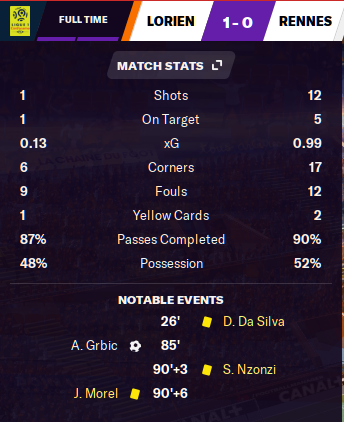
That was the first time we had lost to the opposition’s only shot. It would also be the last.
Niang soon went off the boil, but fellow forward Serhou Guirassy did hit form in the autumn. It was just as well, as we only won three league matches in two months, the most impressive of which was a 2-0 home win over the previous season’s runners-up Marseille. Mind you, we did reach the Christmas break sitting in a respectable 6th place.
Guirassy’s goals were even more vital in the Champions League. After collecting two points from our first three games, we somehow swept the last three to top a difficult group ahead of Ajax, Bayern München and Internazionale. Our reward was a Round of 16 tie with Chelsea, whose striker Tammy Abraham would tear us apart and end our debut campaign in the competition.

Back on the domestic front, 2021 began with a couple of encouraging results. Box-to-box midfielder Benjamin Bourigeaud stole the show as we recorded a thrilling 3-2 win over Monaco, before sensationally ending PSG’s unbeaten start at the Parc des Princes!
A new year brought me my first chance to strengthen the squad. Romain Del Castillo was sold to Crystal Palace and replaced as our starting right-forward with Alessandro Schöpf – a £2.7million steal from Schalke 04. We also found a new right-back in the Bundesliga, with Croatian Tin Jedvaj arriving from Bayer Leverkusen for £2million.
Schöpf and Jedvaj both struggled for consistency at Rennes, and both would move on to pastures new by the third season. My other January signing also didn’t stay for long. Swedish midfielder August Erlingmark (who long-time Fuller FM readers might remember from my FM19 career with Lyn 1896) never really settled in Ligue 1, and he was loaned out for the next two years before being sold.
My early transfer record was pretty dubious, as were some of our winter results. We might’ve been alright against PSG, but there were also losses to relegation candidates like Brest and Dijon.

The Dijon loss was so infuriating that I… erm… went postal on a poor, defenceless tissue box that was lying on my desk. Sorry, Kleenex.
Embed from Getty Images
[Actual tissue box not pictured. Other brands are available.]
Defeats like those meant we were still outside the European places by mid-March. I knew I had to take drastic action, otherwise there was every chance this beta save would be a very short one!
Loanee midfielder Steven Nzonzi had been erratic in recent games, so much so that I wondered how on Earth he ever got to play for Blackburn, let alone for France in a World Cup Final. Nzonzi was also becoming a bit of a stroppy and disruptive influence in the dressing room, so I dropped him to the reserves for the rest of his loan spell from Roma.
With Nzonzi banished, everything suddenly changed. We won our final eight games and surged to 2nd place, with a revitalised Niang scoring six goals to finish the campaign on 20. Guirassy wasn’t far behind on 17 goals – the best of which was a stunning chip shot over the Monaco goalkeeper that secured us an immediate Champions League return.
A second win against PSG (in which both Guirassy and Niang scored early on) was the icing on the cake of what had been a promising first season. No, wait a minute… this was.

Manager of the Year. After the Sporting debacle on FM20, this just goes to show that I can actually play this game, y’know.

Finishing runners-up on 74 points (albeit 16 points behind PSG) was a decent platform to build on, our defence needed reinforcements. While goalkeeper Alfred Gomis hadn’t made too many mistakes, that was another position I would look to upgrade on in the summer.
Also giving me food for thought was that it had been a mediocre season for Camavinga, whom I’d mainly used as a defensive midfielder. His playmaking abilities were in danger of going to waste, but I also knew that to make the most of them, we needed to have better players around him.
SEASON 2 (2020/2021)
So bring in better players I did. One of my first calls was to spend £19.5million on 20-year-old Dominik Szoboszlai from Red Bull Salzburg. This skilful, pacey Hungarian starlet was originally signed as a central midfield mezzala, where he had a very productive first season (getting 11 goals and 9 assists), though he would later enjoy greater success in a more advanced role.
One of Dom’s Salzburg team-mates soon followed him to Rennes. The commanding Cameroon Jérôme Onguéné signed for £15.5million to be our new vice-captain – and the second half of a new-look central defensive partnership. We’d earlier swooped for Nikola Milenkovic after hearing that the 23-year-old ball-playing Serb was available for a dirt-cheap £9million from Fiorentina.
Finding a new goalkeeper was more problematic. The highly-rated Wuilker Faríñez turned us down for AC Milan late in pre-season, so I panicked and settled for a £3million deal for Roma’s Robin Olsen. The Swede might’ve had plenty of experience to call upon, but it quickly became clear that sweeper-keeping was not his thing, and he was gone within a year.
I also agreed a loan deal for Arsenal forward Eddie Nketiah, having loaned in fellow Gunners prospect Emile Smith Rowe for the second half of the 2020/2021 campaign with mixed results. It was much the same with Eddie. Nine goals and seven assists wasn’t a bad return for somebody replacing Adrien Hunou (who played 21 times in that first season and scored twice), but I had expected more.

Meanwhile, our long-time chairman François Pinault announced over the summer that he was planning to sell the club and retire. The 84-year-old retail businessman (valued at just under $43billion by Forbes) received three intriguing offers, all from that world-renowned billionaires’ playground… Kent.
Former Dartford co-chairmen Steve Irving and Dave Skinner and ex-Tonbridge Angels chief Steve Churcher were the three surprise contenders to buy out one of France’s top football clubs. After a few weeks, it was Irving who prevailed, improbably swapping Princes Park for Roazhon Park.
On the pitch, our campaign got off to a promising start, with a couple of 3-0 wins over Amiens and Strasbourg. Schöpf was sensational in both matches, but then the Austrian’s form completely disappeared, and he wouldn’t trouble the scorers again until late April. That was his Rennes career in a nutshell.
Naturally, we lost our following two matches to Nîmes and Lille, but then went unbeaten in our next 18. It wasn’t the most convincing run in history, as those results included disappointing home draws against middling teams like Metz, Nantes and Nice. It was those poor results at Roazhon Park that led to another turning point.
I felt the 4-3-3 was just too conservative to break down weaker, more cautious opponents on home turf. Despite not having much success with attacking midfielders on either FM19 or FM20, I took a punt on a 4-2-3-1, with Szoboszlai in the hole behind the lone striker. Early results were encouraging, as the magical Magyar thrived, our home form improved, and we built up some real momentum.

On the continent, we overcame both Liverpool and Borussia Dortmund to win another Champions League group. Our long unbeaten streak ended with a final-game loss to whipping boys Benfica, in which first-season youth graduate Jeffrey Loricourt made a record-breaking debut. The 16-year-old right-winger was surely destined for a long and prosperous career at Rennes…
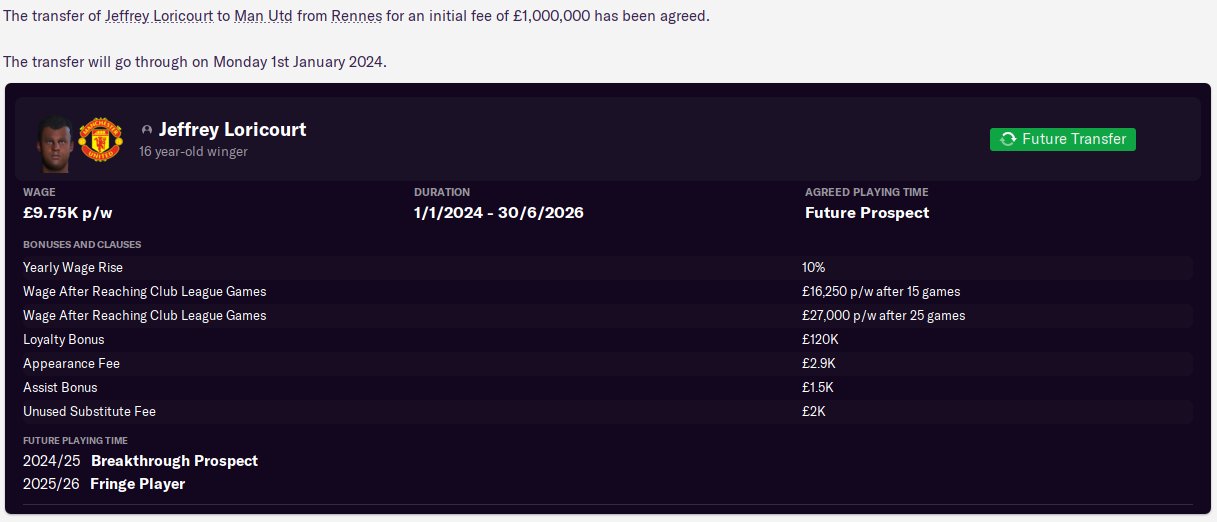
…or perhaps not. That’s what can happen when you don’t tie down your best youth players quickly enough.
Halfway through the Ligue 1 season, we were in 4th position – seven points adrift of leaders PSG and Monaco. While Onguéné and Milenkovic had solidified our defence, our frontline was still far too reliant on Niang and Guirassy, and our midfield had struggled to assert itself since the versatile Bourigeaud broke his leg in October.
Despite that, I didn’t make any major signings in January. For starters, we had another very exciting young forward coming through the ranks. 16-year-old Firas Ben Belgacem – another product of my first youth intake – had made a few appearances off the bench before scoring his first league goal at home to Strasbourg. Then, a few weeks later, he did this to complete a comeback win at Reims.
[Apologies for the poor quality, by the way. FM21 has some major issues when it comes to exporting videos, especially since the last patch, and this is the best I can do right now.]
The turnaround against Reims came after back-to-back league losses to Dijon and PSG, and it would kick off another late-season surge. We lost just one of our final 13 games in Ligue 1 – against local rivals Nantes – as we steadily rose back up the table.

My second season with Les Rouges et Noirs turned out much like my first. We again finished 2nd on 74 points – seven behind PSG, who knocked us out of the Coupe de France for a second straight year. We also exited the Champions League in the last 16 again, losing to RB Leipzig after a couple of rare defensive mistakes from Milenkovic cost us the lead.

It was encouraging to see three of our players named in the Ligue 1 Team of the Season. Maouassa led the way after a slew of assists, while Szoboszlai was joined in midfield by Camavinga, who had thrived since being given more responsibility as a deep-lying playmaker. At 19 years old, Eduardo was starting to fully realise his potential.
Less positively, neither Guirassy nor Niang had quite recaptured their form from the previous campaign, grabbing 14 goals each and posting average match ratings comfortably below 7. Would I keep faith in our popular frontmen for the next campaign, or was it time to upgrade?
And that’s half-time in my Rennes career summary. I hope you’ll join me again on Friday for the next installment, where I write about a turbulent third season at Roazhon Park… and an even more remarkable fourth!
 Fuller FM
You must be logged in to post a comment.