

Pre-season is an often underrated but very important part of Football Manager. It’s during those first few weeks of a new campaign that you have arguably the best chance to set your team up for a successful year.
Your players will return from their post-season holidays refreshed but unfit. It’s up to you to sharpen them up physically and tactically through training and friendlies, so that they can perform to high standards from the first league game onwards. If you fail to prepare, you prepare to fail.
In this article, I will give you some tips for an effective pre-season, while also taking you through how I typically get ready for a new campaign. This isn’t a silver bullet that works for every team, but if you roughly follow my advice, you can’t go too far wrong.
FIRST THINGS FIRST
Almost as soon as you’ve completed a season on Football Manager, you should be planning for the next pre-season. A few days after your final game, your players will go on holiday for the off-season, and you’ll get a message in your inbox like this one:

You may be asked to set a date for your players to return for the start of pre-season training. Whether you should bring them back earlier for a longer pre-season, or later for a shorter pre-season, depends on what you want to do.
A long pre-season (of around 6 or 7 weeks) gives you plenty of time to build up team cohesion and tactical familiarity. You’ll be able to play more friendlies and arrange more training sessions. This is most useful if you have a large squad, plan to make major changes, or just want to test out new tactics before the new season.
Players will naturally lose attributes and sharpness when they’re not playing in the pre-season. Summoning them back to the training ground earlier will reduce these effects, but the players will also have had less time to reduce their jadedness levels. This will make it more likely that they become jaded earlier in the season if they play a lot of matches.
A short pre-season (of around 4 to 5 weeks) will allow your team to have plenty of rest before going back to work, thus making jadedness less of a problem. On the flip side, their attributes may drop more after a longer break, and they’ll have less time to rebuild cohesion and tactical familiarity before returning to competitive action.
You can probably get away with a shortened pre-season if you have a small squad and don’t plan on making major changes between seasons. Give or take a few days, one month should still be enough time to get your players up and running with some fitness training and a handful of friendlies.

When you’re deciding the length of your pre-season, the board may also give you permission to send your team to a training camp. This will typically take place abroad and last about a week and a half.
Your players will gain tactical familiarity quicker during a training camp than they would do usually. Holding a training camp in a country such as China or the United States will also allow you to play money-spinning friendlies against local clubs or other touring teams.
PRE-SEASON SCHEDULE
You’ll then want to think about organising some friendlies to fine-tune your team before the season ahead. Your assistant manager can set up friendlies automatically, but organising them yourself can be much more efficient.
There is no ‘perfect’ pre-season schedule that will suit everyone, but there are a few good rules of thumb to follow.
Firstly, DON’T set up your first friendly in the first week of pre-season, as your players will need plenty of physical work before they’re ready to take to the field again. That opening game should be no earlier than the middle of the second week.
Also, DON’T organise more than two friendlies in the space of a week, and ALWAYS leave at least a three-day gap between matches. Your players need plenty of team training before the new season, and making them play every other day until the big kick-off will just make them very jaded very quickly. A consistent schedule of Saturday and Tuesday/Wednesday friendlies is more ideal.
Depending on how long your pre-season is, you should play somewhere between 6 and 10 friendlies – enough to sharpen up all your first-teamers. But now you have a better idea of how many games you should play, the next question you’ll probably ask is, “Who should I play?”
If you’re managing a big team, you might be tempted to organise loads of home games against rubbish non-league teams. DON’T. Smashing Sawbridgeworth and Waltham Abbey by 10+ goals twice a week might make your team very confident, but it can also breed complacency. You just won’t be prepared for tougher challenges against a team like Arsenal, let alone any half-decent top-flight side.
As for the lower-league manager, inviting over a load of much bigger clubs for friendlies is a good way to raise some cash through gate receipts. It’s also a good way to tank your team’s morale if you’re always on the wrong end of thumpings. A team that’s low on belief is not a team that’s likely to start the season very well.
Another way to raise funds is by hosting a friendly cup or league competition and inviting three bigger teams to take part. Bring in the big boys for over, let them squabble over a meaningless trophy, and rake in those gate receipts. The problem with this is that you’ll be playing two or three matches on consecutive days, which means no proper rest between games.

In terms of an ideal schedule, to misquote Coldplay’s Chris Martin, you’ll want something just like this. You’ll have plenty of chances to build confidence against weaker or similar-strength teams, but you should have a few more challenging home games to properly test your resolve.
Some managers like to alternate between ‘softer’ and ‘tougher’ games and rotate their team accordingly, with the starting XI getting the bigger games and the reserves/youths playing the smaller ones. That’s a decent approach, and one you should certainly think about.
PRE-SEASON TRAINING SCHEDULES

When it comes to pre-season training, you’ll want to focus mainly on building up your team’s fitness levels and tactical familiarity. Fitness training is particularly important in the first two weeks, as your players will inevitably be a bit rusty after spending a month tanning themselves in Magaluf or Bognor Regis.
Match sharpness will be rock-bottom for most players (unless they’ve been playing at an international tournament in the off-season), so they will be at a higher risk of picking up injuries. For this reason, I like to push my players hard in the first week – but not too hard. One physical training session per day is enough for me.
We also have some match practice on the first Saturday back, as we start to increase our tactical familiarity. This is especially vital for our new first-teamers, whether they be new signings, loan returnees, or freshly-promoted from the reserve/youth teams.


For my Rennes team, the second week back saw us begin an 11-day training camp in Switzerland. At this stage, I start to ramp up the physical training a little more – within reason, of course.
We also play our first friendly of the season on the second Saturday, easing ourselves back into action against a local lower-league team. It’s always important to have a recovery session on the day after a game; simply resting your players will reduce match sharpness.
On week three, I start the transition from more physical training to more tactical training. As we’re going to be playing twice a week for the next few weeks, there’s no need to work quite so hard on conditioning.
After another friendly in Switzerland (against Sion – one of the country’s best teams), we leave our training camp and return home to France. We then play one more easy friendly before things start to get tougher.


By the second half of pre-season, we’re very much focussed on tactical training, with no more than two physical training sessions per week alongside our two matches.
We have two midweek away games against teams from a division or two below (these games are still winnable, but not likely to be walkovers). After each of those is a weekend home fixture against a team whose stature is greater than ours (AC Milan) or at least similar to ours (Eintracht Frankfurt). These are the matches that will really prepare us for the challenges ahead.

And then we arrive at the final week of pre-season. Here, I’ll introduce more specified training sessions that focus on the most important parts of our playing style. As we’ll be using a Control Possession-based style for our opening league match at home to newly-promoted Amiens, I’ve adopted a retweaked version of the pre-set Control Possession training schedule.
I wouldn’t play a friendly in the middle of this final week. Your players will need a bit of a breather before they kick their first ball in meaningful anger. A midweek match practice session is enough to keep them sharp without unnecessarily increasing their match load – or their injury risk.
Come the big kick-off, all your first-team players’ match sharpness should ideally be GREEN (peak sharpness) or at least YELLOW, which is good enough to be starting matches. There may be a few who are struggling on ORANGE or RED match sharpness, which means they’re not ready to play a full 90 minutes. This is usually the case if they’ve picked up injuries or have only just signed for your club.
INDIVIDUAL TRAINING & INTENSITY
Now, what about individual training?
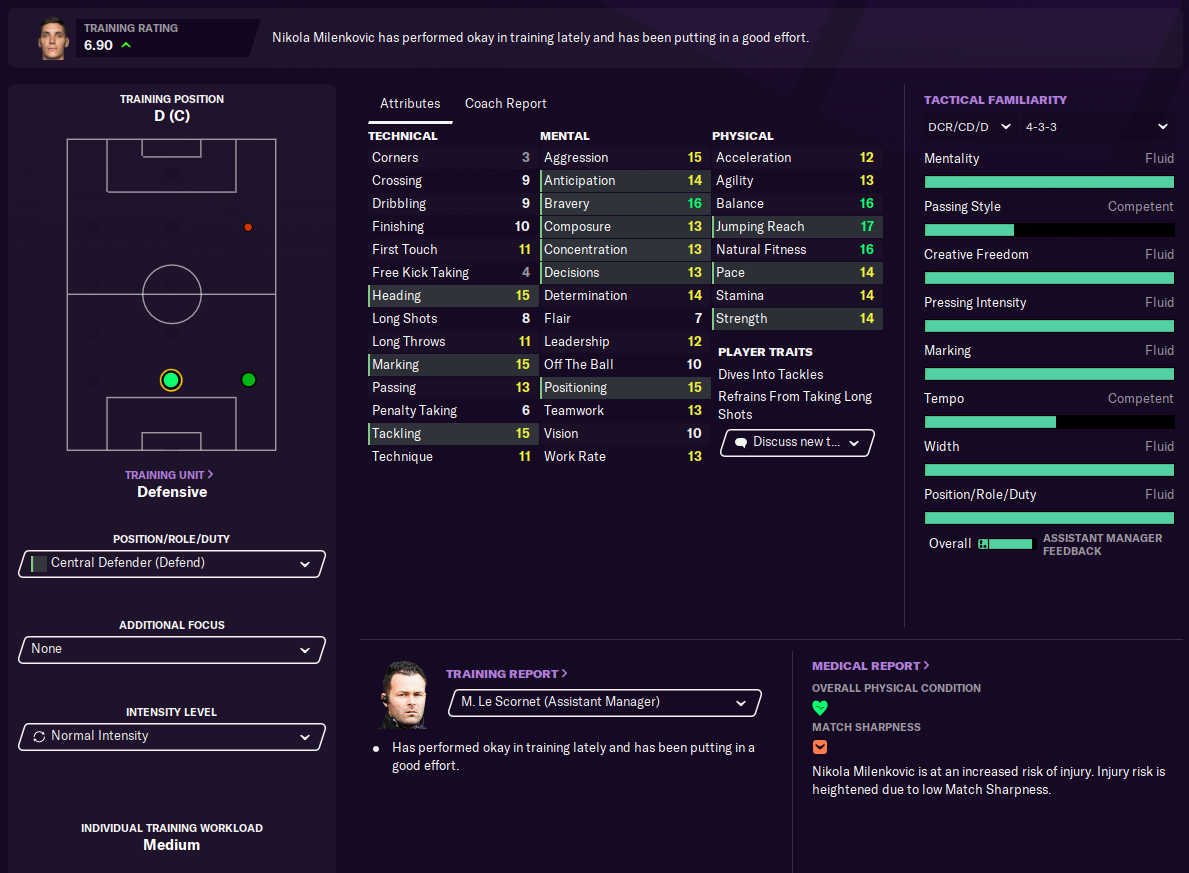
From the Individual tab on the Training page, you can set specific focuses for each of your players. The List view will list all your first-teamers and allow you to quickly set a Position/Role/Duty and an optional Additional Focus for each of them. The Detailed view (as shown above) will give you more information about a highlighted player, including their tactical familiarity and a training report.
When it comes to a player’s Position/Role/Duty, I would select the PRD I would use them most for. That role’s key attributes will be highlighted, and those are the ones your players will focus on improving (or maintaining) when doing individual role training.
While simply training a player in a Position/Role/Duty can improve their tactical familiarity in that PRD, they will also need to play matches there to really build it up. Pre-season is the perfect time for them to do just that.
An Additional Focus is extra-curricular work which focusses on a select few attributes (e.g. selecting Ball Control will focus on First Touch, Dribbling and Technique). I wouldn’t select any additional focuses during pre-season. Your players are already doing a lot of physical and tactical work, so there’s no need to increase their workload further. Save that until the season has properly begun.
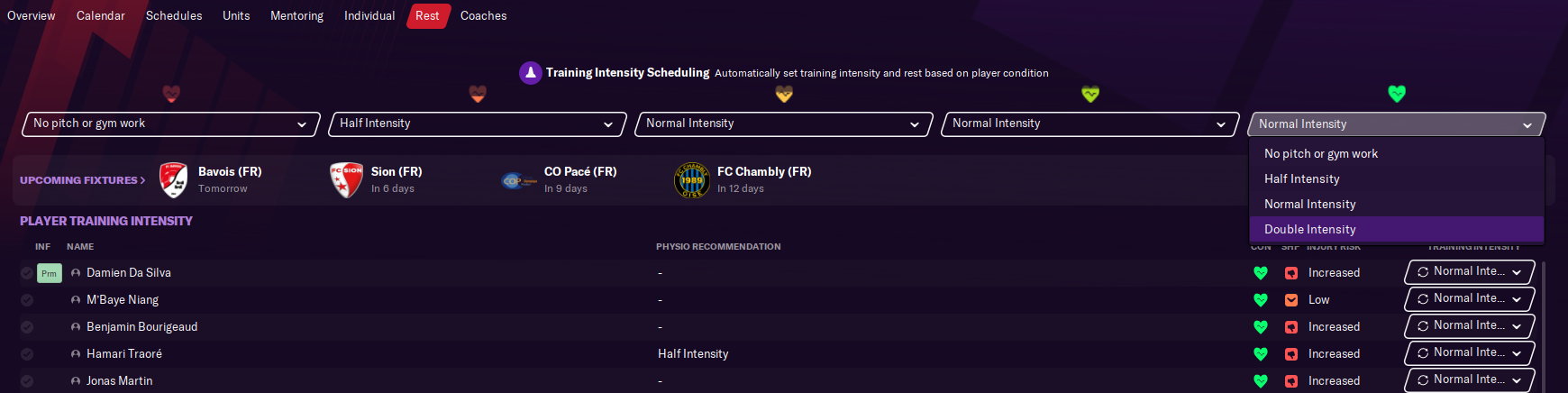
Don’t forget that you can also set your players’ training intensity from the Rest tab. At the top of this section, you can automatically set this by condition. For example, you can push players at peak condition twice as hard as those who aren’t quite there yet, while the more tired ones only train at half intensity.
Usually, players in the top three condition levels will train at normal intensity. When it comes to pre-season, I like to work them a bit harder and set those at peak fitness to double intensity, which can sharpen them up more but also reduce their condition faster.
Of course, you need to be sensible with this. If your players are given too much physical training at double intensity, especially over a prolonged period, they will find it much more difficult to recover and their injury risk will increase. However, a week of more intense training should be alright, and some short-term pain can lead to long-term gain if done well.
You can also manually change each player’s training intensity. If a player’s just coming back from an injury and is at increased risk of picking up another, you might want to ease them back in by setting their intensity to half. Keep an eye out for your physio’s recommendations on who to rest and who could do with a little more effort.
MANAGING FRIENDLIES
So you’ve set up some training routines and arranged your friendlies. Now comes an important question: should you take charge of those pre-season warm-up games?

A lot of FMers leave friendly matches to the assistant manager. You can set this by going to Staff > Responsibilities > Match, and then finding the box that shows who is responsible for leading friendly matches.
Clicking “Delegate” will automatically delegate these matches to your assistant, though you can click on the arrow to pick a staff member from a drop-down menu. Hey, why not put your goalkeeping coach in charge?
There are plenty of reasons why you would want to delegate friendlies to your right-hand man (or woman). Perhaps you do it to save some time and get through pre-season a bit quicker. You might want to simply concentrate on assembling your Ligue 1 team instead of wasting 10 minutes watching them put half a dozen goals past some actual farmers.
Personally, I don’t skip friendlies. I want to make sure every player in my first-team squad is match-fit and familiar with my tactical set-up when the season gets underway. Trusting the AI to do your work is always a bit of a gamble, and I’m worried I might end up in a situation where my starters are knackered and my backups aren’t sharp enough to replace them.
It’s also probably a good idea to take charge of friendlies (at least temporarily) when testing out a new tactic or bringing in a load of new players.

This is how pre-season panned out for my Rennes team. We enjoyed several easy wins on the road against weaker opponents, which kept spirits high. However, I also kept the lads on their toes with a couple of trickier home games – an unlucky defeat to AC Milan, followed by a more impressive performance (albeit not defensively) against Frankfurt.
We carried our momentum into the first two weeks of the Ligue 1, recording successive 3-0 wins at home to Amiens and then away to Strasbourg. Naturally, we then lost our next two games to Nîmes and Lille, but we quickly returned to form and didn’t lose another competitive match until December.
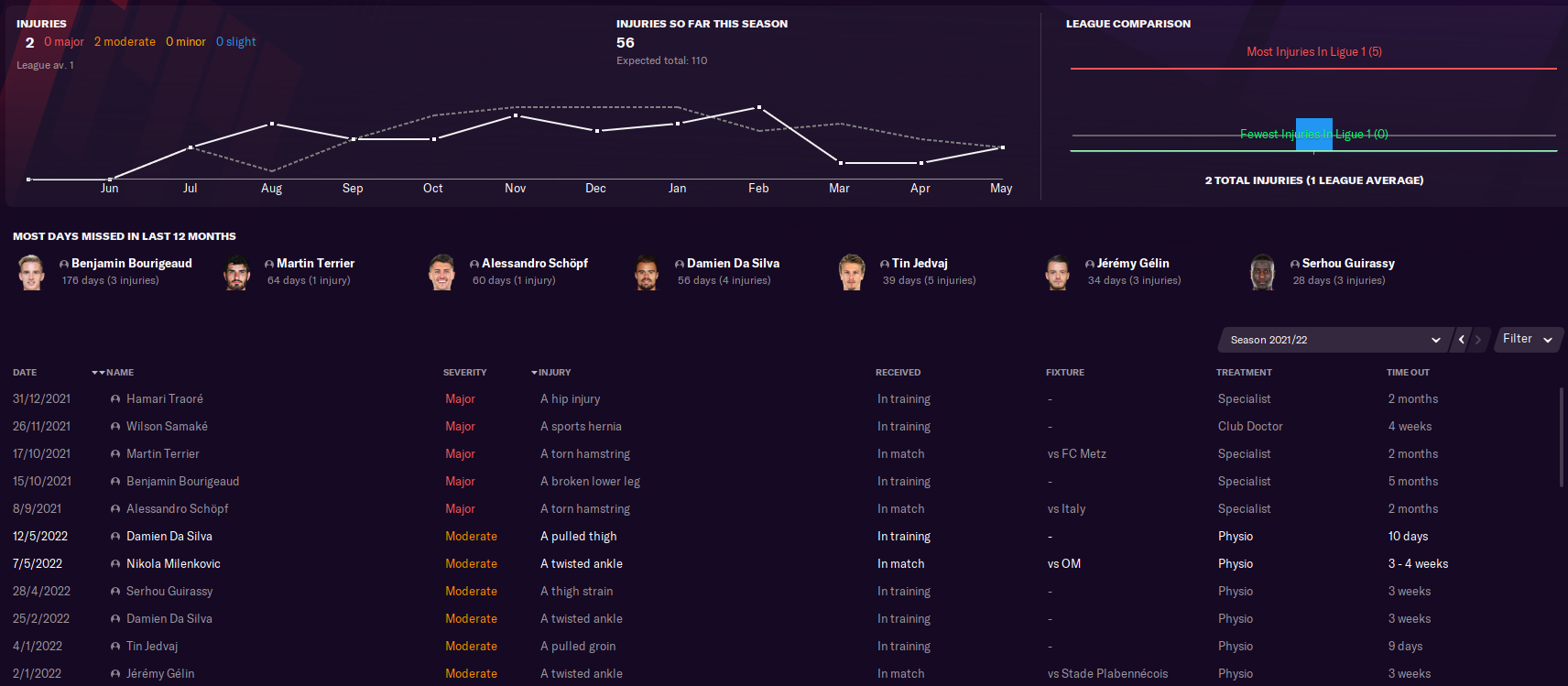
Our preparations arguably had a longer-term impact as well. Early physical training helped keep the players in good condition throughout the 2021/2022 season, as we picked up 46% fewer injuries than projected. There were a few long-term injuries, and I had to send a couple of players on holiday during the mid-season break to address some jadedness, but those were basically the only hiccups we had fitness-wise.
We also exceeded expectations on the pitch to finish 2nd in Ligue 1 and reach the Champions League knockout rounds – both for the second year in succession. Unfortunately, we had some tactical issues when it came to finishing chances as well as getting results at home… but hey, we could always look to sort those out in the next pre-season!
And so the cycle continues…
I hope you’ve found this guide useful in some way. If you have any thoughts and other tips, feel free to leave a comment below or tweet me @Fuller_FM.
 Fuller FM
You must be logged in to post a comment.