

If you’ve followed Fuller FM for a while, you’ll know that every once in a while, I like to look at some football management games from outside of Sports Interactive’s catalogue. The quality doesn’t always compare well to Football Manager, but every now and then, a decent bargain comes along.
Today’s review is going to be a bit different from my previous ones. For starters, instead of reviewing a free-to-play or cheap alternative to FM, I’m going back over 20 years for my first ever Retro Review.
So what am I reviewing today? Ultimate Soccer Manager? Premier Manager? Unfortunately not, but once I can get my hands on one of those games, I’ll be sure to review them for you lot right here.
Instead, I’ve been playing a title that is rather less glamorous – and far more obscure – than its late-1990s adversaries. It’s time to look at Giant Killers.
BACKGROUND
I used to be quite big into football magazines when I was a lad. One such publication that I read every now and then was the now-defunct Shoot. I was always more into its arch-rival Match – at least until I grew up and embraced FourFourTwo – but I digress.
Just before the 2000 FA Cup Final, I bought an issue of Shoot which had then-Chelsea striker – and Ali Dia’s cousin – George Weah on the front cover. The mag came with a free CD, from which one could install the demo version of a video game named Giant Killers.
Giant Killers was released in late 1999 on PC and Dreamcast. The game was developed by Southampton-based Smoking Gun Productions, who went on to release a series of personalised Club Manager titles in the mid-2000s before fading away. It was published by On-Line PLC, which was soon rebranded as Akaei and also disappeared a few years later.
While GK became a cult icon on Sega’s Dreamcast (a commercial flop that was perhaps too far ahead of its time), it had a more modest reception on PC (getting a 36% rating in PC Zone). An international spin-off – Giant Killers: Euro Manager 2000 – was followed in 2001 by Giant Killers 2, which marked the end of this short-lived franchise.
Anyway, back in 2000, the Giant Killers demo had me intrigued. It placed me into the hotseat at Oxford, who were a Division 2 team in real-life but had been parachuted into the Premier League at the expense of newly-promoted Bradford. Trying to turn a third-tier side into top-flight survivors was a challenge for my 10-year-old self, but after a few attempts, I eventually pulled it off.
That being said, it wasn’t until 20 years later that I decided to revisit this game. On a nostalgic whim, I bought a second-hand copy on Amazon and spent a week of my summer reliving those memories. To repay them for being shafted in the demo all those years ago, I took charge of Bradford, who were entering the Premiership for the first time.
STARTING OUT
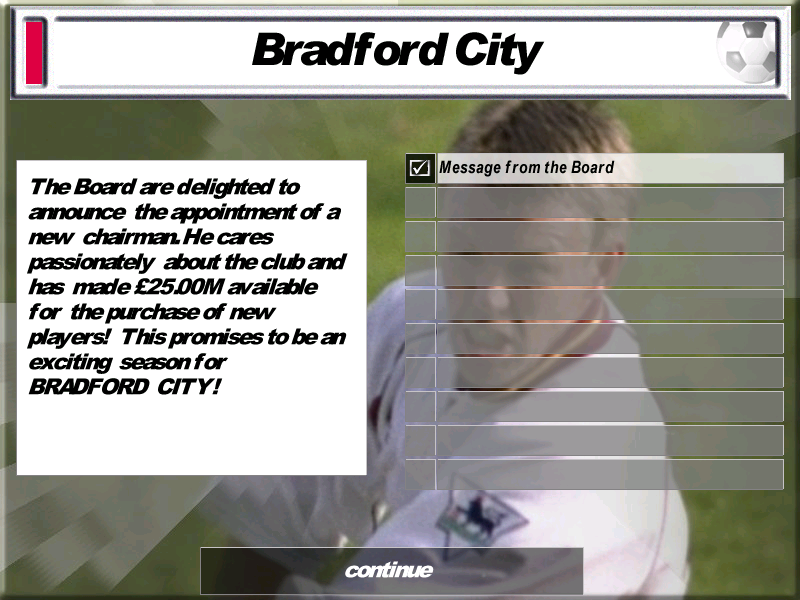
Even for 1999, Giant Killers is a real bantamweight, taking up just 32 megabytes of storage on installation. To compare it to its biggest rivals from that year, FA Premier League Football Manager 2000 took up about 550 MB, while Championship Manager 99/00 hogged just over 900 MB of space!
Clearly, there isn’t much depth to be found here. You can only manage in the top five English divisions, with no signs of any European clubs in the database. If you wanted to attract Rivaldo, Christian Vieri or Dariusz Adamczuk to the bright lights of Tranmere, I’m afraid you’re out of luck.
When starting a new game, all you have to do is choose a club (where you’ll stay forever) and a difficulty setting. On the ‘Easy’ and ‘Medium’ settings, you’ll begin with an additional £25million, which should help you race through the lower leagues or put up a fight in the Premiership. The ‘Hard’ setting doesn’t give you extra money, though it also doesn’t handicap you in any other way.
You’ll spend a large chunk of your time on the ‘Diary’ screen, which is where you’ll get various messages about results, transfers, injuries, suspensions and whatnot. It’s also where you need to go to progress through days and enter matches.
When you’re ready to play a match, you’re taken to your ‘Squad & Tactics’ page. Before you can set up your tactics and then kick off, you’ll need to select exactly 11 starting players and 5 substitutes. You can do this by clicking on the little boxes beside each individual player’s name, which will toggle between a tick (starting), an ‘S’ (substitute) and an ‘X’ (not selected). A little cumbersome, yes, but you’ll get used to it in time.
WHAT I LIKED
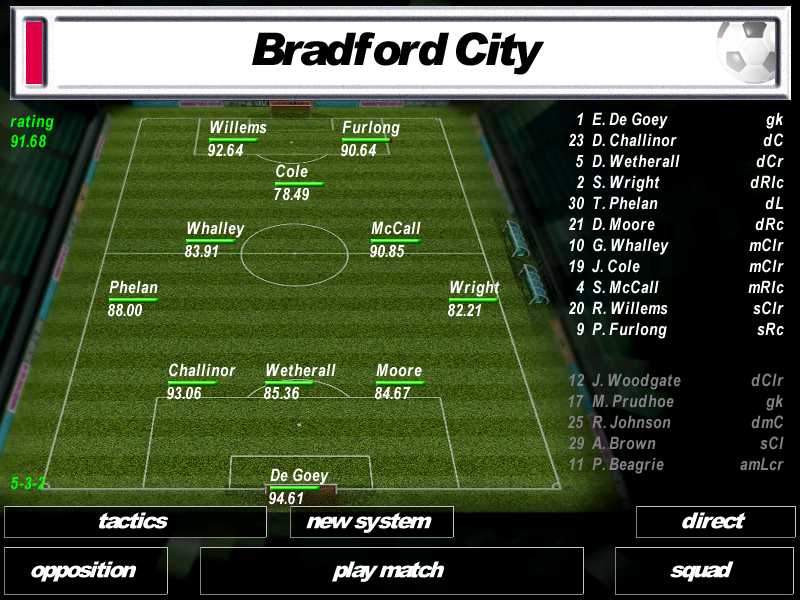
Giant Killers’ biggest strength – or weakness, depending on your viewpoint – is its simplicity. With only transfers and matches to concentrate on (i.e. no training or media duties), you can breeze through a season in a few hours.
If you don’t like the complex tactical settings Football Manager gives you nowadays, this might be more up your street. On the tactics page, you can drag and drop your players anywhere on the pitch. The game also gives you numbered ratings (based on your players’ positions, abilities, form and physical conditions), which you can use to try and assemble a team that has the best chance of winning.
You have a bevy of formations to choose from, and three different styles of play – Passing, Direct, and Long Ball. Alternatively, you can just click on ‘New System’ – which will randomly generate a new line-up, perhaps in a new tactic – until you get a team you’re happy with.
Transfers are also pretty straightforward. Make a bid for the player you want, and if the club accepts it, offer them a contract. Give ’em a basic wage, and possibly some goal and win bonuses to sweeten the deal, and then wait for them to make a decision. Just remember that while you can get transfer-listed players for slightly less than their market values, clubs will typically want at least double price for those who aren’t for sale.
I also like the user interface, which is simple, consistent, and as quintessentially 90s as Britpop (indeed, this game uses the same typeface Oasis used on their band logo). While it does look very dated nowadays, it adds to the nostalgic immersion, as do all those Premier League action shots. All it’s missing is some narration from Georgie Thompson and/or a soundtrack from the Chemical Brothers…
WHAT I DIDN’T
…but we instead get a series of third-rate techno tracks that repeat over and over, stopping only for matches. In-game sound effects are pretty mediocre too, so you might not want them on for very long. Windows’ mute function is your friend here.
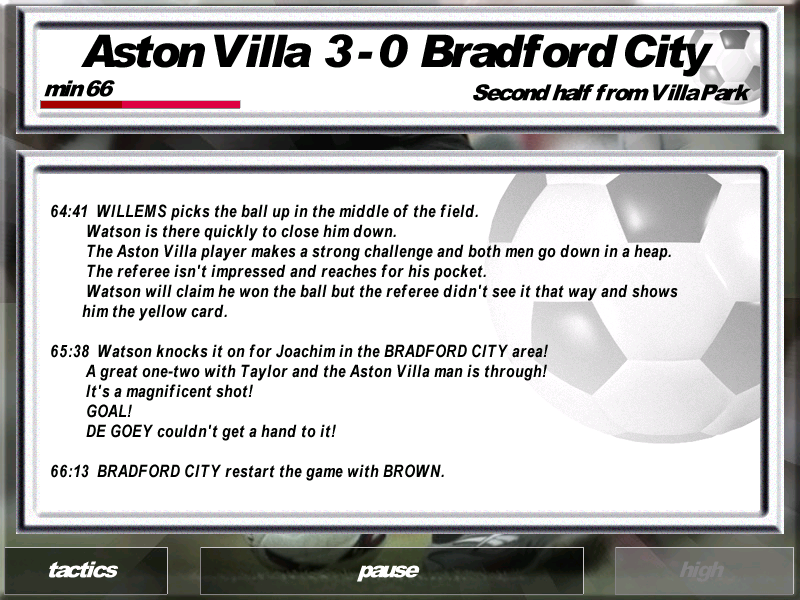
And then we come to the very rudimentary ‘match engine’. You won’t find any snazzy graphics here. Instead, all you get is vidiprinter-style text commentary rolling across the screen as the match progresses.
While this unique approach initially does a good job of building up tension, you may eventually notice some patterns in the commentary. For example, if a player decides to go for goal himself instead of playing the ball to an open team-mate, they will almost always miss the target. And you thought players not squaring the ball on Football Manager 2020 was infuriating!
It’s also worth noting that while you can make three substitutions as you wish, the AI will only replace players in the event of an injury or their goalkeeper getting sent off. That can potentially be exploited to give your team fresh legs late on when the opposition refuse to rest their tiring stars.
An even greater concern is that tactics and team strength don’t appear to have much bearing on results, which often seem erratic and random. My Bradford team lost 1-0 at home to Division 3 Swansea in the FA Cup, yet took draws at Old Trafford and Highbury, and also recorded a couple of wins over 3rd-placed Coventry.
Lastly, here’s a minor bugbear. While appearance, goal and disciplinary statistics are kept for each player, there are no league stats, which means there’s no easy way to see who the Premier League’s top scorers are. Then again, you’d probably be more likely to see Esteban Fuertes win the Golden Boot than Alan Shearer, which brings me nicely onto my next point…
WE MUST TALK ABOUT
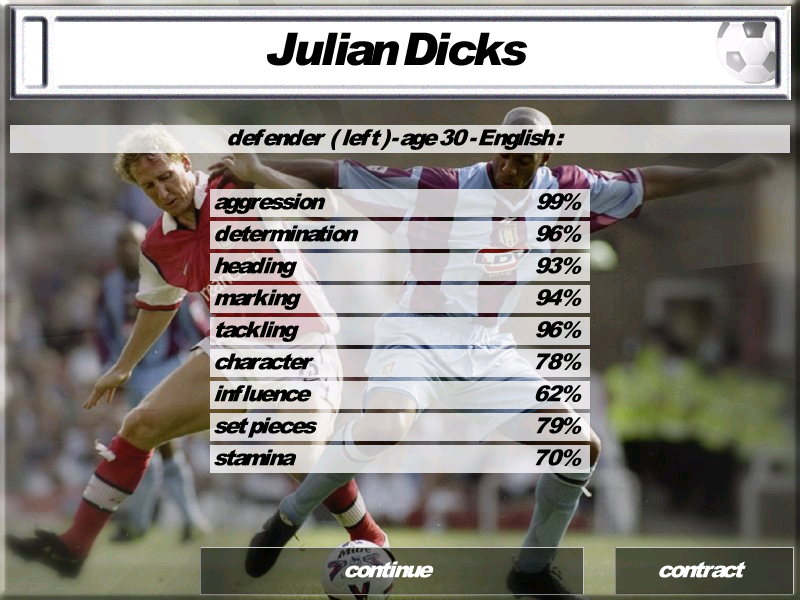
The player database. I wasn’t expecting Sports Interactive levels of research, but there are quite a few oddities in Giant Killers’ database that really make you wonder if the developers even watched football.
According to this game, Marian Pahars and a 35-year-old Mark Hughes are two of the deadliest strikers in the Premier League (Southampton bias?). At my beloved Arsenal, Gilles Grimandi is seemingly a world-class right-back, and the Gunners also have a new pacey young striker named Thierry Henri.
Oh, and you might have noticed that my Bradford team included a striker named Willems. That’s Ron Willems – a veteran Dutchman whom I signed from Derby. The thing is, Ron retired from playing in August 1998 – over a year before this game was released!
Then we get to those players in the database who never even existed! There are quite a few fictional players who can be found across several clubs when you start a new game, and they can be easily identified by their British first names and foreign surnames. For example, Bradford have an 18-year-old Moroccan goalkeeper called Richard Chippo (no relation to Coventry midfielder Youssef, obviously).
Speaking of youngsters (both real and fake)… you know how satisfying it is when you develop raw talents into global superstars on FM? That doesn’t happen on GK, as player attribute scores NEVER change. That means a 19-year-old Steven Gerrard with rubbish skills will still be rubbish when he’s 29. So much for long-term playability!
SUMMARY
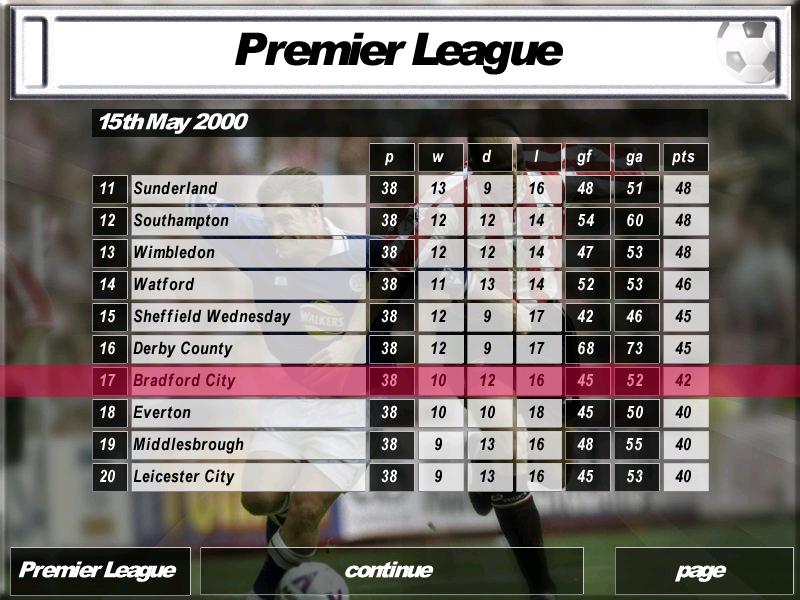
Yeah… there’s a reason why nobody is pre-ordering Giant Killers 21 and Smoking Gun no longer exist. This game isn’t just bare-bones; there’s almost no meat at all on those bones. Player development is non-existent, the gameplay is unsatisfying, and the database is a hard Brexiteer’s wet dream.
If you have a virtual machine or an old Windows XP computer, you have a couple of quid going spare, and you want to relive the late 90s, I suppose you could give this a chance. But while its curiosities may keep you interested for a short while, don’t expect to keep playing long-term. I’m afraid it’s a first-round exit for this would-be Giant Killer.
FULLER FM RATING: 2* – National League.
So those are my thoughts on Giant Killers – a late-1990s football management game that probably should stay forgotten. If you have any thoughts on this game and/or my review, feel free to share them in the comments below or on Twitter @Fuller_FM.
I’m hoping to review more retro games in the future, perhaps once all the hype around the forthcoming Football Manager 2021 has died down a bit more. Any suggestions are welcome, though bear in mind that I’m focussing only on PC titles (so no mobile or console suggestions, please).
Thank you for reading.
JULY 2023 UPDATE: I managed to find my old Giant Killers demo disk that came with my copy of Shoot magazine in 2000. Unfortunately, the disk has deteriorated so much that it cannot be read anymore. However…
…a few days ago, I recovered a lot of data from the hard drive in my childhood computer, which – luckily – still had the Giant Killers demo installed on it! I have now archived these files and made the demo available for download, so you can try it for yourself (if you so wish).
Even better, this game DOES work in Windows 10 or 11, though you need to run it in Compatibility Mode for Windows XP.
 Fuller FM
You must be logged in to post a comment.