

Well… I probably wasn’t expecting to write this in September, but welcome to a brand new Football Manager 2020 blog story on Fuller FM!
After spending much of the past year staying clear of FM20, I finally buckled and bought the game cheap on Amazon for £13. I now have a few months spare to spend on a new mid-term challenge that will tide me over until Football Manager 2021 finally sees daylight.
For this save, I’ve decided to take over a European sleeping giant that hasn’t won its national league for close to two decades. I’m heading to Portugal to try and wake Sporting CP from their slumber, while also making use of one of the continent’s most successful youth systems.
In today’s preview post, I will recount the storied history of this great club before explaining my objectives for my first season at the Estádio José Alvalade.
EARLY GLORY

Sporting Clube de Portugal – also known internationally as Sporting Lisbon – was founded in 1906 by José Alvalade [above], José Stromp, and brothers Francisco and José Gavazzo. Alvalade borrowed 200,000 reis from his grandfather – Alfredo Holtreman, Viscount of Alvalade – to fund the new club. Alfredo also allowed Sporting to build its first stadium on his farm, and in return, he was appointed as the club’s first President.
Sporting played their first match in February 1907, and faced another recently-formed Lisbon club for the first time later that year. A fierce city rivalry was ignited when eight players from Benfica defected to Sporting on the eve of their first encounter, which the latter won 2-1. The ‘Eternal Derby’ has since been contested more than 300 times.
Portugal’s national league was founded in 1934. Sporting finished 2nd in the inaugural season – one point ahead of Benfica, but two behind inaugural champions Porto. The so-called ‘Big Three’ have gone on to dominate Portuguese football, winning 83 out of 85 league championships between them.
The first six titles were shared between Porto and Benfica, but Sporting tasted success for the first time in 1941, under the management of Hungarian József Szabó. They also won their maiden Taça de Portugal that same year, beating Belenenses 4-1 in only the third Final of the new national cup competition’s history.
The ‘Leões’ (‘Lions’) would enjoy a golden period after World War II, winning seven of the eight league championships contested between 1947 and 1954. Their success was spearhead by a fearsome frontline of Fernando Peyroteo, José Travassos, Albano Pereira, Jesus Correia, and Manuel Vasques – known collectively as the ‘Five Violins’.
Three of the Violins were still fiddling away come 1955, when Sporting made more history. João Martins scored the first ever European Cup goal in a 3-3 home draw against Partizan Belgrade, who subsequently knocked them out early by winning the second leg in Yugoslavia.
A year later, Sporting moved into the newly-built José Alvalade Stadium – named after their co-founder, who had died during the Spanish flu epidemic of 1918, aged just 33. They wouldn’t have to wait long to become champions again at their new home, winning a record 10th title just two years later.
OVERSHADOWED
Lisbon’s other club ruled over Portugal in the 1960s and the 1970s. Inspired by the legendary ‘Black Pearl’ Eusébio, Benfica were champions 14 times between 1960 and 1977. They also won back-to-back European Cups in 1961 and 1962 before the infamous curse of Béla Guttmann took effect.
Sporting weren’t left empty-handed during this period, though. They claimed four more league wins, plus a continental trophy of their own in 1964. Having overcome Manchester United and Lyon en route to the Final of the European Cup Winners’ Cup, they drew 3-3 with MTK Budapest before beating them 1-0 in a replay. Full-back João Morais scored the winner direct from a corner kick.
That was the first time – and so far, the only time – the Lions roared loud and proud in Europe. They reached the Semi Finals of the Cup Winners’ Cup again in 1974, but were knocked out by East German side Magdeburg.
1981/1982 saw Sporting briefly get back on top domestically, with former Manchester City manager Malcolm Allison [above] marking his only season in Lisbon by winning the league and cup double. They wouldn’t win another championship until the new millennium, and they also claimed just one Taça during this drought – in 1995.
Now it was Porto who ruled the roost domestically, having dominated the second half of the 1980s and virtually the whole of the 1990s. Yet there were green shoots of hope in Sporting’s academy, which developed several members of Portugal’s ‘Golden Generation’. Their most famous graduates included Simão Sabrosa and future Ballon d’Or winner Luís Figo.
In the 1999/2000 season, former Sporting left-back Augusto Inácio returned to the club as manager. Inácio ended the Leões’ 18-year wait to win the newly-rebranded Primeira Liga, with a 4-0 final-day win over Salgueiros sealing the deal.
Another league and cup double followed in 2002, with László Bölöni at the helm of a Sporting side which included forwards João Pinto and Mário Jardel, midfield wonderkid Ricardo Quaresma… and centre-half Phil Babb. Incredibly, that would be the last green-and-white team to be crowned Portuguese champions.
Sporting subsequently surrendered their title to José Mourinho’s Porto before vacating the José Alvalade Stadium. A new stadium fit for the 21st century had been built nearby ahead of Euro 2004, and it was there where the next chapter of this story would be written.
17 YEARS AND COUNTING
The 50,095-capacity Estádio José Alvalade opened its doors on 6 August 2003. Sporting’s first match at their new home was a 3-1 friendly win over Manchester United, in which an 18-year-old winger named Cristiano Ronaldo dos Santos Aveiro stole the show. Whatever happened to that lad?
Two years later, the Lions had a fantastic chance to claim a European trophy on home soil, facing CSKA Moscow in the 2005 UEFA Cup Final. Despite leading 1-0 at half-time, they collapsed in the second period as their Russian visitors prevailed 3-1 [above].
There was more frustration on the domestic front. Having lifted the Champions League in 2004, Porto redoubled their Primeira Liga supremacy before Benfica got back on top. As their two bitter rivals surged even further ahead in terms of league titles, Sporting had to settle only for back-to-back cup wins in 2007 and 2008.
Financial mismanagement and a series of disastrous coaching hires saw Sporting go into decline over the next decade. Off the pitch, they had mind-boggling debts of €276million by 2011. On it, they endured their worst-ever league season in 2012/2013, finishing 7th and failing to qualify for Europe.
The team soon rebounded, with runners-up finishes in 2014 and 2016 bookending another Taça de Portugal win. The election of outspoken commentator Bruno de Carvalho as club president had brought renewed optimism to the green half of Lisbon, but things would turn very sour in May 2018.
Five days before the Taça de Portugal Final against Aves, several Sporting players – including star striker Bas Dost – were attacked by around 50 ultras at the training ground. Carvalho, who was notorious for criticising his players on social media, was suspected to have incited the attack but denied the allegations.
The damage had been done. Aves won the Taça, and within weeks, nine Sporting players had cancelled their contracts – with prized assets such as Gelson Martins and Rui Patrício leaving on free transfers. Head coach Jorge Jesus headed to Saudi Arabia, and Carvalho himself was ousted as president by angry club members.
Sporting faced a big rebuild in 2018/2019 under their new manager Marcel Keizer. They finished 3rd in the Primeira Liga – 13 points behind champions Benfica – but defeated Porto on penalties to regain the Taça de Portugal. They also won the Taça da Liga for the second season in a row, again having bested Porto on spot-kicks.
Despite making encouraging progress, all was not well behind the scenes, and Keizer abruptly left Lisbon during the summer. With Sporting now experiencing a record-equalling title drought, president Frederico Varandas took desperate measures – by appointing an inexperienced Londoner as the club’s first English coach in nearly four decades.
| TEAM | PRIMEIRA LIGAS | TAÇAS DE PORTUGAL | MAJOR EUROPEAN TROPHIES |
| Benfica | 37 (Last: 2019) | 37 (Last: 2017) | 2 Champions Leagues |
| Porto | 28 (Last: 2018) | 16 (Last: 2011) | 2 Champions Leagues 2 Europa Leagues |
| Sporting | 18 (Last: 2002) | 17 (Last: 2019) | 1 Cup Winners’ Cup |
THE FIVE-YEAR PLAN: YEAR 1
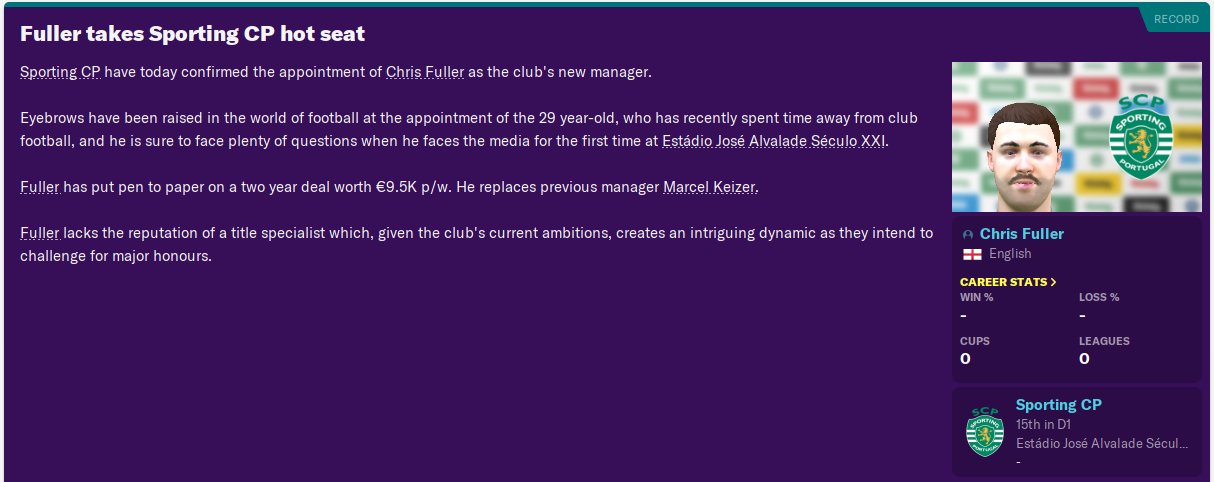
As you might’ve guessed, I won’t be role-playing as Figo or inventing a new persona for this story. Instead, I’ll just be managing as myself. On the plus side, this means I’m now 29 again instead of a lumbering, curmudgeonly 30-year-old.
I’ve loaded 36 leagues from 16 nations (12 in Europe, four in South America), and the database is about 80,000 players strong. I’m also playing with the January update, which means that superstar playmaker Bruno Fernandes starts off at Manchester United instead of Sporting. Heaven knows who’ll take our penalties now…
As always, I’ve turned off budgets for the first transfer window, which means no transfers at all until January. It’s not as if we’d have loads to spend anyway, seeing as our starting bank balance is around €7million (most of the Fernandes money is coming in anual installments or add-ons).

Let’s have a quick look at the club vision, and the first year of my five-year plan at Sporting. Yes, the plan is for this save to last either four or five seasons, depending on when FM21 comes out.
The end goal for this series is, obviously, to halt Sporting’s long title drought and build a team that can compete in Europe. For me, continental success would be either reaching the knockout stages of the Champions League or winning the Europa League.
As you would expect, the board are pretty keen on us playing attacking football while developing our academy prospects. Signing young players for the first-team and then moving them on for a profit – like Sporting did with Fernandes, for example – would also go down well.
Now, let’s talk about our objectives for this first season. The president isn’t bothered about us retaining the Allianz Cup (Taça da Liga) or beating Benfica in the season-opening Supertaça, but he does want us to challenge for silverware. I actually had to negotiate that down, as one of the objectives he’d given me was to win a trophy.
We’re also holders of the Taça de Portugal, in which we’re expected to at least reach another Semi Final. We enter the competition in Round 3 (the last 64), and a bad draw early on could really scupper our chances.
We’ve qualified for the Group Stage of the Europa League, where we’ll likely be among the top seeds. Getting to the second knockout phase (the Round of 16) is paramount if I’m to still be in a job this time next summer… which is actually this summer in real-life as I write this. It’s a little confusing, I know.
My last objective is probably my most difficult. I’m immediately expected to challenge Benfica and Porto for the Primeira Liga title. Let me cast your minds back to the final chapter of my Fiorentina story on FM19, where finishing just SIX points off the top wasn’t considered a title challenge. You can imagine, then, that I’m pretty nervous!
I’m not just worried about the big dogs either. Contrary to popular belief, there are more than three good football teams in Portugal. Braga have been nipping at our heels in 4th for a few years now, while Vitória de Guimarães and Rio Ave are also capable of bloodying the Big Three’s noses.
Only the top two in the Primeira Liga get into next season’s Champions League, but even finishing 3rd is far from a certainty where we’re concerned. That means there’s a chance this story could end in a very early sacking. If that happens, I’ll have to write very a different ending indeed…

But let’s look on the bright side: the club’s infrastructure is AMAZING. We’ve got state-of-the-art training facilities, great data analysis facilities, superb youth facilities, excellent academy coaching, and exceptional youth recruitment. And I imagine the showers are pretty nice too.
Of course, having such a strong youth set-up is no guarantee that we’ll get a William Carvalho or an Eric Dier in our youth intake every season, let alone a Cristiano or a Figo. Nonetheless, we should have a consistent supply of talent come through our Under-19s and Under-23s. Just look at these two boys, for starters…

Beautiful. Just beautiful. I cannot wait until they’re fully developed.
Well, I’d better end it here before Operation Yewtree get onto me and send a couple of Met officers to my new Lisbon apartment!
If I haven’t been arrested, I’ll be back on Monday at around 6:00pm British time for Part 1, where I will review the squad I’ve inherited before playing my first competitive match in the Supertaça. I’m aiming to post TWO updates a week throughout this story’s run – one on Monday evening, and another on Friday evening.
If you want to be notified whenever a new post goes live, please hit the “Follow Fuller FM” button. Don’t forget that you can also follow me on Twitter @Fuller_FM.
Until next time, “obrigado por ler”.
 Fuller FM
You must be logged in to post a comment.