

Here we are, folks. It’s the 13th and final chapter of my Championship Manager 99/00 series with the Scotland national team. I hope you’ve enjoyed reading this as much as I’ve enjoyed writing it.
Today’s final chapter sees the Tartan Army co-host Euro 2008, where I hope to cap off my reign with a major trophy. Even a Semi Final would be quite nice.
You can go back to Part 12 if you want to see how we concluded our preparations for the Euros. When you’re ready, let’s jump into the action and see who I’ve brought along with me for the last leg of my international adventure…
EURO 2008
Nine years of blood, sweat and tears have all come down to this. My history-making tenure as Scotland manager ends with us hosting a major tournament for the first time – the 2008 European Championship.
We’ve reached two World Cup Quarter Finals, but can we go a step further on home soil? It won’t be easy, as we’ve been drawn in a group with co-hosts Wales, former world champions Sweden, and an enigmatic Spanish outfit.
I’ll admit that preparations for this tournament haven’t been the smoothest. We’ve only lost once since England 2006 (against Sweden, ironically)… but we’ve also only won once in the last 18 months. While our defence is as solid as ever, our attackers gone off the boil at just the wrong time.

Anyway, these are the 22 players on whom a nation’s hopes and dreams depend. Celtic goalkeeper Robert Douglas and Rangers winger Neil McCann were the biggest names to be left out, while Liverpool right-back Brian Donaldson was unlucky to miss the cut.
As this is my final tournament, I’ll go into a little more detail when writing about each player in the squad.

Alan Combe [34, West Ham – 17 caps]: After several years as a Scotland backup, this is very much Combe’s time to shine. This flexible shotstopper was ever-present for Premiership champions West Ham this season, making several vital saves.
Neil Alexander [30, Tranmere – 3 caps]: Alexander is a determined and intelligent keeper with great handling skills. The late-bloomer’s displays for Tranmere in his first regular top-flight season have already earned him a £4million summer move to Chelsea.
James Evans [25, Fulham – 1 cap]: We’re a bit short on goalkeeping options nowadays, but Evans is a decent ball-handler. He honed his craft in the lower leagues with York and Burnley before getting his Premiership break at Craven Cottage.
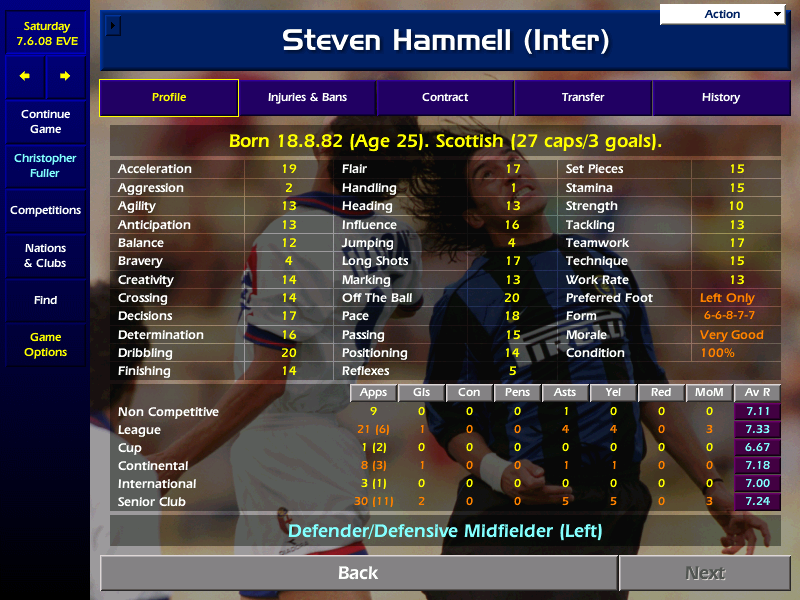
Steven Hammell [25, Inter – 27 caps, 3 goals]: Hammell is our most valuable player, and it’s not hard to see why. The explosive left-back – who has won several major trophies with Man Utd and Inter – is great going forward and pretty solid at the back too.
Gary Naysmith [29, Rangers – 44 caps]: Crossing the Old Firm divide has not done left-back Naysmith’s international prospects much harm. With his high endurance and intelligence, he’s been a regular in my side since the start.
Craig McCulloch [26, Man Utd – 26 caps, 4 goals]: In my view, McCulloch is one of the premier right-backs in world football right now. His crossing ability is elite, he’s supremely strong, and he captained United to Champions League glory in 2007.
Russell Anderson [29, Newcastle – 31 caps, 1 goal]: Anderson is capable of playing at right-back or centre-half. The energetic Aberdonian has been a regular and consistent fixture in an otherwise erratic Newcastle team since 2002.

Alan Archibald [30, Man City – 25 caps, 1 goal]: With man-marking master Archibald at centre-half, City have enjoyed a couple of top-six Premiership finishes in recent years. Despite a chequered disciplinary record, he has been named in the PFA Team of the Year.
Kevin James [32, Hearts – 45 caps, 8 goals]: Though his powers are perhaps starting to wane, captain James is still a rock-solid centre-back and a tremendous leader. After a decade at Hearts, he will move to Celtic on a free transfer before the new season.
Graeme Hendry [23, Watford – 6 caps]: The future of Scotland’s defence looks bright with aggressive stopper Hendry developing nicely. Watford have had a couple of rough Premiership seasons and would surely have been relegated without him.

Barry Ferguson [30, Deportivo – 48 caps, 8 goals]: Ferguson has just had his best season in Spain, where he lifted the Copa del Rey with Deportivo. That bodes well for the flamboyant playmaker as he heads into his fourth international tournament.
Willie Howie [25, Sunderland – 53 caps, 14 goals]: Howie already has so much experience and will surely be our record caps holder when he’s done. The scary thing is that the dribble-happy ‘Scottish Sorcerer’ might only just be heading into his peak years!
Ken Rafferty [30, West Ham – 7 caps]: It’s been a season to remember for Rafferty – a Premiership winner, 11 league goals, and in the PFA Team of the Year. The left-footed midfielder is a solid passer of the ball and loves a good crunching tackle too.
Gary Mason [28, Aston Villa – 11 caps, 2 goals]: Mason is a tireless and determined defensive midfielder who has a mean long shot. Having made 180 appearances for Villa in eight years, he will begin a new challenge with Tranmere next season.
Robert Wilson [23, Birmingham – 20 caps, 2 goals]: Since bursting onto a scene as a teenager, Wilson’s development has stalled a little. He’s still a pretty robust midfield anchor, but recent performances for new club Birmingham have been inconsistent.
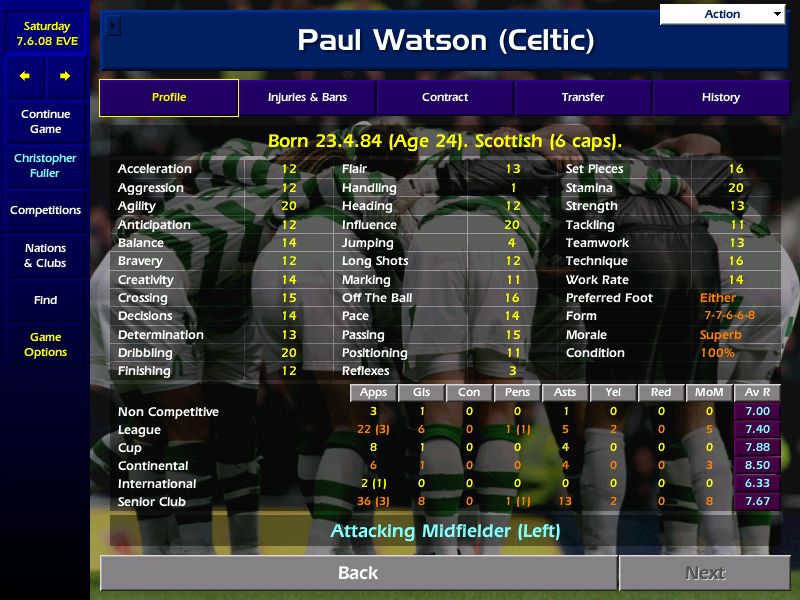
Paul Watson [24, Celtic – 6 caps]: Watson is a creative and skilful left-winger who could also do a decent job in midfield. He was named the 2008 Scottish PFA Player of the Year after an outstanding campaign with Celtic, whom he joined from Rangers last year.
Steven Nicholas [26, Perugia – 2 caps]: Nicholas is a ‘wildcard’ selection, having caught the eye at Perugia as they battled in vain against Serie A relegation. The right-winger has pace to burn and has shown great potential in his first couple of caps.
Craig Callaghan [26, Fulham – 11 caps]: Callaghan is finding his feet in the top flight, having scored or assisted for 19 Fulham goals this season. It surely won’t be long before the selfless attacking midfielder is flourishing with Scotland as well.

Marc Anthony [30, Rangers – 45 caps, 28 goals]: Anthony might have gone off the boil with Rangers this year, but the pacy striker is known to thrive in big tournaments. Three goals at Euro 2008 would see him become Scotland’s all-time top goalscorer.
Mark Burchill [27, Celtic – 55 caps, 15 goals]: Like his regular international strike partner, Burchill’s recent form hasn’t been too hot. Nonetheless, I still regard my most-capped player as an expert finisher and a real game-changer.
Michael Craig [30, Dundee Utd – 14 caps, 4 goals]: 43 goals in two seasons at Dundee United have seen Craig find a new lease of life. The hard-working frontman now needs to end his wait for a maiden competitive goal with Scotland.
Paul Dalglish [31, Leeds – 35 caps, 11 goals]: Dalglish is now seen as more than just Kenny’s son and Kelly Cates’ brother. ‘Prince Paul’ is a technical forward with plenty of ability, despite netting just eight times in his maiden season at Elland Road.
GROUP STAGE
Saturday 7 June 2008. Hampden Park is packed to the rafters as the European Championship begins with Scotland hosting Wales. With two of the continent’s strongest teams lying ahead of them in Group 1, neither side can afford to lose this opening battle.
After the melodious Welsh team perform “Hen Wlad Fy Nhadau”, a young singer-songwriter from Bishopbriggs named Amy Macdonald leads a spine-tingling rendition of the Scottish anthem. The stage is set for a classic between these two proud Home Nations.
WALES vs SCOTLAND (Euro 2008 – Group 1, Match 1)
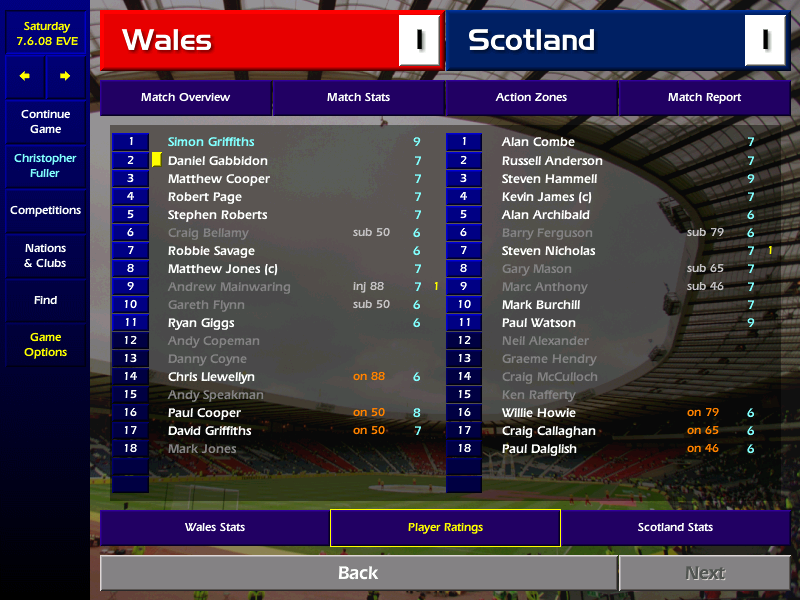
We set our stall out immediately, attacking the Welsh defence with all our might. A hopeful shot from Anthony in the 7th minute was well caught by Simon Griffiths, whom our left-back Hammell knew very well as Inter’s backup goalkeeper.
Two minutes later, Hammell helped us get the better of his club-mate. An excellent delivery into the box picked out Nicholas, who thundered in his first international goal to send the Hampden faithful wild!
The first half went a bit quiet after that, though Griffiths did make another save from Anthony midway through. The 25-year-old goalkeeper (who now had 25 caps despite only making only 13 career club appearances) would prove very difficult to beat in the second period.
The Red Dragons’ attackers started to breathe fire in the 52nd minute, with 21-year-old David Griffiths (no relation to Simon) forcing a save out of Combe. Sadly, his strike partner Andrew Mainwaring did more than just test our goalie 12 minutes later, beating him with a pot-shot from Paul Cooper’s flick-on.
Our other Alan took umbridge to that, with a rough collision in the 88th minute injuring Mainwaring’s groin so badly that he would likely miss the rest of the tournament. Even so, the Chelsea forward’s equaliser felt like a death sentence for us. If we couldn’t beat Wales, what hope in hell did we have of defeating two half-decent sides?
Why does every goalkeeper on the planet suddenly play great against us?! While we pondered the answer, England opened up Group 4 with a 1-0 win over Germany (thank you, Kieron Dyer).
Spain took charge of Group 1 by triumphing 2-0 at Celtic Park against Sweden, who only had a couple of days before they faced us at Hampden.
As Swedish boss Tommy Söderberg pondered how to manage his team during such a short turnaround between games, I made three changes to my starting XI. Hendry came in for Archibald at centre-half, Howie replaced Mason in midfield, and I put my trust up front in Craig rather than Burchill.
SCOTLAND vs SWEDEN (Euro 2008 – Group 1, Match 2)
It seemed like everything was in our favour here. As well as a packed-out Hampden crowd and a favourable schedule, we also had a Home Nations referee in Welshman Paul Coyne. In just the first minute, he booked Swedish winger Zlatan Muslimovic for a holding foul on counterpart Watson.
As far as our team was concerned, we put the 2-0 friendly defeat to Sweden two years ago right at the backs of our minds. Anthony was a constant menace to Mattias Asper – Napoli’s long-time first-choice goalkeeper – while only the woodwork kept out a Nicholas header in the 19th minute.
Another chance came our way after 32 minutes. Staving off pressure from Kennedy Bakirciolgü, Watson played a weighted pass into the box for Craig, who picked it up and then prodded a simple finish beyond Asper. We had drawn first blood again… but could we hold onto our lead this time?
I expected a strong response from the Blågult in the second half, and after 53 minutes, it looked like my worst fears were coming to life. Arsenal winger Pär Karlsson – who scored the Swedes’ second goal in our previous meeting – got his head to Daniel Andersson’s corner delivery, but Combe caught safely.
Surprisingly, Sweden couldn’t follow that up, managing just the one shot on target all game. With Ferguson dominating the midfield battles on his 50th cap, and captain James holding our defence together, they couldn’t find a way through. With their second defeat, the 2002 world champs were eliminated from Euro 2008 after just five days.

Bloody hell! We’ve beaten Sweden!
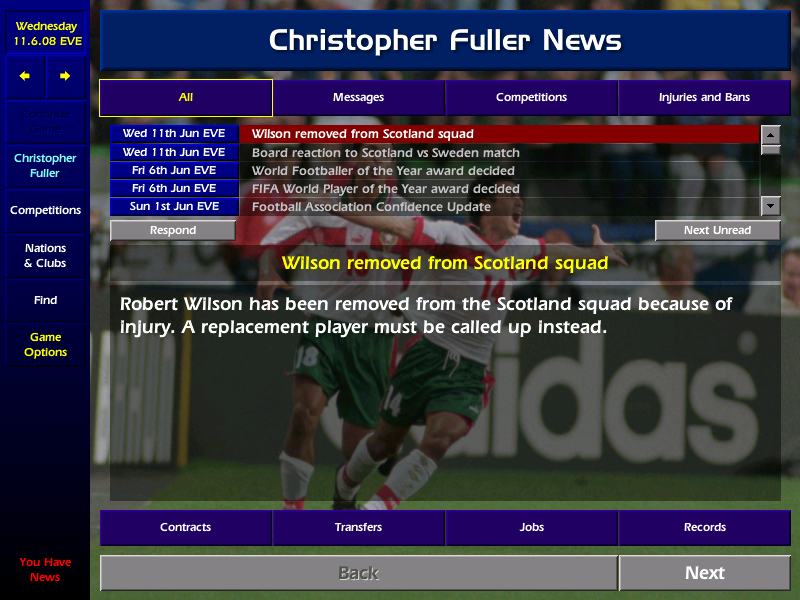
So yeah… our celebrations went a bit Adams and Morrow, which meant Wilson’s tournament was over. I replaced the defensive midfielder with an attacking midfielder – 28-year-old Mark McCormick, who had 9 caps and had recently joined Tranmere on a free transfer after a long time at Preston.
Worse news came the next day. I had hoped Spain would beat Wales, so we would have one foot in the next round before we duelled with La Furia Roja. Unfortunately, Simon Griffiths – aka the new, NEW Neville Southall – was unbeatable again for the Red Dragons, who won 1-0 with a Simon Davies scorcher.
Scotland and Wales were now dead-level at the top of Group 1 with 4 points, and Spain were 3rd with 3. That meant while a draw against José Antonio Camacho’s side would see us through, a defeat would leave us hoping that Sweden had done a job on Wales. As a certain Glaswegian would say, it was “squeaky-bum time”.
After a knee cartilage injury kept McCulloch on the bench for our first two games, he was back to full fitness and replaced Anderson at right-back. He also took the captaincy from a fatigued James, who made way for Archibald at centre-half. Those were the only changes I made for potentially my final game as Scotland boss.
SCOTLAND vs SPAIN (Euro 2008 – Group 1, Match 3)
Celtic Park might have been the venue, but it was two strikers with Rangers connections who led the Scottish attack. In the third minute, current Ibrox hero Anthony looked odds-on to score a close-range effort until Esteban got his fingers to it. Fortunately, the ball fell to Marc’s former clubmate Craig, who fired us into an early lead.
Despite our strong start, we were soon put on the back foot by a determined Spanish armada. Lazio striker Roberto smashed his first shot wide, though a more promising effort from Celta’s Alberto Luque gave Combe his first test in the Scottish goal.
As our discipline started to waver, that dangerous front two unleashed their full Red Fury on us five minutes before half-time. Roberto collected the ball after a terrible first touch from Howie and then sought the run of Luque, who got past Hendry and hammered in the equaliser.
Hammell wasted a chance to restore our lead before half-time, firing a shot straight into Esteban’s hands. While a 1-1 draw would still be enough to send us through, if Spain scored again, we would be facing elimination unless Sweden defeated Wales…
…which, after 54 minutes, they looked set to do. Daniel Andersson’s stunning left-footer from midfield broke the deadlock at Hampden, and we were now on course to qualify as group winners.
Ten minutes later back at Celtic Park, Howie had an opportunity to put us in an even stronger position. One of his trademark mazy runs ended with him in the box, with just Esteban to beat for a 2-1 Scottish lead. To our agony, the Barcelona goalkeeper kept Willie at bay, and the subsequent corner was wasted.
Not long after that, events at Hampden took a disturbing turn. Sweden’s Patric Antonen was sent off for a shove on Craig Bellamy (who can blame him?), and Davies powered the subsequent free-kick home. That meant Wales were back level at 1-1 – and if it stayed that way, we could not afford to lose.
My heart was in my mouth throughout the final quarter of the match, as Spain spurned opportunity after opportunity to take the lead. As time ebbed away, I took a huge gamble, and abandoned the standard 4-4-2 for the diamond. Winger Watson gave way to holding midfielder Mason as we tried to shut up shop.
You can probably guess what happened next.
In the 87th minute, not long after Howie fired a shot against the post, Spain hit us with a devastating counter. Substitute forward José Antonio Reyes played the ball into the area for Roberto, who brushed McCulloch aside and unleashed a shot that rocked Scotland to its core. 2-1 to La Furia Roja.
We would have one more opportunity to save ourselves, when Howie won a corner in injury time. He whipped a delivery into the Spanish box… where Iván De La Peña intercepted before Luque pumped it clear. The referee then called full-time.
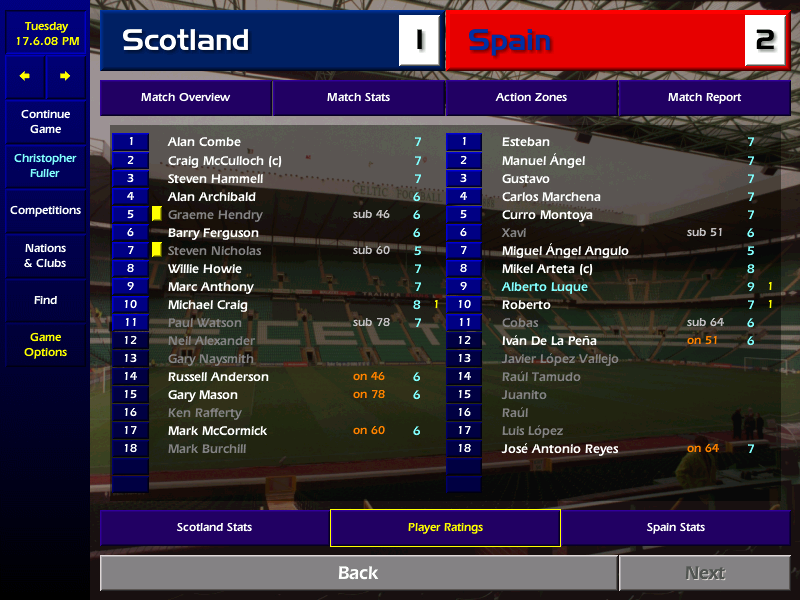
There was no late miracle at Hampden. Wales had stayed level with Sweden, which meant they finished 2nd in Group 1 behind Spain. We had been kicked out of our own party at the first round.

Well, it wouldn’t be a Fuller FM story if it didn’t end in glorious failure, would it?
As unlucky and/or frustrating as we’ve been in recent times, I have to take the blame on this one. I wasn’t brave enough and tried to shut up shop too soon. If I’d just left the lads to it, we might have held Spain off and gone through to the Quarters.
Anyway, before I clear out my Hampden desk, let’s see how the rest of the tournament unfolded.
Switzerland were the shock winners of a goal-shy Group 2, winning two of their three matches to finish ahead of Holland. France crashed out early after three unconvincing draws, while Yugoslavia failed to score a single goal.
Denmark and Italy won their Group 3 openers against Belgium and Portugal and reached the Quarters after the next four games all finished level. As the leaders were dead-level on all criteria, the Danes were awarded top spot after winning a coin toss. (Well, it was either that or rock-paper-scissors.)
There was no doubt about who was the best team in Group 4, as England qualified without dropping any points or conceding a goal. Germany went through as well after beating Romania in the final round, with newcomers Slovakia already eliminated.
QUARTER FINALS
Wales got home advantage at last in the first Quarter Final, and the Cardiff crowd arguably helped them see off Switzerland. After a dour goalless draw, the Red Dragons held their nerves in a penalty shoot-out during which the Swiss missed three times.
Meanwhile in Glasgow, a rematch of the Euro 2004 Final had the same outcome, with Denmark beating Germany on spot-kicks following a 0-0. This time around, Thomas Bælum scored the winning penalty after Thomas Sorensen saved from Marcel Maltritz.
England hopes went up the Swanee after defeat in Swansea. 21-year-old defender Vittorio Manza’s opener for Italy was cancelled out by Francis Jeffers, but Napoli striker Simone Inzaghi broke the Three Lions’ hearts late in extra-time.
Incredibly, the fourth Quarter Final in Glasgow also went to extra-time, where Spain eventually accounted for Holland. Sporting Gijón midfielder Cobas scored a couple of crucial penalties either side of Edgar Davids’ breathtaking piledriver.
SEMI FINALS
Spain followed that up with a surprisingly dominant performance against Italy. They scored just the one goal – from Barcelona’s holding midfielder Xavi on the hour mark – but it was enough to eliminate Alberto Zaccheroni’s side. After decades of underachievement, would this be Spain’s year?
Or would Denmark retain their title? Wales keeper Simon Griffiths put in yet another ‘man of the match’ performance, but even he couldn’t keep out a fierce second-half drive from the wonderful Mads Jørgensen. The Danes – and their 32-year-old manager Ole Tobiasen – were now on the verge of becoming the first three-time European champions.
FINAL
Camacho’s Spanish superstars had other ideas. Roberto opened the scoring 22 minutes into the Final at Hampden Park, securing the Golden Boot with his third goal (yes, the tournament really has been that boring). Aston Villa’s Simon Karkov took just three minutes to equalise for Denmark.
Despite facing a non-stop Spanish inquisition, the Danes took the game to extra-time, which was when they lost their grip on the Henri Delaunay Trophy. De La Peña saved his first international goal for the big occasion, netting six minutes after the restart to earn La Furia Roja their first continental title since 1964.
AN DEIREADH
And so we’ve come to the end. After nine years at the helm, how would I assess my reign as Scotland manager?
You have to say it’s been a success. Despite failing to qualify for Euro 2000, Scotland appeared at the next four tournaments – which is four more than they’ve reached in real-life since France ’98. We’ve also claimed some prize scalps, including two wins over Spain – back in the days when they admittedly weren’t very good.
Not only have I broken Scotland’s run of never getting out of a tournament group stage, but we’ve also reached the Quarter Finals of two World Cups. Only Yugoslavia in 2002 and France in 2006 have stopped us having a shot at taking the trophy (or at least some medals) back home.
Another big achievement was taking us as high as 6th in the FIFA World Rankings, though we finish this save down in 21st place. Just don’t mention our Euros record…
Mercurial striker Marc Anthony scored 14 World Cup goals – a tally that has only been bettered in reality by Ronaldo and Miroslav Klose. He was even well on course to eclipse Kenny Dalglish and Denis Law to become Scotland’s record goalgetter until his powers waned following England 2006.
This generation of Scottish footballers is much more exciting than the last. Where we once had Tom Boyd at right-back, we now have Champions League winner Craig McCulloch. Where once it was Don Hutchison running our midfield, now it’s Willie Howie. We’ve even seen Barry Ferguson and Steven Hammell make greater waves on the continent than Paul Lambert and John Collins.
That said, I can’t help feeling this team has gone a bit stale over the last two years. We’re just not the same free-scoring outfit we once were, even after trying several tactics. To be fair, goals seem to have dried up in general (a common problem with long-term saves on the CM3-era games), but it’s probably time to bow out.
My final record with Scotland was 79 matches played, 45 wins, 15 draws, 19 losses, 157 goals scored, and 69 goals conceded. This Englishman has proven the critics wrong and changed the course of Scottish football history, and he can leave with his head held high.
Now I will pass on the reins to someone who has a proven track record at the highest level and can lead this nation to greater heights…

So, it turns out my successor is the former St Mirren and Dundee boss Tom Hendrie, who was last seen being sacked by Montrose just before they were relegated from Division 1. Oh yeah, I’m sure the Tartan Army will be in safe hands!
I hope you have enjoyed reading this story, even if it didn’t have the perfect ending. This also brings my year-long CM99/00 Revisited series to an end.
If you would like me to revisit Championship Manager 00/01 on Fuller FM in the future, feel free to let me know in the comments below or tweet me @Fuller_FM. I’m also open to suggestions about any challenges I could try on that game.
Fuller FM will now wind down for a few months, though I hope to resume normal service when Football Manager 2021 is released this autumn. I will soon post a blog update (probably later this week, if not next week) explaining my plans in more detail.
Until next time… thank you very much for reading.
(I’m afraid so, Amy.)
 Fuller FM
You must be logged in to post a comment.