
Every version of Championship Manager and Football Manager has its cult icons – those must-buy players whom you can often turn into superstars. Championship Manager 99/00 is, of course, no exception.
We all have our own favourites, whether it’s one of those Swedish wonderkids everybody knows about or that hidden gem you discovered in Indonesia. But for every Zlatan Ibrahimovic who lived up to their superstar tag in real-life, there are at least a dozen who had rather more… modest careers.
I’ve identified 36 of the brightest stars in the CM99/00 database and have tracked their careers to see where they are two decades later. Their names all appear on the title image above, and I’ll look at each of them over two separate posts.
In Part 2, I’ll be looking at players such as Kabba Samura, Stefan Selakovic, Andri Sigþórsson and Mark Tyler. You can read Part 1 in the link provided.
 ISAAC NKUBI
As if we didn’t have enough Swedish starlets in Part 1, here’s another to kick off Part 2. Unlike the others, though, Nkubi had already made his way to England by 1999. With impressive dribbling abilities and technical skill, Aston Villa’s opponents had plenty to fear from this striker in the new millennium.
They need not have worried. Nkubi did not make a single appearance for Villa before being released in 2001. He was back at his previous club Vasteras on the CM01/02 database but then seemed to vanish where football was concerned.
In a 2012 interview, David Curtolo – another Swedish youngster who was at Villa with Isaac – admitted he had no idea what happened to Nkubi following his departure. Just like fellow claret-clad striker David Collins from the first part of this short series, he has stayed very firmly out of the limelight.
 JOHN O’FLYNN
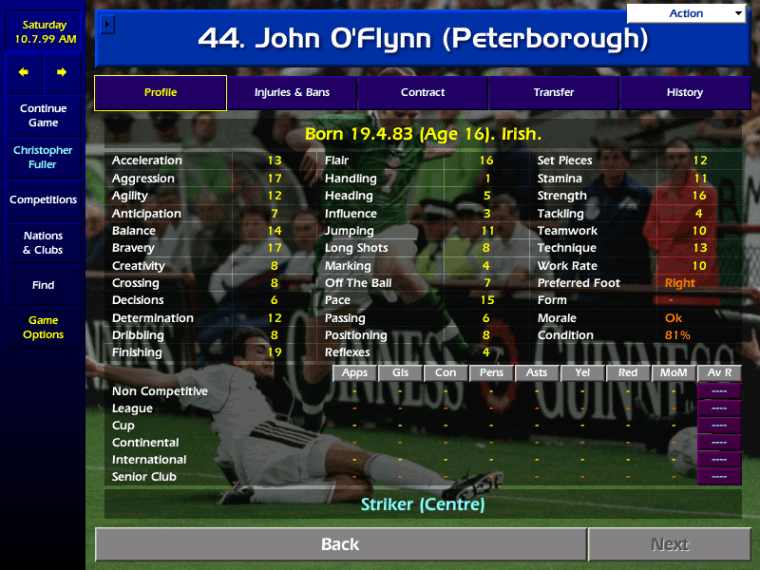
Peterborough had plenty of young prospects on CM99/00. O’Flynn is not the first Posh player on my list, and he won’t be the last, but he was certainly the most potent attacking force. The 16-year-old Irishman was an expert finisher with plenty of physical strength.
O’Flynn never graduated to the Peterborough first-team, joining Cork City in 2002. Over the course of six years, he scored 62 League of Ireland goals for the 2005 champions. In 2008, his impressive form earned him a second chance in England with Barnet, where he scored 34 goals in 70 League Two matches.
O’Flynn spent the next four years playing for Exeter – the first two in League One before the Grecians were relegated back to the basement. He went back home for good in 2014, enjoying a second stint at a reformed Cork before finishing up at Limerick and then Finn Harps.
 RICHIE PARTRIDGE
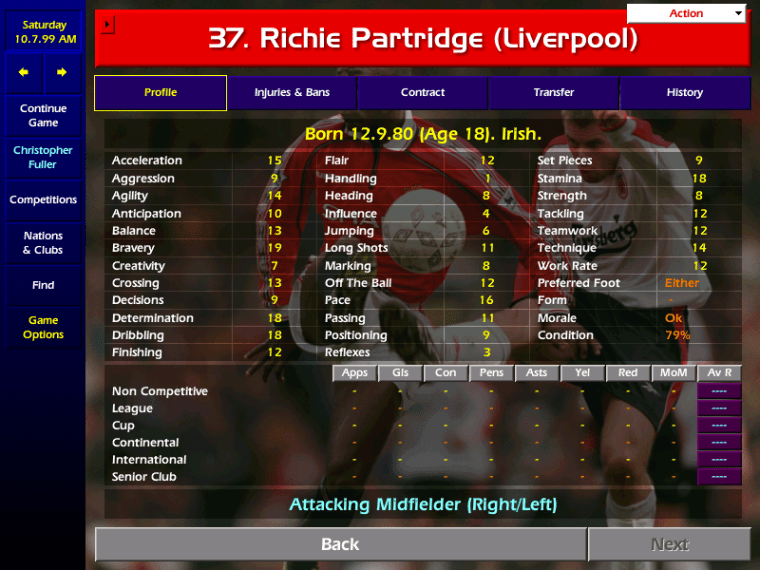
We continue the Irish theme with Richie Partridge – a Dublin-born winger who was an impressive dribbler and very comfortable on either foot. At times in game, he looked unstoppable, but in reality, injuries got in the way far too often.
A couple of ACL injuries wrecked Patridge’s Liverpool career, and he was let go in 2005 after no first-team appearances outside of loans with Bristol Rovers and Coventry. The former Republic of Ireland Under-21s moved on to Sheffield Wednesday – the first of several stops in a short but nomadic Football League career.
Partridge retired from professional football in 2011 – the same year he attained a Master of Science degree in football rehabilitation. He subsequently returned to Liverpool as a physio, though earlier this year, it was announced that he would be leaving to take up a position with Qatar’s national team.
 SIXTO PERALTA
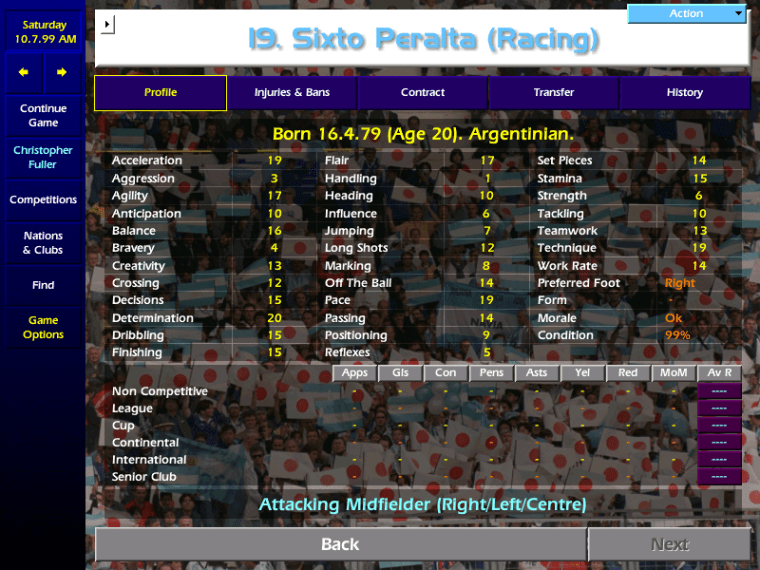
Two decades before Football Manager Redditors began making thousands of Argentinian wonderkid memes, Peralta was one of the top young footballers CMers could find in that part of the world. The attacking midfielder was a creative mastermind with 19 Pace and Acceleration – quite apt, considering he played for Racing!
After a productive 1999/2000 season at Racing, Peralta went to Internazionale. He didn’t play for the Nerazzurri, but was loaned out three times – most notably to Ipswich, who were relegated from the Premiership in 2002 through little fault of his own. He then went back across the Atlantic, spending three years in Mexico.
After an unsuccessful return to Racing, Peralta was back in Europe by 2008 with CFR Cluj. He won the Romanian league and cup three times apiece over four years and then headed off to Chile. He concluded his career triumphantly by lifting the Chilean Cup with Universidad de Concepción in 2015.
 FLORENTIN PETRE
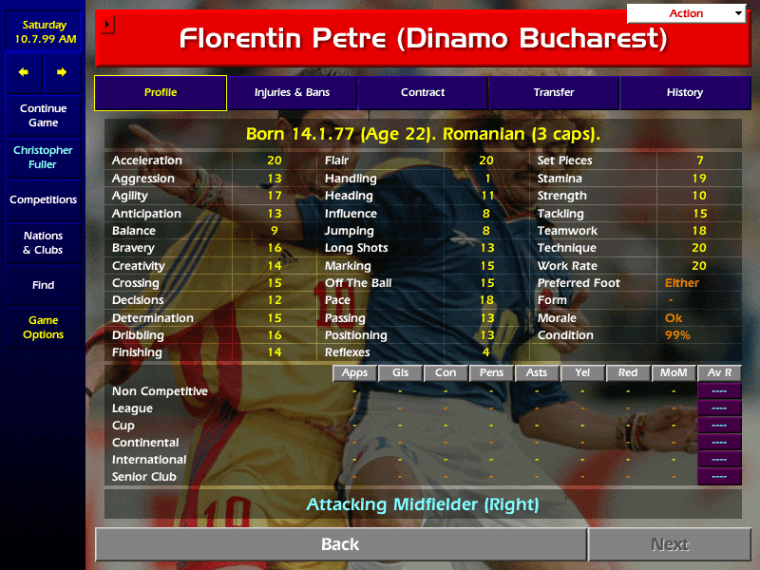
Turns out Adrian Mihalcea wasn’t even the best young CM99/00 player at Dinamo Bucharest, let alone in Romania! That honour arguably went to Florentin Petre – a right-wing marvel with so many high attribute scores in the right areas that anyone who had his services were serious contenders.
Petre made 259 league appaearances in his Dinamo career, scoring 43 goals. Mind you, he had some pretty awful luck, contracting hepatitis C after a freak fishing accident almost killed him. He moved on to CSKA Sofia in 2006, later playing for Russian side Terek Grozny as well as winning a total of 54 caps for Romania, scoring six goals.
Retirement came in 2011, following a relegation season back in his homeland with Victoria Branesti. He is now manager of third-division side Dacia Unirea Braila. It’s not known whether Ralph Ineson does the stadium announcements, but what I can confirm is that Florentin’s 23-year-old son Patrick plays for them.
 ROBSON PONTE
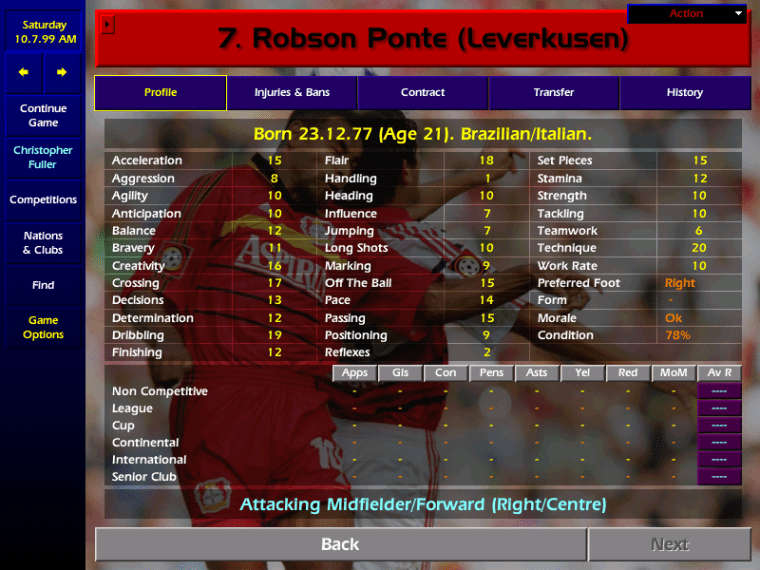
If you read my Leverkusen story, you’ll know just how much I loved Robson Ponte – and I wasn’t alone. With a keen eye for a killer pass, this Brazilian attacking midfielder would always become a serious contender for World Player of the Year on CM99/00.
Ponte spent six seasons on the books at the BayArena, but he missed the worst of Neverkusen’s near-misses, being loaned out to Wolfsburg between 2001 and 2003. In total, he played in 140 Bundesliga matches, scoring 19 goals.
Robson’s greatest career successes came in Japan, during a five-year stint at Urawa Red Diamonds. After winning the J1 League in 2006, he was named the league’s MVP in 2007 – the same year Urawa lifted the AFC Champions League. He hung up his boots in 2011 after returning home to Sao Paulo with second-division side Gremio Barueri.
 ALAN POUTON
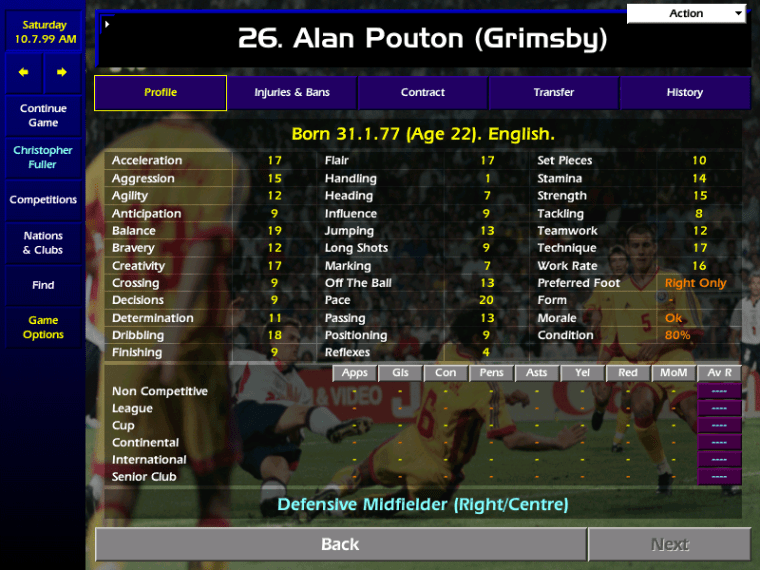
In the CM3 era, the thought of Grimsby winning the Champions League actually wasn’t that absurd. In Alan Pouton, the Mariners had a hard-working holding midfielder who would usually either lead their ascent to the top level or fund it through a sale. International honours were also a given.
The aggressive Geordie was a popular figure at Blundell Park, but his disciplinary record became increasingly problematic over time. Grimsby were relegated from Division 1 in 2003, and Pouton left for Gillingham a year later.
Injuries dogged Pouton’s time at Priestfield, and he was advised to retire from professional football in January 2007. He returned to the game that July, playing part-time for Dover, Maidstone and Sutton before quitting for good. He was assistant manager at Maidstone between 2011 and 2012, but hasn’t worked in football since.
 KABBA SAMURA
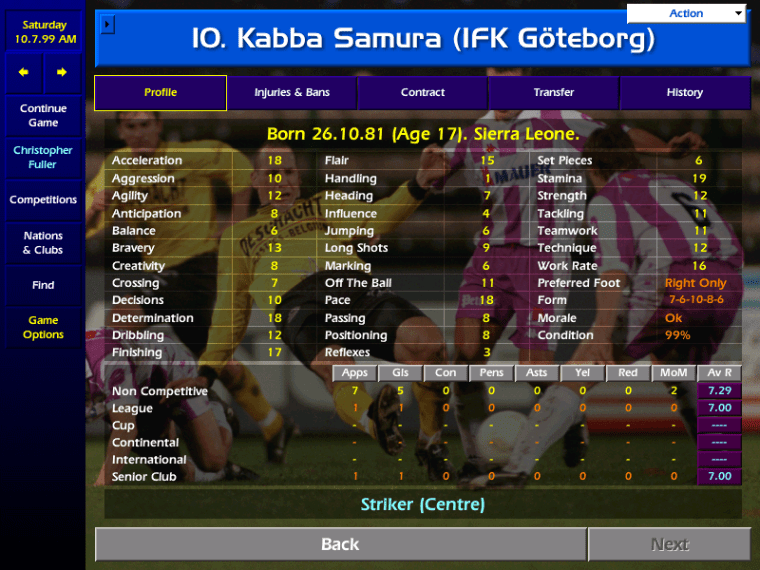
What’s this? Why, it’s a Sierra Leonean striker whose name isn’t Mohamed Kallon! Kabba Samura was a magnificent finisher with the potential to get 30+ goals a season at the highest level. You could probably guess how his real-life career panned out.
Samura started off at Mighty Blackpool (no, really, that’s an actual football club in Sierra Leone) before heading off to Sweden. He was soon on the books of IFK Göteborg, where he scored more than a goal a game for the ‘B’ team but failed to make much impact at first-team level.
Capped only five times by his country, Samura plied his trade in several territories, including Norway, Finland and Azerbaijan. His last stop before retirement was a Vietnamese club named… Câu lạc bộ Bóng đá Hoàng Anh Gia Lai (or HAGL, for short).
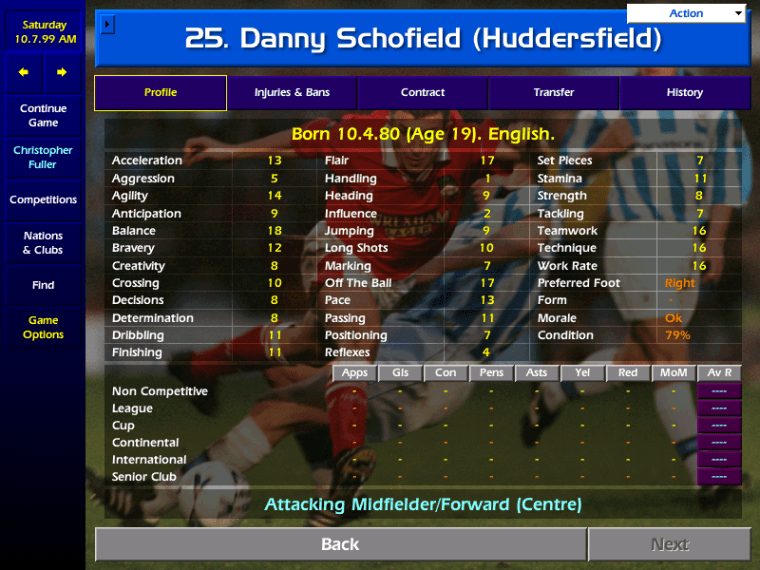 DANNY SCHOFIELD
If you thought Grimsby becoming a force was odd, let me tell you that on my longest CM99/00 career, Steve Bruce turned Huddersfield into multiple Premiership champions. The Terriers began as a competitive Division 1 side, with the unpredictable future England midfielder Danny Schofield one of their top assets.
Schofield would stay at Huddersfield for a decade – though this was the decade before the one that ended with David Wagner leading them to top-flight survival. Indeed, Town were relegated as low as Division 3 and almost went into liquidation. Danny’s 248 league apparances made him a rare constant during that turbulent period between 1998 and 2008.
Schofield continued his Football League career for six more years with Yeovil, Millwall and Rotherham, before retiring at Conference North side Bradford Park Avenue in 2016. After working with Middlesbrough’s Under-23s, he took up an Under-19s coaching position back at Huddersfield in February.
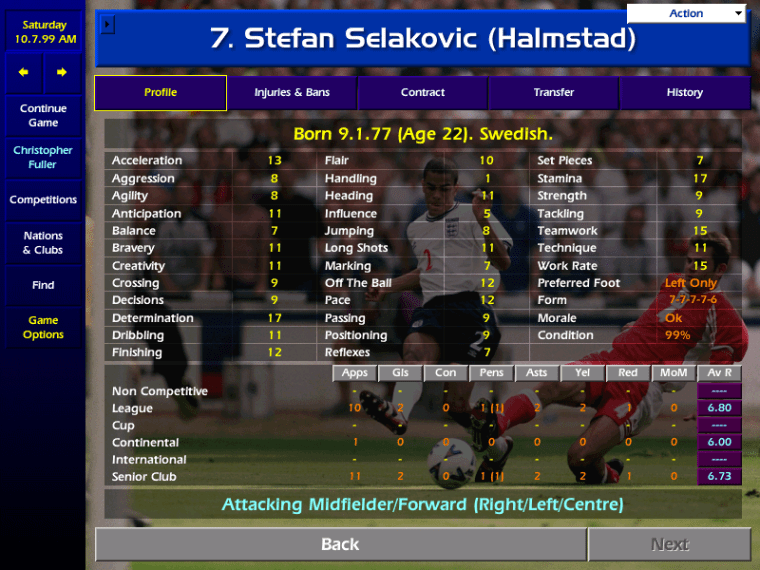 STEFAN SELAKOVIC
Though his attributes aren’t exactly amazing at the start of CM99/00, Selakovic usually blossoms into an excellent attacking midfielder. Once you took him off that Scandinavian conveyor belt of talent, you had a workaholic playmaker with what some unimaginative pundits would call “a wand of a left foot”.
Selakovic was at his best around the turn of the millennium, winning the Allsvenskan with Halmstad in 2000 and becoming the league’s top scorer a year later. Also in 2001, he won the first of his 12 Sweden caps (scoring four goals) and earned a transfer to Heerenveen.
Stefan’s time in Holland wasn’t that successful, and by 2005, he was back in Sweden with IFK Göteborg. He made over 200 league appearances for the Blåvitt before ending his career back at Halmstad in 2013.
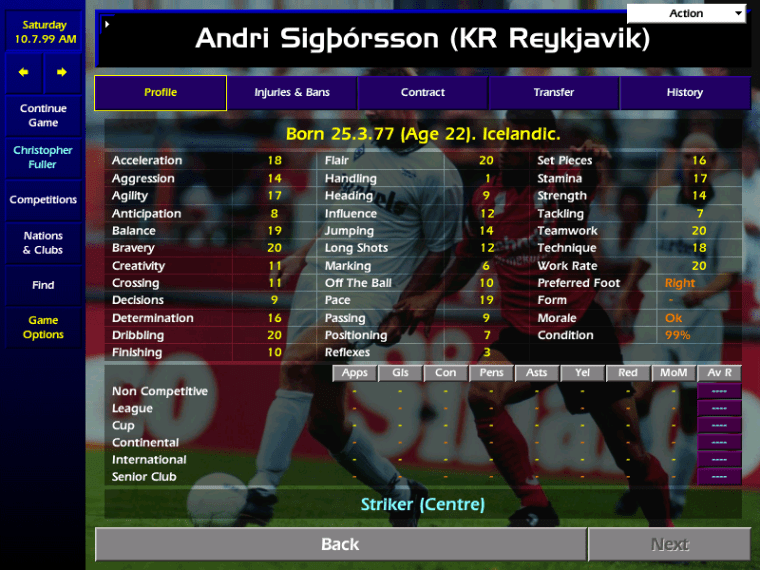 ANDRI SIGÞORSSON
Hey, it’s that Icelandic striker whose name nobody can spell right! Andri Sigþórsson (or Sigthórsson – the “þ” is a “th”) was one of the top bargains on CM99/00, possessing impressive endeavour, pace and dribbling ability at a laughably low price.
Sigþórsson scored nearly a goal a game for KR in his homeland before joining SV Salzburg in 2000. It was actually his second spell on the continent, having played for Bayern München’s reserves in his teens. He later moved to Norway with Molde, where he suffered a serious knee injury that sadly ended his career in 2004, aged just 25.
A few years ago, it was reported that Andri was now running a chain of bakeries in Norway. His family’s football tradition lives on, though. Younger brother Kolbeinn plays up front for AIK and is an Iceland regular who famously stunned England (and Steve McClaren especially) at Euro 2016.
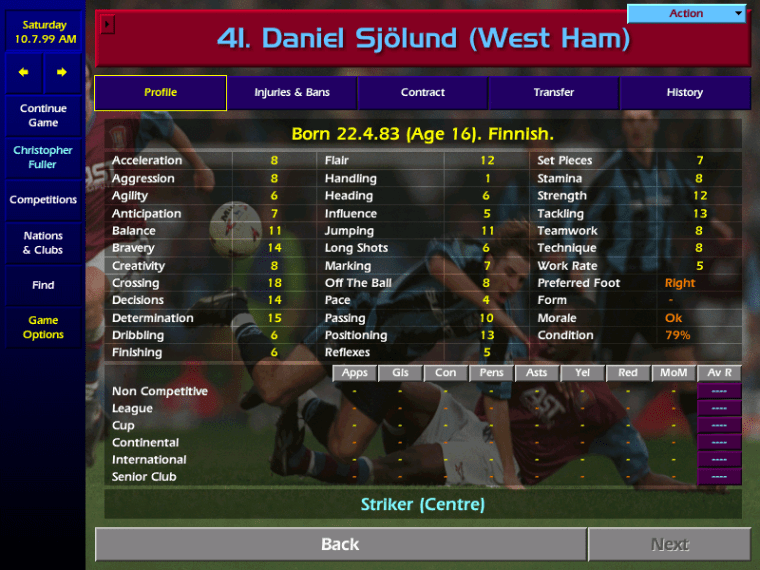 DANIEL SJÖLUND
Just as Jari Litmanen was hitting his peak, it seemed Finland had a new attacking sensation on the secene in Daniel Sjölund. Admittedly, his Finishing attribute didn’t look great, but bear in mind he was only 16. It wouldn’t be long before the native Åland islander’s development sky-rocketed and he became a star striker for club and country.
After breaking into IFK Mariehamn’s first-team aged just 15, ‘Daja’ headed off to England. In four years with West Ham and Liverpool between 1999 and 2003, he didn’t make any first-team appearances, eventually moving to Djurgården. For the next decade-and-a-half, he would enjoy a respectable career in Sweden and Finland as an attacking midfielder.
Sjölund won 37 caps for Finland, though his international achievements were eclipsed by younger sister Annica, who represented her country 67 times and played at two European Championships. Daniel retired last year after one more season back at Mariehamn.
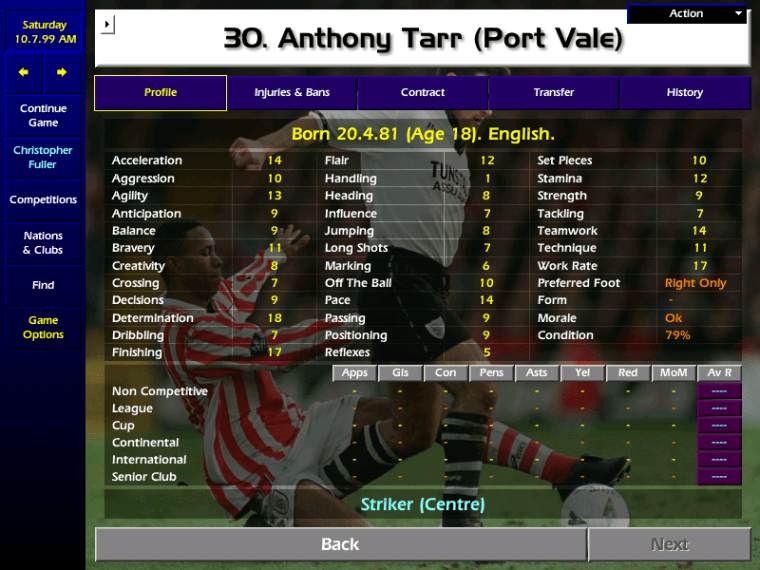 ANTHONY TARR
Though not many other players have cited him, Tarr is a CM99/00 cult icon where I’m concerned. On my England save, he formed a prolific partnership with Michael Owen, scored a hat-trick against Germany and helped us win Euro 2004. In other saves I’ve had, he always turned into a handy Premiership striker at the very least.
This was really the only game where Tarr turned out to be any good. The Stoke-on-Trent native was released by Vale in 2000 and later had an unsuccessful trial at Chester. He was an unrated free agent on CM00/01, but by CM01/02, he was at Newcastle – that’s Newcastle Town.
Though he never made the grade professionally, Tarr played on for many years at non-league level. He turned out for a variety of clubs in or around Staffordshire, including Nantwich, Norton United and Leek CSOB.
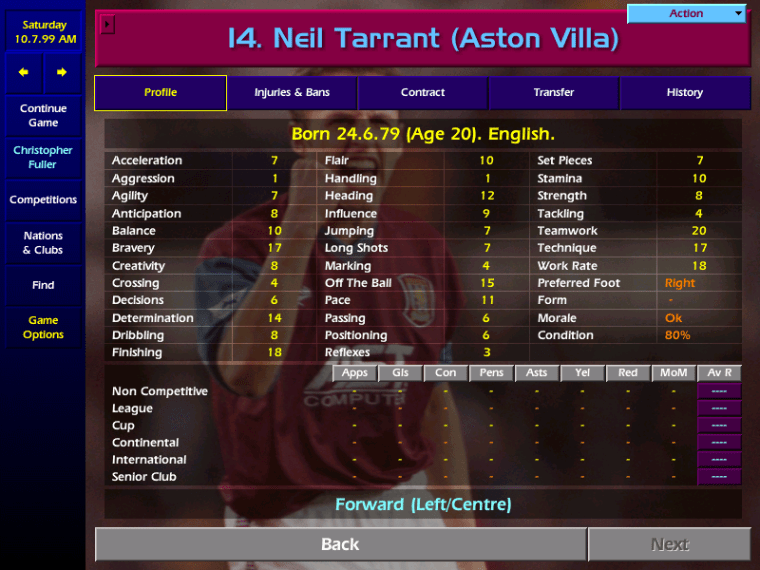 NEIL TARRANT
Here was another young attacker with impressive marksmanship, teamwork and potential to be an England international. While Chris Tarrant was asking the British public if they wanted to be millionaires, Neil Tarrant was on his way to becoming one… in the virtual world, at least.
The young Geordie moved to Villa in 1999, having won the Scottish Division 3 title with Ross County after a prolific season. Though he was capped by Scotland Under-21s (for whom he qualified through a grandparent), he never stepped up to the Villans’ first-team and was released in 2001.
Tarrant also failed to make much impact with Motherwell, and a second stint at Ross County didn’t live up to his first. He would spend nearly a decade bouncing around several non-league clubs in northern England before calling time in 2011. After some time away from football, he unexpectedly returned in 2019 as manager of Wearside League side Richmond Town.
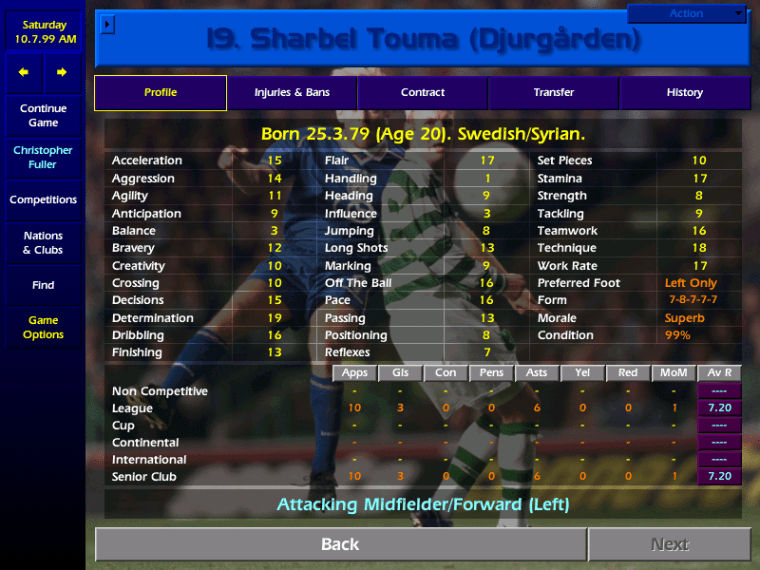 SHARBEL TOUMA
This will be the last Swedish cult icon I cover, I promise – and it’s a big one. Touma was an outstanding left-wing talent whose stamina, flair and technique made the Djurgården man hugely sought-after on CM99/00.
Having impressed in his first Allsvenskan season at Djurgården in 1999, Touma was poached by AIK. Though he didn’t really fulfil his potential in Solna, Halmstads got the best of his goalscoring talents between 2002 and 2004. The Lebanese-born attacker was also capped twice by Sweden.
Touma went to Twente in 2005 and had two-and-a-half decent years in Holland, but later moves to Borussia Mönchengladbach and Iraklis didn’t work out. By 2010, he was back in Sweden – first with Djurgården again, and then with his first club Syrianska. He retired in 2014, though he came back onto the pitch for one final appearance in 2017.
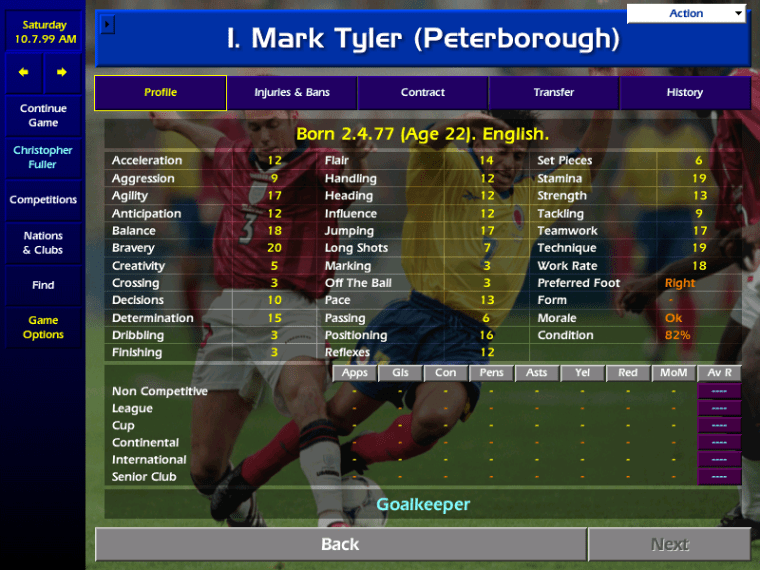 MARK TYLER
Tyler is a Championship Manager legend, having been a highly-rated goalkeeper on several versions. Exceptional agility and positional awareness made him an England number 1 in the making – as soon as you gave Peterborough’s shy and retiring manager Barry Fry an offer he couldn’t refuse.
Tyler never graced the top flight but is an icon in his own right at London Road. Between 1994 and 2009, he featured in 486 matches for Posh, even getting a testimonial against Liverpool in 2007. He also became a firm favourite at his next club Luton, making 297 appearances over seven seasons.
In March 2016, Peterborough fans were greeted by the news that Tyler had returned as player/goalkeeping coach. He pulled on the gloves a few more times – most recently against Oldham in March 2017, just before his 40th birthday – but now concentrates on coaching.
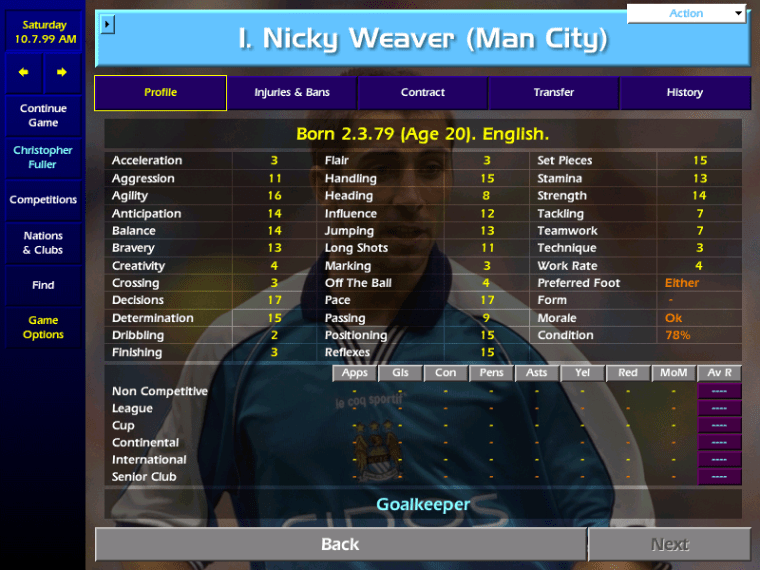 NICKY WEAVER
English football certainly looked in safe hands on CM99/00, as there was another budding goalie making his mark in the lower leagues. 20-year-old Nicky Weaver was number 1 at Manchester City, where he’d earned iconic status by saving the decisive penalty from Gillingham’s Guy Butters to win the Division 2 Play-Off Final.
Weaver remained first-choice as City were promoted again in 2000 before failing to retain their new-found Premiership status. Sadly, a spate of injuries stalled his progress for several years. A loan spell at boyhood club Sheffield Wednesday got him back on track for awhile, and though he broke back into the City XI in 2006, he was released a year later.
Thereafter, Weaver played lower-league football for Charlton and Wednesday, as well as having a couple of stints in Scotland with Dundee United and Aberdeen. He finished playing in 2014 aged 35 – not exactly ancient for a goalkeeper – and went back to Hillsborough as Wednesday’s goalkeeping coach.
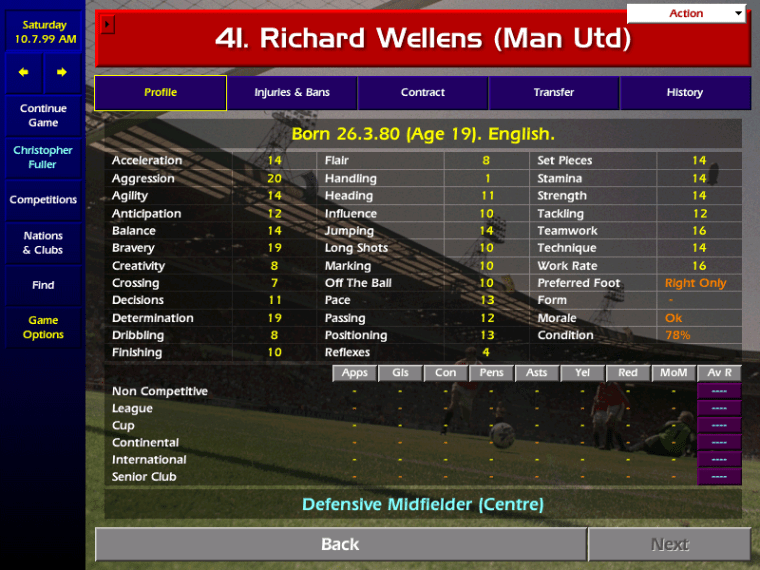 RICHARD WELLENS
Last, but not least, we have Richie Wellens. The Mancunian whose name sounds like a 1950s rock-and-roll star played aggressive rock-and-roll football in holding midfield on CM99/00. He was arguably one of the more exciting prospects at Manchester United…
…which makes you wonder why he only played once for them, in a League Cup defeat to Aston Villa in 1999. After leaving United, Wellens enjoyed a very long Football League career, starting at Blackpool in 2000 and ending at Shrewsbury in 2016 – around 600 appearances later. During that time, he also played over 100 games apiece for Doncaster and Leicester.
Wellens joined Oldham as a coach in July 2017 and became manager that September, though he couldn’t save them from relegation to League Two. He’s had better luck in his next job at Swindon, who were crowned League Two champions last month. Richie’s two sons are both academy players at Manchester United, where 17-year-old Charlie recently signed his first professional contract.
And there we have it! Did you enjoy that look through some of CM99/00’s best players? If you think I missed anyone and want to know where they are now, you can drop a comment below.
Don’t forget that you can hit the ‘Follow Fuller FM’ button to be notified whenever a new blog post goes live. You can also find me on Twitter @Fuller_FM.
Thank you for reading.
 Fuller FM
You must be logged in to post a comment.