
Every version of Championship Manager and Football Manager has its cult icons – those must-buy players whom you can often turn into superstars. Championship Manager 99/00 is, of course, no exception.
We all have our own favourites, whether it’s one of those Swedish wonderkids everybody knows about, or that hidden gem you discovered in Indonesia. But for every Zlatan Ibrahimovic who lived up to their superstar billing in real-life, there are at least a dozen who had rather more… modest careers.
I’ve identified 36 of the brightest stars in the CM99/00 database and have tracked their careers to see where they are two decades later. Their names all appear on the title image above, and I’ll look at each of them over two separate posts.
In Part 1, I’ll be looking at players such as Kennedy Bakircioglü, Mads Jørgensen, Johnnier Montano and the legendary Tonton Zola Moukoko.
 ALEX AGUINAGA
While most Championship Manager cult icons were raw young talents when they were ‘discovered’, Aguinaga was a long-established Ecuador international by the time he became a hit on CM99/00. You could sign him from Mexican side Nexaca for a pittance and he’d provide assists galore for a good few years.
Aguinaga might have been aged 28 in-game, but by this point, he was actually 31 – and had won the first of his 109 caps over a decade earlier. He had just celebrated 10 years at Necaxa, where he stayed for another four before ending a glittering career back home.
In 2011, he was appointed as manager of Barcelona – that’s Barcelona SC, who play in the Ecuadorian top tier. He didn’t stay there long, though, and went on to manage several other clubs in Mexico and Ecuador – most recently leaving LDU Quito in 2016.
 PATRIC ANTONEN
We now come to the first of several Swedish starlets in this game. Patric Antonen was a pacy forward with incredible stamina and work rate, and once you prised him from hometown club Örebro, you were all set.
In real life, Patrik Antonnen was a right-back who never left Örebro for greater things, not even after they were relegated from the Allsvenskan in 2004 (they returned two years later). He would go on to make nearly 300 league appearances in 14 years at ÖSK.
Antonnen was capped once by Sweden – starting a 2009 friendly win over Mexico in Oakland, California. After eventually leaving Örebro, he wound down his career with second-division side Degerfors and retired at the end of the 2015 season.
 KENNEDY BAKIRCIOGLÜ
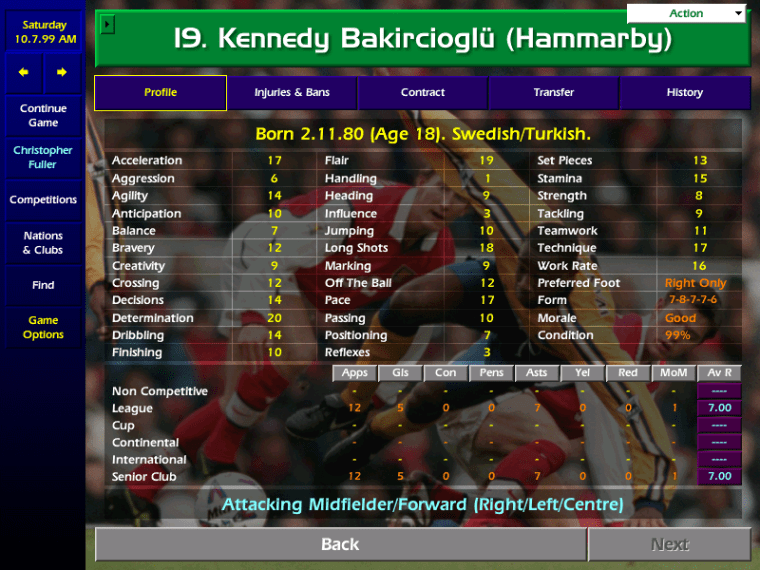
Bakircioglü was one of the first Championship Manager wonderkids I came across in my childhood, unsuccessfully trying to sign him for Manchester United. If you were more fortunate, you were blessed with an attacking midfield marvel who could change games and bang in long shots almost at will.
Named after a former US President, Kennedy was destined for big things… and though he never became a real-life superstar, he didn’t have a bad career. After winning the Allsvenskan with Hammarby in 2001, he spent some time in Greece (with Iraklis) and then graced the Eredivisie (Twente and Ajax) and La Liga (Racing Santander).
Bakircioglü won the last of his 14 Sweden caps in 2008, but he played on another decade. He fittingly ended his career back at Hammarby, where he got them back into the Allsvenskan and reinvented himself as an Andrea Pirlo-esque playmaker. You can read more about his career in this fantastic article from Planet Football.
 DAVID COLLINS
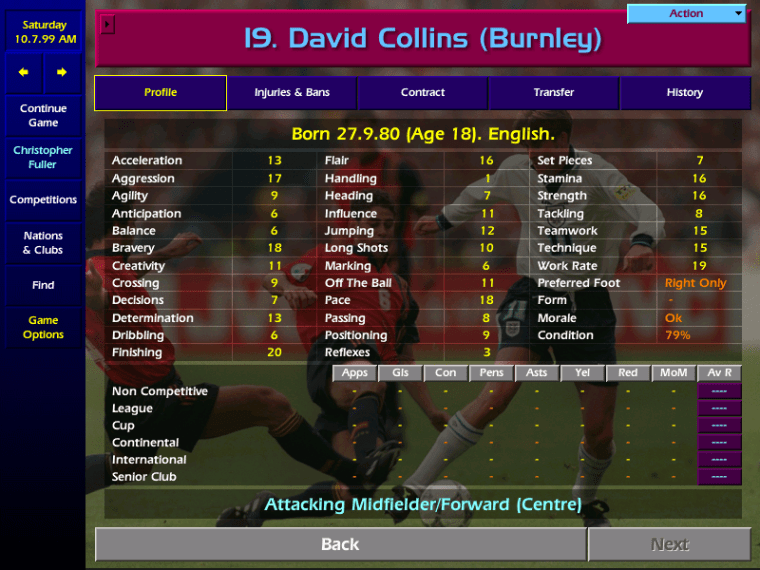
I had countless CM99/00 careers when I was growing up – and one constant was that David Collins would always play for England. This energetic teenager with 20 Finishing would quickly be poached from Division 2 Burnley, and before long, he was rivalling – if not displacing – Alan Shearer at international level.
The real-life Collins never played a single minute of League football. When he did leave Burnley, it was for Altrincham, and he was at Radcliffe Borough by 2001/2002, when he became a CM favourite once again. After that, the trail goes cold.
Frustratingly, Collins was one of only two players in this project that I couldn’t find any recent information about – at least not from the past decade. Somewhere out there, though, probably in north-west England, is an ordinary 39-year-old bloke who’s lived many extraordinary virtual lives.
 JOHN CURTIS
Curtis was like an English Franz Beckenbauer in CM99/00 – a versatile defensive sweeper with energy for days. The 20-year-old West Midlander would quickly hit the big time and become the last of Alex Ferguson’s 90s Fledglings to establish himself as a Manchester United mainstay…
…but not in reality. By 2000, Curtis had moved on to Blackburn for £1.5million. He got them promoted to the Premiership a year later and stayed at the top level for a while before things started to unravel at Leicester and then Portsmouth. Before long, he was a lower-league journeyman with the likes of Nottingham Forest and Wrexham.
Curtis’ career went (down) under in 2011, having spent a season at ill-fated A-League side Gold Coast United before calling it quits. Since then, he has coached in a number of countries across the world. Most recently, he was appointed assistant coach to Radhi Jaïdi at Hartford Athletic, who play in the USL Championship – the second tier of American soccer.
 MATTHEW ETHERINGTON
Cornwall’s finest footballing son since Nigel Martyn burst into Peterborough’s first-team when he was only 15. On CM99/00, this explosive and flamboyant left-winger could be picked up from Posh for not very much money. Indeed, when Etherington did join Tottenham just before the turn of the millennium, it was for only £500,000.
Etherington’s big move didn’t go to plan, and in 2003, Spurs shipped him off to West Ham in a part-exchange deal that saw Frédéric Kanouté go the other way. He became an instant hit at the Hammers, who were still reeling from relegation. Promotion followed in 2005, and though he was a top-flight regular thereafter, he never earned a senior England call-up.
A gambling addiction and a reduction in first-team chances contributed to his West Ham career ending in 2009. He spent the next five years establishing Stoke as a top-half Premier League team, also scoring one of the goals that sent them to their first FA Cup Final in 2011. Having retired in 2014 due to a back injury, he returned to Peterborough as Under-19s manager in 2018.
 ERNESTO FARÍAS
Nicknamed ‘El Ticla’ (or ‘The Key’), Farias was a goalscoring virtuoso who was playing all the right notes in La Plata. When you know just how good he became on CM99/00, it’s astonishing to find out he only earned one cap for Argentina in real-life. Then again, that was more down to La Albiceleste’s immense strength in depth than anything else.
Farías scored 93 league goals for Estudiantes before joining Italian side Palermo in 2004. Thereafter, he featured for several clubs across South America and Southern Europe. His greatest successes arguably came at Porto, with whom he won back-to-back Primeira Liga titles in 2008 and 2009.
Farías retired from playing in 2017, after a stint at Colombian side América de Cali ended in an acrimonious departure. As far as I can tell, he is now back at River Plate – another of his former employers – in a coaching capacity.
 JONAS FORSBERG
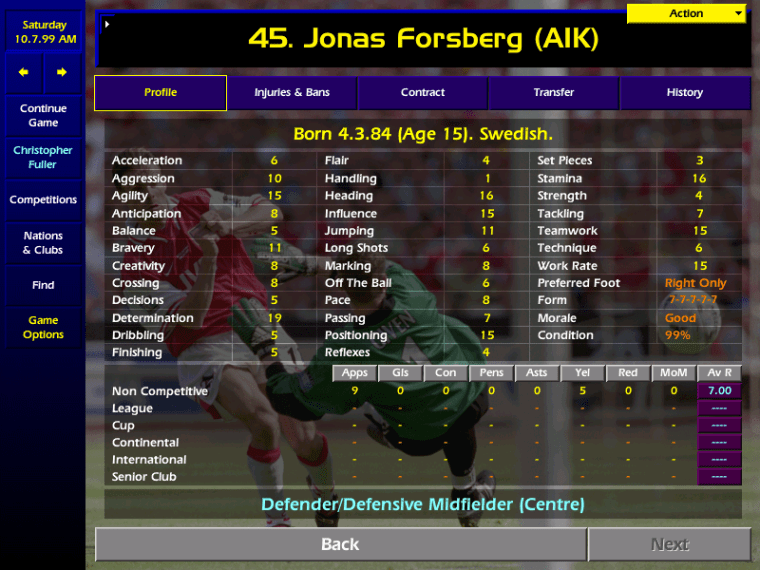
Forsberg was just 15 when he debuted on Championship Manager. Though the defender’s tackling ability was still pretty raw, he was positionally astute for his age and had the determination to hit the top of his game. But just like many of the approximate 63 Swedes on my list, that didn’t really happen.
Forsberg spent his entire career in Sweden. He left AIK for the last time in 2006, having returned to the Stockholm club after a stint at the wonderfully-named FC Café Opera. After that, his CV is basically a list of random lower-league Swedish clubs such as Umeå, Gröndal, Arameisk-Syrianska and Karlberg.
As for where he is now… that’s where we get into murky waters. Google throws up links to a Jonas Forsberg with 15 years of football experience working as a “Soccer Speed Coach”, a “Fitness Expert”, and the co-founder of a ‘biohacking’ company named OsteoStrong. I have no idea whether any or all of them are the guy we’re interested in.
 HAUKUR GUDNASON
Iceland have two striking wonderkids on CM99/00. The first of them is Gudnason – an aerial beast with technique to die for. In a virtual universe, he was likely to form a deadly strike partnership with Michael Owen, winning countless major trophies with Liverpool before they rode off into the sunset together in 2015.
Erm… no, that didn’t happen. Gudnason never even made a first-team appearance during his three years at Anfield, returning to Iceland permanently in 2000. Over the course of his career, he had three separate spells at hometown club Keflavík, but he also spent several years at Fylkir. Internationally, he was capped eight times at senior level.
Haukur retired in 2011 and briefly became Fylkir’s assistant manager a year later. In 2018, he married his long-term partner Ragnhildur – an actress, TV presenter and former Miss Iceland – with whom he has four children.
 FRANCIS JEFFERS
On 12 February 2003, two exciting young Liverpudlian strikers made their England debuts in a shock friendly defeat to Australia. Only one scored that night, but it wasn’t Wayne Rooney. It was Everton’s pre-Wazza sensation Franny Jeffers, who was set for superstardom on CM99/00… but in reality turned out to be a one-hit wonder.
After a very bright start to his career with the Toffees, Jeffers joined Arsenal for £8million in 2001. Unfortunately, his time at Highbury was hampered by injury. He returned to Goodison Park on loan in 2003 and then joined Charlton permanently the following year, but the goals dried up – he never scored more than five in a season again.
Jeffers’ top-flight career was effectively over by 2007, though he plodded on as a lower-level journeyman (even playing in Malta for a short time) until 2013. He has been an Everton academy coach since 2014, but he was in the news for the wrong reasons last year, having been prosecuted for abusing his estranged wife on WhatsApp.
 MADS JØRGENSEN
To many CM99/00 managers, Mads Jørgensen was a powerful and versatile attacker who would blossom after being bought from AGF in his native Denmark. His elder brother Martin wasn’t bad either, as I will vouch from my time managing Leverkusen. Thanks to those two especially, the Danish Dynamite had explosive potential.
While Martin won 102 caps and became a Serie A star with Udinese and Fiorentina, Mads’ career was horribly blighted by injuries. He played only once for his national team (against Iceland in 2001), and a move to Italy in 2003 ended without him making a single appearance for Ancona.
After a season with Norwegian side Stabæk, Jørgensen had second spells at his former clubs Brøndby and AGF, but persistent injuries caught up with him. In June 2008, aged just 29, he announced his retirement. He has done scouting work for Liverpool for nearly a decade, but as far as I’m aware, he wasn’t the guy who recommended Christian Poulsen to them.
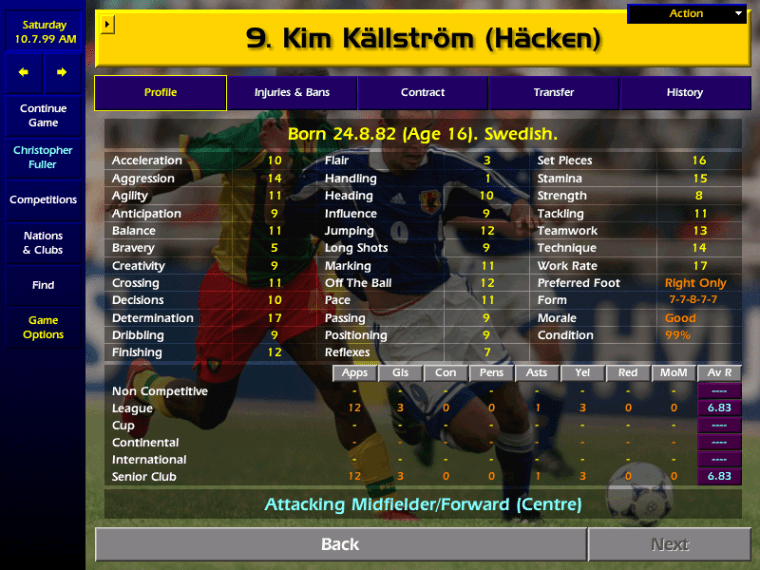 KIM KÄLLSTRÖM
At just 16, Källström entered CM99/00 as a prodigious attacking midfielder with fantastic set-piece skills. Given a few years’ development, he would become one of the best players in world football – and though that never quite happened, calling his actual career a “failure” would be a stretch.
After winning promotion to the Allsvenskan with Häcken in 1999, he moved on to Djurgårdens, averaging more than a goal every two games. France beckoned next, and after continuing to shine at Rennes, he was picked up by Lyon – winning two Ligue 1 titles in 2007 and 2008.
Between spells in Russia and Switzerland, Källström finally made his way to England in 2014 – but Arsenal fans saw very little of an ageing midfielder with a dodgy back. He signed off back at Djurgårdens in 2017, ending a career which saw him make 131 appearances for Sweden and feature in five international tournaments.
 KURNIAWAN
Indonesia has never been a footballing hotbed, but it had a few gems on CM99/00 – and Kurniawan was a sparkling diamond. Once he was brought to Europe, this silky-smooth striker’s impact would often be immediate. Indeed, on my Leverkusen save, he went to Ajax and was named World Footballer of the Year in his first season!
Kurniawan Dwi Yulianto was actually born in 1976, making him two years older than the game said he was. He had already tried to make it in Europe during the mid-1990s, but personal problems saw him return home. He enjoyed a productive career in south-east Asia, scoring nearly 200 league goals for a variety of clubs – and 39 in 55 caps for Indonesia.
Kurniawan retired from playing in 2013, aged 37. He served as the national team’s assistant manager in 2018 and was appointed head coach of Malaysia Premier League side Sabah earlier this year.
 SALIOU LASSISSI
Saliou Lassissi was a quality centre-half and occasional right-back on this game. The young Ivorian’s immense strength, bravey and aggression made him a rock in any defence. Unfortunately for bargain-hunters, Parma had already got their mitts on Rennes’ young sensation in 1998.
Sadly, Lassissi’s career went downhill fast. Shortly after joining Fabio Capello’s Roma in 2001, he suffered a double leg break in a friendly against Boca Juniors. He never played a competitive match for the Giallorossi, and when they declined to pay him for six months, he successfully sued them for €3million.
After leaving Roma in 2004, Lassissi returned to the Ivory Coast for a year. Incidentally, he had only been capped eight times by the Elephants due to disciplinary problems. Subsequent attempts to restart his European career proved brief, and after a spell at third-tier French side L’Entente in 2007/2008, he never played competitively again.
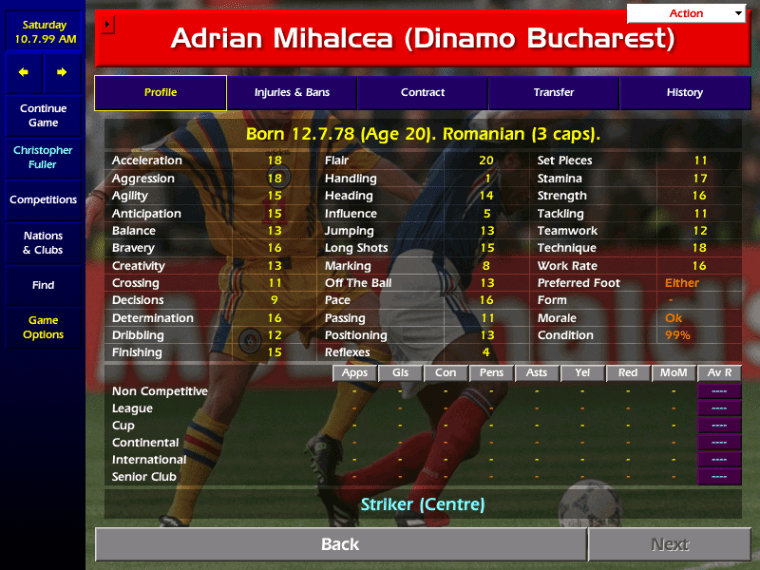 ADRIAN MIHALCEA
When you think of Romanian strikers named Adrian from this era, you probably think first of Messrs Ilie and Mutu. But Adrian Mihalcea has a special place in the hearts of many CM99/00 players as an exceptional centre-forward with bags of flair and technical skill.
Mihalcea netted 68 league goals in five years at Dinamo Bucharest before Italy came calling in 2001. He was a hit at Genoa, though not so much at Verona, who sent him back to Dinamo in 2004. A year before that, he won his 16th and final cap for Romania – remarkably failing to score a single goal.
The latter half of Mihalcea’s playing career was nomadic, taking in spells in South Korea and Cyprus as well as back in his homeland. He subsequently went into management, and was appointed Dinamo’s head coach in March this year, following a two-year stint as assistant to national team manager Cosmin Contra.
 JOHNNIER MONTANO
Montano looked phenomenal on CM99/00 as a 16-year-old. Passing 20, Technique 18, Flair 18: you could tell straight away this kid was going to be a megastar. In most careers, the attacking midfielder would enjoy over a decade of club glory and win at least a century of caps for Colombia.
The summer of 1999 had seen Montano move to Parma after a breakout season at Argentine club Quilmes which also saw him named in Colombia’s Copa America squad. Unfortunately, he didn’t get many opportunities in Italy, leaving in 2004 to rejoin his first club América de Cali.
A nomadic globe-trotting career followed for Montano, who was only capped six times by Los Cafeteros (his international career ending aged just 24). It’s quite hard to believe tha this former wonderkid is now 37 – and that he is STILL active in professional football today. He signed for Peruvian second-tier side Chavelines in March.
 JAIME MORENO
Major League Soccer made its Championship Manager debut on CM99/00. One of the most familiar names to English CMers managing in America for the first time was former Middlesbrough forward Jaime Moreno. The Bolivian’s pace and power would usually earn him a successful return to the Premiership (quite often with Liverpool, I found).
As it turned out, Moreno was in the United States to stay. He represented DC United in 14 of the first 15 MLS seasons (except 2003, when he played for MetroStars). During that time, he won four MLS Cups, four Supporters’ Shields and two US Open Cups, as well as the CONCACAF Champions’ Cup in 1998.
Moreno was briefly the top goalscorer in MLS history, and still holds United club records for most appearances (329), goals (131) and assists (102). No other Black-and-Red player can come close to his legendary status. After retiring from playing in 2010, he was retained as a youth academy coach and Under-23s head coach.
 TONTON ZOLA MOUKOKO
I’ve saved arguably the best player in this first part for last. Anybody who’s played this game has their own Moukoko story, which often ends with the playmaker/striker leading their team to Champions League glory. He would also often become an international star with either Sweden or Ghana, though he was actually born in Zaire (now DR Congo).
After being orphaned at a young age, Tonton emigrated to Sweden to live with his older brother Fedo. His footballing talents were first discovered at Djurgårdens, from whom Derby signed him in 1999. Tragically, Fedo passed away not long after, and a distraught Tonton went home in 2002 without ever breaking into the Rams’ first-team.
I don’t think I can do this guy’s journey justice, especially when SportBible have already covered it so beautifully in this article. To cut a long story as short as possible, while Moukoko never hit the heights expected of him, his tale has a happy ending. He now has a young family in Stockholm, where he works as an agent and also runs a lower-league club named Kongo United.
I hope you’ve enjoyed this look at some of the best players from CM99/00. The second part of this Cult Icons mini-series will be published in a fortnight’s time, on Friday 31 July. You can stay updated by hitting the ‘Follow Fuller FM’ button or following me on Twitter @Fuller_FM.
Thank you for reading.
 Fuller FM
Its funny what you can find when you are bored and google yourself during a global pandemic. Yep your guess is correct, just an ordinary man these days, with a family enjoying life, just slightly hidden from the world 🙂
I absolutely loved my time at Burnley, unfortunately i signed for the right club at the wrong time, though. In Hindsight, 3 managers in the 2 years i was there (Heath, Waddle and Tennant) disruption from staff and players changing, only pure concentration on the first time (senior pros) and trying to prevent the club from being relegated meant that they focused on the first time and shy-ed away from playing youngsters and our involvement/progression.
After trying to make it via Non-League, I eventually gave up playing competitively at about 22/23 years old. I’d been to Uni, was working and also playing football on a Tuesday, Thursday and Saturday I’d had enough of trying to make it to professional standard and ventured on a normal career.
One of my now best friends played/plays champ and footie manager. The day i met him and he found out who i was, i think it was one of the best days of his lives hahah, you sometimes forget the value of computer games and the fun people have on them.
Nice write up.
The real David Collins 😀
Thank you for getting in touch, David. I’m glad you enjoyed the write-up. You were one of my favourite players from CM99/00, but I’ll admit it was very hard to find information about your post-Burnley career when doing my research for this article. I’m very grateful and appreciative that you’ve shared your story and given some insight into how and why things went the way they did.