

Last spring, I started an occasional series here on Fuller FM where I review football management computer games from outside the Sports Interactive catalogue.
The very first game I reviewed was Soccer Manager 2019. I was pretty scathing of that game, particularly singling out its ‘ice-skating’ players and its obsession with microtransactions, and gave it only 2 stars out of 5. (That review also happened to be one of my most-viewed blog posts of 2019.)
The sequel has been on Steam for a while now, so I thought I’d see for myself if things have changed for the better over the past year. Here is my honest review of Soccer Manager 2020…
BACKGROUND
If you read my SM19 review, you’ll already know about the history of this series, but here’s a refresher. Lancashire-based Soccer Manager Ltd started out by releasing a hugely-popular multiplayer game – now known as Soccer Manager Worlds – in 2005. I played that game for over a decade but quit last year because of serious neglect.
And why have the developers seriously neglected Soccer Manager Worlds? Probably because, since 2014, they’ve focused their resources mainly on a single-player spin-off. Soccer Manager 2015 debuted as a primitive Football Manager knock-off, but newer and improved versions have come out every year since then.
That leads us towards Soccer Manager 2020 – the sixth version of this experience, and arguably the most ambitious yet. Among the most trumpeted new features are new 3D animations of your club facilities (nice), an improved transfer system (cool), and an enhanced match engine (we’ll see about that).
You can download SM20 for free on PC (via Steam) and on mobile devices (via Google Play or the App Store). If you’re a Fuller FM regular, you’ll probably know that I’m almost exclusively a PC gamer, so I’ll be looking at the Steam version.
STARTING OUT
One thing I noticed straight away was that I was no longer restricted to only selecting four playable nations when starting a new game. While mobile gamers still have that restriction, Steam players can now pick up to 10 countries (from the 33 available) and run as many as 26 leagues.
Otherwise, the game creation process is just standard-fare. You simply name your manager and pick a club, and that’s it. You’re ready to go.
If you’ve previously played SM19, you’ll have no problems negotiating the user interface, which is sleaker and friendlier than last year’s. But even if you haven’t touched Soccer Manager before and are mainly an FMer, there’s nothing here that you shouldn’t be familiar with.
Another familiar (but less welcome) feature of SM19 that has been retained in SM20 is… [sigh]… the in-game store. You’ll regularly be hit with adverts for those bloody microtransactions, suggesting that you could pay real money for some extra in-game cash and Credits. Why grind through a few seasons in the lower leagues when you could simply pay £15 and bring Erling Haaland to Chesterfield straight away?
Free-to-play, pay-to-win, it’s exploiting consumers, blah blah blah, you’ve heard it all from me before. Time to change the record…
WHAT I LIKED

I’ll be honest: I wouldn’t have even bothered reviewing SM20 if it wasn’t very different from the disappointment that was SM19. Thankfully, there are plenty of additions and tweaks worth touching on.
Most important to me is that the old Club Points tokens have been scrapped. In SM19, you could only upgrade facilities with Club Points, which were rarer than hen’s teeth and thus made developing your infrastructure very frustrating. Instead, you can now buy those upgrades with in-game cash, which is particularly helpful if you start off at one of the bigger clubs.
Credits still exist and are mainly for the impatient premium manager, but they are easier to come by if you just want the free ‘vanilla’ experience. For those who aren’t familiar with Credit, think of them as an alternative currency for buying players. You can also use them to buy various ‘boosts’, which I’ll come to later.
Then there’s training. While the randomness of the old training drills had its charm, this new system is so much more realistic. You can select up to two drills per day to focus on, and you can also choose how intensely you want your players to train. This means you now have some sense of control over training instead of leaving it all to chance.
Lastly, let’s talk about transfers. You’ll still see a few anomalies at the higher end of the transfer market, such as Cristiano Ronaldo signing for Barcelona, but lower-league moves are much more realistic. To put it another way, Real Madrid won’t suddenly decide to buy Scunthorpe United’s third-choice goalkeeper anymore.
WHAT I DIDN’T
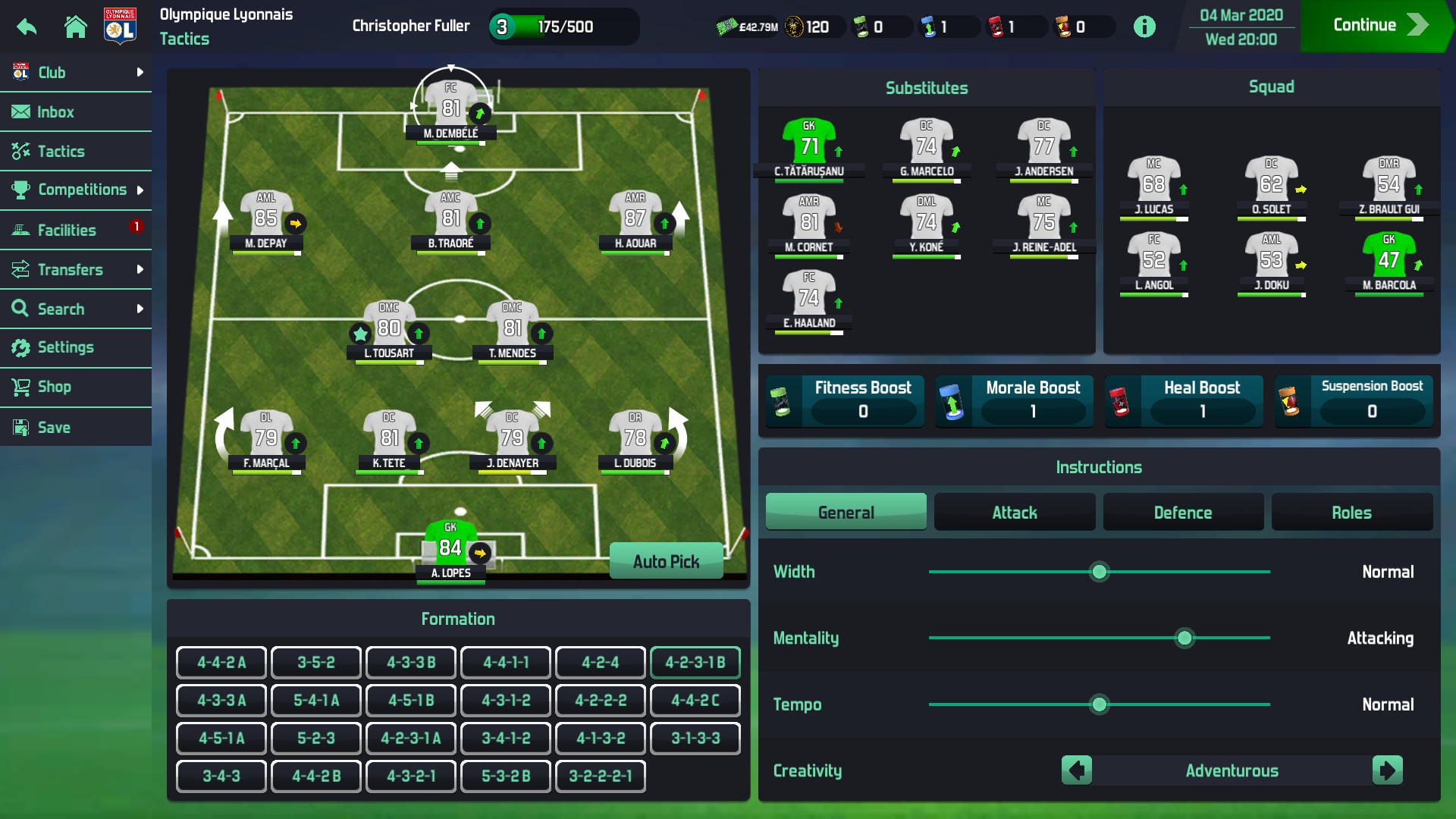
Also new to SM20 are ‘boosts’. You can use these to improve a player’s fitness, raise their spirits, heal their injuries, or reduce their suspensions. Sounds good, right?
In practice, the effects of these are very small – so small, indeed, that you might as well not bother with them. For example, Heal Boosts reduce an injury length by one week, while using a Morale Boost improved my goalkeeper’s mood from ‘really annoyed’ to just ‘moderately disgruntled’.
Searching for players is still cumbersome and frustrating, while scouting also takes longer than it perhaps should. At least you’ll get a steady flow of youth players, even if you don’t know what exactly you’re going to get. There’s only so much you can make out of five promising centre-forwards.
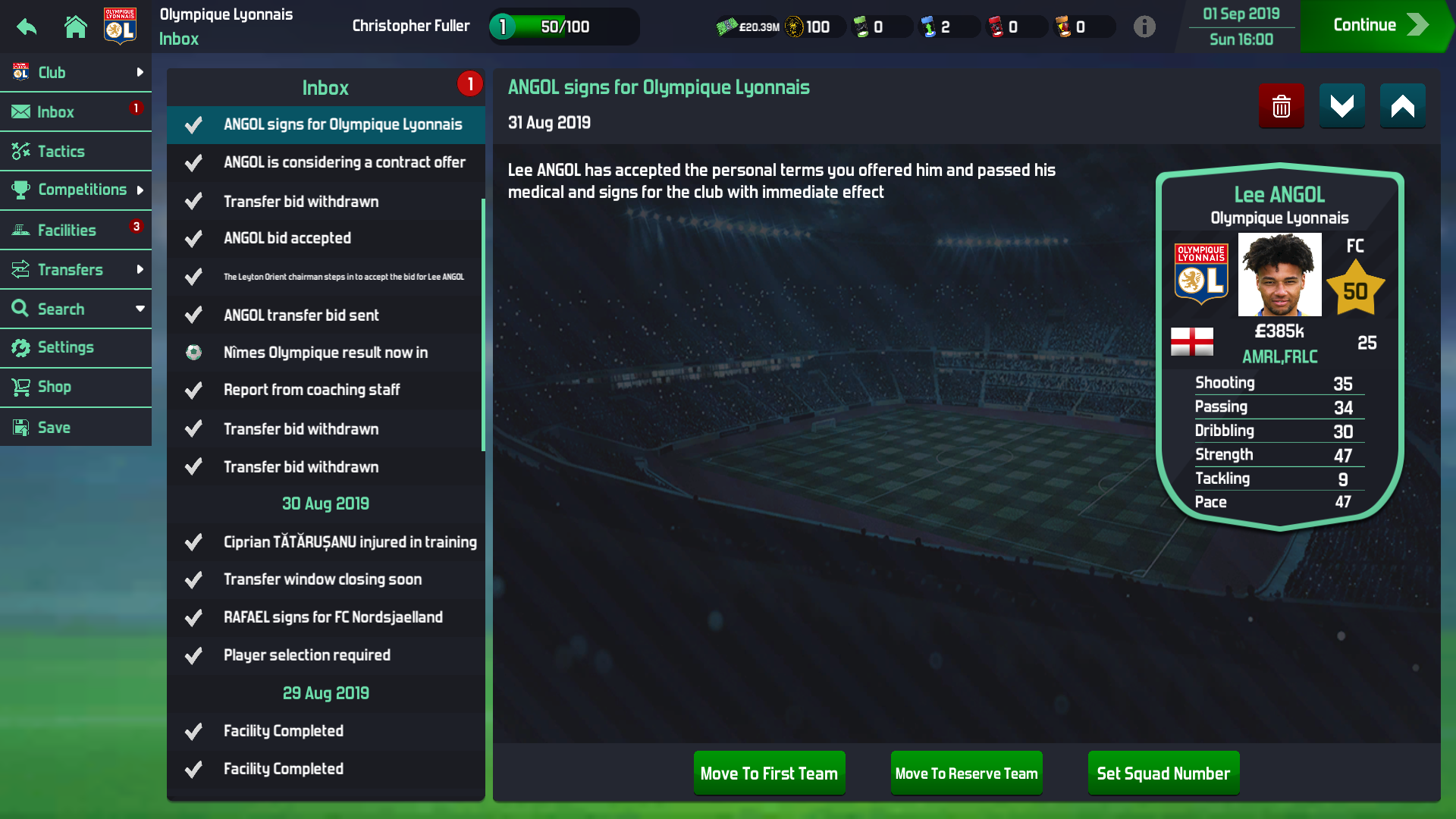
A new bugbear of mine is that the inbox has become a nightmare to negotiate. Some messages disappear after you click on them, meaning it’s easy to miss something important. Conversely, certain dilemmas stick around after you’ve addressed them, meaning that you could – for example – fine a player TWICE for going AWOL from training. I know Mario Balotelli can be a handful, but even that is a bit harsh on the lad.
All those complaints are about arguably superficial aspects of the game. There’s a much bigger part of SM20 that really breaks it for me…
WE MUST TALK ABOUT

The match engine. Now, a lot of people in the Football Manager community have criticised its ME or even just taken it for granted. To those people, I’d say, “Watch a few matches on Soccer Manager 2020, and then try arguing that it’s any better than what we’ve got right now.”
Attackers will frequently knock the ball clean off defenders’ feet and go one-on-one with the keeper. They might not even have to do that, seeing how defenders seem to have the spatial awareness of my two-month-old nephew. That metaphor would be even more apt if his name was Casper, as substituted players tend to ‘ghost’ through their replacements like Carlos Fierro on Football Manager 2012!
Then we go from the silly to the plain ridiculous. The offside rule apparently doesn’t exist in the SM universe, with goals being given despite the scorers being A LOT more than a fingernail past the last defender. My Lyon team even scored unchallenged from a corner because our opponents had all wandered out of their penalty area while they were making a sub!!
SM19’s match engine was quirky but still watchable, even if the animations were ropey. I don’t know what’s happened development-wise in the past 12 months, but some ‘highlights’ from my career really need to be seen to be believed.
(That is the first of five videos I’ve uploaded to YouTube showcasing the SM20 match engine at its ‘best’. You can view the full playlist right here.)
Mind you, it’s not all bad. I like that goal celebrations are fully animated, though players seem to only have three moves in their repertoire. Even better is that you can now ‘Quick Play’ through matches, so you can breeze through those late-season dead rubbers without having to watch your players pay homage to the Three Stooges again.
SUMMARY

It’s been five years since Soccer Manager released their first single-player game. I’m afraid to say that the development since then has just not been good enough. For all the promise of Soccer Manager 2020’s new features, the chaotic match engine makes the latest title feel like one step forward and two steps back.
If the developers focus on making the ME resemble football (rather than its current mixture of hockey, pinball and farce), I reckon next year’s game has real potential. Until then, I’d say you could do a whole lot better than SM20.
FULLER FM RATING: 2* – National League.
If you have enjoyed reading this review, feel free to let me know your thoughts, either in the comments below or on Twitter @Fuller_FM.
 Fuller FM
You must be logged in to post a comment.