

As you might have noticed, things have been a little quiet here at Fuller FM lately. I took about a month away from blogging for health reasons and then started a weekly career series on Championship Manager 99/00 (you can find Part 1 and Part 2 in the links provided).
Why nothing about Football Manager 2020 yet? Well, unlike with Football Manager 2019 (and Football Manager 2017 as well), I didn’t pre-order the latest version or play it on launch. Instead, I held fire and waited for the demo, which came out alongside the full version on the evening of Monday 18 November.
So, for the past week-and-a-half, I’ve been getting to grips with FM20 while taking the reins at Birmingham City for six months. Here are my thoughts on the latest installment of Sports Interactive’s hit franchise…
A TALE OF THE SECOND CITY
This short story takes place at St Andrew’s – or the St Andrew’s Trillion Trophy Stadium to give it its ridiculous sponsored title. Mind you, even calling it the Three Trophy Stadium would be a stretch, seeing as Birmingham only have two League Cups to their name in terms of major honours. Anyway, my tenure as ‘caretaker head coach’ got off to an… interesting start.
Though I stuck mainly with City’s starting squad, I also brought in three of my own players to provide extra depth. Wales international Joe Ledley came in on a free transfer, just to be an emergency midfield option. Ben Osborn featured more prominently on loan from Sheffield United, while Rhian Brewster arrived from Liverpool as a striker of great potential.
We lost our first game at Brentford.
Then Bristol City tonked us 4-1 at home.
Then Ipswich knocked us out of the League Cup.
And then we lost another league game (see the own goal above).
And another.
AND ANOTHER.
That was six straight defeats in all competitions, with only Luton keeping as off the bottom of Championship by being somehow even more inept. We did get a result at last when Stoke came to St Andrew’s, but in the final minute, their left-back Stephen Ward produced a Maradona-esque solo goal to deny us a potential 3-2 win.
Long-awaited victories at Charlton and Derby edged us up to 20th and kept the pressure off my shoulders, if only for a short while. Three straight losses followed, including crushing defeat to Leeds in which they were 4-0 up come half-time. The board were “deeply saddened” at my leadership and – presumably – trying to find Chris Hughton’s phone number.
As a last roll of the dice, I reverted to a narrow 4-4-2 diamond, which had consistently served me well in previous FMs. The change of tactic worked wonders, as the Blues won six out of the next seven games (only a 2-2 draw at Cardiff blotted our record). By the end of November, we were up into the top half.
Having staved off the threat of a very early exit, I could now take things easy. Though we only took four points from my final four games, 14th was still a solid position to be in at the halfway stage. To put it in context, we were just six points off the play-offs.

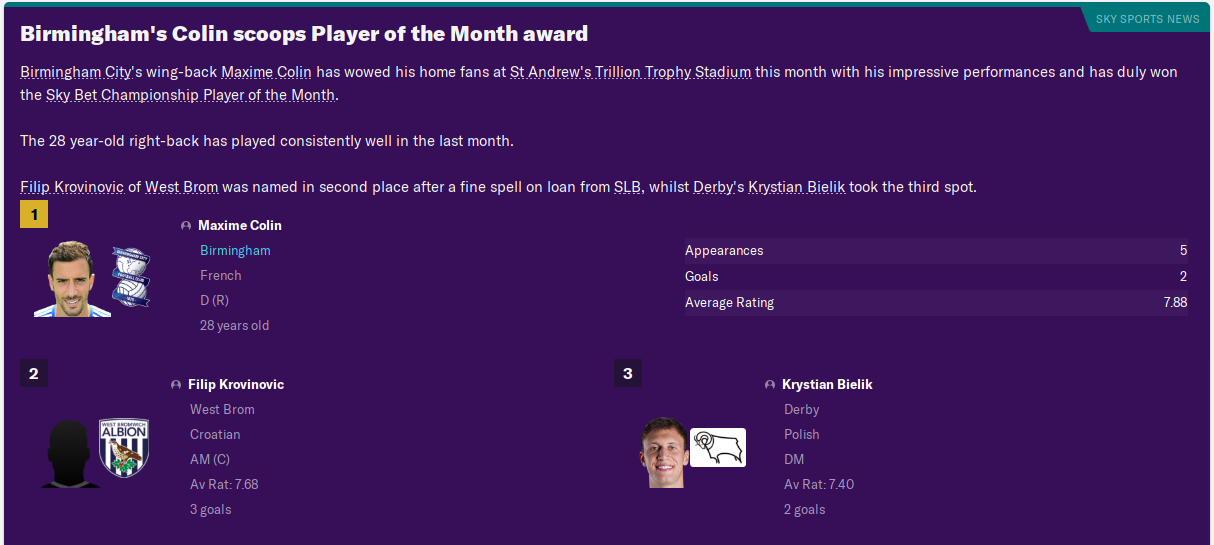
Brewster finished as our top scorer with five goals, though the teenager could’ve had far more had he not been caught offside so many times or wasted so many one-on-ones. Wide attackers Fran Villalba and Jérémie Bela shone brightly every now and again, while wing-backs Kristian Pedersen and Maxime Colin were consistently solid.
Then there was the local boy wonder – 16-year-old Jude Bellingham. After taking a while to make a first-team impact, Bellingham’s development kicked on over the autumn and he established himself as an energetic midfield mezzala. I can definitely see why he is one of the most-coveted English players – not just on FM20, but also in real-life.
NEW FEATURES

Compared to the tactical and training revolution of FM19, FM20 is more of an evolution. Some of the headline new additions are centred around long-term team and player development. As such, FMers who play mainly short-term saves – or, indeed, those who try the demo before deciding whether to buy – won’t immediately feel the benefits.
Take the new development centre. It’s now much easier to track your youth players’ progress and see who might be ready for first-team action, either on loan or through promotion to your own senior squad.
You’ll also get a preview of your youth intake about three months before the players are actually generated into the game. If there’s an exciting striker potentially coming through but the full-backs don’t look quite so promising, you can now plan accordingly.
The ‘playing time pathway’ also ties into player development. Squad statuses have been overhauled, so you can now tell your third-choice goalkeeper specifically that they should only expect to play cup matches or in emergencies. Likewise, when negotiating a promising youngster’s contract, you can state that they’ll be a ‘breakthrough prospect’ this season with a view to becoming a bona-fide squad player next term.

Then there’s the new-and-improved ‘Club Vision’ feature. Each club now has its own philosophies, which you’re expected to maintain (e.g. sign young first-teamers for RB Leipzig, play direct football at Burnley, don’t win any trophies with Tottenham). Of course, this can change if your club comes under new ownership, or you can even ultimately mould it in your own style.
You are also now given a five-year plan for the future. At Birmingham, for example, you’re expected to reach the Championship play-offs by the end of 2021/2022, and win promotion to the Premier League by 2022/2023.
WHAT I LIKE ABOUT FM20

One less-trumpeted feature I quite like is the ‘Code of Conduct’. You can now set automatic (and incremental) punishments for players if they miss training, go AWOL or get sent off. If you get it right, it will help you to maintain discipline and keep every member of your team singing from the same hymn sheet.
And while you should never treat your assistant manager’s advice as gospel, they are at least more helpful. Their suggestions have been made more contextual, in that they’ll advise you on exactly why you should consider picking certain players come matchday.

The match engine runs quite smoothly (at least on my computer, which is four years old and far from top-of-the-range) and is sleeker than ever. Weather effects have been enhanced and made more dynamic, even if the mud patches that appear late on in games leave a little to be desired.
Goalkeeper animations have improved significantly, which’ll certainly make you less inclined to think of your number 1 as a Kostas Chalkias tribute act. Mind you, I always find it a nice touch whenever a goalie gets a glove to a shot but can’t quite keep it out.
Another old bugbear from FM19 – namely crossing – has also been addressed. Whereas many wide players used to cross far too late, leaving an opponent with an easy block, they will instead try to make space for a cross if possible. This improvement to wing play has made wing-backs more effective, though not so much that they’re almost unstoppable (à la FM16).
The differences between defined tactical styles – which were introduced in FM20 – seem to be more obvious in this version of the match engine. By the end of my Birmingham demo save, I had two set-ups: a gegenpressing diamond for home games, and a counter-attacking 4-3-3 for away matches. I was satisfied with how differently those systems played out in the ME.
I think this ME is a few tweaks away from being a significant improvement on FM19, which was already the best yet in my opinion. That isn’t to say it’s faultless, which brings me onto my main criticisms of FM20 so far…
WHAT I DON’T

Ever felt that sense of frustration when your wide attackers keep shooting from difficult angles instead of squaring the ball to an open team-mate, haven’t you? Me too.
Don’t get me wrong; this doesn’t always happen. Sometimes common sense will kick in and the attacker will move the ball to his colleague instead of firing it straight at the opposing keeper (or worse, the side netting). The former still happens much too regularly for me, even bearing in mind that real-life professional footballers can – and do – often do exactly that in such situations.
A similar thing tends to happen when an attacker is one-on-one with the keeper. About 90-95% of the time, the attacker will fail to score. From what I could gather, an elite striker like Harry Kane would be expected to score around 25% of the time from those situations. I’m sure SI will also look to address that in a future patch.
While long shots probably aren’t as ‘overpowered’ in FM as many will argue, some of those I saw with Birmingham looked overpowered in the literal sense. For instance, I remember Álvaro Giménez hitting a half-volley from the penalty arc against Millwall that flew into the net in about a quarter-second. That’s far too quick for the goalie to even think about reacting.
Other common complaints include high numbers of penalties and red cards. While I didn’t notice either of those issues in competitive matches, our seven pre-season friendlies did see NINE penalties awarded. We also had two midfielders sent off for two-footed tackles, including David Davis, whose punishment was to be sent to San Jose until the new year.
There’ve also been a few bewildering user interface changes. Some of you may feel aggrieved that your Under-23s and Under-18s no longer have their own spaces on the sidebar, having been usurped by the Development Centre. Personally, I found the team and analyst reports to be more clunky than on FM19, and setting first-teamers to play in reserve/youth matches is more laborious.
On the main, though, the game seems solid and stable, and I’ve noticed hardly any major bugs I’d term as “gamebreaking”.
SUMMARY
Does FM20 have the potential to be the best version of Football Manager yet? Yes, for sure.
Has playing the demo convinced me to buy FM20 right now, for £40? Reluctantly… no. And that’s neither a criticism of the game nor of Sports Interactive.
FM has never been a consistent annual purchase for me. I’ve said before that I tend to skip even-numbered FMs – something I’ve done more or less since the Championship Manager days of the early 2000s. From experience, it’s easier to appreciate all the new improvements SI have made when you move two versions forward (e.g. from FM17 to FM19).
Also, and it might seem peculiar for a Football Manager blogger to write this, but I feel burnt out from FM. Since FM11 was released, I have played at least one version on most days of every month for the past nine years (save the odd month off here and there).
That’s pretty much the whole of my 20s which have been dominated by Football Manager. As I turn 30 next year, that’s led me to re-evaluate things. I feel that it’s time to take an extended break from the FM series and focus on other interests. The impending arrival of my sister’s first child will also see my family take a greater priority.
Fuller FM will obviously continue, albeit with a retro theme for the next 9-12 months – and with CM99/00 being the main focus. By the time Football Manager 2021 comes along, though, I should be re-energised and ready to return to FM all guns blazing. (Those of you who follow me on Twitter may know that I’ve already announced which team I’ll be managing in my long-term save!)
But would I recommend FM20 to you? If you didn’t buy FM19, sure. If you did, and you’re happy with a slightly more refined upgrade, then by all means go for it. Of course, if you’re still unsure about whether to buy FM20, I would play the demo first, so you can get a good idea of whether it’d be worth your money.
I hope you’ve found this review of FM20 interesting. If you have any points you wish to add, feel free to either leave them in the comments below or tweet me (please be civil and constructive, obviously).
 Fuller FM
You must be logged in to post a comment.