

Welcome to my third Football Manager 2019 story on Fuller FM. Following my previous exploits with Fiorentina and Shrewsbury Town, this will be my main save for the rest of FM19’s life cycle (if not beyond).
In “Lyn On Me”, we will follow the progress of Lyn 1896, who play in the third division of Norwegian football. More than 50 years have passed since Lyn were last crowned league champions, but they’re looking back up again after some difficult times.
This preview post will give you some more insight into the club and its illustrious history. You will also be introduced to the manager who will be tasked with taking them back up the leagues.
THE CLUB
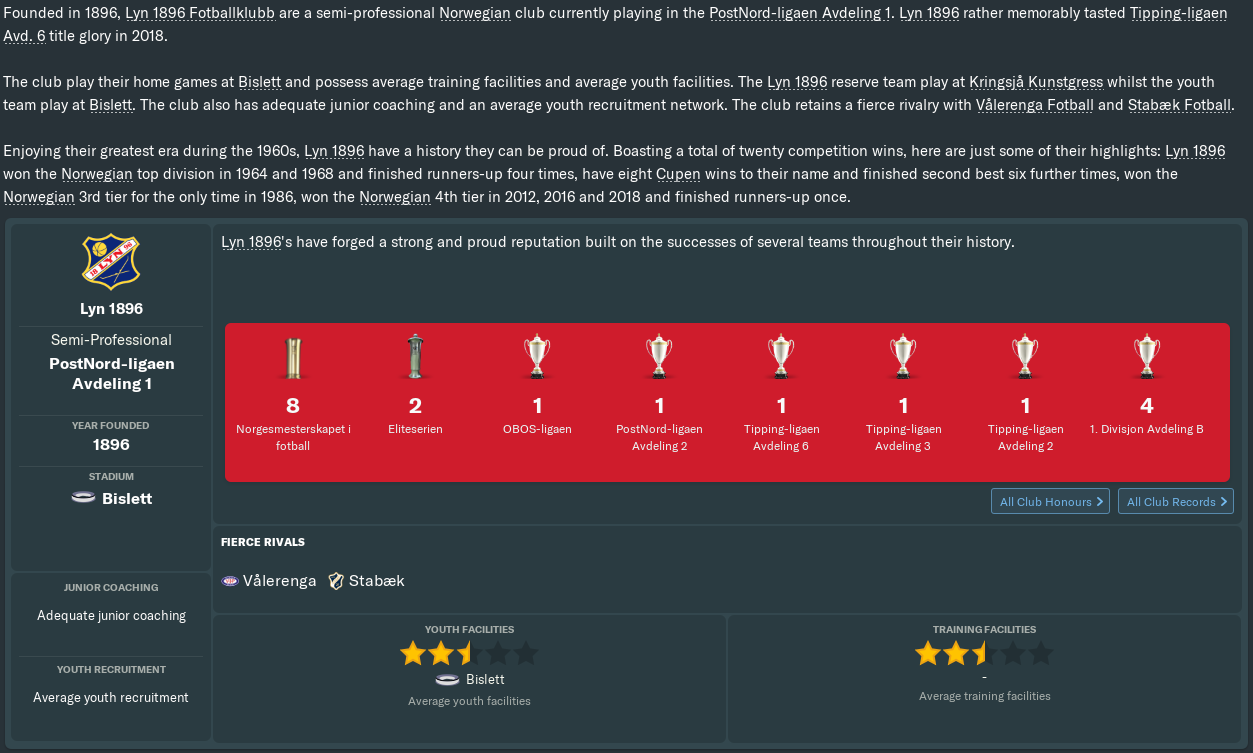
Lyn 1896 play their matches at the 15,500-capacity all-seater Bislett Stadion in Oslo. That makes it comfortably the largest stadium in their division, and one of the largest in Norway. The original stadium was built in 1907, but it was demolished in 2004 and reconstructed at the cost of around €55million.
In the past, Lyn used to call the Ullevaal Stadion – the Norwegian equivalent to Wembley – their home. To put things into context, that can house 27,182 spectators.
Lyn currently have average training and youth facilities, which would put quite a few second-tier clubs to shame. Our youth program is at a pretty decent level too, which should help with identifying and developing young prospects for the future.
The team has traditionally worn a home kit consisting of red and white jerseys, blue shorts, and red socks. The jerseys are characterised by red sleeves and sides, and a vertical white bar in the middle. The away kit is generally all-blue.
Our fiercest rivals are the other two major clubs in Oslo. Vålerenga have five league titles and represent the city’s working classes, while Stabæk – who were relegated from the top flight in 2018 – play in the western suburb of Bærum. We retain smaller rivalries with Lillestrøm (who are also five-time league champions) and a couple of smaller teams in Frigg and Kjelsås.
Now, how does the Norwegian football pyramid work?
The Eliteserien and the 1. divisjon (OBOS-ligaen) consist of 16 teams each, who play each other twice on a home-and-away basis. Below that is the 2. divisjon (PostNord-ligaen), which is split into two groups (or ‘avdelinger’) of 14 teams apiece. Lyn start this story in the 2. divisjon and have been assigned to Avdeling 1.
The Eliteserien’s bottom two are automatically relegated and replaced with the top two in the 1. divisjon. The 3rd, 4th, 5th and 6th-placed teams in the second tier then take part in Playoff Semi Finals and then a Final. Whoever wins the Final will subsequently play the 14th-ranked Eliteserien side over two legs for their spot in the top flight.
Professionalism is not a requirement in the top two tiers. There is one semi-pro club in the Eliteserien for the 2019 season, and a smattering of professional sides in the 1. divisjon. Several clubs also have reserve teams in the league pyramid (e.g. Rosenborg 2 are in our group), but they cannot be promoted any higher than the 2. divisjon.
The bottom two sides in the 1. divisjon are relegated to the 2. divisjon, from which the two group winners are promoted automatically. The runners-up will face one another in a two-legged tie, with the winner progressing to a promotion/relegation play-off with the 14th-placed side from the 1. divisjon – also over two legs.
Any teams that finish in the bottom three of their 2. divisjon group are relegated to the 3. divisjon (Tipping-ligaen), which consists of six groups of 14 teams apiece. I do not have those leagues added, but they are unplayable anyway, which means relegation from the 2. divisjon would see the new manager their job automatically. No pressure, then…
The Norwegian Cup (or the Cupen, for short) is quite simple to understand. Every team in the top three tiers qualifies automatically for Round 1 – the ‘Last 128’ stage. Before that, teams in the 3. divisjon and 4. divisjon compete in qualifying rounds to decide who joins the higher-ranked sides in the competition proper.
For the first two rounds, Eliteserien sides are seeded to avoid one another and are drawn away against lower-league teams. All matches are straight knockout ties (i.e. no replays!), with the last two teams playing in the season-ending Final at the Ullevaal in late November/early December.
Unlike in most countries, the cup winners are regarded as Norway’s national champions, rather than the league winners.
EARLY SUCCESS

The FK Lyn team which won the Cupen in 1908.
As the current club’s name suggests, FK Lyn was formed in 1896, in the St Hanshaugen district of Oslo. Six years later, they were one of the three founding clubs of Norway’s football association – the Norges Fotballforbund (NFF).
Lyn’s first major trophy was the 1908 Norwegian Cup, which they won after beating Odd 3-2 in the Final. That was the first of four consecutive cup victories for the capital-based side. They would regain the trophy in 1945 – despite needing two replays to see off Fredrikstad – before defending it successfully once more a year later.
The club continued to have a huge presence during the early days of Norwegian football. They moved into the newly-built Ullevaal Stadion in 1926, which soon became the national team’s home stadium and was eventually bought out by the NFF.
When Norway won the bronze medal at the 1936 Olympic Games in Berlin (the best achievement by a Norwegian senior men’s team to date), their squad included six Lyn players. Amongst them was captain Jørgen Juve, whose tally of 35 international goals is still a Norwegian record today. Juve spent the bulk of his career at Lyn, representing the club between 1926 and 1938.
League glory surprisingly eluded Lyn until 1964, when they were crowned champions of what was then the 1. divisjon. They won the Cupen again in 1967 before securing a first domestic league and cup ‘Double’ in 1968. Lyn would not win another major trophy over the next half-century, though even today, their record of eight Cupen victories has been bettered by only three other clubs.
The club had their best run in a European competition in 1968/1969. After knocking out Turkish club Altay and Swedish side Norrköping to reach the Quarter Finals of the European Cup Winners’ Cup, they were narrowly beaten 5-4 on aggregate by Barcelona.
1969 was not an enjoyable year for Lyn, who were thrashed 16-0 on aggregate by Don Revie’s Leeds United in the European Cup before being relegated from the top flight. Despite that, they secured an immediate promotion the following year, during which they reached another Cup Final. They then finished as league runners-up to Rosenborg in 1971 in what was a last hurrah before their ‘wilderness years’.
FINANCIAL WOES
Future Nigeria midfielder John Obi Mikel plays for Lyn in 2005.
Lyn became a yo-yo club in the latter part of the 20th century, often moving back and forth between divisions, and never staying in the top flight for more than three years straight. They hit their nadir in 1984, suffering relegation to the 3. divisjon, where they spent a couple of years before a new coach named Egil Olsen took them back up.
Lyn did return to the Cupen Final in 1994, but that ended in a 3-2 defeat to Molde. They lost another Final in 2004, this time to Brann. In between those two cup heartbreaks, the club was saved from the impending threat of bankruptcy by a takeover from financier Atle Brynestad.
The 2000s started brightly for Lyn, who were promoted back to the top division (then named the Tippeligaen for sponsorship reasons). They re-established themselves there and even looked set for an unlikely championship win in 2002. They ultimately had to make do with a 3rd-place finish, which they matched in 2005 under new coach Henning Berg.
2005 was – as it so happened – when things started to turn sour for Lyn. Their teenage midfielder John Obi Mikel was the subject of a heated transfer dispute involving both Manchester United and Chelsea. The Blues eventually secured the player’s services for £16million, though not before a disturbing series of events that The Guardian have outlined here.
By all accounts, Lyn were nothing more than innocent victims in the Mikel scandal, and it set them back significantly. After Brynestad quit in 2008, the club was left with a hefty wage bill that it couldn’t sustain. Despite selling two more young prospects in Odion Ighalo and Jo Inge Berget (both to Udinese), major wage cuts were inevitable. When Berg moved on as well, things looked increasingly bleak.
After nine years in the Tippeligaen, Lyn were relegated at the end of the 2009 season, having won just two games out of 30. Indeed, they were fortunate to complete the season, having received a rescue package to spare them from bankruptcy. It would only be a temporary reprieve.
RISING FROM THE ASHES

Lyn beat Vestli 6-1 in a 3. division match in 2012. (Photo by Sjur Stølen)
FK Lyn’s financial problems continued in the 1. divisjon in 2010. They moved out of the Ullevaal and relocated to the smaller Bislett Stadion – better-known for athletics than football – while squad was overhauled post-relegation. However, further efforts to cut costs were not enough, and the club was wound up midway through the season.
There was some comfort for FK Lyn’s distraught fans – known colloquially as the ‘Bastionen’ – in that they could now switch their support to the club’s amateur side. Lyn Fotball were participating in the 6. divisjon and played home matches at the Frogner Stadion, which would be used for football in the summer and bandy (a form of ice hockey) in the winter.
With the fans’ backing, the amateur team were promoted to the 4. divisjon for the 2011 season. They then secured another league title in the most emphatic fashion, recording a perfect 20 wins out of 20, and scoring 106 goals. A third consecutive promotion (to the 2. divisjon) followed in 2012, though they could not continue their extraordinary rise in 2013.
Lyn moved back into the Bislett in 2014, when they reached Round 3 of the Cupen – their best run in that competition since the original club folded. They narrowly avoided relegation from the 2. divisjon that year, though they weren’t so lucky in 2015. Despite winning their 3. divisjon group in 2016, a restructuring of the Norwegian league system meant that promotion was not on the cards.
Now running semi-professionally and rebranded as Lyn 1896, the club remained in the fourth tier until Thomas André Ødegaard guided them to promotion in 2018. However, Ødegaard would not join them in the 2. divisjon, resigning as manager for personal reasons. When his successor was announced in January 2019, it would raise eyebrows across the Norwegian footballing community.
THE MANAGERESS
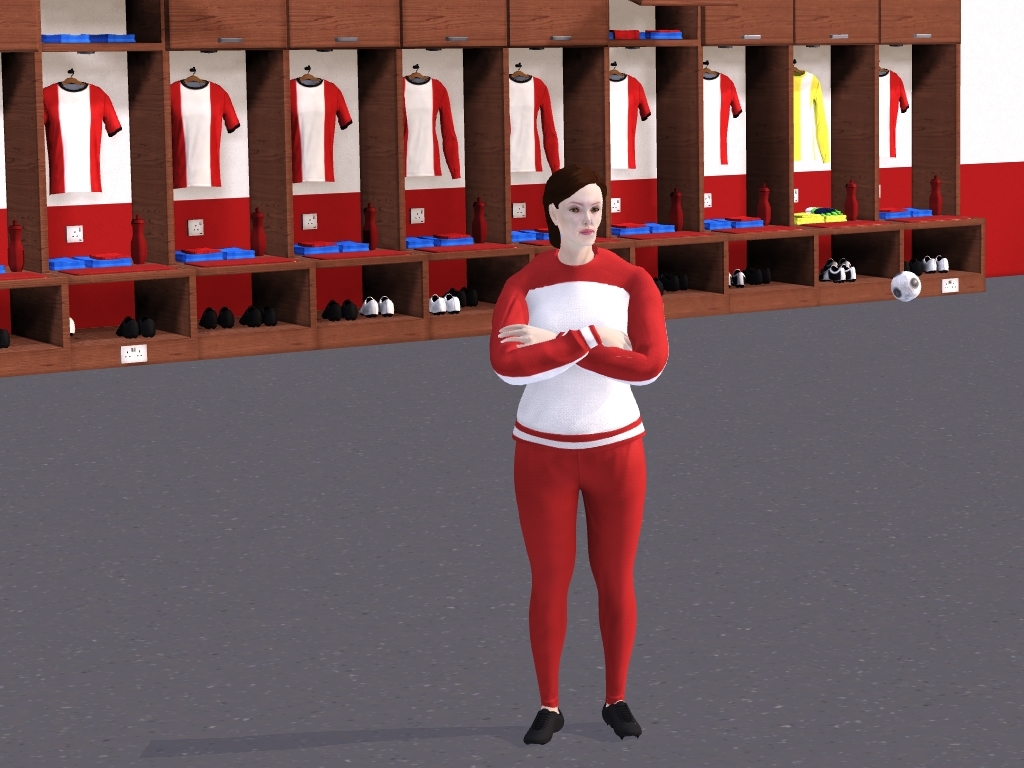
Marit Enstad was born in the Ullevål district of Oslo on 14 July 1987. She was the only child of Magnus Enstad – a carpenter – and his wife Synnøve Lyng, who was a social worker.
Marit became interested in football at an early age. Magnus was a passionate Lyn supporter who regularly took his young daughter to home matches at the Ullevaal Stadion, where she was instantly captivated by the atmosphere and the spectacle.
Marit was a smart and studious pupil at school, particularly excelling in numeracy as well as becoming fluent in four languages. Like most Norwegians, she was a very proficient English speaker, and she also had a strong grasp of Danish and Swedish, largely due to their similarities to her mother tongue.
She also developed a talent for playing the sport she loved, thriving as a diminutive but explosive right-winger. After winning a national competition with her school team when she was 16, she was signed by Røa, who played in the Toppserien – the highest level of Norwegian women’s football. Within a year, she had made her senior debut for the ‘Dynamite Girls’.
Røa won their first Toppserien title in 2007, and they retained it the following year, when they also won the Norwegian Women’s Cup. Marit was now established as a first-team regular, which was no mean feat, as she was combining her sporting career with university studies.
The young winger continued to excel in 2009, so much so that she was named in Norway’s preliminary squad for that year’s European Championship. Sadly, less than a month before she was due to travel to Finland for the tournament, Marit suffered a serious knee injury in an innocuous challenge. She had torn her cruciate ligaments and was out for the season.
That injury changed the course of her career – at least where football was concerned. After graduating from university in 2010, she was hired as a physical education teacher at a primary school in Ullevål. She left Røa at the end of the football season to concentrate on her new career.
Meanwhile, Lyn had launched their women’s team in 2009. After taking some time away from football, Marit was invited to play part-time for her childhood club in 2012. She jumped at the chance and helped Lyn to secure promotion to the 1. divisjon – the second tier – that season.
Sadly, another long-term knee injury – sustained late in the 2013 season – put paid to Marit’s playing days for good. She hung up her boots at the age of just 26, but she was persuaded to stay in the game and study for a coaching licence.
After gaining her UEFA B Licence in 2015, she returned to Lyn as a first-team coach, and was then promoted to head coach midway through the 2016 season. Lyn won the 1. divisjon during Marit’s first full season in charge in 2017, and were promoted to the Toppserien for the 2018 campaign. Despite finishing 11th out of 12 teams, they won a relegation play-off to remain in the top flight.
Enstad’s achievements with the women’s team didn’t go unnoticed. Following Ødegaard’s resignation as manager of the Lyn men’s team, she was interviewed by chairman Marius Solbakken and the club’s board about the vacancy. Solbakken was so impressed that he offered her the job less than a week later.
On 13 January 2019, Marit Enstad was announced as the latest female football coach to take charge of a men’s team. She would now follow the likes of Shelley Kerr, Corinne Diacre and Chan Yuen Ting by attempting to make her name in a male-dominated sport.
Before I end this post, I’ll give you a few details about the save game. I have loaded 52 leagues from 26 European nations (including all the other Nordic countries), and over 90,000 players have been loaded. The save began in mid-July 2018, and I have holidayed until January 2019, when the Norwegian season changeover takes place.
For illustrative purposes, I will be using the Euro as the in-game currency throughout this story. Norway is not part of the Eurozone and still uses its own currency (the krone), but this will make it easier for most of my readers to understand any wages and transfer fees involved. (As of 3:00pm BST on 15 May, 10 Norwegian krone is equivalent to €1.02, £0.89 and $1.15 USD.)
If you are looking forward to this story, make sure you hit the ‘Follow Fuller FM’ button on the sidebar and/or follow me on Twitter @Fuller_FM. That will keep you updated whenever any new posts go live. I’m aiming to regularly post two updates per week, and between four and six updates per season.
“Takk for lesing!” (“Thanks for reading!”)
 Fuller FM
You must be logged in to post a comment.