

Fiorentina fans had plenty of reason to be excited about the 2021/2022 season. Having ended a long absence from the Champions League, hopes were high that we would do ourselves justice back on Europe’s biggest stage. Meanwhile, the Viola looked to wrest the Serie A scudetto from Inter’s grasp and become Italian champions for the first time in 53 years.
My fourth and final season as Fiorentina manager proved to be my most dramatic yet. My quest for silverware came down to the final weeks, after which I would leave Florence either in glory… or simply as a glorious failure.
CAUTION: If you have not yet read Part 42 – the closing chapter in this story – then PLEASE read that before continuing here. I’m sure you don’t want the ending to be spoiled.
SERIE A
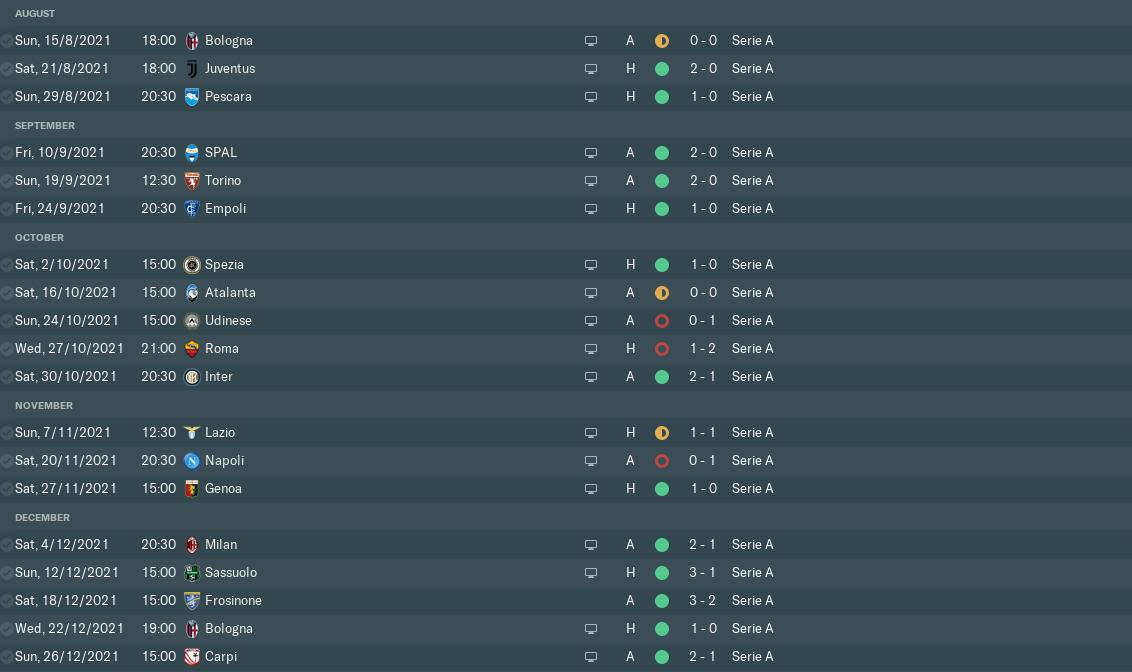
We didn’t enjoy the most promising of starts, drawing 0-0 in our opening match at Bologna. A 2-0 home win over bitter rivals Juventus showed rather more of our potential, with two-goal hero Federico Chiesa putting in a truly exceptional performance. Here was hoping he could keep that up throughout the season…
Our next five matches were all narrow, largely unconvincing victories, but the returning Federico Bernardeschi – an €18million buy from Paris Saint-Germain – our momentum going. Meanwhile, our defence remained impenetrable. A goalless draw at Atalanta saw us set a new record of nine consecutive Serie A clean sheets, and it also sent us top of the table.
Our joy didn’t last, as fellow high-flyers Udinese took advantage of our attacking profligacy to snatch a late win. Roma then became the only visitors to triumph at the Artemio Franchi in Serie A this term. Those defeats were part of a tricky six-game run in which our only victory was away to Inter. By the time we lost at Napoli, we were down to 5th, and our awful Champions League form was only damaging confidence further.
Oh yeah, and I was appointed England manager in the middle of that barren run. Sean Dyche failed to qualify them for the World Cup in Qatar, don’t you know?
It took a hard-fought home win over Genoa to get us back in business. We started to play a bit more expansively in December, which helped us to record maximum points from five matches. While our defensive record took a bit of a hit (particularly from Frosinone), we were now in 3rd place and starting to play like serious title contenders.

Our excellent form continued in the new year, as Chievo were handsomely beaten 4-0 at the Franchi. That was one of six clean sheets we kept in our first seven league games after the mid-season break. The only blip came when goalkeeper Alban Lafont was caught dawdling on the ball by Torino’s Simone Zaza, which wasn’t the first time he’d gifted a goal in such a manner. We only took one point from that home game – a sign of struggles to come.
By February, we were in a three-way fight for the scudetto with Napoli and Udinese, but goals were still proving somewhat hard to come by. That all changed when a late surge saw us beat Atalanta 4-2, before storming to a 5-1 win in what was effectively a title eliminator with Udinese. Roma were then brushed aside to the tune of 3-1 as we steadily closed in on Napoli at the top.
Then came the March international break, which wrecked our momentum. The Udinese thrashing would be our last home win of the campaign, as we drew our next five – including against Inter, Napoli and Milan. However, it was our inability to score against Frosinone which effectively cost us the title, rather than the Olimpico thrashing at Lazio that ended our 17-match unbeaten league run.
Despite a couple of thrilling away wins against Sassuolo and Chievo, Napoli had already hoisted the league trophy into the air by the time we played our our final match. A dour stalemate against Carpi ended my Viola reign on a rather sour note. Though Fiorentina finished runners-up with 80 points, that was only six fewer than the Partenopei mustered, so I believed a fantastic opportunity had gone begging.
CHAMPIONS LEAGUE
“For God’s sake, do I have to talk about this? [Sigh] Fine…”
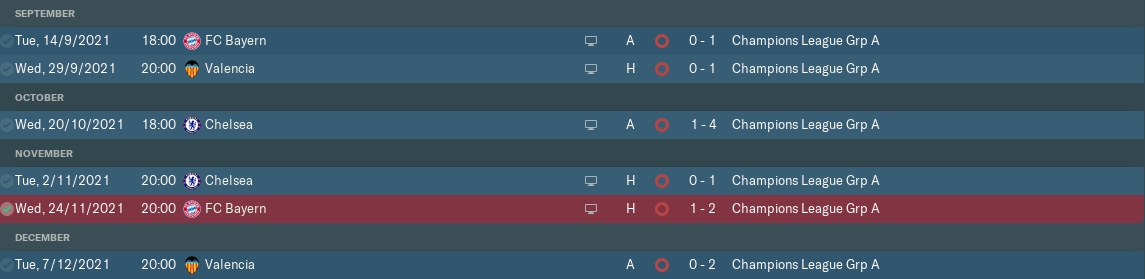
We were drawn into a very difficult group on our Champions League return. We almost started off with an impressive draw at Bayern München, until a shaky Lafont handed Andrea Belotti a very soft winner late on. Another 1-0 defeat to Valencia followed, and then our CL results list quickly became a sea of red.
Chelsea demolished us 4-1 late on at Stamford Bridge and then won (1-0 again) at the Franchi to all but eliminate us. Bayern’s Kingsley Coman hammered the final nail in our coffin, meaning our visit to Valencia was all about salvaging pride. A team of fringe players failed to take anything from the Nuevo Mestalla, and so we were dumped out of the CL in disgrace, with two goals and no points to our name.
COPPA ITALIA

After last season’s early exit from the Coppa Italia, we made amends here. Spezia were quite simply no match for us in Round 1, and the Quarter Final saw us narrowly beat Inter for our third victory at the San Siro this term. Awaiting us in the next round… Napoli.
The first leg was a tense affair, decided by a clinical Alessandro Bastoni header that gave us a precious home win. Bastoni would also score in the second leg at the San Paolo… but he put the ball into his own net after Willian had given Napoli an early lead. Trailing 2-1 on aggregate, we tried all we could to eke out a win on away goals, but the Partenopei defence would not yield at all. They went on to contest the Final at the Olimpico, losing to Udinese.
We’d been knocked out of the Coppa Italia at a different round in each of the past four seasons – Quarter Final, Final, Round 1, Semi Final. This competition was arguably my best chance of ending Fiorentina’s 21-year wait for major silverware, but we just didn’t have it in us to go all the way.
AWARDS & STATISTICS

Now, that’s a bit of a surprise. Newly-appointed captain Federico Chiesa had not enjoyed a particularly great campaign – nine goals and six assists paled in comparison to his 2019/2020 hauls – but the Fiorentina fans didn’t seem to mind. They voted Chiesa their Player of the Season for the second time in three years.
Seven of Federico’s nine strikes came before the mid-season break. PSG made a big-money offer for his services in January, but I stood my ground and refused to let him leave. Chiesa was deeply upset about this and rarely performed to his high standards thereafter. In hindsight, maybe I could’ve handled that situation better and kept my skipper sweet throughout the season.
Chiesa also scored our Goal of the Season – a stunning long-range free-kick against Juventus on the second weekend of the season. That helped us on our way to a first home victory over the Bianconeri in four years.
As he was now 25, Chiesa was a bit old to be considered for the Young Player of the Season award, which he’d dominated in recent years. This time around, that accolade went to Bastoni, who’d put in some strong performances at centre-half.
André Onana was a curious choice for Signing of the Season. Despite keeping goal only in two league games plus a load of cup ties, the Cameroonian got the nod ahead of Bernardeschi, Belaïd Nemdil and Daniele Rugani. I presume that’s mainly because Onana – at €6.5million from Ajax – was the cheapest of those four players, though it doesn’t explain why 14-goal free signing Mario Mandzukic was ignored.

Those greeny-yellow average ratings on the top-right of the player statistics screen immediately jump out. All eight first-team defenders who saw regular action (excluding Germán Pezzella, who seldom played due to injury or illness) had an average match rating of above 7.00. Though right-back Kevin Diks scored highest, he only played in 19 matches, which meant Bastoni was ‘technically’ the best of our regular starters.
Curiously, no Fiorentina player in any other position got past 7.00 on their average match ratings. Chiesa came agonisingly close on 6.99, but again, he wasn’t particularly bothered for half of the season. Consistency wasn’t much of a thing when it came to our midfielders and forwards.
Rugani took home five ‘man of the match’ awards, which wasn’t bad, though four other Serie A players bettered that with six each. He was a consistently solid presence in our defence, as was Lafont. Despite sitting out a couple of matches, the French goalkeeper kept 19 league clean sheets, just two shy of Napoli’s Alex Meret.
Mandzukic was the only Fiorentina player to get past double figures on goals, but 14 from 37 appearances was not the high return I was expecting. The 12 he managed in Serie A were comfortably surpassed by Juventus’ Cristiano Ronaldo and Udinese’s Facundo Colidio, on 20 apiece.
45% of Mandzukic’s shots were on target, which was a mediocre percentage by top-flight standards. Indeed, that remained a general problem for us, as the team’s 41% shots on target ratio ranked us 15th. Then again, Napoli were 16th on that table… and they didn’t fare too badly, did they?
On a more positive note, we continued to distribute the ball very well, with an 83% pass completion ratio (the same as Napoli’s). On an individual level, three midfielders – Christian Nørgaard, Lucas Tousart and Sandro Tonali – completed at least 89% of their passes. Surprisingly, we lacked any real assist machines, with Chiesa and Patrick Roberts leading the way on six apiece.
Discipline-wise, we were again a shining example to everyone else in Italy. We collected 48 yellow cards and were among two teams (the other being Atalanta) not to have had a single player sent off. Indeed, not a single Viola player saw red in any competitive fixture this term. As a result, we were handed Serie A’s Fair Play award for the second time in three seasons.
Then again, maybe we paid a hefty price for being on our best behaviour. Looking at last season’s statistics, I counted SIX Fiorentina players who averaged more than three tackles per game. This season, that number had dropped to ZERO (Tousart had the most, averaging 2.91). If we’d shown a bit more passion, especially against the weaker teams, then perhaps we might not have left empty-handed after all.
ELSEWHERE…
It seemed apt that the London Stadium should host an all-English Champions League Final – the first since 2008. It would be an emotional occasion for East London’s very own Harry Kane, who captained Manchester United against his former club Tottenham.
Tottenham took the lead after 41 minutes through Christian Pulisic, but a second-half own goal from Raphaël Varane gave United hope. A tense affair eventually went to a penalty shoot-out, which Spurs won 4-3 after costly misses from Red Devils midfielders Paul Pogba and Ander Herrera. That prompted José Mourinho to go on a 20-minute rant about Tesco’s own-brand ice cream.
Mourinho was especially grumpy, as United had earlier thrown away a great chance to claim their first Premier League title since 2013. They went unbeaten in their first 25 matches before eventually coming a cropper at Newcastle. Three more defeats opened the door for Manchester City to burst through and claim an unbelievable FIFTH straight title.
City defeated Chelsea 3-0 in the EFL Cup Final, but Pep Guardiola’s men narrowly missed out on a domestic treble after squandering the FA Cup. Kylian Mbappé and Leroy Sané gave them a 2-0 lead at Wembley after eight minutes, only for Liverpool to cancel it out in the second half before winning 5-4 on penalties. It was feast or famine for the Reds in the league, who finished 3rd despite losing all of the 10 games they failed to win.
It wasn’t quite a total famine at the bottom of the PL for poor old Brentford. Mind you, the Bees’ 2007/2008 Derby tribute act still only mustered three wins (their first coming on Boxing Day) and 16 points. Swansea and Middlesbrough were also relegated to the Championship, while coming up in the opposite direction were Bournemouth, Huddersfield… and Leeds.
Tottenham came 4th, with Chelsea, Everton and Arsenal some way behind in the Europa League places. Chelsea’s new €107million striker Lautaro Martínez not only topped the Golden Boot standings with 24 goals, but he also made Blues fans completely forget about Álvaro Morata’s existence. (Morata’s now playing for PSG, because they have far more money than sense.)
Another former Stamford Bridge hitman was on fire in the Europa League Final, as Diego Costa scored Atlético Madrid’s opener in their 2-0 win over Borussia Dortmund. What’s that – a continental Final without any English teams? How novel.
It wasn’t all sunshine and rainbows for Diego Simeone’s side in La Liga, though. Local rivals Real Madrid returned to the top of Spanish football, scoring 91 goals on their way to a first championship since 2017. Mauro Icardi – who had lasted just 18 months at Old Trafford – scored 32 goals in all competitions for Real, thus giving Mourinho something else to complain about. Barcelona came home in 3rd, because obviously.
As for Dortmund, they finished a dismal 5th in the Bundesliga. Their former manager Jürgen Klopp’s gegenpressing worked a treat for Bayern München, who regained the title from RB Leipzig, despite a late challenge from Bayer Leverkusen. Erm… yay for hipster football, I guess?
Those soccer fans who sport rimmed glasses and lumberjack beards and listen to Alvvays wouldn’t have found much excitement in Ligue 1 either. Maurizio Sarri’s PSG spent over €300million and lost only once on their way to a 10-point victory over Lyon. 3rd-placed Monaco were the top scorers, sporting a frontline that consisted of Giovanni Simeone, Pietro Pellegri and Willem Geubbels. I hear those three lads are quite decent…
SERIES REVIEW
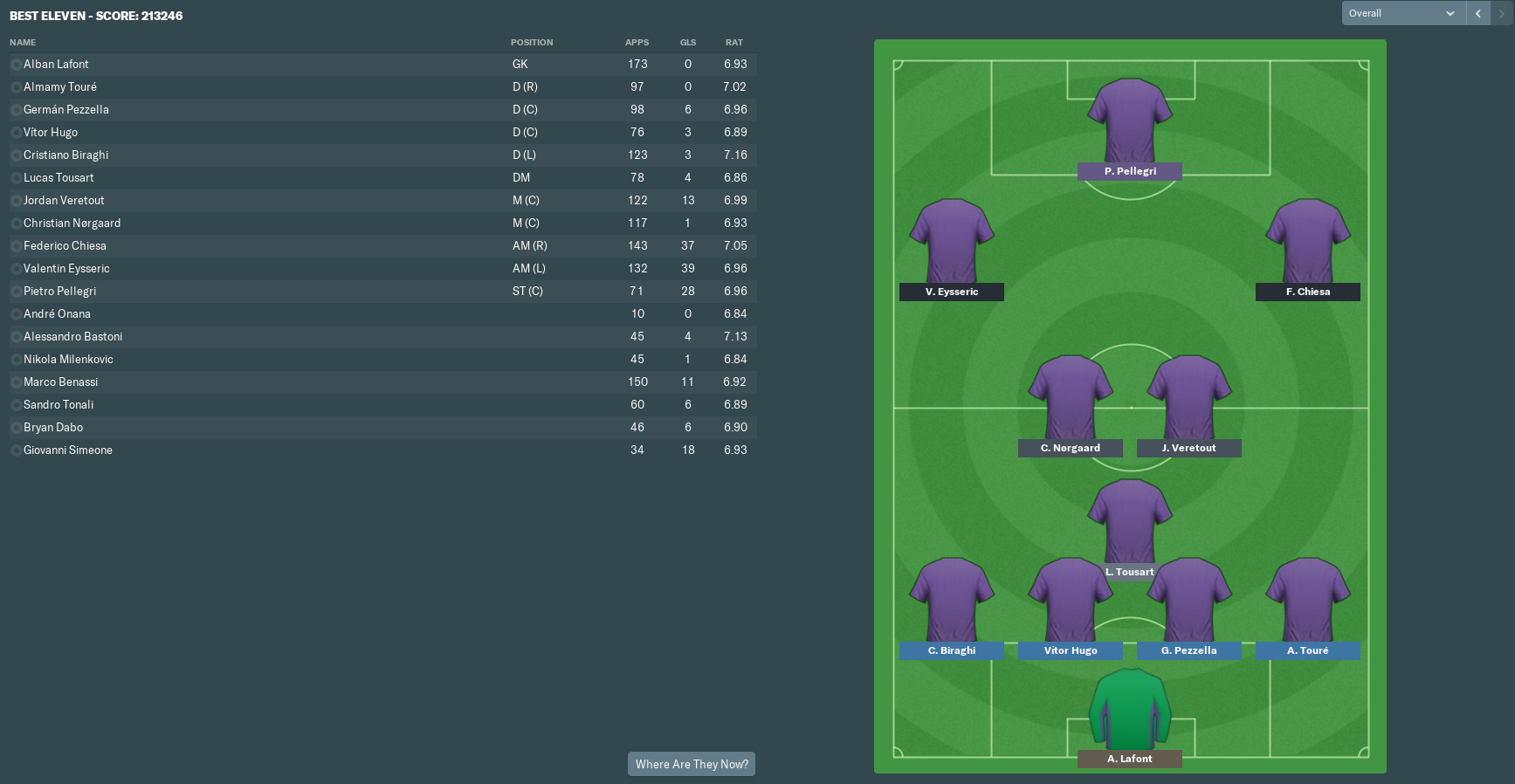
So this is my overall best XI from my four seasons at Fiorentina. While a few of the statistics aren’t quite right, I think the game has nailed my strongest line-up.
Lafont had a couple of errors in him every season, but by and large, he was a dream to work with. Vítor Hugo (now at Club Brugge) and Pezzella were rock-solid centre-backs at their peaks, and I was blessed with two very effective wing-backs in Cristiano Biraghi and Almamy Touré. Indeed, Biraghi had the highest average rating in this best XI, and he was perhaps my favourite player from the entire series.
I also really liked Tousart in the half-back role, and I’m sure he will one day become captain of Fiorentina (perhaps even next season, if Chiesa moves on). Nørgaard was an underrated deep-lying playmaker, and Jordan Veretout could produce magic in the box-to-box role on his day.
It’s not surprising to see Chiesa and Valentin Eysseric on the wings, as they were our top scorers throughout my reign. Eysseric topped the charts with 39 goals, despite being regarded as little more than a decent squad player when I arrived. Our top centre-forward was Pellegri, who enjoyed two strong campaigns on loan from Monaco and is now establishing himself as one of Europe’s most prolific hitmen.
In terms of how I view this four-year Fiorentina project, I wouldn’t quite describe it as a success… but neither would I say it was a failure. I would simply say that my objectives for the first three seasons were – in hindsight – a bit too ambitious.
We were never really good enough to qualify for the Champions League in either of the first two seasons, which was my initial aim. When we did make it through at long last, we embarrassed ourselves by losing six games on the bounce. Our best Europa League run came when we reached the Quarter Finals in 2019/2020, but that was followed by what could best be described as a monumental collapse in the next season’s Group Stage.
I ‘failed’ on the continental front, and I also ‘failed’ to win the Coppa Italia, coming closest when we lost 2-0 to Napoli in the 2020 Final. We did make slow but steady progress in Serie A – a couple of 6th-place finishes were followed by a 4th, and then by a 2nd. In that sense, I have ‘succeeded’ by building a team capable of challenging for the scudetto.
Of course, I could have done better in some respects. It took me the best part of three years to develop a tactic that was strong at the back while still being somewhat potent going forward. Having started as my high-pressing version of Maurizio Sarri’s vertical tiki-taka, ‘Fullerball’ became more of a fluid counter-attacking system. It’s no real coincidence that, by the end, we were getting better results on our travels than on home soil.
Perhaps I could’ve been a bit bolder in the transfer market by using more of the initial €51million we got from Everton for Simeone in 2019. A lot of my signings were more ‘low-risk, low-reward’ than ‘high-risk, high-reward’, which perhaps explains why it took us longer than expected to finish in the top four. Take Santi Mina – a €3.7million striker who played just like one. Don’t even ask me about Radamel Falcao or Luciano Vietto.
My inability to settle on a centre-forward post-Simeone perhaps explains why our top scorers became less effective season-on season. Gio scored 18 goals for us in 2018/2019, Pellegri got 17 the next season, Eysseric netted 15 the season after that, and our best goal-getter this term was Mandzukic on only 14.
There were some success stories in the transfer market. Touré was snapped up for free when his Monaco contract expired in 2019, and I rejected offers as high as €54million for him last summer. Sandro Tonali didn’t cost us much from Brescia and is now looking like Italy’s next great playmaker. I am also very excited about Nemdil, who could marshal France’s and Fiorentina’s defences for the next 10-15 years if he cuts out the complaining.
I’m leaving the Viola in a better position than when I succeeded Stefano Pioli in 2018. My successor will inherit a strong and close-knit squad that is well-placed to win a first major trophy since 2001, if not a first scudetto since 1969. They will find around €25million in the bank balance, which isn’t much, but that could easily be swelled by selling a particularly valuable asset or two. Invest that money wisely, and the future could be very bright… and very purple.
Despite my lack of obvious success at Fiorentina, I have absolutely enjoyed my time in Italian football. Now, though…

…it’s time to go back home.
And that’s it. It has been a pleasure to share my Fiorentina career with you over the last two months. This was only ever going to be a short-term story before I got stuck into my main career on Football Manager 2019, but it’s been very enjoyable, even though I have no silverware to show for it.
I will return to this save later in the year to begin a new story as England manager*. After the Three Lions failed to qualify for Qatar 2022, it’ll be up to me to pick up the pieces and restore the national team to its former… ahem, glory.
My next FM19 career will be with Shrewsbury Town in League One, and I will again chart my progress on Fuller FM. I am hoping to publish the first chapter of “Floreat Salopia” at some point in late January or early February.
Before that, though, I hope you will enjoy a new mini-series that I will be publishing throughout next week. I don’t want to give too much away, but I’ll give you a couple of clues. 1: It’s got nothing to do with FM19. 2: I might not be finished with Italian football just yet…
“Arrivederci.”
* JANUARY 2024 UPDATE: We’re still waiting, Christopher…
 Fuller FM
You must be logged in to post a comment.