
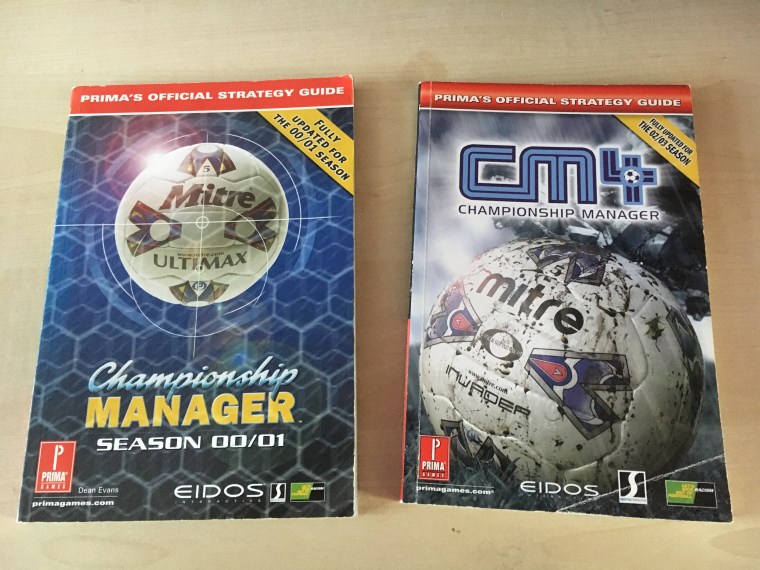
I was browsing the Sports Interactive forums on Friday afternoon when I came across some rather sad, if not surprising news.
Prima Games – who had published video game strategy guides for the best part of 30 years – would be shutting down in the second quarter of 2019. The closure was announced in an internal memo from its parent company DK (formerly known as Dorling Kindersley).
These days, if you need help on a particular game, there’s no need to buy a bulky book when you can find all the tips and hints you need online without paying. Back in the days before the Internet was massive, though, Prima guides were almost essential reading for strategy gamers such as yours truly…
Prima Games have been around about as long as I have. The company was launched in 1990 by publisher Ben Dominitz and writer Rusel DeMaria in Roseville, California. The pair initially released guides detailing “games secrets” for fourth-generation consoles such as the Game Boy and the Sega Genesis.
Over time, Prima branched out into other systems, producing over 1,400 different titles and reportedly selling over 90 million copies worldwide. A handful of them found their way into the Fuller household during the late 1990s and early 2000s.
I first heard of Prima through my father, who was very much into war-based real-time strategy and first-person shooter games on the PC. He had guides for titles such as Commandos: Behind Enemy Lines, Command & Conquer: Red Alert 2 and Medal of Honor: Allied Assault. He has since sold some of them on eBay, but a few remain in his possession to this day.
I personally remember having a Prima guide for Age of Empires III, along with the official Microsoft guide for Age of Empires II: The Age of Kings (which was not a Prima title, obviously). As far as this blog is concerned, though, I’m most interested in revisiting the trusty – and rather worn – books I often had at hand when playing Championship Manager: Season 00/01 and Championship Manager 4.
I was 10 when I bought CM00/01, and had only played the Championship Manager series for a couple of years. To be honest, I was not very good at the game back then, as my underachieving Manchester United team from Championship Manager: Season 99/00 would testify. (I will go into more depth regarding my early CM experiences when I publish a new mini-series – “Football Manager and Me” – later this month.)
A few weeks later, I got Prima’s CM00/01 strategy guide for £10 in my local GAME store (this was back when GAME wasn’t desperately trying to fleece its customers). Reading it opened my eyes to what I was doing wrong. I hadn’t yet realised that I was fielding many players out of position, and also that a forward with 20 Finishing wasn’t necessarily expected to score non-stop goals.
Also, while the official manual could be helpful to a point, it wasn’t all that great when it came to explaining how one would play the game to a competent level. The Prima guide provided much more detail whilst keeping the language clear and crisp, and also adding the odd humorous comment and quote to keep one amused…
“So Campbell there, using his strength. And that is his strength. His strength.” – Kevin Keegan
“We must have had 99 percent of the game. It was the other three percent that cost us the match.” – Ruud Gullit
“I’ve told the players we need to win so that I can have the cash to buy some new ones.” – Chris Turner
Using Wycombe as a starting point, the author would guide you through how best to assess your playyersand backroom staff when starting a new career. There was also a handy ‘Manager Task List’:
- Note Board Expectations
- Hire and Fire Backroom Staff
- Assess Your Squad
- Renew Player Contracts
- Improve the Squad
- Define Your Tactics
- Training Schedules
- Arrange Friendlies
- Click “Continue Game”
- Repeat Tasks Until Satisfied…
The authorwould also go into depth about each attribute – basic, hidden or miscellaneous – and explain its significance to certain positions. All positions were assigned some ‘critical attributes’, and a simple chart explained the minimum scores that would be considered ‘good’ at a certain level (e.g. a critical attribute score of at least 16 would be good by Premiership standards).
HIDDEN ATTRIBUTES
Right Foot: “How good a player is with his right foot, where 20 is the football skill of David Beckham, and 1 is the football skill of Victoria Beckham.”
Towards the end of the guide was a Q&A section. Some of the more frequently-asked questions were answered by CM00/01’s lead programmer Marc Vaughan, who still works for Sports Interactive today as their Head of Handheld Development (he makes Football Manager Mobile, basically).
Back in those days, you could fine players for “No Reason”. As a kid, I used to do that quite a bit (and you wonder why I wasn’t very successful). Whereas the manual suggested that one might do this because “you just might not like the guy”, Vaughan explicitly stated in Prima’s guide that this would be “extremely dangerous” and “tantamount to victimisation”. The ability to dock players’ wages without grounds was rightly removed in later CMs.
You could also find a quick summary on all the basic formations in the game, along with all the various tactical options, plus any other factors that impacted on the outcome of matches. It was through reading the guide that I first realised the weather held some significance, with long balls becoming less accurate in breezy conditions and players tiring faster when in high temperatures.
Outside of specific tactics, there were snippets of general advice, including from Vaughan – or ‘The Guv’nor’, as Prima dubbed him. Some of those pointers are arguably just as relevant in 2018 as they were back in 2000:
Leave It!
“Don’t meddle for the sake of it, and have faith in your team. Unless something drastic occurs such as a player injury or sending off, or you’ve let in five goals, leave things as they are for the first half. Give your starting formation and strategy, and the skills of your players, 45 minutes to settle down and start to work. Don’t panic if you go a goal down before the half-time whistle.”
Scaring The Opposition
“If an opposition player controls the game but has a low bravery rating then you might consider man-marking him with a big bruiser who has high strength and aggression. The thought of facing a man mountain in a bruising challenge may cause the player to back off from 50-50 balls so your team can impose themselves more on the match.”
A couple of seasons later, the CM4 Prima guide went even further by summarising all the default formations (from the goal-tastic 2-3-5 to the ultra-defensive 5-4-1), plus a handful of custom ones. There were also some tips from former Liverpool and Republic of Ireland midfielder Ray Houghton, who had advised SI during the development of the new 2D match engine.
“What I want is for people to look at it and use it in the right way. I want you to think of it not as a supporter, but as a manager.
“I want you to go, ‘Right, hang on a minute, that was a good goal from our point of view, how did we score that? That was a great ball, that’s what I want my left-back doing, cross-field ball, seen the man in space, he’s took it down, first-time cross, where’s my forwards? Yes, good movement from my two strikers, that’s why we’ve got the goal.'”
The CM4 guide had a quick synopsis on what to expect in each of the 39 playable league systems (remember when Paul Gascoigne was a player-coach in the Chinese second division?). There was also basic information on every club in the five English leagues, including their reputation, finances, star players and board expectations. Reading “Finances: Insecure” under Chelsea’s name still gives me a chuckle to this day.
If your club had the financial muscle, you could ponder signing any of the various players recommended by Prima, all of whom had their starting attributes provided. Any Premiership managers looking for fresh blood in midfield were advised to look at Jay Jay Okocha, Damien Duff and… ahem, Patrick Paauwe.
Training had undergone its most drastic overhaul ever (at least until Football Manager 2019), though only four pages were reserved for that. While one could only describe activities such as Pig In The Middle in so much detail without coming across as garrulous, that did disappoint me.
Truth be told, I didn’t find the CM4 guide to be quite as interesting or revelatory as the one CM00/01. I suppose that was because I’d become rather more skilled at the game in the intervening years, and that I found the learning curve with CM4 to be surprisingly gentle, despite all the major changes.
And so we fast-forward to the present day. There is no Prima guide for FM19, but if there was, it would need to be larger than the Encyclopædia Britannica to adequately cover all the new game’s complexities. It would certainly take more than a couple of paragraphs to describe a Segundo Volante or a Carrilero.
Besides, all the FM advice you need is out there online if you know where to look. The Guide to FM website is a useful resource that does what it says on the tin. Daljit (Bustthenet) and Cleon (Tea & Busquets) are two of the pre-eminent authorities on FM tactics and how to get the best out of the game.
Indeed, any old search engine will help you find various guides, walkthroughs and YouTube videos (of varying quality) on almost every video game out there.
For all of IGN’s faults, it was one of my first ports of call when I was finding my way through the latest Tomb Raider titles. There’s a Wiki dedicated to the comedy adventure game West of Loathing. GamerZakh is a YouTuber who uploads walkthrough videos of classic strategy games. Those are just three examples of online resources that serve the same purpose as Prima did at their peak.
Prima themselves went digital a decade ago, while still selling books in physical form. One of their most recent releases was for Fallout 76. The collector’s edition costs $50, but I honestly can’t think how anyone who’s not an ardent Fallout fan can justify forking out that much.
And so Prima is no more, defeated by the rise of web-based guides and free information. Its main headquarters in California will shut down later this month, while another office in Indiana will stay open until next spring. In truth, the only surprising aspect of Prima’s demise is that they lasted as long as they did.
There is no room in modern gaming for Prima. For a while, though, they were like a helpful mentor to this budding strategist and virtual Football Manager… and I will always be grateful to have had them around.
 Fuller FM
You must be logged in to post a comment.